Logic Loft Blog
Sudoku & Number Puzzles
5 articles
Here is the fact that changes how most people see Sudoku: there is no arithmetic in it. Nothing is added, subtracted, or counted. The digits one through nine are only labels, chosen because nine familiar symbols were lying around and a page did not have room to print nine different colours or nine little animal icons instead. Swap every 7 for a paw print and every 3 for a triangle and the puzzle plays exactly the same, because the only rule that matters is that each symbol appears once in every row, column, and box. If you have ever told yourself you are "bad at maths" and therefore bad at Sudoku, the two things are not actually connected. It is a logic puzzle wearing a costume borrowed from arithmetic.
The puzzle's history is a good demonstration of how an idea can travel and be renamed along the way. The modern grid — nine boxes, nine rows, nine columns, one solution — was published in 1979 by Dell Magazines under the flat, functional title "Number Place," designed by Howard Garns, a retired architect whose name did not appear on the puzzles at the time. It crossed to Japan in the 1980s, where the publisher Nikoli picked it up, trimmed the given numbers down for a harder solve, and gave it the name that stuck: Sudoku, short for a Japanese phrase meaning roughly "the digits must be single." It stayed a mostly Japanese habit for another two decades until 2004, when Wayne Gould, having encountered it on a trip to Japan, got his puzzles running in The Times of London — and from there it went from a curiosity to a fixture of newspapers everywhere within a couple of years.
Solving technique escalates in a fairly natural order, and most players stall because they try to skip straight to the end of it. Start with scanning, sometimes called cross-hatching: look at a digit already placed in two of the three boxes in a band, and use the rows and columns it rules out to see if the third box has only one legal square left for it. When scanning stops producing easy placements, pencil in the small candidate numbers in each empty square — every digit that could still legally go there — and the grid stops being a guessing exercise and becomes a visible map of constraints. From that map, named patterns start to appear: a naked single is a square with only one candidate left; a hidden single is a square where a candidate appears only once across a whole row, column, or box even though other candidates are still pencilled in beside it; a naked pair is two squares in the same unit sharing the same two candidates, which lets you strike those two digits from every other square in that unit. None of this involves luck. A properly constructed puzzle has exactly one solution reachable by logic alone, and a puzzle that seems to require a guess is either badly made or not being read closely enough yet.
The articles below cover this ground in order: the rules for anyone learning to play, the solving techniques from basic scanning up through the named patterns, a ranked look at the best Sudoku and number puzzle games worth playing in 2026, and a look at Meowdoku specifically, a logic puzzle built on the same underlying rules with a considerably furrier presentation.

Four Years of Threes!: Why I Can't Get Past 1536
Four years, one 1536 card, and an all-time best of 69,222 — of which a single card is 85%. The wall in Threes!, and why the game keeps me playing anyway.
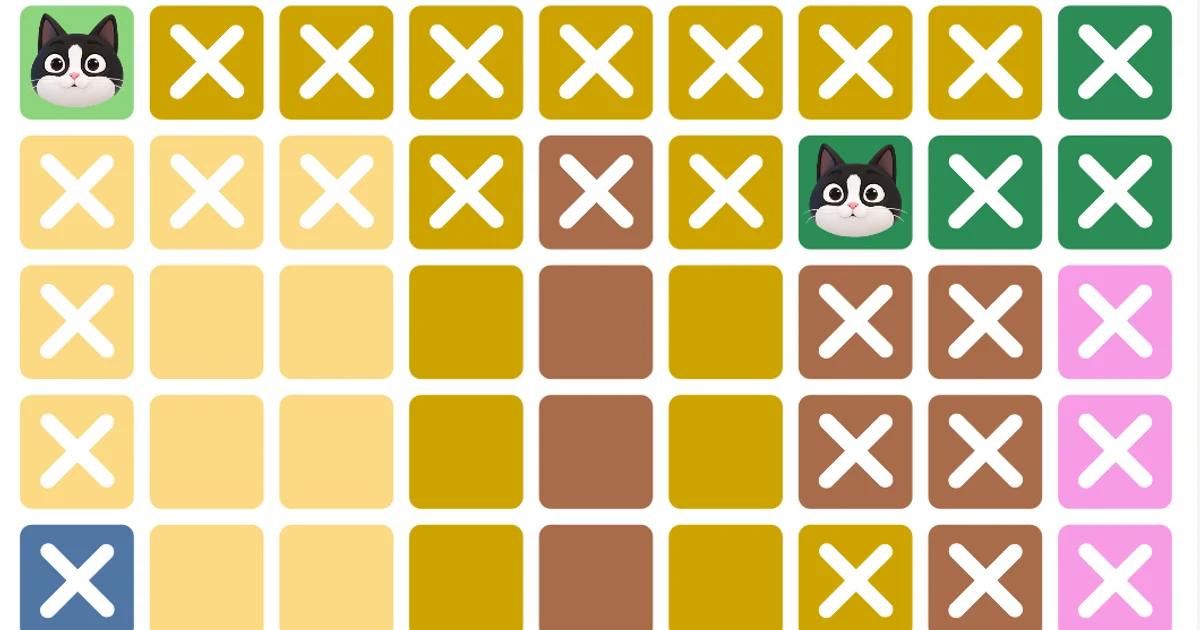
Meowdoku: A Surprisingly Addictive Logic Puzzle
A colorful grid, nine hidden cats, three lives — Meowdoku looks intimidating at first glance, but the deduction chain that unlocks it is pure Sudoku logic.
How to Play Sudoku: A Complete Beginner's Guide
New to Sudoku? Learn the single rule behind the game, how to read the grid, and the beginner techniques that take you from stuck to solved — no math required.
Sudoku Techniques: Naked Pairs, Hidden Singles & X-Wing
Stuck on a hard Sudoku? Learn the techniques that crack it — hidden singles, naked and hidden pairs, pointing pairs, and the X-Wing — explained simply.
The 10 Best Sudoku and Number Puzzle Games in 2026
From Good Sudoku to Cracking the Cryptic, these are the 10 best digital sudoku and number puzzle games — whether you want a quick daily puzzle or an all-night logic marathon.