Logic Loft Blog
Word Search
2 articles
A word search hands you the answer before you start. Every word on the list is spelled correctly and already sitting somewhere in the grid, waiting to be found. There is no vocabulary being tested, no clue to interpret, no letter you have to guess at — the entire task is visual. That is exactly why word search is the puzzle most people reach for when they want to switch their brain into neutral rather than switch it on.
That is a real distinction, not a slogan. A crossword tests what you know. An anagram tests how you read a jumble of letters. A word search tests almost nothing except your eyes' ability to hold a straight line across a noisy field of text. It sits closer to a hidden object picture than to a vocabulary game, and it rewards the same instinct those games do — not cleverness, but patience and pattern recognition, the willingness to look properly instead of just looking.
Which is also why the genre has real technique, even though it looks like there is nothing to learn. The single most useful habit is to stop reading the grid the way you would read a paragraph. Scanning row by row treats every letter as equally interesting, and almost none of them are. Pick a distinctive letter from your target word instead — a Q, an X, a Z, a J, even something merely uncommon like a V or a K — and hunt for that letter alone across the whole grid before you look at anything else. A busy fifteen-by-fifteen grid might contain exactly one Q. Once you have marked every place that letter appears, you only need to check whether the rest of the word radiates outward from one of those points, in one of eight directions.
The second habit is to work in a single direction at a time rather than letting your eyes wander freely. Sweep for horizontal words first, then verticals, then the two diagonals, instead of trying to catch all four orientations in one glance. It feels slower at first. It finds more words per minute, because you stop re-scanning the same rows out of habit and start covering ground you have not already checked.
The counterintuitive part is that long words are usually easier than short ones, not harder. A ten-letter word has very few places it can physically fit inside a grid without running off an edge, and its uncommon letter combinations stand out against the random filler around it. A three-letter word could be almost anywhere, and its letters are common enough to blend straight into the noise. Beginners assume length is the enemy and hunt the short words first. Solvers who have done this for years save the short ones for last and clear the long words immediately.
It is also worth knowing what actually makes a grid hard, because it is rarely the size. A constructor makes a word search difficult by placing words on the diagonal and by writing some of them backwards, so your eye's ordinary left-to-right, top-to-bottom habits stop working for you. A large grid where every word runs forward and horizontal is genuinely easier than a small one where half the words are reversed on a diagonal.
The format itself is younger than most people assume, especially next to a centuries-old genre like the anagram. The word search as we now know it is generally traced to a single 1968 puzzle by Norman E. Gibat, published in the Selenby Digest in Norman, Oklahoma — a specific, dateable invention rather than something that simply evolved out of the crossword.
The two articles below cover the practical end of that history: a full walkthrough of how to play and get genuinely faster at word search, and a ranked look at the best word search games and apps worth your time in 2026.

How to Play Word Search and Find Every Word Faster
The rules of word search, the scan order that clears a grid fastest, the extend-until-blocked trick, and a chart of the letter chunks that give words away.
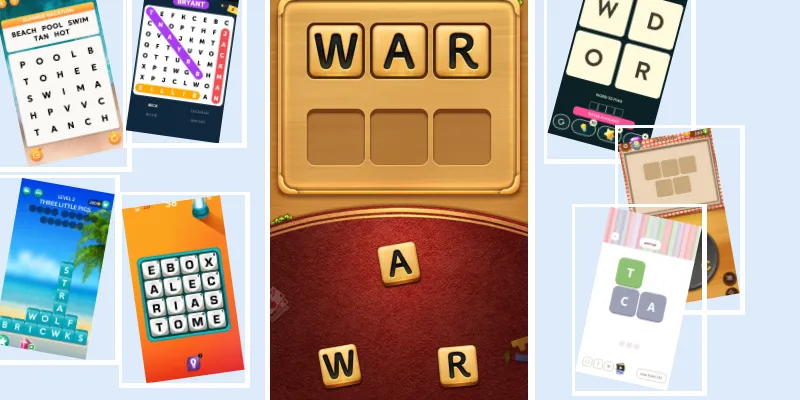
The 10 Best Word Search Games and Apps in 2026
From classic grid hunts to modern twists, these are the 10 best word search games and apps — perfect for relaxing, sharpening your eye, or keeping kids busy.