Logic Loft Blog
Trivia & Quiz
1 article
A crossword makes you work for the answer. A trivia question just asks whether you already have it. That is the whole genre in one sentence, and it is also what makes trivia the odd one out among puzzle formats: the difficulty is not encoded in the question at all. It lives in you, in whatever you happened to read, watch, or overhear at some point in your life — which is exactly why a trivia night can feel like the fairest game in the room and the most rigged one, sometimes in the same round.
That externalised difficulty is also what makes trivia the most social and most argued-about format going. A word puzzle rarely produces a dispute once the answer is revealed; a trivia answer produces one constantly, because "I knew that" and "that is wrong, actually" are both live possibilities right up until someone checks a source. Good trivia writing exists specifically to prevent the argument. A well-written question has exactly one defensible answer, phrased so precisely that it survives the pedant at the table who wants to argue the wording. The moment a question admits a technically correct alternate answer, or leans on a fact that changed after the writer looked it up, the whole format breaks — the contract with the player is that there is one right answer and the game is fair about finding it.
Multiple choice exists to manage a second, quieter problem: recall is a much harder cognitive task than recognition. Asked to produce a fact cold, most people draw a blank even on things they technically know, because retrieval without a cue is difficult. Show the same person four options and the correct one often jumps out immediately, because now the task is comparison rather than search. That is not the format going easy on the player so much as it is testing something different — not "can you produce this fact" but "can you recognise it when you see it" — which is why the same questions asked open and multiple choice can produce very different scores from the same players.
There is also a design question every trivia game has to answer: breadth or depth. A broad category rewards a wide but shallow memory and levels the field, since nobody has read everything. A narrow, deep category rewards someone who has spent real time in one subject and can punish everyone else completely. Neither is wrong; they test different things, and a well-built quiz mixes both so no single kind of memory dominates the whole game.
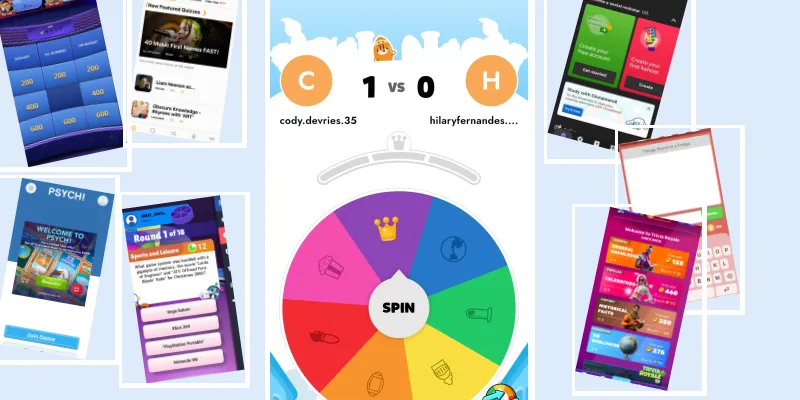
None of this happened in a vacuum. The pub quiz gave trivia its social shape long before an app could — teams, rounds, a compere reading questions aloud, and the specific pleasure of being the only table that got the sports round right. Board games standardised it for the living room: Trivial Pursuit, since 1981, built a category-wheel structure around the idea that a good trivia session should force you through subjects you are weak in as well as ones you are strong in. Television pushed the format further. Jeopardy! took the standard question-then-answer shape and inverted it, handing contestants the answer and asking them to supply the question — a small structural twist that changes the thinking required more than it looks like it should. HQ Trivia, more recently, showed the genre as a live, synchronous event, thousands of people answering the same question at once. Its collapse is its own lesson: a format built entirely around a scheduled broadcast moment is fragile in a way a puzzle you can pick up anytime is not.
A trivia game can have the smoothest interface in the world and still fail if its questions are ambiguous or its categories are lopsided. A genuinely well-written set of questions carries a plain, unadorned format a very long way, because the pleasure was never really in the screen. It is in the moment the answer surfaces from wherever it had been sitting, half-remembered, until the question found it.
The article below ranks the trivia and quiz games worth your time in 2026, weighing exactly the things covered here — question quality, the recall-versus-recognition balance a format chooses, and how honestly its categories are built — rather than just polish or download numbers.