Logic Loft Blog
Brain Training & Logic
2 articles
A logic puzzle never asks you to know anything. It asks you to notice what a set of rules forces to be true, and then to write that down before you check whether it is. Five people, five houses, five nationalities, and a page of clues about who owns the zebra: nothing in a puzzle like that rewards trivia, vocabulary, or memory. It rewards attention to what one fact rules out about another, held in your head long enough to follow the chain to the end.
That is the actual definition worth using here, because "logic puzzle" gets applied loosely to almost anything with a grid. What separates the genre properly is that it is constraint satisfaction done by hand. You are given a small set of rules and a finite set of possibilities, and the puzzle is built so that reasoning alone — never a guess — narrows those possibilities down to exactly one arrangement. Sudoku is the most familiar form: nine digits, nine constraints repeating across rows, columns, and boxes, and a well-made puzzle solvable cell by cell through elimination, no trial and error required. Nonograms work the same principle sideways, using row and column counts to force in the shape of a hidden picture one cell at a time. Logic grids, the "who owns the zebra" style of puzzle, make the constraints explicit as sentences instead of numbers, which is why they read more like a small mystery than a maths exercise. Minesweeper, stripped of its clock and its cartoon mine, is pure deduction as well — every number on the board is a constraint about its neighbours, and a properly generated board can, in principle, be solved without ever clicking blind.
That last clause is the whole craft of building one of these things well. A logic puzzle that occasionally forces a guess partway through is not a lesser version of a good one — it is a different, weaker category of object, because a guess turns deduction into luck at exactly the moment the puzzle was supposed to reward thinking. The mark of a properly constructed logic puzzle, whatever form it takes, is that it never needs one: every step forward is derivable from what came before it, all the way to the final cell. Setters who take this seriously will actually solve their own puzzle from scratch as a chain of forced moves before publishing it, specifically to catch the point where it secretly stops being logic and starts being a coin flip.
It is worth being honest about the category this sits inside, too, because "brain training" carries baggage the puzzles themselves do not deserve. The claim that playing these games regularly makes you generally smarter, sharper at unrelated tasks, or protected against cognitive decline, is not well supported by the evidence, and the research on commercial brain-training products is genuinely contested rather than settled in their favour. Lumosity, the best-known brand in the category, paid a settlement to the US Federal Trade Commission in 2016 over advertising claims that its games improved performance in school, at work, and in daily life — claims the FTC found the company could not substantiate. That is a real, checkable episode, and it is worth knowing before taking any "train your brain" pitch at face value.
None of that is a reason to skip the genre. It is a reason to enjoy it for what it actually gives you, which is not a general cognitive upgrade but something narrower and entirely genuine: you get measurably better at solving that specific kind of puzzle, faster at spotting the constraints that matter and quicker to discard the ones that do not. That is a real skill, earned the ordinary way, through practice on a well-made problem, the same way a crossword solver gets faster at crosswords without becoming faster at anything else in particular. It also happens to be one of the more satisfying feelings a small screen can produce, which is reason enough on its own.
The article in this category runs through ten of the current logic and deduction games worth your time, weighing what each does well against what it asks of you. Start there if you are looking for the next puzzle to get properly stuck on.
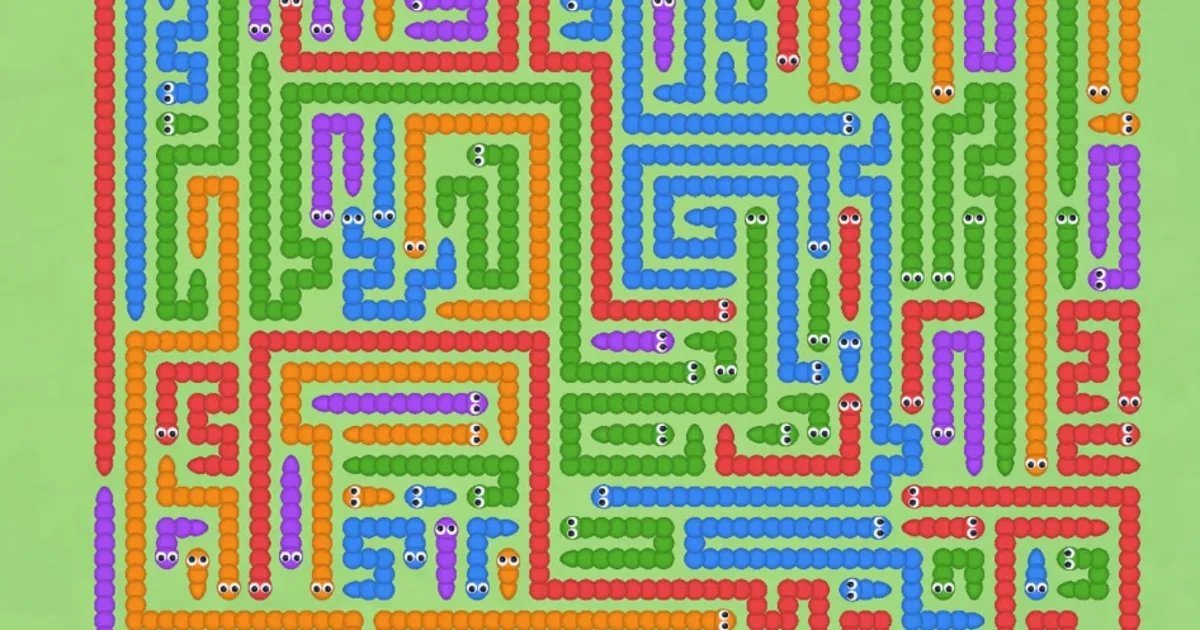
Amaze Go: Addictive and Frustrating in Equal Measure
A board full of twisting arrows, three lives and one job — send each arrow off the board without hitting another. Relaxing right up until you overlook something.
The 10 Best Brain Training and Logic Puzzle Games of All Time
From Portal's mind-bending physics to Lumosity's daily cognitive workouts, these are the 10 most influential brain training and logic puzzle games — ranked by cultural impact.