Logic Loft Blog
Crossword Puzzles
3 articles
Solve enough crosswords from the same outlet and you start to recognize the setter before you have filled in a single square. The clue for a five-letter word meaning "annoy" is never just "annoy" — it is something closer to "get under one's skin, say", and that small flourish is a signature. No other mainstream word puzzle works this way. A crossword does not just test whether you know a word. It is a conversation with a specific person's vocabulary, sense of humour, and taste for misdirection, and learning to solve one well means learning to read that person rather than the dictionary.
The puzzle is older than most people assume. Arthur Wynne's "word-cross," a diamond-shaped grid with no black squares, ran in the New York World on 21 December 1913, built for a Sunday supplement rather than for posterity. The name flipped to "cross-word" almost immediately, the hyphen wore off over the following years, and the format that felt like a throwaway novelty in 1913 is essentially unchanged in structure a little over a century later. Almost everything that makes a modern crossword recognizable — the black-square symmetry, the numbered grid, the down-and-across pairing — was present from close to the start.
Two distinct traditions grew out of that first grid. The cryptic clue, which is largely a British tradition, hides a second puzzle inside the clue itself: wordplay, an anagram or hidden-word indicator, and a definition, all woven into one sentence, so that solving the clue is close to the whole game and the grid is almost secondary. American-style crosswords went a different way. Clues lean on straightforward, wordplay-lite definitions rather than cryptic misdirection, and the craft moved into construction instead — a theme running through the long answers, tight grid symmetry, and clue-writing that rewards knowing pop culture and idiom as much as vocabulary. Neither tradition is harder than the other. They are testing different instincts, which is why a sharp cryptic solver can still stall on a themed American grid, and the reverse is just as common.
The technique that actually speeds up a solve is the same regardless of which tradition you are working in. Start with the short entries and their crossings before you touch the long ones. A three- or four-letter answer constrains every word that crosses it, so clearing the short fills first turns a blank grid into scaffolding you can lean on for everything harder. Learn the handful of short words that show up constantly because they are vowel-rich and grid-friendly — solvers call this crosswordese, and a good chunk of getting fast is simply recognizing those on sight instead of re-solving them from scratch every time they appear. Read the clue's part of speech and tense as carefully as its meaning: if the clue is a plural noun, the answer has to be a plural noun, no matter how well a singular form would otherwise fit. And treat a question mark at the end of a clue as an explicit warning label from the setter — it means the clue is a pun, a stretch, or wordplay dressed up as a straight definition, and taking it literally is exactly the mistake it is designed to invite.
What separates a good crossword from a forgettable one has less to do with raw difficulty than with the quality of the fill. A grid stuffed with obscure abbreviations and awkward partial phrases just to make the geometry work is a sign the black squares won and the constructor didn't. A strong puzzle hides that scaffolding entirely — every answer reads like something a person would actually say, the theme entries are genuinely clever rather than merely long, and the clues have personality without ever crossing into unfair. Beginners tend to assume that difficulty is the whole point; solvers who stick with the habit usually end up chasing craft instead, gravitating toward setters whose puzzles reward the particular kind of close reading a crossword asks for.
The pieces below start where most solvers actually get stuck. One walks through solving a themed grid from an empty page to a finished one, covering the habits that separate a slow solve from a fast one, including short fill first, matching tense, and the question-mark rule. A second is aimed squarely at speed, for people who already finish grids comfortably but want to finish them quicker without guessing. The third is a ranked look at the crossword puzzle games actually worth your time in 2026, for anyone trying to decide where to do this solving in the first place.

How to Get Faster at Crosswords
Solving crosswords faster is a trainable skill. Here are the habits — crosswordese, fill-first solving, and clue-pattern recognition — that cut your time.
How to Solve a Crossword Puzzle (Even a Hard One)
A practical guide to solving crosswords — how to read clues, where to start, the trick to crossing letters, and how to crack the wordplay in tougher puzzles.
The 10 Best Crossword Puzzle Games and Apps in 2026
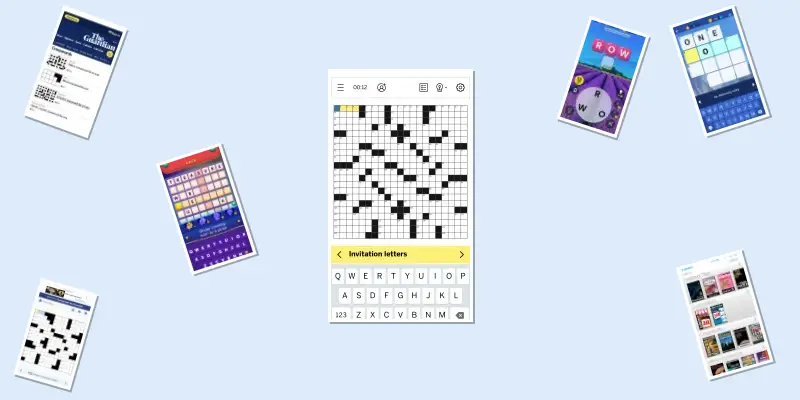
From the NYT Crossword to quirky indie takes, these are the 10 best crossword puzzle games and apps — for beginners and seasoned solvers alike.