How to Play Pairdle
Overview
Pairdle is a daily word puzzle. The answer is a 6-letter word cut into three letter pairs, and your job is to work out which pair belongs in which position within six guesses.
You never type a letter. You tap a pair to drop it into the next open box, or drag it to the box you think it belongs in, and press GUESS. The board answers in three colours, and you go again.
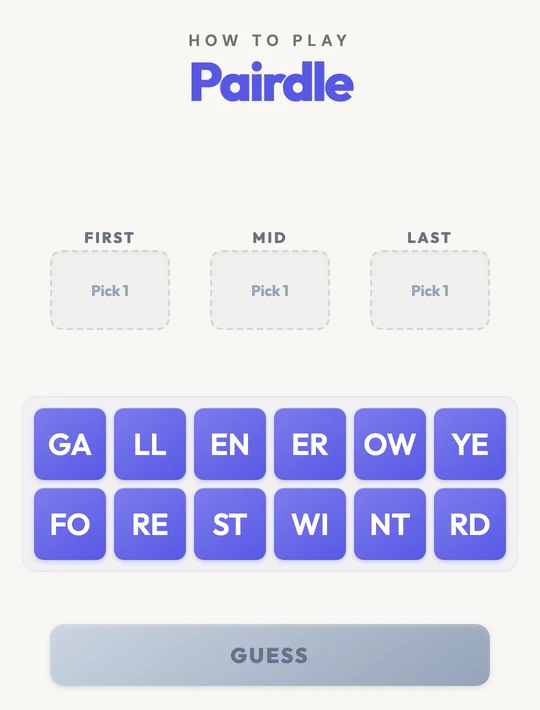
The board: one box per position
There are three boxes, labelled FIRST, MID, LAST, and one pair goes in each. That is the whole guess — three tiles, one row, no second slot to hedge with.
Underneath sit 12 pair tiles. They are the pairs of four different 6-letter words — three tiles each — and one of those four is today's answer. The other three are decoys, built from the very same tiles. That is why a tile being “in the pool” tells you nothing on its own.
A real pool — the twelve tiles from the walkthrough below. Tap a pair to place it, or drag it into a box. Tap a filled box to take the pair back. GUESS stays greyed out until all three boxes hold a pair.
The three colours
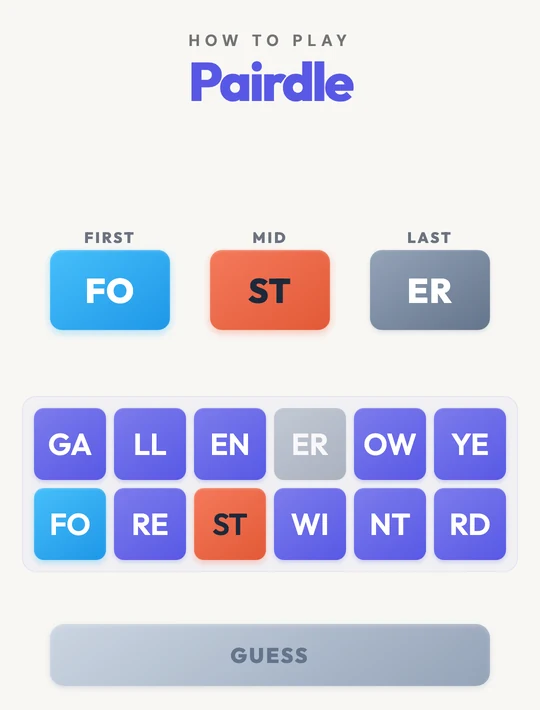
The moment you press GUESS, each of your three boxes turns one of three colours:
Strategy for a one-row board
- Spend guess one on information. Three tiles you have not tested beats a word you happen to like. You have six guesses and only three boxes, so the first one is cheap.
- Red can be worth more than blue. Blue settles one box. Red tells you the pair is in the answer and rules out the box you tried — on a three-box board that usually leaves one candidate.
- Locked boxes are free. Once a box goes blue you are only choosing the remaining tiles, so each lock makes the next guess dramatically narrower.
- Grey tiles kill whole words. Every tile belongs to one of the four pool words, so a grey tile eliminates its entire word. Two or three greys and elimination finishes the puzzle for you.
- Position habits are real. When ED appears in a Pairdle answer it is the last pair 96% of the time. TS is 97%, ES 96% and ER 90%. Others only look that way: EN ends the word barely half the time. Up front, CO starts the word 96% of the time and BE 79%, while CH starts it only about two times in three.
- Spot the impossible. RR and MN never start a word — no six-letter word does. RR lives in the middle (sorrow, barren, parrot), and MN is always an ending (column, autumn, solemn). English has damned with it in the middle, but our answer list leaves that word out, so that is a rule of the game rather than of the language. Ruling a box out before you guess is worth as much as finding a pair. The full tables, including which pairs can never appear where, are in How to Master Pairdle, Column by Column.
Walkthrough: solving FOREST in two
This is the board from the how-to video, tile for tile. The pool holds FOREST, WINTER, GARDEN and YELLOW — four words, 12 tiles. One of them is the answer.
Guess 1 — FOSTER
FO, ST and ER are all on the board, and together they spell a real word. One guess, three answers.
FO is blue, so it is the first pair and it locks. ST is red, so it is in the word but not in the middle box. ER is grey, so it is not in the word at all.
Guess 2 — FOREST
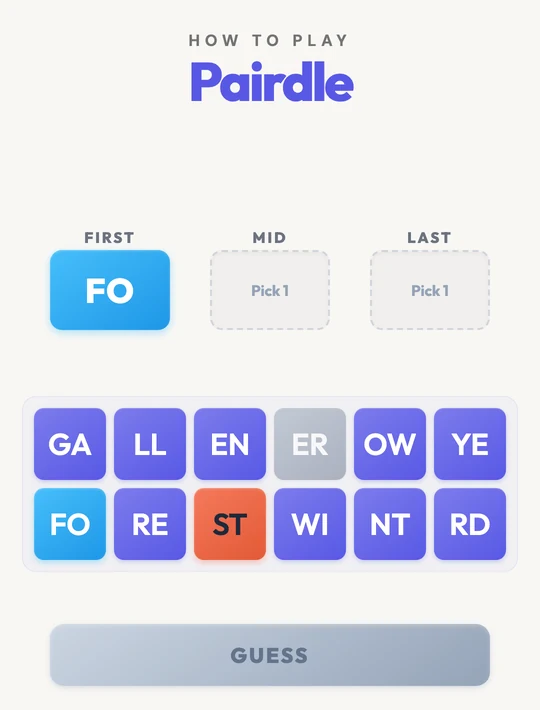
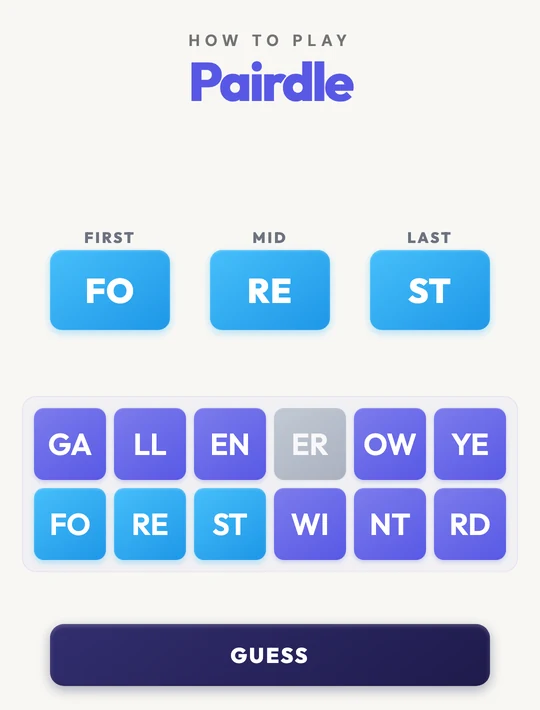
FO stays locked. Move the red ST to the last box and try RE in the middle.
All three boxes turn blue. FOREST, solved on the second guess.
Pairdle Pro and Expert
Same rules, longer words. Every level is one row of boxes, one pair per box, six guesses, and the same three colours — only the size changes.
| Level | Word | Boxes | Pairs in the pool |
|---|---|---|---|
| Pairdle | 6 letters | 3 | 12 |
| Pairdle Pro | 8 letters | 4 | 16 |
| Pairdle Expert | 10 letters | 5 | 20 |
Longer words mean more boxes and a bigger pool, so eliminating a box early matters more, not less. Pairdle Expert's 5 boxes come from a 10-letter word, and its pool of 20 tiles is still built from four words.