Logic Loft Blog
Classic Word Games
5 articles
A Scrabble board looks like the simplest kind of word game: a fifteen-by-fifteen grid, a bag of tiles, and turns taken one at a time. It is also the word game most newcomers play wrong, because they treat it as a vocabulary contest when it is really an economics problem. Every tile in that bag has a price, and the price was not chosen to feel fair. It was measured.
Alfred Butts, the architect who invented the game, was out of work during the Depression and treated the letter distribution like a research project rather than a guess. He counted letter frequencies across the front page of the New York Times and built the tile values and tile counts directly from that count. E is worth one point and there are twelve of them in the bag, because E is the most common letter in English prose. Q is worth ten and there is exactly one, because Q barely appears at all. The game did not take off under Butts himself — it took James Brunot, who bought the rights, renamed it Scrabble, and began manufacturing it in 1948, to get it into shops, and it was the early 1950s before it became the hit it still is today. The tile bag, in other words, is a frequency table of the English language, and the score on your pad at the end of a game is really a measure of how well you exploited that table, not how many words you know.
That is the part beginners miss, and it is why raw vocabulary matters less than club players assume. A seven-letter word nobody has heard of is worth very little sitting on ordinary squares; a three-letter word landed across a double-letter and a triple-word score is worth far more. Strong players read the board geometry first and their rack second, hunting for the squares that turn a plain word into a large one, and they treat a bingo — playing all seven tiles at once for the fifty-point bonus — as the single biggest swing available on any turn. Expert Scrabble is a game of rack management and board control much more than a test of who owns the bigger dictionary.
The other high-leverage habit, and the cheapest one to build, is learning the two-letter word list. There are only around a hundred of them, and knowing which combinations are legal is what lets a player hook a new word onto an existing one at a right angle without opening a gap they cannot defend. It is unglamorous knowledge, closer to knowing your times tables than to knowing rare words, and of everything a club player memorises, it pays back the fastest and the most often.
The articles below cover this ground directly: how to actually play Scrabble if you are picking up the rules for the first time, the mechanics of setting up and landing a bingo, which tiles are worth protecting for their point value and which are worth spending early, the two-letter list itself, and a ranked look at the classic board-and-tile games worth your time in 2026.
High-Value Scrabble Tiles: Where to Use J, Q, X, Z
The J, Q, X, and Z are worth the most in Scrabble — and the most wasted. Here's how to place each for maximum points without getting stuck on your rack.
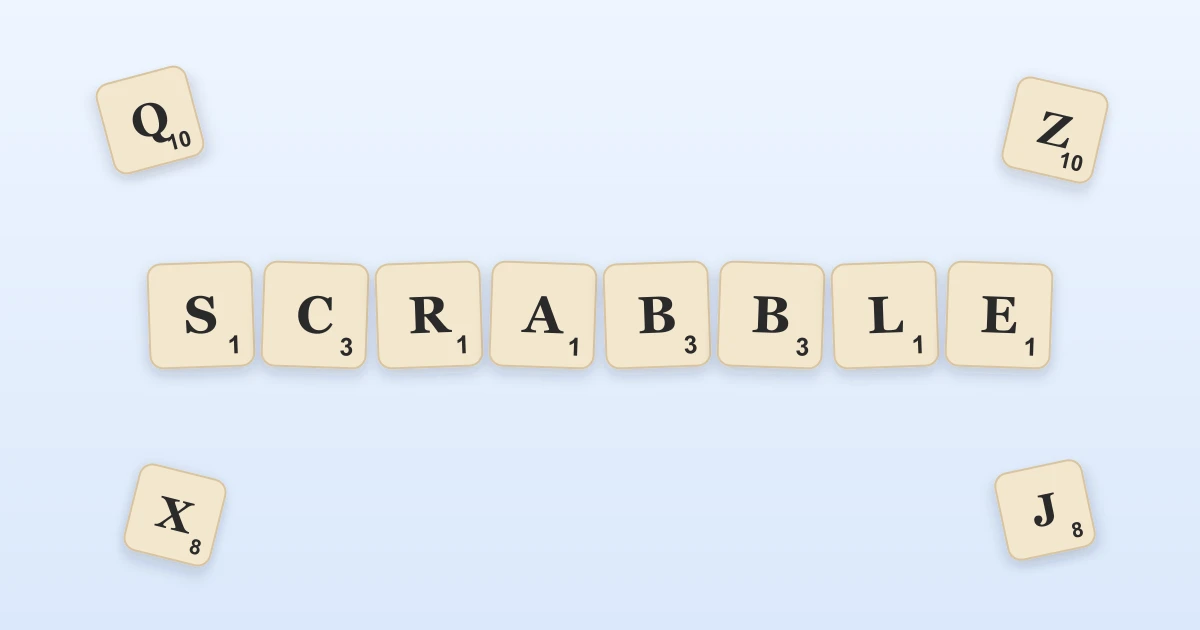
How to Play Scrabble: Rules, Scoring & Board Bonuses
A clear, complete guide to Scrabble — setup, turn order, how scoring and the premium squares work, and the beginner habits that quietly win games.
How to Get a Bingo in Scrabble (7-Tile Plays)
A bingo — using all seven tiles in one turn — is worth a 50-point bonus. Here's how to set them up, the endings that unlock them, and how to train your eye.
The Complete List of 2-Letter Scrabble Words
Every valid 2-letter Scrabble word, grouped to actually memorize — plus why these tiny words are the highest-leverage thing a Scrabble player can learn.
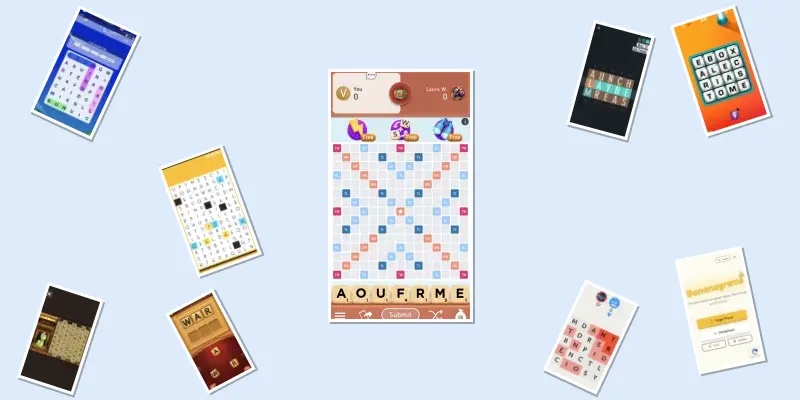
The 10 Best Classic Word Games With Digital Versions (2026 Edition)
From Scrabble to SpellTower, these 10 classic word games have stood the test of time — and all have digital versions you can play today on your phone or browser.