
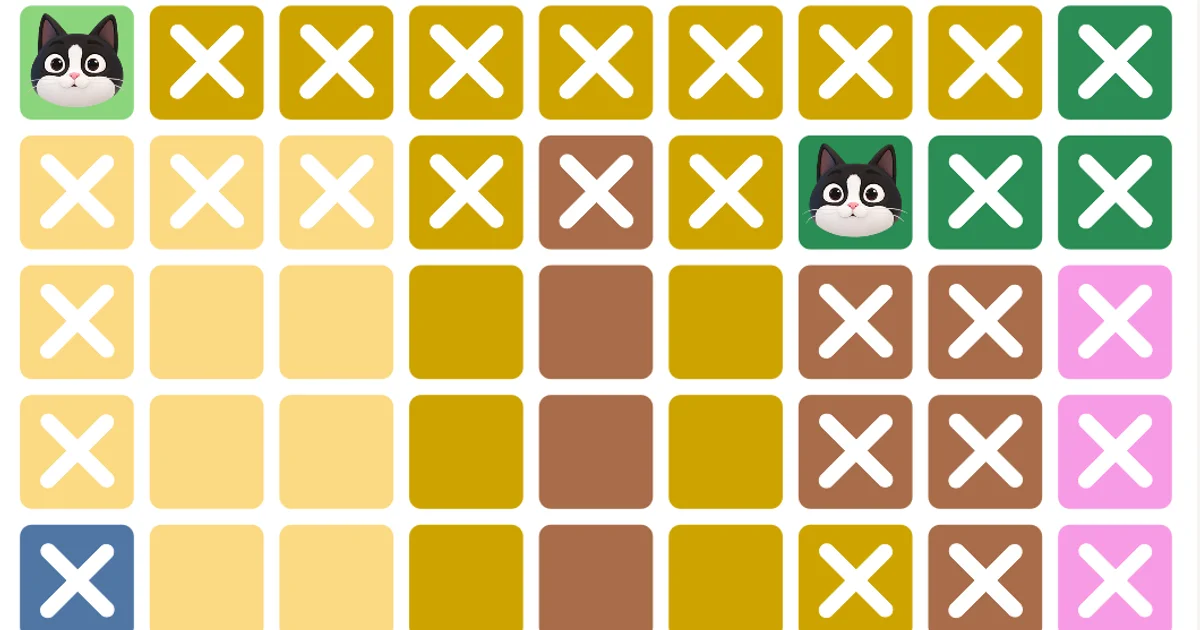
I recently stumbled across a puzzle game called Meowdoku, and what looked like a simple grid quickly turned into one of those "just one more go" evenings.
At first glance, the colorful board is a little intimidating. Nine columns, nine rows, and a patchwork of colored regions layered on top. But the rules are surprisingly simple. You're hunting for nine hidden cats, and each one has to obey three constraints at once: one cat per row, one cat per column, one cat per colored region, and no two cats can ever touch, not even diagonally. You only get three lives, so every placement matters.
Where to play: Website · App Store · Google Play
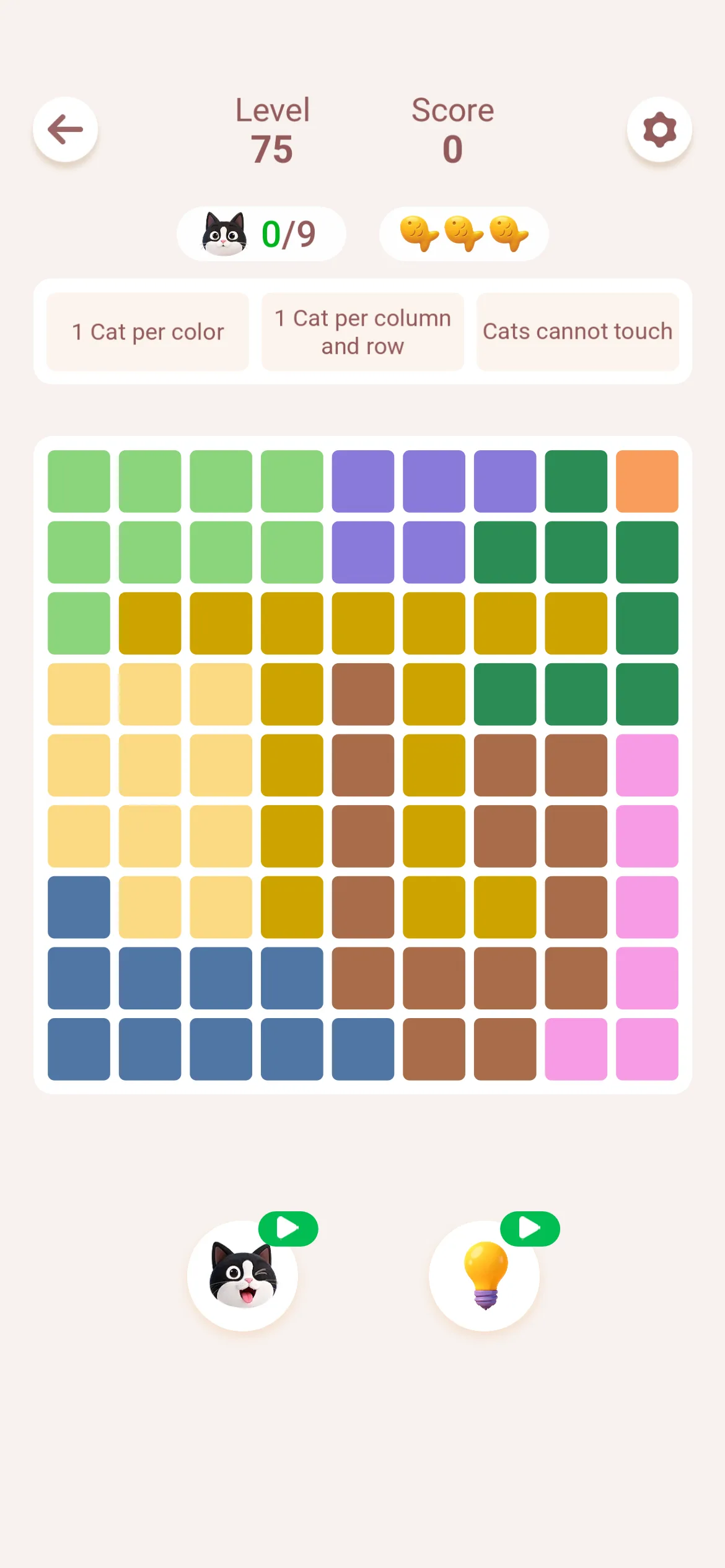
Why this is really a Sudoku variant
If you've ever solved a Sudoku, the "one per row, one per column" part will feel instantly familiar. It's the same row/column exclusivity that makes classic number Sudoku work. Meowdoku swaps digits for cats and swaps the 3x3 box constraint for an irregularly shaped colored region, which changes the shape of the puzzle without changing the underlying logic. The "no touching, not even diagonally" rule is the twist. It's borrowed from a newer family of grid logic puzzles (you may know it from games like Queens or Star Battle) where adjacency, not just row/column/region membership, becomes a fourth source of deductions. Once you see it that way, Meowdoku is classic elimination logic with an extra layer of constraints stacked on top. That is what makes each solved cat feel more satisfying than a single Sudoku digit.
Start by looking for the obvious
My first move wasn't to hunt for cats directly. It was to look for clues the board was already giving me.
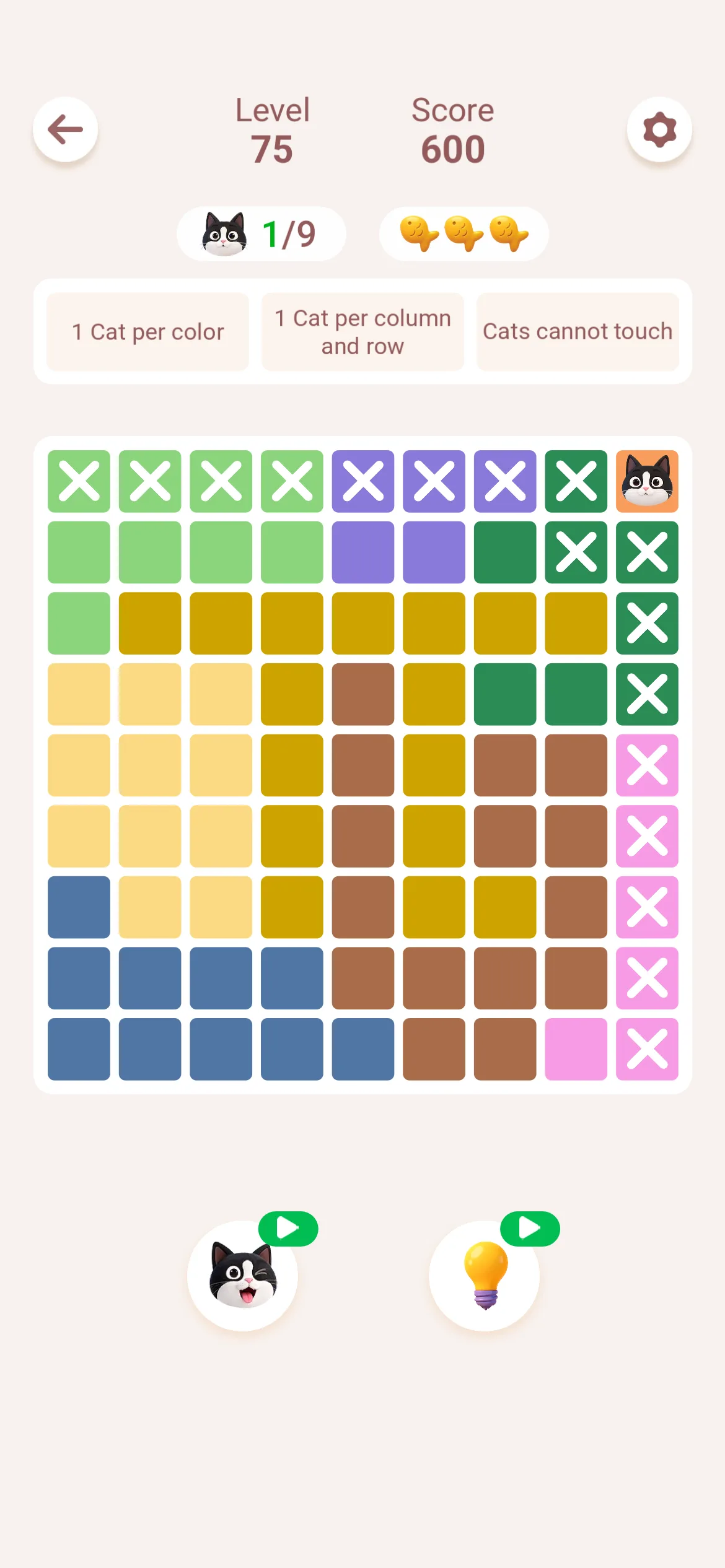
On this particular puzzle, there was only one orange square on the entire grid. Since every colored region needs exactly one cat, that told me immediately where my first cat had to be. No guessing required.
Once that cat was placed, I could mark every square it made impossible with a cross: the eight squares touching it, the rest of its row, the rest of its column, and the rest of its region. That's four constraints firing off a single placement: a lot of eliminated territory from one confident move.
Something interesting happened almost immediately. With those crosses down, there was now only one pink square left uncrossed anywhere on the board. That meant a second cat, found without a single guess, just the fallout from the first one.
Every cat creates another clue
From here, the puzzle stops being about finding cats and starts being about eliminating possibilities.
I noticed there were only two purple squares left, and both sat in the same row. Since a row can only hold one cat, and this row's only candidates were those two purple squares, every other square in that row could be safely crossed off, even squares that had nothing to do with purple. That's the kind of deduction that feels like a small trick the first time you spot it, but it's really just the "pointing pair" logic that number Sudoku players already know: when two candidates are trapped between the same two cells, everything else in their shared row, column, or region is off the table.
Those eliminations left exactly one light green square standing, which had to hold the next cat. It's a genuine chain reaction. Every correct decision reveals the next clue, and the board gets easier to read with each cat you place, not harder.
One feature I particularly appreciate is the Hint system. Rather than simply handing you the answer, it explains the logic behind a move, walking you through why a square can or can't hold a cat, the same way a good Sudoku app teaches technique instead of just filling in the grid. If you're further stuck, it can mark a batch of impossible squares for you, or, as a last resort, reveal a cat's location outright. Both of the stronger hints ask you to watch a short ad first, which felt like a fair trade. There's no pressure to buy anything, and I never felt nickel-and-dimed.
I also appreciate that the game saves your exact position if you close it mid-puzzle. Walking away and coming back with fresh eyes is often what breaks a stall. A pattern I missed at 11pm was obvious the next morning.
If I had one suggestion for the developers, it would be a Share button. I've already recommended Meowdoku to a few friends, and it would be nice to send them straight to the game instead of describing it from memory.
Four cats down, five to go
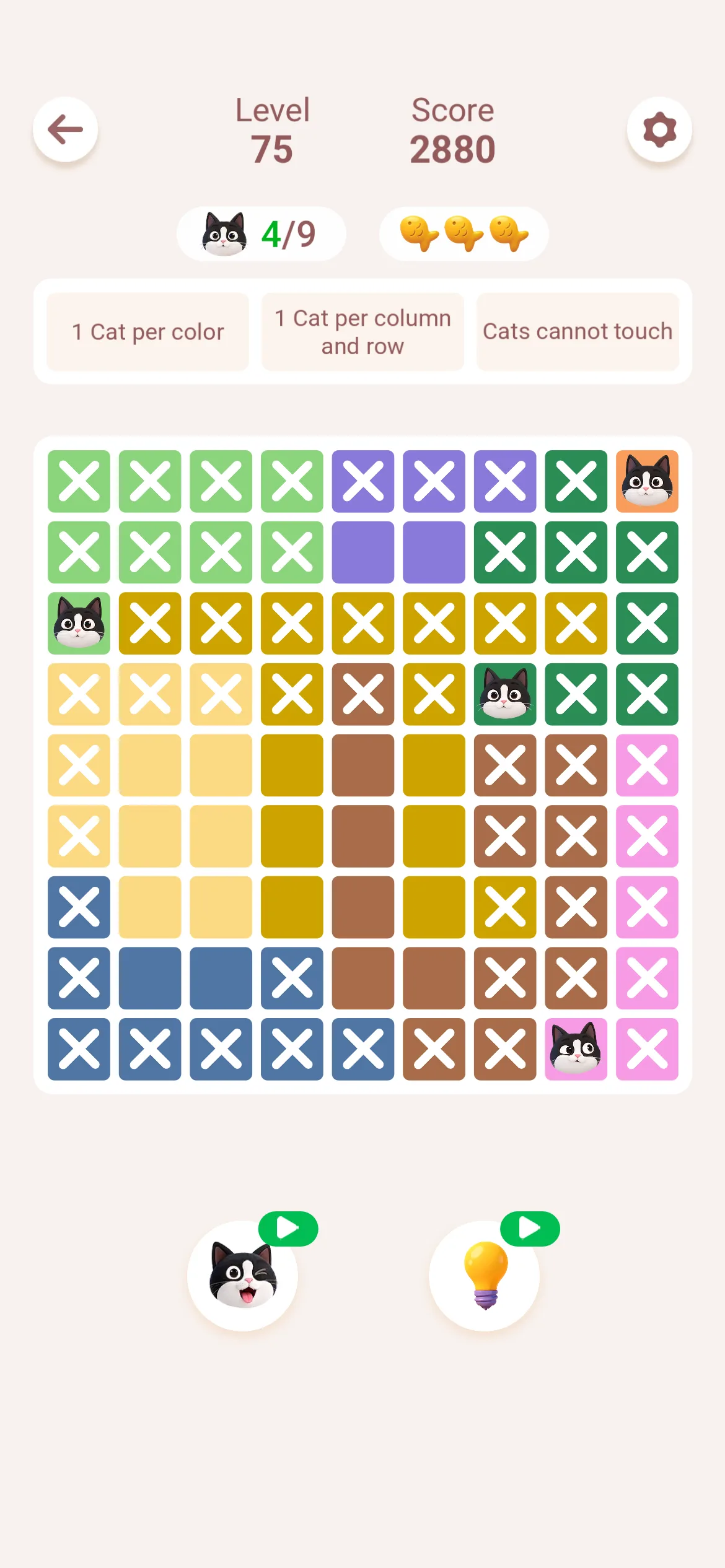
At this point in the puzzle, four of the nine cats are placed and most of the board is crossed off. Notice how little empty space is left uncertain. That's the elimination chain doing its job. Where do you think the fifth cat is? 🐱
If you like this kind of puzzle
The appeal of Meowdoku is the same appeal behind every good constraint-satisfaction puzzle: you're never rewarded for guessing, only for noticing. If that's your itch, our beginner's guide to Sudoku covers the row/column/box logic Meowdoku borrows from, and our roundup of the best Sudoku and number puzzle games is a good next stop if you want more of this genre. For a deduction puzzle that swaps the grid for letters, Pairdle runs on the exact same "eliminate until one answer remains" principle, just with words instead of cats.
By Suzette Simons, Logic Loft Games
Related articles
Four Years of Threes!: Why I Can't Get Past 1536
Four years, one 1536 card, and an all-time best of 69,222, of which a single card is 85%. The wall in Threes!, and why the game keeps me playing anyway.
How to Play Sudoku: A Complete Beginner's Guide
New to Sudoku? Learn the one rule behind the game, how to read the grid, and the beginner techniques that take you from stuck to solved. No math required.

The Mobile Gaming Landscape: Every Major Genre, Explained
From puzzle to shooter, slots to strategy, a founder's field guide to the 14 genres that make up mobile gaming today, with the games worth trying in each.