
There is a folder on my phone I only open above ten thousand feet. It has two games in it. One is Pairdle Slide, which I made. The other is Threes!, which I have been playing for four years and have never come close to beating.
Where to play: Website · App Store · Google Play
I downloaded the free version. At some point early on I paid a one-time fee to turn the ads off. I cannot remember how much it was, which tells you both how long ago it happened and how little it stung. It has not asked me for money since.
In four years I have reached the 1536 card exactly once. Most of my games die at 768. I have read the strategy guides, more than once, and I understand every word of them, and my ceiling has not moved.
So I did what I should have done three years ago: I stopped reading guides and started reading my own score screen. It turns out the game had been explaining the problem to me the whole time.
What the score screen actually told me
If you have never played, the rules fit in a sentence. Cards slide on a four-by-four board. A 1 and a 2 merge into a 3, and from there matching cards merge into their double: two 3s make a 6, two 6s make a 12, and so on up through 24, 48, 96, 192, 384, 768, 1536. Unlike the games it inspired, cards in Threes! move exactly one square per swipe, and only if nothing is in the way. When nothing can move, the run is over.
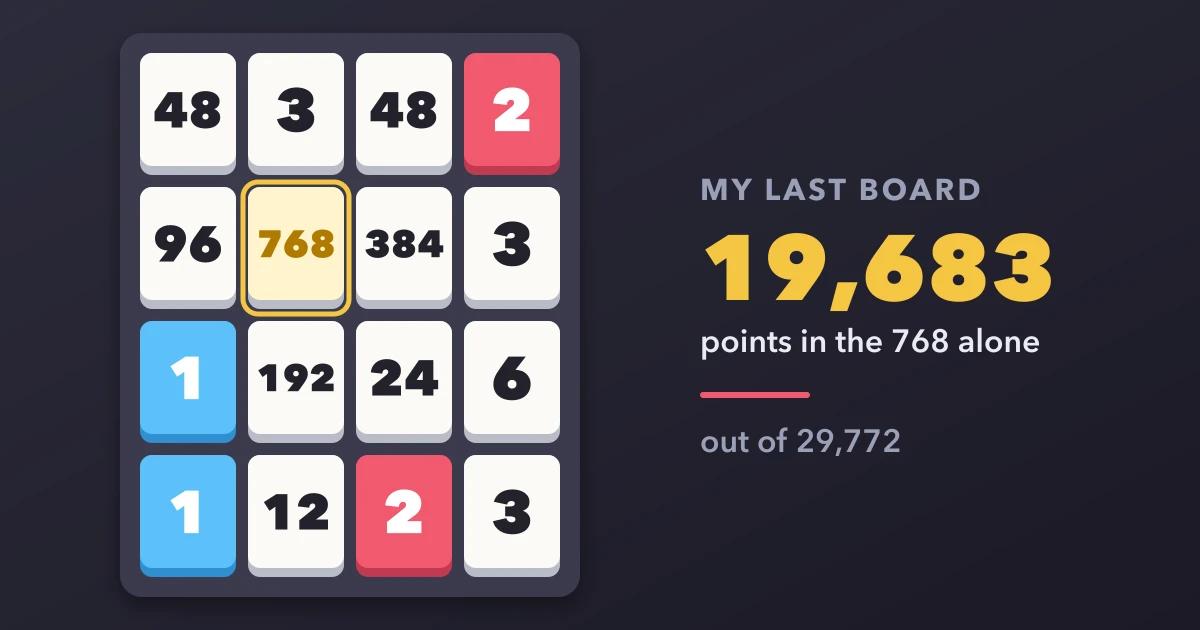
Then it shows you your score, and it shows you the arithmetic. Here is my last game:
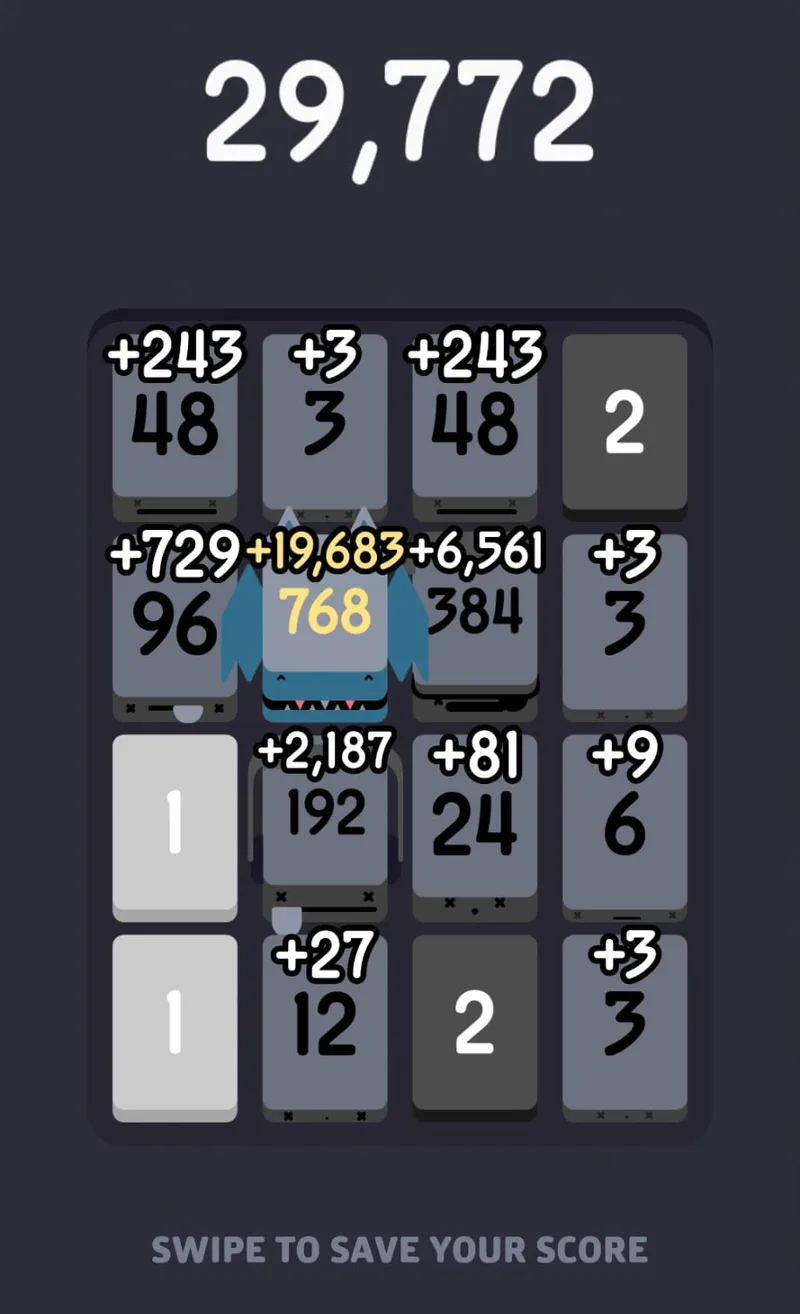
Look at the numbers stamped over each card. 3, 9, 27, 81, 243, 729, 2187, 6561, 19683. Every single one is a power of three. A card showing 3 is worth 3. Each time it doubles, the score triples. Written out: a card showing 3 × 2ᵏ is worth 3ᵏ⁺¹.
Add all twelve of those stamps together and you get 29,772, exactly the number at the top of the screen, with nothing left over. There is no bonus for surviving longer, no multiplier for a long chain, no reward for tidiness. Your score is the board you died holding, and nothing else.
Which means my entire run came down to one card. That 768 was worth 19,683 points: two-thirds of the whole game.
My best run ever is basically one card
The all-time leaderboard tells the same story in a harsher way. My best is 69,222, which puts me 5,536th, in the top two percent.
A 1536 card is worth 59,049.
That is 85% of my best score ever, sitting in one square. My personal record is one card. Everything else I did in that game (every merge, every careful swipe, the better part of an hour) is the other fifteen percent.
The wall isn't a wall, it's an exponent
Go back to that final board and count properly. Four cards (the 96, the 192, the 384 and the 768) were worth 29,160 points between them. The other twelve cards on the board were worth 612 points in total, about two percent of the run.
Twelve of my sixteen squares were doing nothing except being in the way.
That is the shape of the whole problem, and it gets worse the higher you climb. To build a 1536 I need two 768s. Each 768 is two 384s, each of which is two 192s, and so on all the way down. A single 1536 card is five hundred and twelve 3s that all found each other in the right order.
Now here is the part no guide ever says out loud. To make a 3072, I need two 1536s alive on the board at the same time. The first one has to sit there, taking up one of my sixteen squares, contributing nothing, doing nothing, for the entire length of time it takes me to rebuild the second one from scratch, while the game carries on dealing me 1s and 2s that have to go somewhere.
Making a 3072 means playing the entire game twice, on the same board, with one square permanently unavailable and fifteen squares to do it in. And 6144 is playing it four times. Every doubling costs more than everything that came before it combined, and it costs it on a board that has just got smaller.
Four years of practice will not move a wall like that by one notch. Each step up doubles the work.
What the guides say, and why it didn't take
For the record, the standard advice is good advice, and here it is:
- Pick a corner, keep your largest card there, and only ever use three of the four directions. The moment you swipe the fourth way, your big card leaves its anchor and the run is usually finished.
- Pair a 1 with a 2 the moment you can. They only ever merge with each other, they are worth zero points, and every one you leave lying around is a square you no longer own.
- Read the strip at the top before every swipe. It tells you what is coming, and half of good play is simply not being surprised.
- Keep your big cards in a descending run along one edge, so the board can collapse in order instead of jamming.
- Once your highest card reaches 48, bonus cards start appearing in the deck. They are a gift, but only if you have somewhere to put them.
None of that is wrong. My problem is that it is all early-game advice, and it is all about not poisoning a board you will not need for another twenty minutes.
Threes! never punishes you when you make the mistake. It punishes you ten minutes later, when a card you should have paired in move forty is finally the reason nothing can move in move three hundred. By the time the screen says "Out of moves!", the decision that killed you is long out of sight. That makes it a hard game to learn from, no matter how many guides you read. The feedback arrives far too late to attach to the cause.
The board that killed me
Which brings me to the corpse:
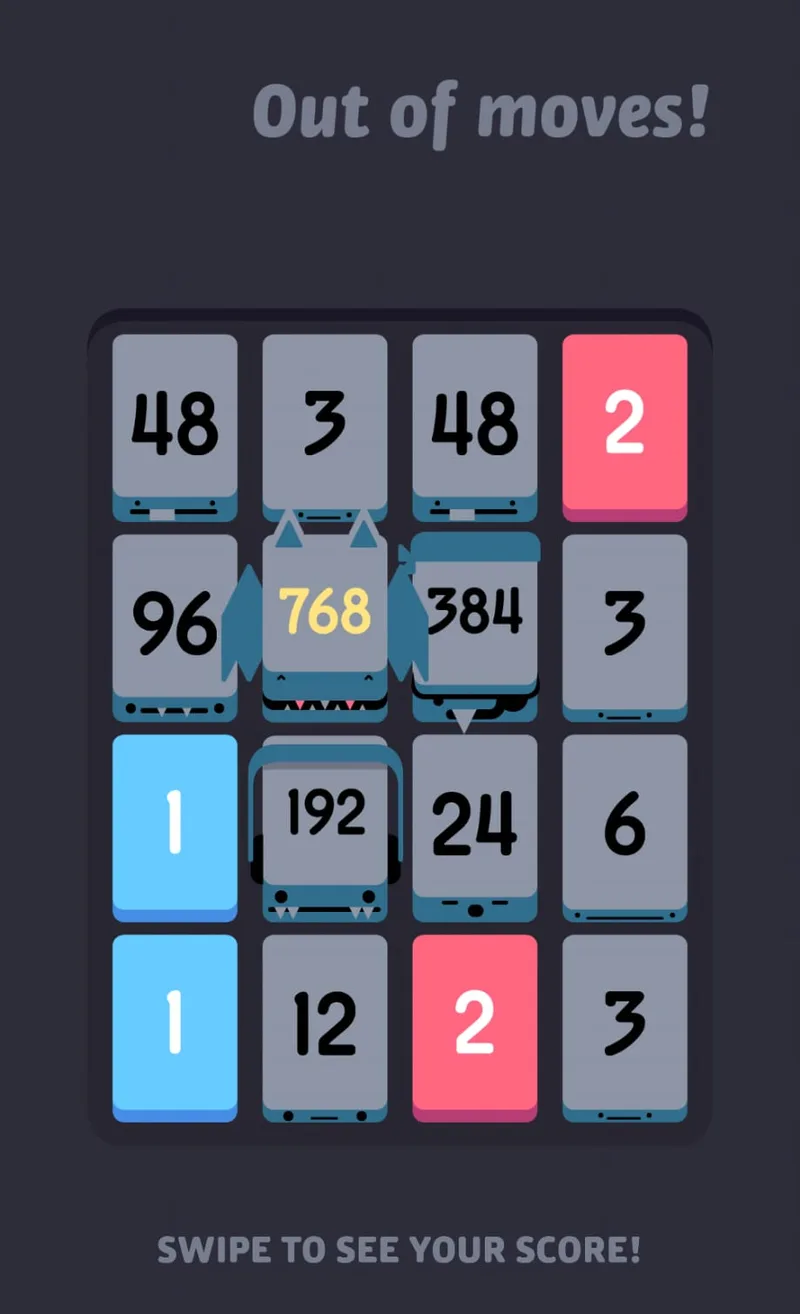
Read it as a post-mortem and it is embarrassingly clear:
The 768 is in the middle of the board. It should be against an edge. In the middle it has four neighbours, which means four different ways to be fenced in, and it is: a 96 on one side, a 384 on the other.
The 384 next to it is useless. People assume a 384 beside a 768 is nearly a merge. It is not: they are not equal, so they can never combine. That 384 needs to find another 384 first, and there isn't one on the board, or anywhere near being on the board.
My two 48s are separated by a 3. One small card sitting between them, and the only way to introduce them is to first deal with the card in the middle, which I cannot do, because everything around it is jammed too.
Both 1s are stacked in the left column, and the two 2s are over on the right, one in the top corner and one in the bottom row. A 1 only merges with a 2, and none of them are touching. They are worth zero points. They are never leaving.
Twelve of sixteen squares, 612 points, and every one of them a wall. Not one of those problems was a mistake I made in the last ten moves.
About that leaderboard
Then there is the other number.

Top of the all-time board: 3,000,000 points. I am on 69,222. My first reaction was that somebody out there is forty times better at this than I am. My second reaction, after the afternoon I had just spent doing arithmetic, was: hang on, how?
Because the card ladder does end. 12288 is the last card in the game, and making it ends the run then and there. It is worth 3¹³, or 1,594,323 points. So even a perfect, once-in-a-lifetime, game-ending run lands somewhere in the region of one and a half to two and a half million, depending on what else you are still holding when the music stops.
My first thought was that finishing the game might simply award some kind of maximum score. That would explain the round three million nicely. But it does not survive contact with the board: a fixed maximum would produce a tie at the top, and those top five are five different numbers. My own score screen had already shown me there is no bonus of any kind. The total is the sum of the cards, full stop.
So try the other test. Every card in Threes! is worth a power of three. 1s and 2s are worth nothing. Which means every possible score in this game is a multiple of three. There is no way to construct one that isn't.
Now look at ranks three and four: 2,836,609 and 2,836,608.
They are one point apart. Two multiples of three cannot be one apart. And 2,836,609 is not a multiple of three at all.
I am going to leave that there, because the arithmetic does not need my help. It did do one useful thing for me, though: I stopped measuring my ceiling against the top of that leaderboard.
What I'd steal for my own games
This is the part I care about, because it is my job.
Threes! is the most durably addictive game I own, and it does none of the things I have been told make games addictive. There is no energy meter. There are no lives. Nothing expires while I am not playing, so there is no streak to protect and no guilt for missing a day. In four years it has never once nagged me to come back. It works with the aeroplane in aeroplane mode, which is the only reason it survived on my phone at all. And I paid it a small amount of money one time, years ago, and it has never mentioned money again.
It also has the best tutorial I have ever seen, which is that it doesn't have one. The strip at the top of the screen shows you the next card. That single piece of UI teaches you that the future is knowable, that planning is possible, and that being surprised is your own fault, and it teaches it without a single word of instruction.
And then there is the loss screen, which is the thing I keep coming back to. When you die, Threes! does not offer to sell you a continue. It stamps a number on every card and shows you your own working. It uses the worst moment in the game, the moment every other studio on earth would put a paywall, to teach you why you lost.
Here is the uncomfortable conclusion, though. The real reason I am still here after four years is that I have never won. The game has a ceiling I can see clearly and cannot reach, and that ceiling is the entire retention mechanic. It costs nothing to operate. Nobody is tuning it. There is no team A/B testing my sense of inadequacy.
Every retention feature I have ever built (daily puzzles, streaks, badges, weekly themes) is, if I am honest, a manufactured reason to come back tomorrow. Threes! just has a number I cannot beat.
I don't think you can fake that, and I don't think you can bolt it on afterwards. A ceiling only works as a hook if the game underneath it is good enough that failing at it is fun. Sirvo (Asher Vollmer, Greg Wohlwend and Jimmy Hinson) spent fourteen months on those rules and published the entire email chain afterwards to prove how long it took. It shows. The simpler games that copied it in 2014 and spread faster got the mechanic but not that care, and I know which one is still in my Plane folder twelve years later.
Final thoughts
I am flying again next week, and I will play it again, and I will almost certainly die somewhere around 768 with a couple of 1s marooned in a corner.
The guides were never going to fix that, because the guides were never the problem. The problem is that the next card up costs more than every card before it put together, and there are only ever sixteen squares.
If I ever see a 3072, you will hear about it.
If you like this kind of game
Threes! sits in the small, stubborn family of number puzzles where the maths is trivial and the ordering is everything. Our roundup of the best sudoku and number puzzle games covers more of them, including the famous clone that outgrew it. If it is the quiet, no-timer, one-more-go feeling you are after rather than the arithmetic, Meowdoku scratches a very similar itch with far less heartbreak.
The deeper idea, that a board can be perfectly solvable and still be lost because things ended up in the wrong order, goes all the way back to the sliding puzzle we all grew up with. And if you want the other game in my offline folder, Pairdle Slide is ours: sliding tiles, words instead of numbers, no lives, no timer, and it works at altitude too.
By Tim Nye, Logic Loft Games
Related articles
Meowdoku: A Surprisingly Addictive Logic Puzzle
A colorful grid, nine hidden cats, three lives. Meowdoku looks hard at first glance, but the deduction chain that opens it up is pure Sudoku logic.
How to Play Sudoku: A Complete Beginner's Guide
New to Sudoku? Learn the one rule behind the game, how to read the grid, and the beginner techniques that take you from stuck to solved. No math required.
Futbolle: Eighteen Daily Football Puzzles
A solo developer in Turkey built Futbolle, eighteen daily football puzzles — a Wordle whose dictionary is a squad list, a hidden starting XI — earning nothing.