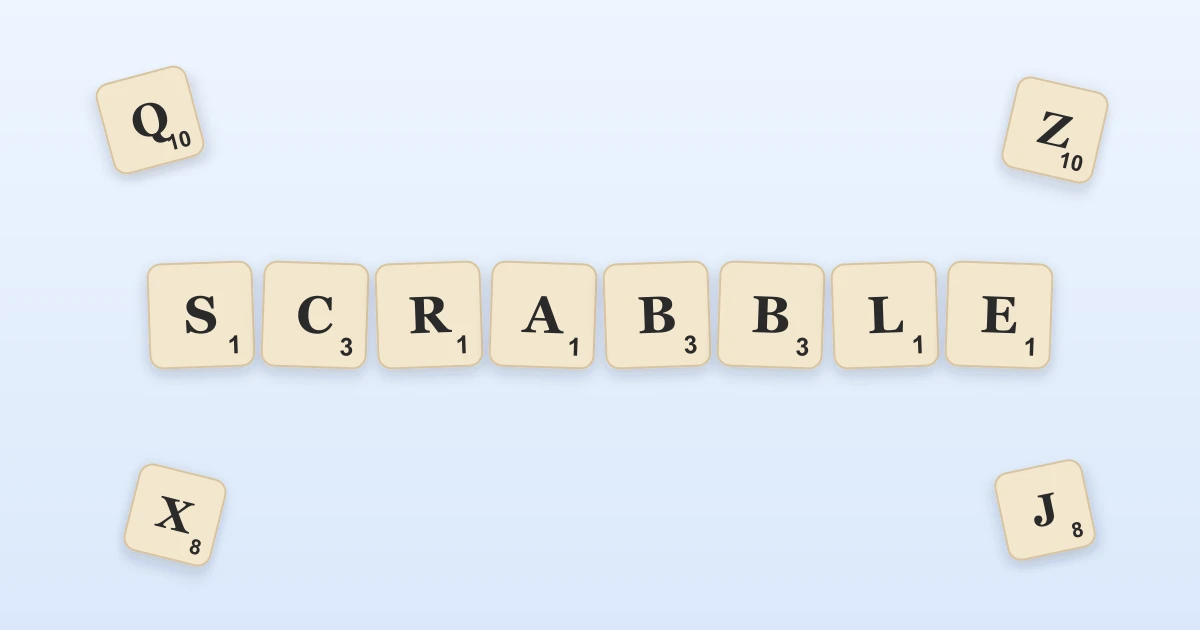
Scrabble is the word game almost everyone has played at least once and almost no one has been formally taught. People pick it up by playing or watching others, which means most players carry around a few wrong rules for years. This guide lays out how the game actually works: the setup, the turn, the scoring and the premium squares. It also covers the beginner habits that add the most points.
We build word games for a living, so we have a soft spot for Scrabble: it's the ancestor of nearly every tile-based word game, including a few of our own.
What you need
- The board: a 15×15 grid with colored premium squares.
- 100 letter tiles (including 2 blanks).
- A tile rack for each player (2–4 players).
- A dictionary you agree on in advance for challenges.
What's in the bag
The 100 tiles are not a random assortment. Alfred Butts set the counts by charting letter frequencies on the front page of the New York Times, and the English set has looked like this ever since:
| Copies | Letters | Tiles |
|---|---|---|
| 12 | E | 12 |
| 9 | A, I | 18 |
| 8 | O | 8 |
| 6 | N, R, T | 18 |
| 4 | D, L, S, U | 16 |
| 3 | G | 3 |
| 2 | B, C, F, H, M, P, V, W, Y | 18 |
| 2 | blanks | 2 |
| 1 | J, K, Q, X, Z | 5 |
Add it up and the bag holds 100 tiles worth 187 points, an average of 1.87 points a tile. Three things fall out of that, and all three change how you play:
- 68 of the 100 tiles are worth one point. Most of what you draw all game is cheap, so big turns come from the board, not the rack.
- 42 of the 100 tiles are vowels. That is two in every five you draw, which is why vowel gluts are the most common bad rack and why unloading them matters.
- J, K, Q, X and Z are five tiles, 5% of the bag, but they carry 41 points, 22% of everything in it. One-fifth of the game's raw value sits in five tiles you may never draw.
A random seven tiles average about 13 points of face value. The bonus for emptying your rack in one turn is 50. That ratio is the argument for playing for bingos rather than for tiles.
Setup and turn order
Each player draws one tile; whoever draws closest to "A" goes first (blanks beat A). Return the tiles, then everyone draws seven to fill their rack. On your turn you do one of three things:
- Place a word on the board and score it.
- Exchange tiles and score zero for the turn. Every tournament rulebook also requires at least seven tiles still in the bag. See the fine print below, because this one catches people out.
- Pass.
After placing, draw back up to seven tiles. The first word must cross the center star, and after that every new word must connect to existing tiles. Scrabble is a crossword you build together.
How scoring works
Each tile has a point value printed on it. Common letters are cheap; rare letters are expensive:
| Points | Tiles |
|---|---|
| 1 | E, A, I, O, N, R, T, L, S, U |
| 2 | D, G |
| 3 | B, C, M, P |
| 4 | F, H, V, W, Y |
| 5 | K |
| 8 | J, X |
| 10 | Q, Z |
| 0 | the two blanks (no points, but they can be any letter) |
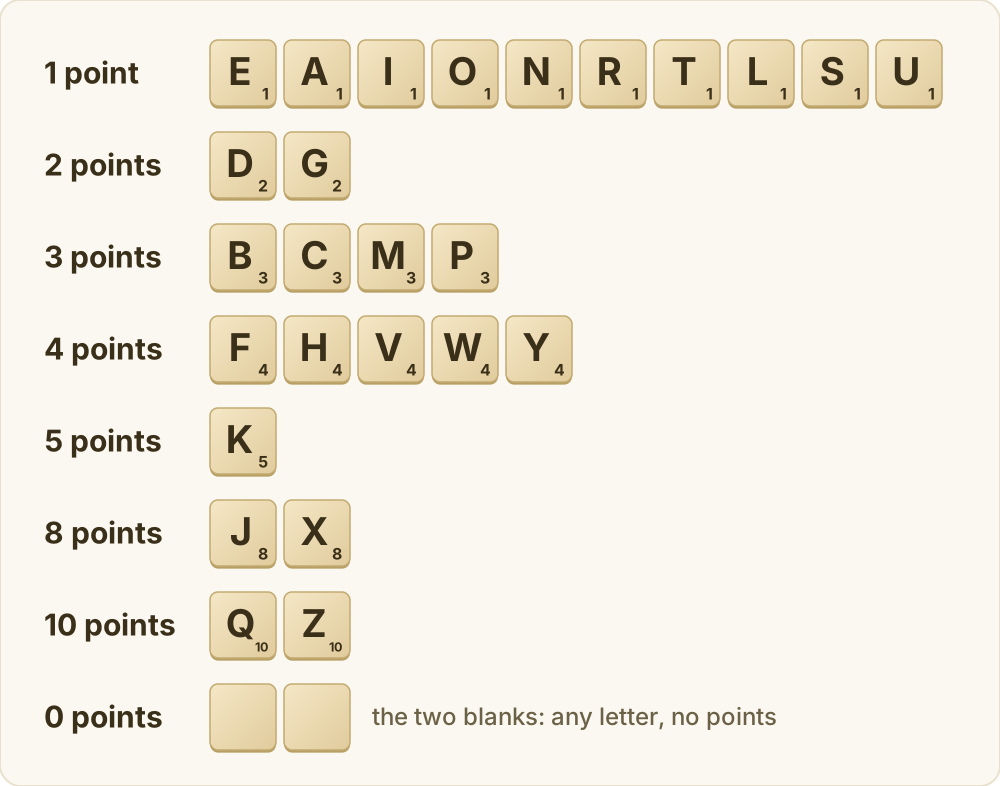
Your word's base score is the sum of its tiles. Then the board changes it, and that is where the game is played.
The premium squares (the part people get wrong)
The colored squares multiply your score, and the order of operations matters:
- Light blue, Double Letter (DL): doubles that one tile's value.
- Dark blue, Triple Letter (TL): triples that one tile's value.
- Pink, Double Word (DW): doubles the whole word's score.
- Red, Triple Word (TW): triples the whole word's score.
- Center star counts as a Double Word for the opening move.
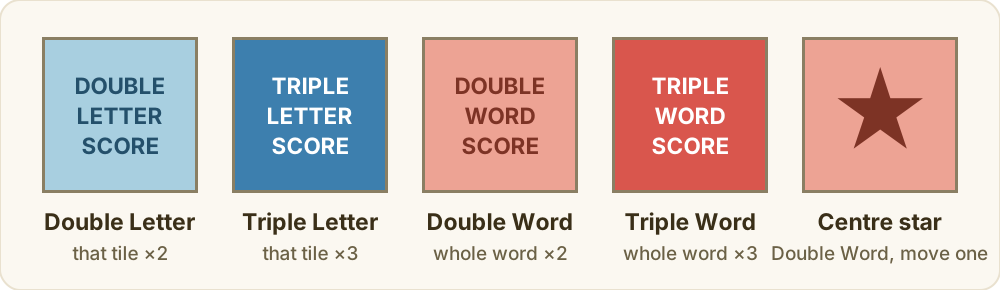
Order of operations: apply letter bonuses first, total the word, then apply word bonuses. If a word covers two Double Word squares, you double twice (×4). Premium squares only count the turn they're first covered. Play over them later and they're just normal squares.
The 50-point bingo
Empty your rack in one turn, all seven tiles, and you collect a flat 50-point bonus, added after the word and its premium squares have been totalled. It is the biggest single bonus in the game, and strong players plan whole turns around it. The short version: keep a balanced rack and hold common letters that combine into seven-tile plays. The bingo section of our Scrabble words guide shows the letters to keep and one rack that makes nine different bingos.
The board, counted
People talk about the premium squares as if the board were covered in them. It isn't. We counted them off the standard layout (the same 15×15 map our scoring drill below runs on, which is pinned by a unit test against its premium counts and its rotational symmetry):
| Square | How many | Share of the board |
|---|---|---|
| Triple Word | 8 | 3.6% |
| Double Word | 17 (16 pink, plus the centre star) | 7.6% |
| Triple Letter | 12 | 5.3% |
| Double Letter | 24 | 10.7% |
| Premium total | 61 | 27% |
| Plain | 164 | 73% |
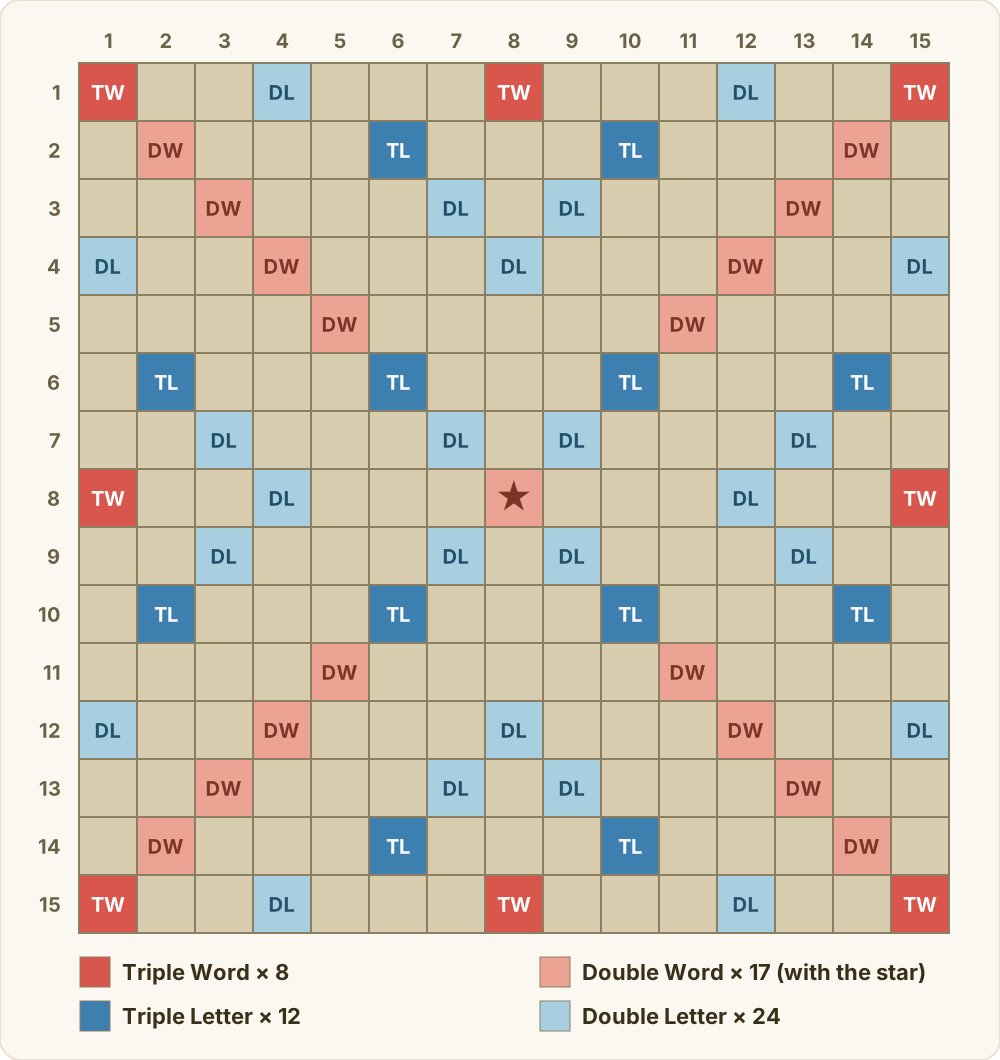
Just over a quarter of the board pays a bonus, and the cheapest bonus, the Double Letter, is the most common one by a wide margin. The eight Triple Word squares are the corners and the mid-points of the four edges, and they are the only squares on the board worth designing a turn around from two moves away.
What the opening move can actually reach
Move one has to cover the centre star, which fixes the geometry. Reading along the star's row (columns numbered 1 to 15, star at column 8), here is every square an opening word of each length can touch:
| Opening word | Columns it can reach | Best premium available |
|---|---|---|
| 2 letters | 7–9 | the star only |
| 3 letters | 6–10 | the star only |
| 4 letters | 5–11 | the star only |
| 5 letters | 4–12 | one Double Letter |
| 6 letters | 3–13 | one Double Letter |
| 7 letters | 2–14 | one Double Letter |
The star's row has Double Letters at columns 4 and 12 and Triple Words at columns 1 and 15. Nothing else. So the rule for move one is short: if your opening word is five letters or longer, slide it sideways until your most expensive tile lands on the Double Letter four squares from the star. That tile is doubled by the square and the whole word is then doubled by the star, so it pays four times its face value. ZEBRA played with the Z on that square scores 52. The same word centred on the star scores 32, 20 points less for the same five tiles.
A scored example
Say you play QUIZ with the Q on a Double Letter square and the whole word ending on a Double Word square:
- Q (10, doubled = 20) + U (1) + I (1) + Z (10) = 32
- Word doubled = 64 points for a four-letter word.
A short word on the right squares can beat a long word on plain ones by a lot. There are four places on a standard board where a four-letter word starts on a Double Letter and finishes on a Double Word with plain squares between, so you can set this up on a real board.
Scoring a play that forms more than one word
This is the rule most casual players never learn, and it is where the points are. Hasbro's own rules sheet puts it in two sentences: when two or more words are formed in the same play, each one is scored, and the shared letter counts in full, including its premium, for every word it belongs to.
That turns a three-tile play into a four-word turn. Here is a worked position. Rows and columns are numbered the way you'd count them on a real board.
The opening player put HUMAN across row 8, with the H on the Double Letter at column 4 and the N on the centre star at column 8, exactly the placement rule above. That's 14 doubled, 28 points.
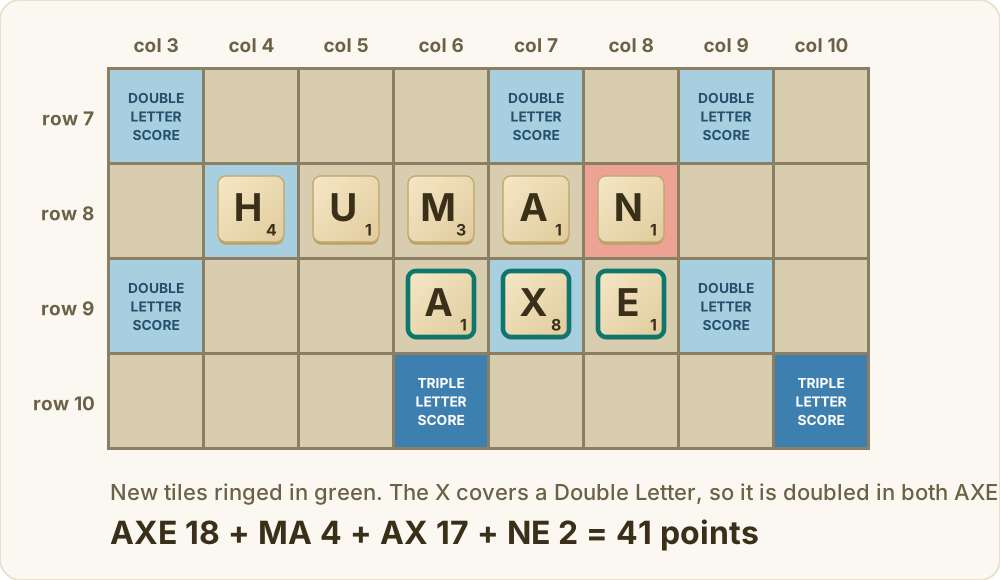
You answer with AXE across row 9, three tiles, sitting directly under M A N. Because each new tile touches a tile above it, each one also forms a two-letter word reading down. Four words, scored separately:
| Word | Direction | Arithmetic | Score |
|---|---|---|---|
| AXE | across, row 9 | A 1 + X 8×2 + E 1 | 18 |
| MA | down, column 6 | M 3 + A 1 | 4 |
| AX | down, column 7 | A 1 + X 8×2 | 17 |
| NE | down, column 8 | N 1 + E 1 | 2 |
| Turn total | 41 |
Three tiles, 41 points. Look at where they came from: the X sits on a Double Letter, so it counts as 16 in AXE and as 16 in AX. One tile on one square supplies 32 of the 41 points. Those same three tiles laid on plain squares with nothing above them score 10.
Two things follow from that. First, a premium square covered on this turn pays into every new word that uses it, the short ones as well as the longest, which is why parallel plays out-score bigger words so often. Second, the play is legal only because MA, AX and NE are all real words. Every word a play creates has to be valid; one bad cross-word invalidates the whole turn, main word included. Slide AXE one column left and the cross-words become UA, MX and AE. The first two are not words, and the play dies.
That is the entire argument for knowing the short words cold, and why we keep a list of the Scrabble words that win games.
Beginner habits that win
- Hold high-value tiles for premium squares. Face value for a
Zis 10. A Triple Letter turns the same tile into 30, and a word bonus on top multiplies it again. - Play off spare vowels early. A rack of five vowels is a dead rack. Trade them or play them off before they pile up.
- Keep a balanced rack. A good mix of common consonants and one or two vowels is what makes bingos possible.
Two more habits, knowing the two-letter words and not opening a Triple Word lane, get their own treatment below.
How I actually find a word on my rack
Everything above is the rule book. This part is mine: the routine I use at the table as a casual player, in the order I do it.
- Group the tiles into pairs before looking for a word. ER, EN, ET, ST and the like. Seven loose tiles become three or four objects, and objects are easier to move around than letters.
- Make three-, four- and five-letter words first. A short word is something to extend. Staring at seven tiles waiting for a seven-letter word to arrive is much harder work.
- Keep physically shuffling the rack. I move the tiles a lot, because my brain re-sees them depending on the order. A word that was invisible in one arrangement is obvious in the next.
- Then read the board for a letter I can connect through, and run steps 1 to 3 again pretending that letter is an eighth tile on my rack.
- Learn the legal two-letter words, like QI, so you can fit words in. This is not really about the points. Without them you do not even realise a word will go in, because a word laid alongside another one is only legal if every little pair it forms is also a word. QI is valid in both the North American and the Collins lists, and knowing it lets you see slots other players miss.
- Find the word first, worry about the double and triple squares second. The premiums are a second pass over a play I have already found.
- I never end a word where it lets the next player reach a Triple Word, unless that player is not very good, or we are playing for fun.
- Blanks are great for connecting words, so I use them sparingly. There are only two in the bag, and a blank can stand in for whichever letter makes a word fit.
- I rarely hand tiles in, and when I do I hand in all seven.
- Seven one-point tiles is not a good rack unless you can use all seven.
Four of those are worth putting numbers on.
The pairs. We ran the numbers on whether the chunks I reach for are really the ones English uses. Taking every 3- to 7-letter word in the ENABLE dictionary, weighting it by its frequency in ordinary English, and counting adjacent letter pairs once per word, here are the pairs that turn up in the most different short words:
| Pair | Different 3–7 letter words containing it | Share of short-word usage |
|---|---|---|
| ER | 6,561 | 7.2% |
| IN | 5,197 | 5.8% |
| ES | 5,100 | 4.7% |
| ED | 4,657 | 3.1% |
| LE | 3,738 | 3.5% |
| RE | 3,484 | 7.0% |
| TE | 3,156 | 4.9% |
| AR | 3,086 | 4.9% |
| NG | 2,861 | 3.2% |
| AN | 2,786 | 7.3% |
| AL | 2,646 | 4.2% |
| ST | 2,448 | 4.7% |
| EN | 2,402 | 4.0% |
ER is first out of 576 possible pairs, which is a good habit to have. ST is 12th and EN is 14th. ET is not in the top thirty: it ranks 35th by word count and 58th by usage, so it is the weakest of the four and IN, ES and ED would all repay the slot more. Reversed forms count too, since a rack does not care which way round you lay a pair: RE is 6th and TE is 7th.
One caveat on the numbers. If you rank by raw usage instead of by breadth, TH and HE come first at 13.5% and 10.6%, but that is mostly the word "the" doing the work, and the is not a play. Breadth is the number that matters for a rack. ENABLE is also a general English word list, not the official NASPA or Collins tournament lexicon, so treat this as a chart of English rather than of what a judge will accept. For the full ranked list across the whole language, beyond Scrabble racks, see common letter pairs across English.
The two-letter words. Go back to the AXE play above. It scores 41, and it is legal only because MA, AX and NE are all words. Shift it one square and two of the pairs become UA and MX, which are not, so a play that looked obvious on the rack simply does not exist on the board. So the two-letter list does more than add points. It is how you see the slot in the first place. QI is the classic case: a Q with no U is unplayable in most places and worth 11 points in that one. Our complete 2-letter list marks which entries are Collins-only, which matters, because a few of them will be rejected in a North American game.
The Triple Word squares. There are only eight, and they sit in fixed places: the four corners, plus the middle of each edge at row 1 column 8, row 8 column 1, row 8 column 15 and row 15 column 8. Feeding one is easy to do by accident. A rack holds seven tiles, so if one of my tiles sits in the same row or column as a Triple Word, with seven or fewer squares between them, the next player can build a word along that line through my tile and finish on the square. The closer the tile, the fewer letters they need: two squares away takes only a two-tile play. On the standard board that danger zone is easy to picture, because it is every square on the four edges plus every square of the middle row and the middle column. That is 73 of the 217 squares that are not Triple Words themselves, about a third of the board. The price is plain multiplication: a word worth 10 at face value, like FRIEND, becomes 30 there, and BREAK at 11 becomes 33. In the top row the corner and the edge Triple Word are seven squares apart, so an eight-letter word spanning both triples twice, for nine times the word.
The seven one-pointers. Seven 1-point tiles played as a word on plain squares score 7. The same seven played all at once collect the bingo bonus and score 57, eight times as much for the same letters. That is the arithmetic behind the habit, and it is why a flat rack is only worth keeping if you can see a way to empty it. The bingo section of our Scrabble words guide covers how to set that up.
One honest note, since this is my routine and not received wisdom: competitive players usually go the other way on exchanges, keeping their best two or three tiles and swapping only the rest, so that the "leave" (the tiles still on the rack after a play or an exchange) stays balanced. Throwing back all seven is simpler and it suits how I play.
Common rule mistakes
- Proper nouns, abbreviations, and prefixes or suffixes on their own are not allowed. Nor are hyphenated words or anything needing an apostrophe. Only words you'd find as standalone dictionary entries.
- You can't rearrange tiles already on the board. You build off them.
- Words must read left to right or top to bottom. There are no diagonal words, and no tile may be moved once the turn is over.
- A blank is free to place but not free to keep. It scores zero for the rest of the game, but the word it sits in still gets full word multipliers.
The fine print most players get wrong
Each of these is in a published rulebook. None of them is in the summary most people learned the game from.
Exchanging needs seven tiles left in the bag. Both tournament codes say so plainly. The North American tournament rules allow an exchange "as long as there are at least seven tiles in the bag", and the international rules make "check that the bag contains at least seven tiles" the first step of the procedure; Hasbro's own School Scrabble tournament rules match. The consumer rules sheet in the box doesn't mention the floor at all, which is why most people meet this rule for the first time when an app refuses the exchange. The practical consequence: once the bag is nearly empty you cannot dump a stranded Q, so plan your exit a few turns earlier than feels necessary.
The blank is permanent. When you play it you declare a letter out loud, and it stays that letter for the rest of the game. It scores zero, but if it lands on a Double or Triple Word square, the word still gets doubled or tripled. A blank on a word premium is free multiplication.
Challenges work three different ways, and you must agree which before you start.
- Hasbro's boxed rules and North American club and tournament play use the double challenge. If the play is bad, the tiles come off and the player loses that turn. If the play is good, the challenger pays instead and loses a turn of their own. A play only survives if every word it formed is acceptable.
- International play mostly uses a points penalty. The governing rules list five standard options, of which "five-point penalty per unsuccessfully challenged word" is named as the preferred international norm. Loss of turn and no penalty at all are also on the standard list, so a tournament can pick any of them.
- House rules vary a lot. Under the no-penalty version you should challenge every word you don't recognise, because a failed challenge costs you nothing; under the double challenge you should challenge almost nothing. Settle which one you use before the first tile goes down.
The game can end three ways. Someone plays their last tile with the bag empty; no legal play remains; or six consecutive turns score zero. That third one is real and is in both tournament codes: six turns in a row of passes, exchanges and successful challenges ends the game. The boxed rules carry a simpler version of the same idea: if every player passes twice in turn, it's over.
The end-game adjustment is bigger than it looks. Under the boxed rules, each player's score drops by the value of their unplayed tiles, and if someone went out, the total of everyone else's leftovers is added to them. Say you go out and your opponent is holding Q, V and E: that's 10 + 4 + 1 = 15. You gain 15, they lose 15, a 30-point swing on a turn where nothing was scored. North American tournament rules get there differently, adding double the opponent's rack to the player who went out and leaving the opponent's score alone: you gain 30, they lose nothing. The gap between you ends up the same. Either way, a stranded Q is a 20-point mistake.
Which dictionary applies depends where you are. In the United States and Canada, tournament play uses the NASPA Word List; the current edition is NWL2023, released in October 2023 and in effect since 29 February 2024. Home games in the same region usually point at The Official Scrabble Players Dictionary, seventh edition, published by Merriam-Webster in 2022. Everywhere else, the word source is Collins Scrabble Words, currently CSW24, adopted for international tournament play from 1 January 2025. The lists are close but not identical, which is why an argument over a two-letter word can be unresolvable until you agree which book you're playing from.
Test your knowledge
Knowing that J is worth 8, and that letter premiums apply before word premiums, is the easy part. Finding the squares that turn a decent word into a big one, with a clock running, is harder, and it is most of what makes a good player.
Below is a real nine-by-nine slice of a Scrabble board, with the centre star in view and a Triple Word on its left edge. You get seven tiles and five minutes by default; drop it to four, three, two or one if you want the pressure. Tap a square to set where your word starts, tap the same square again to switch between across and down, then tap your tiles to lay them out. Every play is scored the moment you make it, and you're told up front what the best play on the board is worth, though not what it is.
The arithmetic is the same one the sections above describe: letter premiums first, total the word, then the word premiums, then 50 for using all seven tiles. Words must be four letters or longer, so the two-letter words are out of scope here. They're their own study project, and we've covered them in two-letter Scrabble words.
Placement is the whole exercise. Across these racks, taking the same word and putting it on the wrong squares costs about 56 points, often more than the word is worth on its own. That is the lesson the premium squares teach, and it is hard to feel by reading a list of them.
One caveat, for anyone keeping score properly: this is a scoring drill, not a legal turn. In a real game your first word must cover the centre star, and every word after it has to connect to tiles already on the board. Here you can play anywhere on the slice, because that is what makes the premium squares matter. There is a board reason for that too. You can never reach a Triple Word on the opening move. The nearest one sits seven squares from the star, and a seven-tile word covering the star only reaches six. Move one is always a modest score; the big plays come later, once someone has built out toward the corners.
A note on how high the tiles alone can go. The highest-scoring seven the bag can physically deal spell MUZJIKS (Russian peasants) at 3+1+10+8+1+5+1 for 29, plus the bingo, for 79 points on plain squares. The best everyday word is JUKEBOX, two points behind at 77. Neither is in the set above, and for the same reason: a rack built around J, K, X and Z spells almost nothing else, so the round would be over in seconds. The racks in the drill are picked to score well and leave you something to hunt for. Their best plays, once you find the right squares, are worth between 122 and 140, roughly double what the same seven tiles score sitting on plain ones.
Scrabble rewards a strange mix of vocabulary, arithmetic, and board sense. If you enjoy the tile-building part, you'll probably like what we do with letter pairs in Pairdle, and our roundup of the best classic word games has more in the same family.
SCRABBLE is a trademark of Hasbro in the US and Canada and of Mattel elsewhere. Logic Loft Games is not affiliated with either company; this guide is independent commentary on how the game is played.
Related articles
Scrabble Words That Win: 2-Letter Words, Q Without U, Bingos
All 107 two-letter Scrabble words, the Q words with no U, vowel dumps, where J, X and Z score most, and how to set up a 50-point bingo.
The 10 Best Classic Word Games With Digital Versions (2026 Edition)
From Scrabble to SpellTower, these 10 classic word games have lasted, and all of them have digital versions you can play today on your phone or in a browser.
How to Play Spelling Bee: Rules, Scoring and a Worked Puzzle
Spelling Bee rules and scoring in plain words, then one puzzle of our own solved step by step, plus what 55,818 of our puzzles say about the middle letter.