
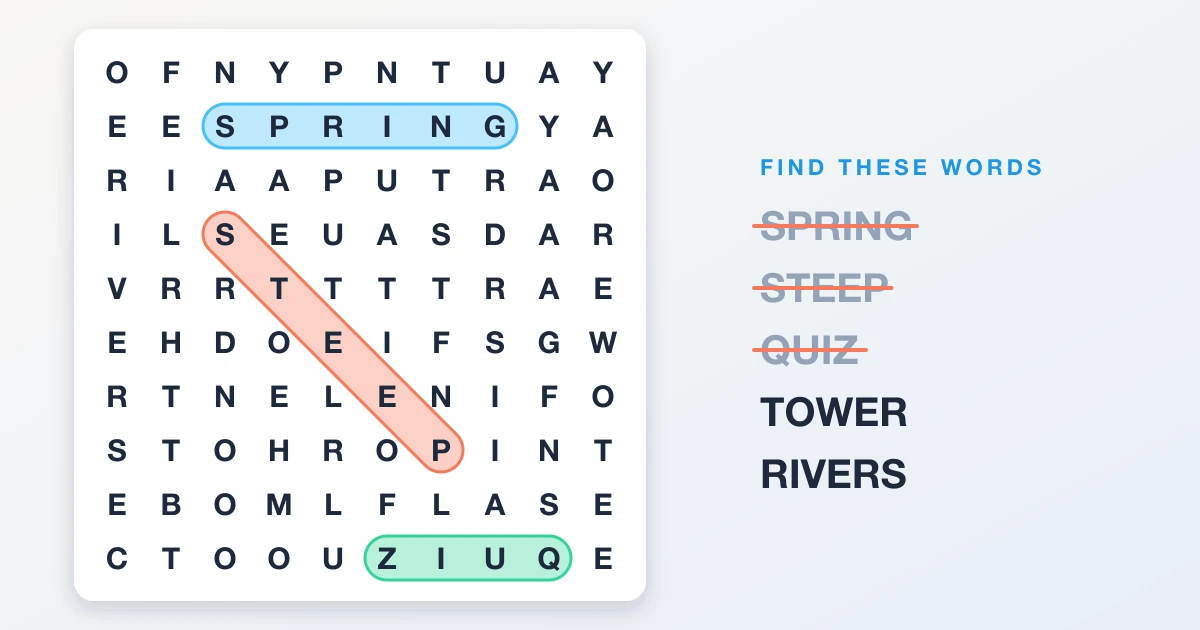
Word search is the puzzle everyone learns as a kid and few people ever get fast at. The rules take five seconds to explain. Finding every word quickly takes skill, and you can learn it, because a word search grid is not random. A constructor put real words into it in straight lines, and English has habits (letter chunks like ING and TION that show up everywhere) that give away where those words are.
This guide covers the rules, how word searches are built, a scan order that clears a grid in a fraction of the usual time, and a technique we call the extend-until-blocked walk. It ends with a chart of the three-letter chunks most likely to be sitting inside a hidden word, computed from a 72,000-word English list rather than copied from someone else's post.
We make word games at Logic Loft, and word search is the clearest case we know of a very simple rule that still rewards technique.
The rules
You are given a grid of letters and a list of words to find. Each word is hidden in the grid as a straight line of consecutive letters. When you find one, you circle or highlight it and cross it off the list. Find every word on the list and the puzzle is solved.
Words can run in up to eight directions, the same set Penny Dell lists for its own puzzle books:
- Left to right and right to left (horizontal)
- Top to bottom and bottom to top (vertical)
- All four diagonals
Easier puzzles, and most puzzles aimed at children, use only left-to-right and top-to-bottom. Harder ones use all eight directions, including backwards. That is where most of the difficulty comes from, and where most of the slowdown happens for people who scan without a plan.
Some digital versions add a twist: a themed list you have to work out for yourself, a timer, or a grid where the leftover letters spell a hidden message once every word is found. The techniques below work for all of them.
How word searches are built, and why it helps to know
A constructor places the target words first, overlapping them where letters happen to match, then fills every empty cell with filler letters. Two facts fall out of this that make you faster:
- The target words are the structure; everything else is noise. Filler is chosen to look plausible, so a cluster of letters that almost spells something usually spells nothing. Only the listed words are real.
- Uncommon letters are signposts. Filler tends to lean on common letters, so a Q, Z, X, J or K in the grid is very often part of a real word. If QUARTZ is on your list, find the lone Q first. There is rarely more than one.
There is a third fact that matters for the scan order in the next section. Constructors spread words across the whole grid. They do not pile five words into one corner and leave the rest empty. So once you have found a few words, the regions of the grid with nothing circled in them are exactly where the remaining words have to be.
The scan order: horizontals, verticals, diagonals, then the empty zones
Most people scan a word search the way they read a page: eyes wandering, hoping something jumps out. It is the slowest possible method, because you are checking eight directions at once and none of them properly.
Commit to one direction at a time, in this order:
- Horizontal, left to right. This is the direction your reading eye is trained for, so it is the fastest sweep. Run every row.
- Vertical, top to bottom. Run every column. Reading down a column is slower than reading across, but it is still a single, disciplined pass.
- Backwards, in both of those directions. Right to left along the rows, then bottom to top up the columns. Backwards words are where puzzles hide their difficulty, and where an undisciplined scan misses them for minutes.
- The four diagonals. Diagonals are the hardest to read and the last place most words sit, so leave them for what is still missing.
- The empty zones. By now you will have circled most of the list. Look at the grid, find the largest areas with nothing circled, and concentrate the remaining search there. The words you have not found yet are almost certainly in those gaps, because the constructor had to put them somewhere.
The point of the order is not that horizontal words are more common (that depends on the constructor). It is that each pass is a single, mechanical job for your eyes, and a mechanical pass misses far less than a wandering one.
The extend-until-blocked walk
This is the technique that turns scanning into something closer to reading. Pick a letter, pick a direction, and extend one cell at a time, saying the growing string in your head. The moment the string stops being the start of any English word, stop and try the next direction.
Take an S. Read to the right: S, SH, SHO, SHOX. Nothing in English begins with SHOX, so that run is dead. Same S, read down the diagonal: S, ST, STE, STEE, STEEP. Found.
It works because English prefixes die fast. We checked this against a standard dictionary of 172,000 words, counting only words of four letters or more:
| String length | Strings that begin at least one English word |
|---|---|
| 2 letters | 313 of 676 (46%) |
| 3 letters | 3,020 of 17,576 (17%) |
| 4 letters | 13,863 of 456,976 (3%) |
Put another way: from a live two-letter start, adding a third letter kills the run 63% of the time. From a live three-letter start, adding a fourth letter kills it 82% of the time. So a dead run almost always dies by the third or fourth cell. You are never reading more than a few letters before you know whether to keep going, and that is what makes the walk quick enough to use on every promising cell.
Two refinements make it faster still:
- Start from consonants. Of the English words you meet in everyday text, only about one in six begins with a vowel. A consonant start is simply more likely to be a word's first letter, and consonant-plus-consonant combinations (SH, ST, TR, PR, CH) narrow the possibilities quickly.
- Use the list to prune. You are not looking for any English word, you are looking for the six or twelve on your list. If the walk gives you STE and nothing on the list starts with STE, you can stop even though STEEP exists in the dictionary.
Spot the chunks: ING, ION, ENT and the rest
The walk finds words from their first letter. Chunk spotting finds them from the middle or the end, and it is often faster, because some three-letter sequences are so common in English that seeing one in the grid is a strong signal that a real word is running through it.
We measured which chunks matter. The table below takes a list of 72,518 English dictionary words between four and twelve letters long, weights each word by how often it appears in a large body of web text, and reports the share of word occurrences that contain each three-letter sequence. The last column is how many distinct words on the list contain it, which tells you how general the chunk is.
| Chunk | Share of words | Distinct words containing it |
|---|---|---|
| ING | 5.2% | 6,431 |
| ION | 4.2% | 2,516 |
| TIO | 3.4% | 1,949 |
| ENT | 3.3% | 1,956 |
| ATI | 2.3% | 2,190 |
| ATE | 2.3% | 2,286 |
| TER | 2.2% | 2,395 |
| THE | 2.0% | 634 |
| ERS | 1.8% | 2,782 |
| PRO | 1.8% | 879 |
| RES | 1.8% | 1,260 |
| CON | 1.6% | 1,156 |
| VER | 1.5% | 1,154 |
| MEN | 1.5% | 957 |
| HER | 1.5% | 801 |
| COM | 1.5% | 628 |
| ESS | 1.4% | 1,444 |
| ECT | 1.4% | 756 |
| ONS | 1.4% | 1,254 |
| TED | 1.3% | 1,536 |
ING is in a class of its own: it appears in more than six thousand distinct words, and in a themed word search (verbs, hobbies, activities) it is close to guaranteed. TIO and ION are the two halves of TION, which is why they sit together near the top.
How to use the chunk once you see it: read outward in both directions. If you spot ING, the word almost certainly ends there, so read backwards from the I to find its start. If you spot PRO or CON, the word almost certainly starts there, so read forward. If you spot TER or ATE, it could be either, so check both ways.
That distinction, start-chunk or end-chunk, is worth knowing on its own. Here are the most common three-letter word endings and beginnings from the same data:
| Common endings | Common beginnings |
|---|---|
| ING (4.7% of words) | PRO (1.6%) |
| ION (3.0%) | CON (1.4%) |
| ENT (1.8%) | COM (1.3%) |
| TED (1.3%) | STA (0.8%) |
| ERS (1.3%) | RES (0.8%) |
| TER (1.0%) | TRA (0.6%) |
| IES (1.0%) | SHO (0.6%) |
| ATE (1.0%) | PRI (0.7%) |
| NCE (0.9%) | FRO (0.7%) |
| ITY (0.9%) | MOR (0.5%) |
Endings are the more useful half for word search, because a list of nouns and verbs is full of them, and because an ending pins down the direction of the word. See an S at the end of ERS and you know which way the word runs.
If you want the two-letter version of this idea, we have a separate piece on the most common letter pairs in English, and one on common prefixes and suffixes that goes deeper on the start-chunk and end-chunk distinction.
Hunt by first letter, and chase the rare ones
The two older techniques still earn their place, and they combine well with the walk.
Hunt by first letter. Pick a word from the list and scan the grid for its first letter only. Looking for PYTHON? Find every P, and at each one glance in all eight directions for a Y. Most Ps fail instantly. The one with a Y beside it is your candidate, and the walk confirms it in three more cells.
Target the rare letter instead. For a word with an uncommon letter, search for that letter rather than the first one. JUNGLE has a J. Js are rare in filler, so finding the J and reading around it beats scanning for a common first letter that appears all over the grid. Q, Z, X, J and K narrow the search to a handful of cells, and often to one.
A worked example
Here is a small grid with five hidden words: SPRING, RIVERS, STEEP, QUIZ, TOWER. Rows and columns are numbered so you can follow the walkthrough.
| 1 | 2 | 3 | 4 | 5 | 6 | 7 | 8 | |
|---|---|---|---|---|---|---|---|---|
| 1 | T | S | P | R | I | N | G | A |
| 2 | R | O | D | E | E | G | S | A |
| 3 | I | O | S | H | O | X | L | R |
| 4 | V | E | Y | T | S | R | E | E |
| 5 | E | E | I | I | E | E | R | W |
| 6 | R | E | S | I | E | E | G | O |
| 7 | S | L | A | R | D | D | P | T |
| 8 | L | E | L | Z | I | U | Q | L |
Walk through it the way this guide suggests:
- Rare letter first. QUIZ has a Q and a Z. There is exactly one Q, in row 8 at column 7. Read outward: to the left it gives Q, QU, QUI, QUIZ. Found, running backwards. That took three cells and no scanning.
- Horizontal sweep. Row 1 reads T S P R I N G A. SPRING sits in plain sight, left to right. Cross it off.
- Vertical sweep. Column 1 reads T R I V E R S L. RIVERS runs top to bottom. Two words left.
- The walk. There are six Ss in the grid. Take the one at row 3, column 3. Rightward: S, SH, SHO, SHOX. Dead. Down the diagonal: S, ST, STE, STEE, STEEP. Found.
- Empty zone. Nothing is circled in column 8. TOWER has five letters and the column has eight cells, so read it both ways. Bottom to top from row 7: T, TO, TOW, TOWE, TOWER. Found, running upward.
None of the five needed a line-by-line read of the grid.
Finishing the last few words
The last two or three words are where most of the time goes, so it is worth having a routine for them:
- Use the word's shape. A nine-letter word cannot fit in a four-cell gap. Long words are restricted to long straight runs, and in a small grid that rules out most of the board.
- Use its letters. If the word has a double letter (SUMMER, BALLOON), scan for the pair. Doubles are easy to spot and rare in filler.
- Go back to the empty zones. Whatever is left is in the part of the grid with nothing circled.
- Reverse and diagonal last. If a word will not appear after a horizontal and vertical pass, it is running backwards or diagonally. Sweep those deliberately instead of hoping.
- Cross off as you go. Mark each word the instant you find it. It clears the word from your working memory and shrinks the list you are still hunting.
Common mistakes that slow you down
- Reading the grid like a book. Line-by-line reading is the slowest method. Sweep one direction at a time, or walk from a promising letter.
- Checking all eight directions at once. Your eyes cannot do it. One direction per pass.
- Forgetting backwards and diagonal. If a word will not appear, it is almost always running a direction you have not checked.
- Trusting filler clusters. Random letters sometimes almost spell a listed word. Verify every letter before circling.
- Ignoring the rare-letter shortcut. Q, Z, X and J narrow the search to a few cells. Look for them first.
- Reading a dead run too far. If the string in your head has stopped being the start of an English word, stop. The numbers above say it will happen by the fourth letter nearly every time.
Why it is worth doing well
Word search trains fast visual scanning and pattern recognition, and the chunk-spotting habit in particular transfers to every other word game. The same eye that catches ING in a grid catches it in a scrambled rack, which is the skill behind how anagrams work, and it is the whole game in a word hunt like Pairdle Hunt, where you build words out of a letter board that never empties.
For places to play, our roundup of the best word search games covers the good ones, from classic printable grids to the daily themed puzzles. If you enjoy hunting for words and want a daily twist, Pairdle hides the word by logic rather than in a grid. Two other puzzles use the same kind of grid discipline: solving a crossword clue by clue and the elimination logic behind Sudoku's solving techniques. And the rest of our game guides cover the other puzzles that reward a bit of technique.
Quick reference
- Sweep in this order: across, down, backwards, diagonals, then the empty zones.
- Walk from a consonant: extend one cell at a time and stop the moment the string is not the start of a word. Dead runs die by the fourth letter 82% of the time.
- Spot the chunks: ING, ION, ENT, TER, ERS, ATE. Endings mean read backwards; PRO, CON, COM mean read forwards.
- Rare letters first: Q, Z, X, J, K.
- Cross off every word the moment you find it.
Related articles
The 10 Best Word Search Games and Apps in 2026
From classic grid hunts to modern twists, these are the 10 best word search games and apps for relaxing, sharpening your eye or keeping kids busy.
Pairdle 1.5: What's New, What's the Same, and an Exciting New Level
Pairdle 1.5 puts every level on one row, unlocks Pro, adds Expert and endless Practice, and introduces Olly the owl. Plus what a 12-tile board really holds.
How to Play Wordle: Rules, Tiles & Walkthrough
New to Wordle? Learn the full rules, what green/yellow/gray tiles mean, and follow a complete game walkthrough from the team that builds daily word puzzles.