
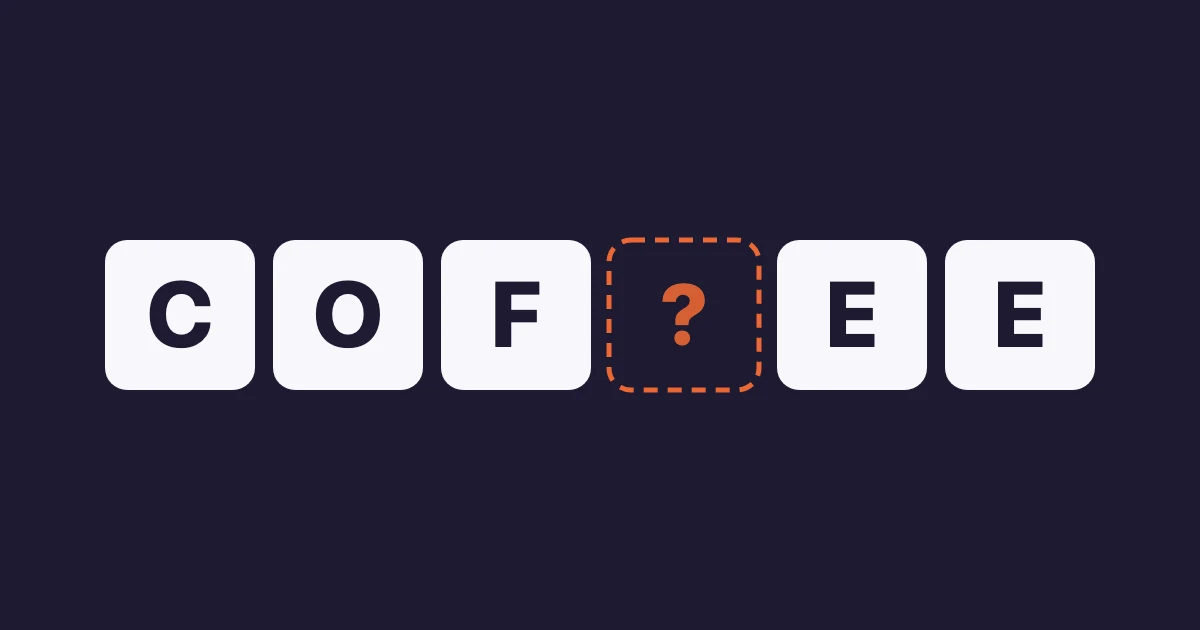
You can play Boggle every night for the rest of your life and you will never once spell COFFEE. Not because it is hard to find. Because the dice cannot produce it. The same goes for PIZZA, BIBLE, OFF, JOB, KICK, BABY, PUZZLE and, by our count, 10,359 other words in the dictionary.
This started as a footnote to our Boggle strategy article, where we rolled 100,000 boards to see which words and letter pairs actually win. Along the way I asked a simpler question: are there words that cannot appear at all? The answer turned out to be a list long enough for its own article, and the reasons behind it are three small rules that most players have never heard of.
The sixteen dice
Boggle is played with sixteen dice, and every die has the same six faces every time you play. Here they are. The letters in orange are the ones that appear on a single die and nowhere else.
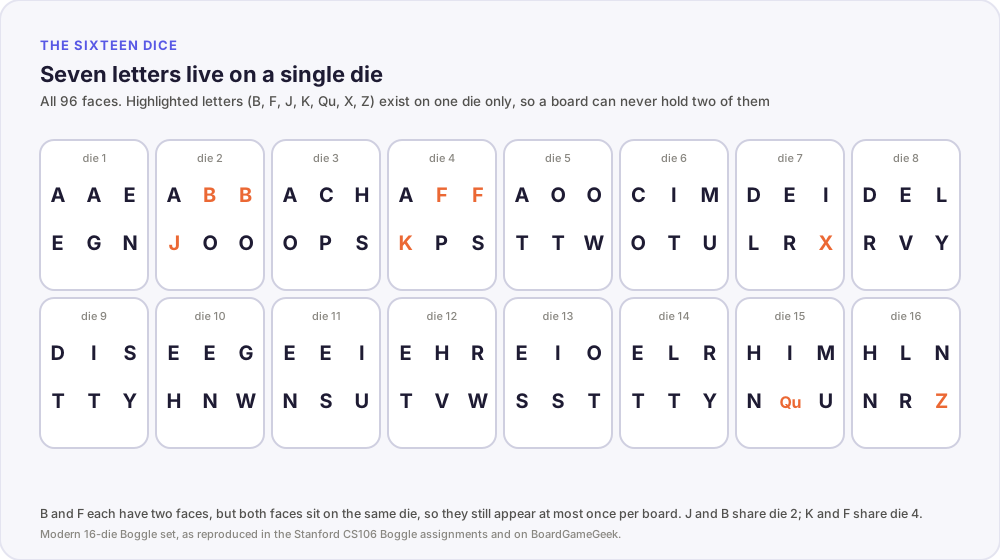
Because each die shows exactly one face, a board is a sample of sixteen letters drawn from these sixteen fixed sets. That has a consequence people rarely think through: the number of copies of any letter on a board can never exceed the number of dice that carry it. E is on eight dice, so a board can hold up to eight E's. Z is on one die, so a board holds at most one Z. A word with two Z's is impossible on every one of the billions of possible boards.
How we checked
We took the 186,602-word dictionary that powers our own games, Pairdle Slide, Pairdle Hunt and Word Slots, and asked one question of every word: is there any way to assign each of its letters to a different die that carries that letter? That is a matching problem, and a computer settles it in a fraction of a millisecond per word. We ignored adjacency entirely, so this is the most generous possible test. A word that fails it cannot be made even if you were allowed to pick letters from anywhere on the board.
| Count | |
|---|---|
| Words in the dictionary | 186,602 |
| Words no roll can produce | 10,359 (5.6%) |
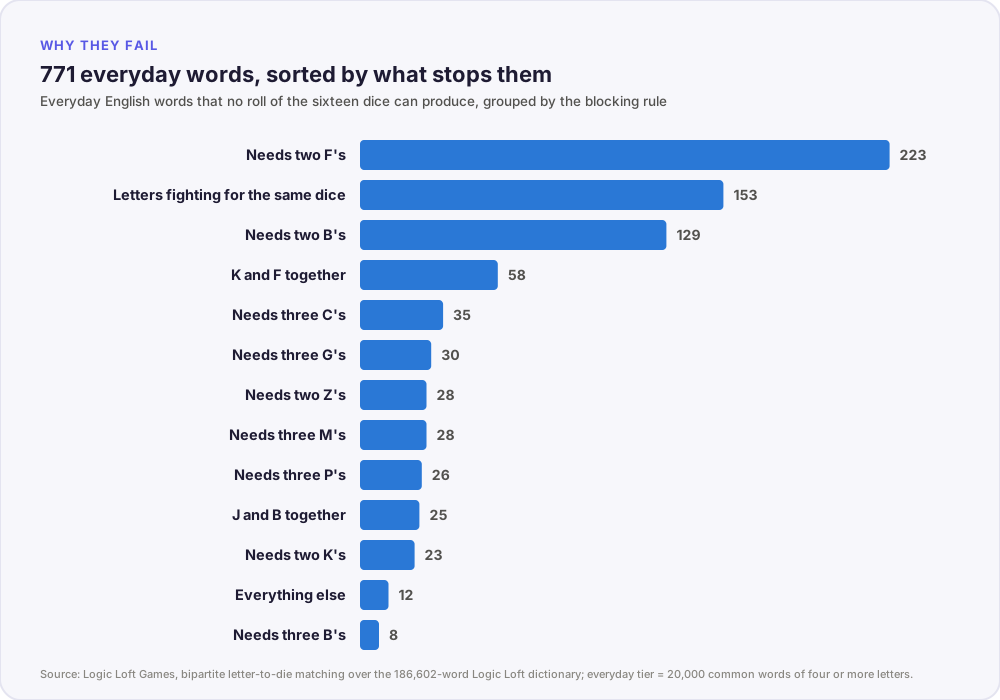
| Of those, everyday words of four or more letters | 771 |
| Of those, words most adults use routinely | 138 |
The last row uses a standard word-frequency scale, and I will come back to it, because the list of common words Boggle cannot spell is the part of this that made me laugh out loud.
Rule one: seven letters can only appear once
B, F, J, K, Qu, X and Z each live on one die. The trap is that B and F have two faces each, which makes them feel like ordinary letters. They land on about a third of boards. But both faces sit on the same die, and a die shows one face at a time, so a board can never hold two B's or two F's.
| Letter | Its only die | Faces | Maximum per board |
|---|---|---|---|
| B | ABBJOO | 2 | 1 |
| F | AFFKPS | 2 | 1 |
| J | ABBJOO | 1 | 1 |
| K | AFFKPS | 1 | 1 |
| Qu | HIMNQU | 1 | 1 |
| X | DEILRX | 1 | 1 |
| Z | HLNNRZ | 1 | 1 |
Every word with a doubled one-die letter is out:
- Two F's: OFF, OFFER, OFFICE, OFFICIAL, OFFICER, EFFECT, EFFORT, DIFFER, DIFFERENT, DIFFICULT, COFFEE, TRAFFIC, STAFF, STUFF, CLIFF, FIFTH, FIFTY, MUFFIN, AFFORD. This is the single biggest group: 223 everyday words.
- Two B's: BABY, BIBLE, BOMB, BULB, HOBBY, LOBBY, RABBIT, RUBBER, RIBBON, ROBBER, PROBABLY, SUBURB, BAMBOO, BARBER. 129 everyday words, plus BUBBLE and BOBBIN, which need three.
- Two K's: KICK, KNOCK, KAYAK, KHAKI, KNACK, SKUNK, BACKPACK, COOKBOOK, CHECKBOOK, KNUCKLES.
- Two Z's: PIZZA, JAZZ, BUZZ, PUZZLE, DIZZY, FUZZY, DRIZZLE, GRIZZLY, BLIZZARD, MOZZARELLA.
- Two X's: XEROX, on its own.
Three-letter words are not in our everyday list, but they fail the same way: OFF, JOB, JAB, JIB, BOB, EBB and BIB can never appear. BOB is a decent trivia answer. So is the fact that a game called Boggle cannot spell PUZZLE.
Rule two: some letters can never share a board
This is the rule nobody sees coming, because the words it kills do not repeat a letter.
J and B are both on die 2, ABBJOO, and on no other die. If J is showing, B is not, and the other way round. So any word containing both a J and a B is impossible: JOB, JOBS, JAB, JIB, JUMBO, BANJO, OBJECT, SUBJECT, JUBILEE, JUKEBOX, ADJUSTABLE, ENJOYABLE, OBJECTIVE.
K and F share die 4, AFFKPS, in the same way. That takes out FAKE, FORK, FOLK, FUNK, FLAKE, FLASK, FLICK, FLOCK, FREAK, FRANK, KNIFE, FEEDBACK, FOLKLORE, THANKFUL, SKILLFUL and BOOKSHELF. Fifty-eight everyday words in total, every one of them spelled with no repeated letter, every one of them unreachable.
I have watched people search a board for FORK. It is a satisfying word to find, four letters with a K for a slightly unusual feel. It has never been there.
There may be a reason those two letters ended up together. Boggle was designed by Allan Turoff and published by Parker Brothers in 1973, and the company redesigned the dice in 1987. Dan Lewis, who writes the Now I Know newsletter, has pointed out that before 1987 the F's and K's sat on different dice, and afterwards every F and K lived on AFFKPS, which happens to make one particular four-letter expletive impossible to spell. He is careful to call it a theory. Parker Brothers never explained the change, and in a follow-up he says he searched for evidence and found none. Our count adds the other side of the ledger: whatever the redesign was for, it took FORK, FOLK, KNIFE and fifty-five other everyday words with it.
Rule three: two-dice letters cap at two
C, G, M, P and V each appear on exactly two dice. A third copy has no die to come from, so:
- Three C's: ACCURACY, CYCLICAL, ECLECTIC, ECCENTRIC, CONSCIENCE, COINCIDENCE, CIRCUMSTANCE, CHARACTERISTIC.
- Three G's: GIGGLE, GOGGLES, LUGGAGE, BAGGAGE, BEGGING, DIGGING, HUGGING, JOGGING, STRUGGLING, SUGGESTING.
- Three M's: MAMMAL, MAMMOTH, MOMMY, MUMMY, MAXIMUM, MINIMUM, MOMENTUM, COMMITMENT.
- Three P's: PEPPER, PUPPY, POPPY, PUPPET, PINEAPPLE, APPROPRIATE, INAPPROPRIATE.
There is also a quieter group of 153 everyday words that fail on a combination rather than a single letter. SPECIFIC is the cleanest example. It needs two C's, which use up both C dice, ACHOPS and CIMOTU. It also needs a P, and P's two dice are ACHOPS, already taken, and AFFKPS. So the P must come from AFFKPS. But SPECIFIC also needs an F, and F's only die is AFFKPS, which the P just claimed. Every letter in SPECIFIC exists on the dice, and there is still no way to lay them all out at once. MUSEUM fails the same way (its two M's take both M dice, which are also two of the three U dice, leaving one U for a word that needs two), as do PICKUP, PUMPKIN, CUPCAKE, COMMERCIAL, SUCCESSFUL and COMMUNICATION.
The most common words Boggle cannot spell
Ranking the impossible list by how often each word appears in written English, using the Zipf frequency scale (a 5 means about ten occurrences per million words, a 6 means a hundred), gives this top twenty-five. These are not obscure words. Several sit among the most common few thousand words in the language.
| Rank | Word | Zipf frequency | Why it fails |
|---|---|---|---|
| 1 | OFF | 5.9 | two F's |
| 2 | DIFFERENT | 5.6 | two F's |
| 3 | JOB | 5.5 | J with B |
| 4 | OFFICE | 5.4 | two F's |
| 5 | PROBABLY | 5.4 | two B's |
| 6 | BABY | 5.3 | two B's |
| 7 | OFFICIAL | 5.1 | two F's |
| 8 | STUFF | 5.1 | two F's |
| 9 | STAFF | 5.1 | two F's |
| 10 | DIFFICULT | 5.1 | two F's |
| 11 | OFFER | 5.0 | two F's |
| 12 | OFFICER | 5.0 | two F's |
| 13 | SPECIFIC | 5.0 | C, P and F compete for dice |
| 14 | EFFECT | 5.0 | two F's |
| 15 | DIFFERENCE | 5.0 | two F's |
| 16 | JOBS | 5.0 | J with B |
| 17 | SUBJECT | 5.0 | J with B |
| 18 | SUCCESSFUL | 4.9 | C, S and U compete for dice |
| 19 | COMMERCIAL | 4.9 | C and M compete for dice |
| 20 | EFFORT | 4.9 | two F's |
| 21 | EFFECTIVE | 4.9 | two F's |
| 22 | OFFICERS | 4.9 | two F's |
| 23 | COFFEE | 4.9 | two F's |
| 24 | TRAFFIC | 4.8 | two F's |
| 25 | FRANK | 4.8 | K with F |
The F die does most of the damage. OFF alone is one of the hundred most common words in English, and the whole OFF family (OFFER, OFFICE, OFFICIAL, OFFICER, OFFSET, OFFEND) goes with it. If the second F sat on a different die, more than two hundred everyday words would come back into play. Whether that trade was ever weighed, nobody outside the company knows. Neither Parker Brothers in 1987 nor Hasbro since has published the reasoning behind the letter distribution.
Possible in theory, missing in practice
The impossible list is the hard boundary. Just inside it is a much larger group of words that the dice allow but almost never deliver, because they need two or three rare letters to land on the same board and then touch. From the same 100,000-board simulation as the strategy article, here is how often a few of them actually appeared.
| Word | Boards where it could be spelled | Boards where all its letters were present |
|---|---|---|
| BLACK | 0.01% | 0.41% |
| FROZEN | 0.01% | 0.89% |
| JUDGE | 0.01% | 0.69% |
| QUICK | 0.03% | 0.47% |
| BOOK | 0.08% | 0.99% |
| JOKE | 0.12% | 1.55% |
| KING | 0.15% | 2.09% |
| QUIZ | 0.24% | 1.66% |
| ZERO | 0.65% | 5.44% |
| QUEEN | 0.83% | 5.49% |
| ZOO | 1.31% | 5.47% |
BLACK appeared on one board in ten thousand. It needs the B die and the K die to both show the right face, plus a C from one of two dice, and then all five letters have to form a chain. BOOK, which feels like the most ordinary word in the language, showed up on 0.08% of boards, roughly one game night in a hundred if you play a dozen rounds. The gap between the two columns is the adjacency tax: even when every letter is on the board, most of the time they are not touching.
So if you have a nagging sense that some perfectly normal words never come up, you are not imagining it. Roughly one word in eighteen cannot come up at all, and a good many more are rarer than an eight-letter word.
What to do with this
Nothing, during a game. You read the board in front of you and the impossible words are simply absent from it. But it settles a few arguments and wins a few bets:
- If someone writes down COFFEE, PIZZA, OFF, JOB or KICK, they have miscounted a die. There is no board on which those words exist.
- FORK, FAKE and KNIFE are not on the board either, and never have been, no matter how sure you are that you saw them.
- A friend who claims to have spelled PUZZLE in Boggle is misremembering. It is a good story precisely because it cannot happen.
The same is true of every letter-tile game. The tile or die distribution is a hidden rulebook. In Scrabble the constraint is the bag: one Z, one Q, two blanks. In Boggle it is the faces, and because letters are grouped onto dice, the constraints are stranger than a simple count. Two letters that both exist can still be mutually exclusive. If you enjoy that kind of structure, our piece on how anagrams work covers the letter arithmetic behind word puzzles more generally, and Pairdle Hunt is our own grid word game, where every board is built so that its words are guaranteed to be there.
For the full method, the dice set and the strategy that came out of the same simulation, start with How to Play Boggle, and What 100,000 Boards Taught Us. If grid-hunting without a timer is more your speed, our roundup of word search games covers that side of the genre. And if you want to test any of this on a real board, the board generator rolls one from the same sixteen dice and will show you every word it holds, so you can confirm for yourself that COFFEE never turns up.
Related articles
How to Use a Word Unscrambler Without Spoiling the Puzzle
A word unscrambler will hand you 348 words you did not ask for. The skill is narrowing it to the six that fit, without spoiling the answer.
Boggle Got Easier in 1987. It Also Lost 735 Words.
Parker Brothers replaced every Boggle die in 1987 and never said why. We simulated 100,000 boards on both sets: more words per board, 735 words lost.
Why Does Wordle Hate the Letter N?
I counted every letter in all 2,343 Wordle answers and compared them to the dictionary. N and I get snubbed, Z runs five times hot, and F is innocent.