
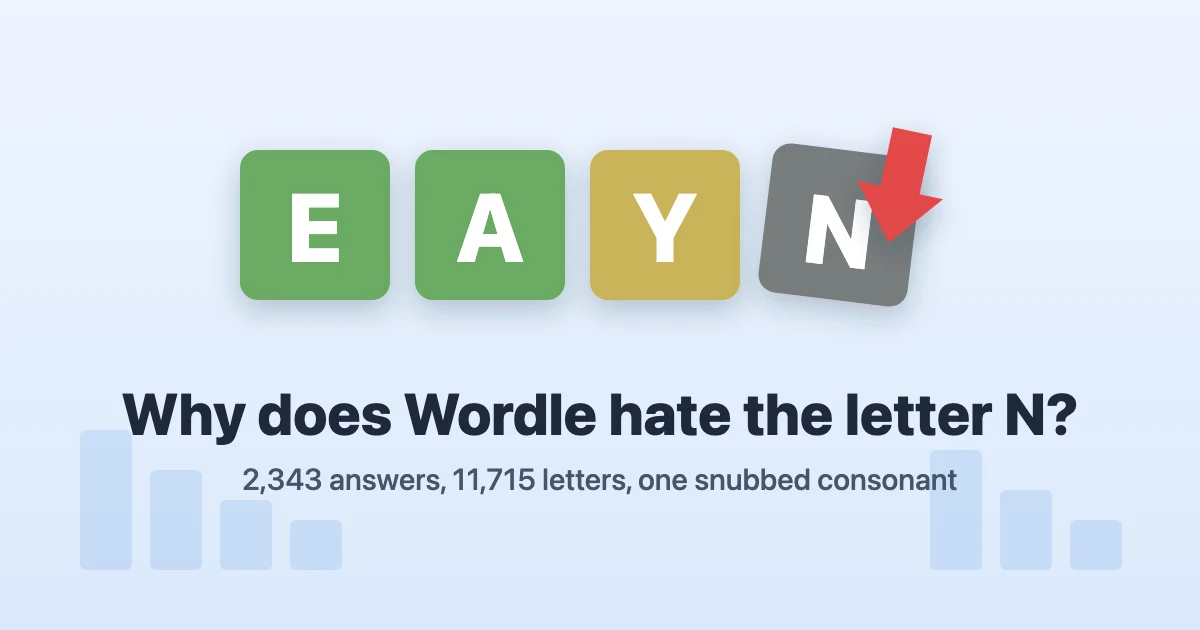
If you've played Wordle for more than a week, you've probably picked a favorite starting word, and if you're the type who researches these things, you picked it using an English letter-frequency chart. E, then A, then R and I and O. Get the common letters on the board early, and the rest of the puzzle falls into place.
Where to play: Website · App Store · Google Play
The trouble is that Wordle doesn't play by English's rules. I took the full list of 2,343 legal Wordle answers and counted every letter, 11,715 of them, then lined the results up against Oxford's letter-frequency analysis of the Concise Oxford English Dictionary. Some letters match closely. Others are so far off that the frequency chart you memorized is steering you wrong.
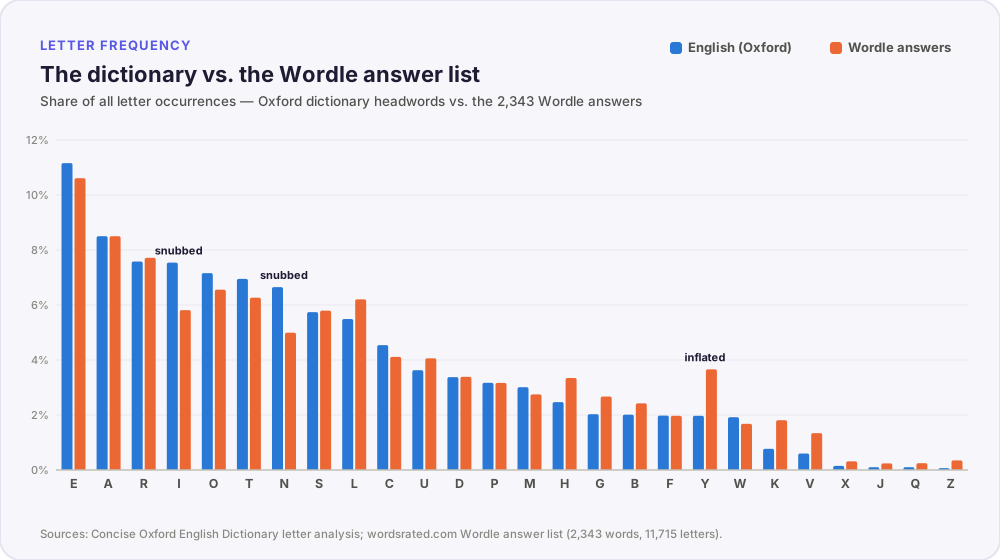
At the top of the chart, things look calm. E is the king in both worlds. A is almost identical (8.50% in English, 8.50% in Wordle, a rounding error apart). But look at I, N, and that suspicious orange spike over at Y.
The gap, letter by letter
Subtract English's rate from Wordle's rate and the pattern jumps out:
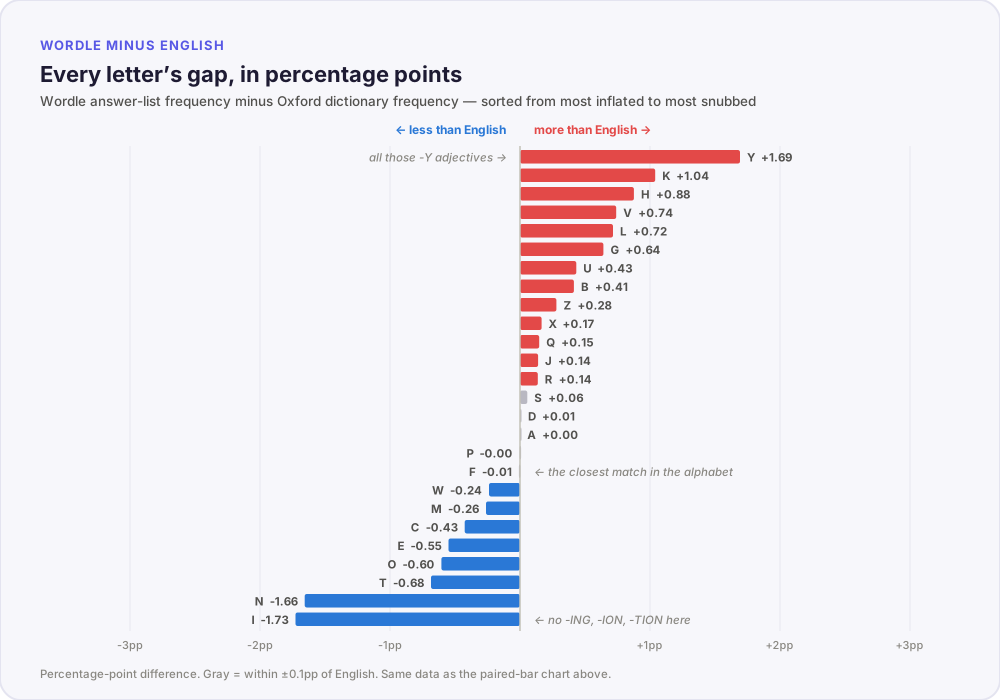
The two most snubbed letters in Wordle aren't obscure ones. They're N and I, the 7th and 4th most common letters in the English dictionary:
- N falls from 6.65% of dictionary letters to 4.99% of Wordle letters: a 25% haircut, the biggest relative cut of any common letter.
- I falls from 7.54% to 5.81%: the single largest absolute drop in the alphabet.
And one I didn't see coming: F is the closest match in the entire alphabet. 1.98% in English, 1.97% in Wordle. Whatever grudges the New York Times is nursing, F isn't one of them. (I know, because this article was originally going to be titled "What does the NYT have against the letter F?" The data had other plans.)
So why does Wordle hate N?
It doesn't, really. It hates long words, and N is collateral damage.
Dictionary headwords average around eight letters, and the long ones are overwhelmingly Latinate: information, nationality, intention, definition. Those words are stuffed with I's and N's. The -ING, -ION, and -TION endings alone are an I-and-N factory. Chop the dictionary down to five-letter words and that entire family of words simply can't exist. The suffixes that made I and N superstars don't fit on the board.
The flip side: short English words skew Anglo-Saxon and odd. That's where the rare letters live. And Wordle loves them:
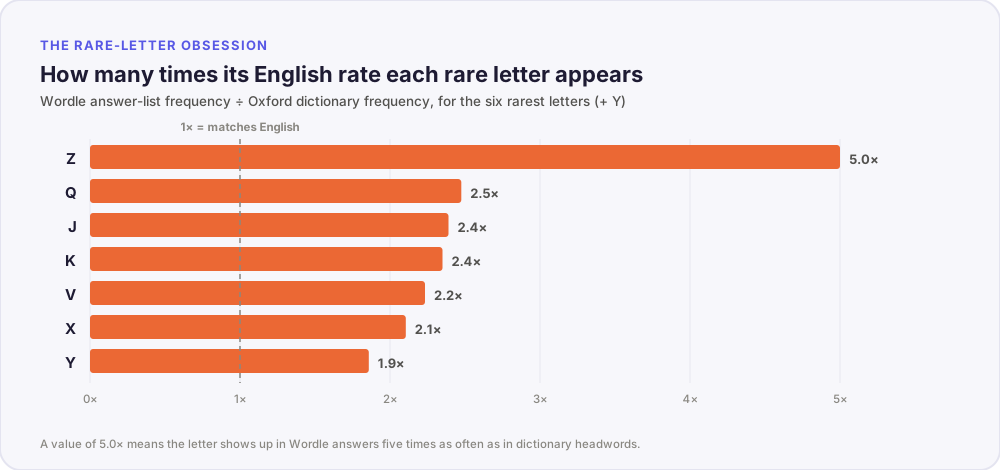
Every one of the six rarest letters in English is over-represented in Wordle, by a lot. Z appears five times as often in Wordle answers as in the dictionary (36 answers contain a Z, from ZEBRA to WOOZY). Q, J, K, V, and X all run at more than double their English rates. K alone shows up in 204 answers.
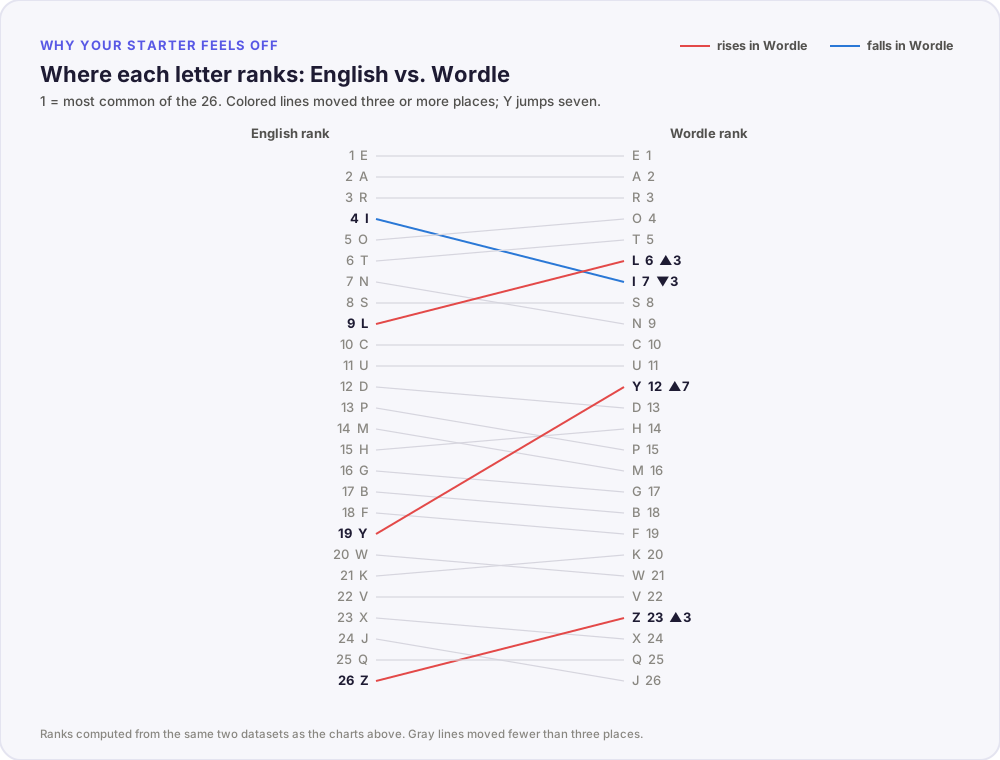
Then there's the biggest single distortion in the whole dataset: Y, at +1.69 percentage points, nearly double its English rate. The culprit is a whole genre of five-letter words English is full of: the -Y adjective. BOOZY, JAZZY, DODGY, GAUDY, TIPSY, WOOZY... 368 of the 2,343 answers, one in six, end in Y. In the dictionary, Y is the 19th most common letter. In Wordle, it's 12th.
One more thing Wordle's curators did on purpose: plurals. Only 39 answers end in S, because the answer list deliberately avoids plural nouns and third-person verbs. That's why S, the 8th most common letter in the dictionary and the first letter of more English words than any other, merely breaks even in Wordle instead of dominating. The same curators are also responsible for some of Wordle's rarest answers, like CAPON, which were never on the original word list at all.
What this means for your starting word
If your starter strategy came from an English frequency table, make three changes:
- Stop overvaluing I and N. They're still useful (28% of answers contain an I, 24% an N) but they're not the near-locks an English chart implies. An N that would earn its slot in a crossword-frequency world is only the 9th best letter here.
- Start respecting Y as a last letter. Y is the 12th most common letter in Wordle, ahead of D and H, and it overwhelmingly lives in the final slot. A second guess like GODLY or MANGY when you're fishing does real work. (Y is also why purely positional thinking beats raw frequency: almost all of its value is in slot five.)
- Give L and H more credit. L jumps from 9th in English to 6th in Wordle, and H runs 35% hot: all those TH, CH and SH words. The classic SLATE/CRANE/TRACE family of starters already bakes this in, which is part of why those words keep winning solver rankings: they were computed from the answer list, not from English at large. We dug into that family in our guide to the best Wordle starting words.
Any strategy tuned to English at large is mis-tuned for Wordle, because the answer list is not a sample of English. It's a curated, five-letter, no-plurals, family-friendly slice of it. Want to know how your own opener scores? We turned this dataset into a free Wordle starting word calculator. Type any five-letter word and it tells you what percentage of the 2,343 answers it reaches.
The perfect starter, according to each list
Here's a party trick that falls out of the data. Take Wordle's five most common letters (E, A, R, O, T) and they anagram into a real word: ORATE (or OATER, if you're a fan of old Westerns). A statistically perfect opener. With one catch: neither ORATE nor OATER is in the 2,343-word answer list. The best possible first guess is a word Wordle will accept but never, ever use as the answer.
Try the same trick with English's top five (E, A, R, I, O) and it falls apart: four vowels and an R make no five-letter word at all. You have to reach down to English's sixth letter, T, to get anything playable, and even then all six letters together only produce OATIER ("more oat-like", technically a word, barely). Drop one letter instead and the six give you two famous starters: IRATE (drop the O) and RATIO (drop the E). And in a neat reversal of the ORATE situation, both of those are in the answer list.
So the two frequency charts hand you different opening moves: English's chart builds IRATE and RATIO, words that could win the game outright; Wordle's own chart builds ORATE, a word that never can, but fishes in exactly the pond the answers swim in.
Maybe it's not Wordle's fault
A fairer way to put it: any word game's letter distribution is a fingerprint of its format. Fix a word length, curate for common words, ban plurals, and you've bent the alphabet, whether you meant to or not.
So I ran the same analysis on our own daily word game, Pairdle, which works on six-letter words built from letter pairs instead of five-letter words guessed one letter at a time. Same method: every letter of the 935 different answers Pairdle 1.5 has scheduled for its daily boards, against the same Oxford baseline.
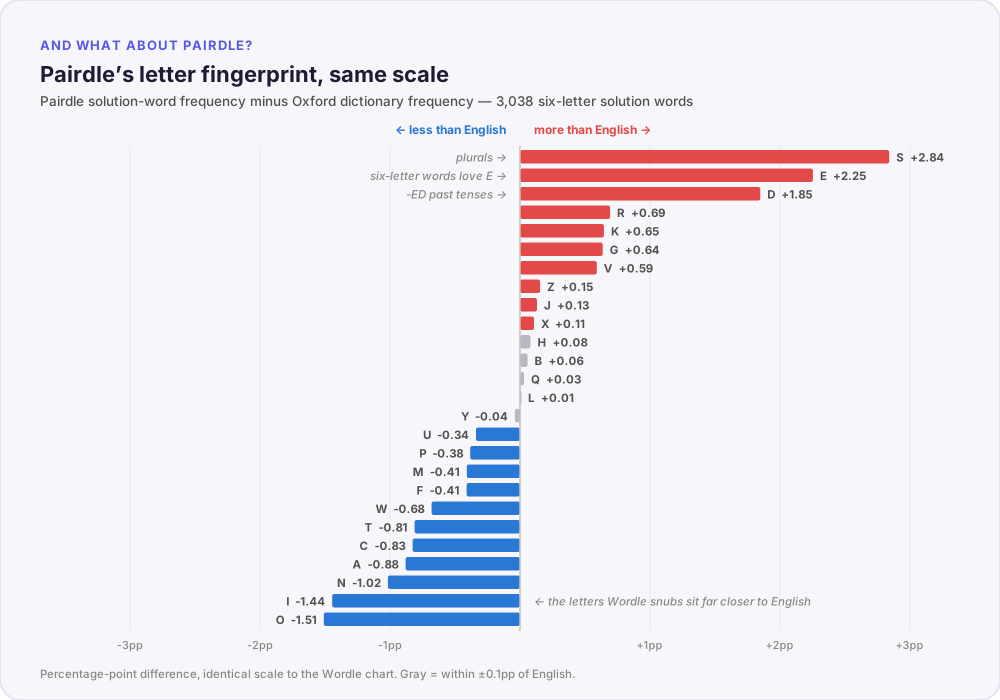
On the letters Wordle bends most, Pairdle 1.5 stays closer to English. Y sits at 2.35%, 0.38 points above its English rate, where Wordle's Y runs 1.69 points over. H and B are within a twentieth of a point. N moves the most: Pairdle 1.5 runs 0.64 points under English, against 1.66 in Wordle. I stays low, 1.35 points under against Wordle's 1.73. Rare letters still run hot, but less so. Z turns up three times as often as in the dictionary, where Wordle has it at five times.
Pairdle 1.5 has a fingerprint too. S, E, and D all run hot, because six-letter English is full of plurals (202 of the 935 answers end in S) and -ED past tenses (another 99), the word forms Wordle's editors pruned away by hand. Wordle's odd letters come from curation, and Pairdle's come from grammar. If you want to know how the two games compare beyond the letter counts, I've written a fuller Pairdle vs. Wordle comparison.
So Wordle doesn't hate N. It hates -ATION, and every word game hates something. What matters is whether its grudges match the frequency chart in your head.
The same hand-picked answer list decides something else, too: how hard the game is. I simulated every possible Wordle game at four, five, six, seven and eight letters to find out whether five was the right call, and four letters turns out to be the cruellest of the lot. That's why Wordle is five letters long. If you'd rather measure hardness one puzzle at a time, we built a test from its five toughest answers.
Methodology: the English baseline is Oxford's letter-frequency analysis of entries in the Concise Oxford English Dictionary (dictionary headwords, not running text). Wordle figures were computed across all 2,343 legal answer words. Pairdle figures are for Pairdle 1.5: the 935 distinct answers of the six-letter Pairdle level across all 1,124 scheduled daily boards, recomputed on September 24, 2026. Repeated letters within a word count each time they appear.
By Tim Nye, Logic Loft Games
Related articles
The Hardest Wordle Words on Record: Can You Solve Them?
We ranked 502 Wordle answers by the guesses they actually took, found the five worst, and built a five-round test so you can play them against the average.
Easy but Hard: How Pairdle Breaks Wordle's Bell Curve
Wordle's guess distribution is a tight bell. Pairdle's isn't. Players win faster and lose more often. We pulled real data to find out why.
The Hobbit's (Wordle) Wager: Why Wordle Is Five Letters Long
I simulated every possible Wordle game at 4, 5, 6, 7 and 8 letters. Four letters is the hardest: short words hide in packs, and five is the sweet spot.