
Boggle is the word game equivalent of a sprint: sixteen letter dice, a three-minute timer, and a race to find as many words as you can before the sand runs out. Every guide to the game, including the first version of this one, tells you the same things. Look for -ING. Chase long words. Start in the corners. I wanted to know which of that advice is true, so we did what a studio that builds word games can do and simulated it.
We rolled 100,000 Boggle boards with the real dice and solved every one against the same dictionary that powers our games. The rules and scoring come first, because you need them. The second half is what the numbers say, and some of it contradicts the folklore.
The rules
- The board is a 4x4 grid of 16 letter dice. You shake the tray and the dice settle into the grid showing 16 random letters. Big Boggle uses a 5x5 grid and is a different game statistically, so everything below is about the 4x4 set.
- A timer, traditionally 3 minutes, starts.
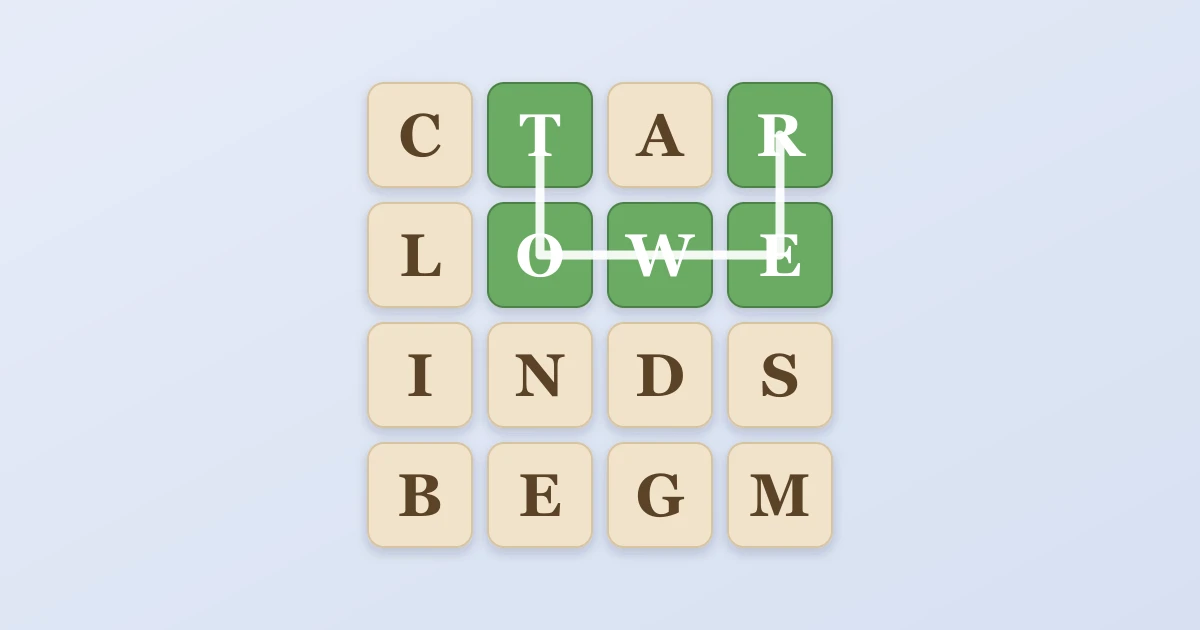
- You find words by connecting adjacent letters: horizontally, vertically, or diagonally. Each die can be used once per word, and the letters must form an unbroken chain of neighbours.
- Words must be at least 3 letters long.
- One die shows Qu and counts as both letters. QUIT is a four-letter word that uses three dice.
- Write down every word you find. When time is up, players compare lists.
How scoring works
You only score words no other player found. Duplicates cancel out, which rewards unusual words. Points scale with length:
| Word length | Points |
|---|---|
| 3 or 4 letters | 1 |
| 5 letters | 2 |
| 6 letters | 3 |
| 7 letters | 5 |
| 8 or more | 11 |
The adjacent-chain rule in practice
This is the part beginners get wrong. Every letter in your word must touch the next one, including diagonally. If you spot C-A-T, the A must be a neighbour of the C and the T a neighbour of the A. You can change direction freely, but you cannot jump across the board or reuse a die inside one word. Tracing the path with your eye or your finger before writing is how you avoid invalid words.
How we ran the numbers
The modern Boggle set has sixteen dice with fixed faces: AAEEGN, ABBJOO, ACHOPS, AFFKPS, AOOTTW, CIMOTU, DEILRX, DELRVY, DISTTY, EEGHNW, EEINSU, EHRTVW, EIOSST, ELRTTY, HIMNQU, HLNNRZ. Those aren't the dice every Boggle box has shipped: the set changed in 1987, and what the redesign actually did to the game is its own story. We shuffled the dice into the sixteen positions, rolled each one, and repeated that 100,000 times.
Each board was solved exhaustively against our definitions master, the 187,000-entry dictionary behind Pairdle Slide, Pairdle Hunt and Word Slots, with our moderation blocklist removed. That is a Scrabble-sized list, so it credits words like TAE and OES that no family game night would accept. To keep it honest we also tracked a second count using only the roughly 20,000 words we flag as everyday in our word pipeline. Where I say "everyday words" below, that is the list I mean. Three-letter words are counted separately, because that tier does not cover them.
How many words are actually on a board?
More than you will ever find.
| All valid words | Everyday words (4+ letters) | |
|---|---|---|
| Average board | 103 | 22 |
| Median board | 95 | 19 |
| A poor board (10th percentile) | 45 | 6 |
| A rich board (90th percentile) | 172 | 42 |
| Best board we rolled | 494 | 221 |
Only 0.2% of boards held fewer than ten valid words, and 18 boards out of 100,000 held none. One of them was S J T L / R N C N / S G C M / W V L S, which is what happens when you roll fifteen consonants.
The average board's full word list is worth about 147 points if you find everything, but the everyday-word list is worth about 70. A strong player at a kitchen table finds a fraction of that. The point is not that you should find 100 words. It is that the board is never the problem. Your eyes are.
Short words dominate, and that is fine
| Word length | Share of all valid words | Average per board |
|---|---|---|
| 3 letters | 37.8% | 39 |
| 4 letters | 35.5% | 37 |
| 5 letters | 17.8% | 18 |
| 6 letters | 6.6% | 7 |
| 7 letters | 1.8% | 1.8 |
| 8 or more | 0.4% | 0.4 |
Nearly three quarters of everything on a typical board is three or four letters long. The old advice to "skip the three-letter words" is only half right. They are worth one point each and they get duplicated, but they are also the fastest points on the board, and as you will see below, most of the longer words are built from them.
How often is a long word even there? A five-letter word exists on 98.8% of boards, a six-letter word on 88.2%, a seven-letter word on 56.9%, and an eight-letter word on just 23.2%. So on four boards in ten there is no five-point word to be had at all, and on three in four there is no eleven-pointer. Spending your last minute hunting an eight-letter word is a bet that usually cannot pay off. Hunting a six-letter word is a bet that usually can.
The words to check on every board
Boggle dice are heavy on E, T, S, N, A and O, so the same words keep turning up. These are the words that appeared on the largest share of the 100,000 boards. If you learn to see them at a glance, you have a fast opening on almost any grid.
Three-letter words (share of boards where the word exists): TOE 19%, TEE 19%, TEN 18%, NET 18%, TEA 18%, SET 17%, ATE 17%, EAT 17%, TIE 16%, THE 15%, ONE 14%, SEE 14%. The Scrabble list also puts TES, ETA, TAE, HET, ETH and OES in that top tier. They are valid in tournament play and useless at a family table, which is exactly the argument you will have.
Four-letter everyday words: TEEN 6.4%, NOTE 6.0%, TENT 5.9%, TONE 5.8%, TOES 5.6%, TEST 5.5%, NETS 5.3%, TENS 5.2%, NEAT 5.1%, NEST 5.1%, TOTE 5.1%, SENT 5.0%, SEAT 4.9%, EATS 4.7%, TREE 4.6%, TORE 4.6%, TIES 4.6%, HEAT 4.5%.
Five-letter everyday words: EATEN, TENSE, TEETH, TEASE, TEENS, NOTES, EATER, TENTS, RESET, TONES, STONE, ONSET, SHEET, STEER, ENTER, TREES, TASTE, TENTH, STATE, TENOR. Each of these sits on roughly 1.4% to 1.9% of boards, which sounds small until you notice they are all made of the same six letters.
Six-letter everyday words: STEREO, TESTER, TENETS, ESTATE, SENATE, STREET, HEATER, EASTER, ATTEST, ROTATE, ENTERS, EATERS.
Seven-letter everyday words: THEATER, REQUEST, EASTERN, THEATRE, ENTREES, NITRATE, QUIETER, TENANTS, STREETS, RETREAT, ATHLETE, EARNEST, NEAREST, TOASTER.
Read that list again and a pattern jumps out. E, T, S, N, A, R, O. If your board has those letters touching, you are looking at TEEN, TENSE, TENETS and EASTERN in sequence. This is why the fastest players do not search for words. They search for that cluster and then read words off it.
The pairs that matter, and the one that does not
This is the section I most wanted to write, because our own guide used to tell you to hunt for -ING.
First, the pairs that appear most often inside the words you can actually form. Across all 10 million words the solver found, the most frequent adjacent letter pairs were TE, ES, RE, ER, ET, SE, AT, EN, EE, NE, IN, TA, AR, EA and LE. Restrict it to everyday words and the order barely moves: TE, RE, AT, ES, SE, ET, EA, EE, EN, AR, NE, ER. If you have read our piece on the most common letter pairs in English, none of that will surprise you. Boggle is English with the letter frequencies turned up.
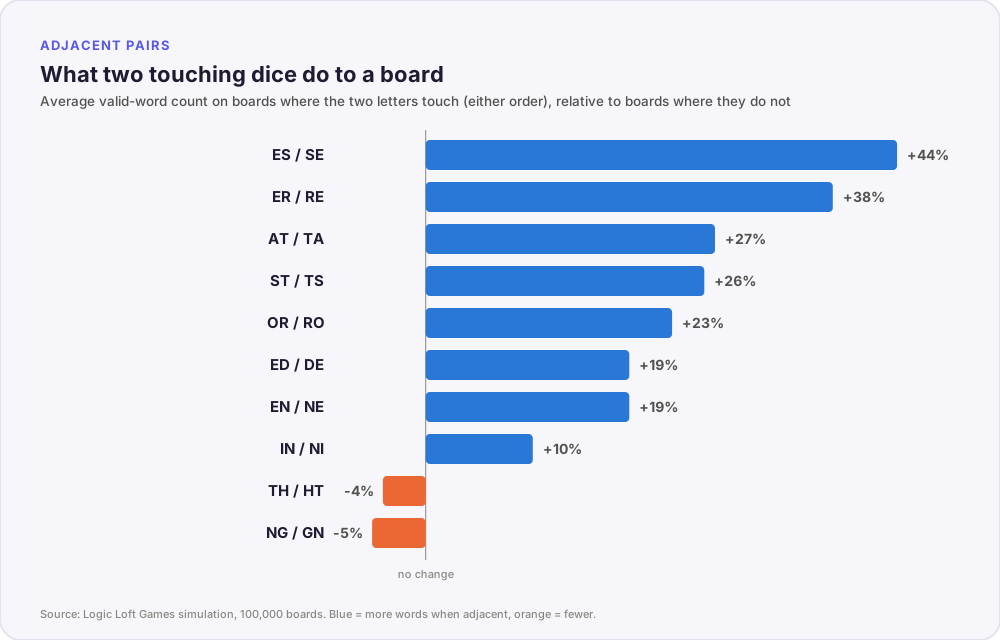
The more useful question is what a pair does to a board when the two dice happen to land next to each other. Here is the average number of valid words on boards where the pair is adjacent, against boards where it is not.
| Adjacent pair (either order) | Words when adjacent | Words when not | Lift | Share of boards |
|---|---|---|---|---|
| ES / SE | 127 | 88 | +44% | 38% |
| ER / RE | 126 | 92 | +38% | 32% |
| ST / TS | 120 | 95 | +26% | 33% |
| AT / TA | 120 | 95 | +27% | 34% |
| OR / RO | 120 | 97 | +23% | 24% |
| ED / DE | 118 | 99 | +19% | 22% |
| EN / NE | 115 | 96 | +19% | 37% |
| IN / NI | 110 | 101 | +10% | 24% |
| TH / HT | 100 | 104 | none | 29% |
| NG / GN | 98 | 103 | none | 8% |
Two findings changed how I play.
E-S and E-R touching is the single best thing that can happen to a board. An adjacent E and S lifts the word count by 44%, an adjacent E and R by 38%. When you see either pair, work outward from it before you do anything else. Every -ES plural, every -ER agent noun, and a large share of the five- and six-letter words on the board route through those two dice.
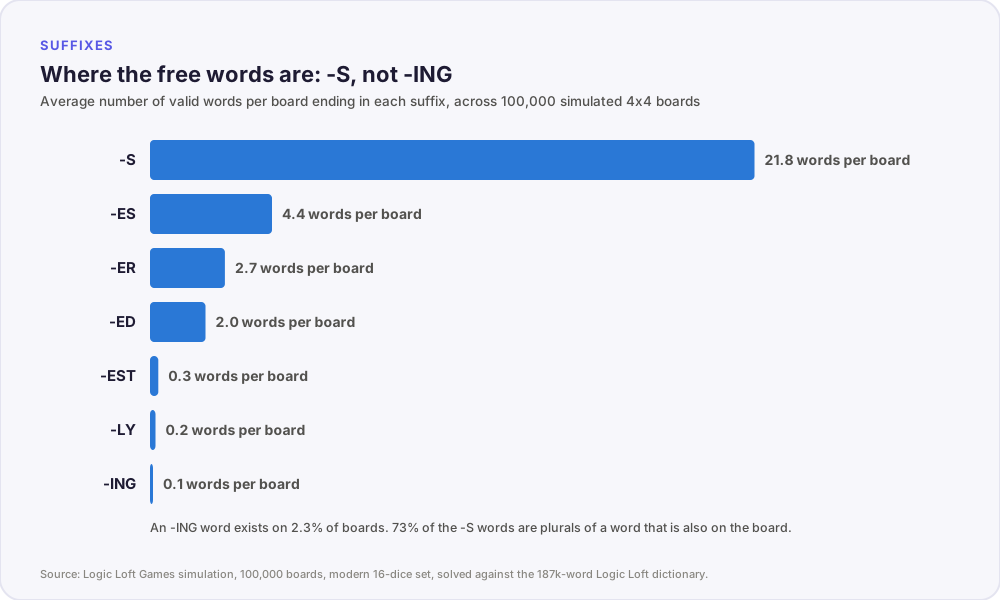
-ING is a myth on a 4x4 board. An I, N and G chain exists on 2.5% of boards. An -ING word of any kind exists on 2.3%. The average board contains 0.1 of them. The reason is the dice: G appears on only two of the sixteen, so it shows up on fewer than a third of boards, and it then has to land beside an N that is beside an I. Our old advice to "scan for an adjacent -ING cluster" was asking you to spend clock on something that almost never exists. Delete it from your routine. The same goes for T-H, which touches on 29% of boards and, to my surprise, adds nothing on average.
What replaces -ING is -S. The average board holds 21.8 words ending in S, and 73% of those are plurals of a word that is also on the board. That is about 16 words per board you get for free by asking "is there an S next to the last letter?" every time you write a word down. -ER adds 2.7 words per board on average and exists on 31% of boards. -ED adds 2.0 and exists on 21%. -EST and -LY are rounding errors. So the suffix routine, in order of payoff, is S, then ES, then ER, then ED, and then stop. This is the same logic as our prefixes and suffixes guide, just with the numbers attached.
Which letters make or break a board
Comparing boards that contain a letter against boards that do not gives a clean picture of what to celebrate and what to shrug at when the dice settle.
| Letter | Boards containing it | Average words with it | Without it |
|---|---|---|---|
| E | 88% | 107 | 75 |
| S | 68% | 113 | 82 |
| A | 68% | 111 | 86 |
| R | 60% | 111 | 92 |
| T | 83% | 105 | 94 |
| O | 74% | 106 | 95 |
| Qu | 17% | 89 | 106 |
| V, F, Y, W | 30% to 42% | 93 to 97 | 106 to 108 |
| J, X, Z | 17% | 85 | 107 |
S is the letter you want. A board with no S averages 82 words. One S lifts it to 110. Two lifts it to 120, and 20% of boards have two. E is the letter you need: a board without an E averages 75 words, and boards with two or three E's average about 112. J, X and Z each knock a fifth off the board's potential just by being present, because they occupy a die that could have been a vowel.
Vowel count has a sweet spot. Boards with five to seven vowels out of sixteen average 108 to 115 words. Three vowels averages 77. Nine averages 97, and eleven averages 64. Too many vowels is as bad as too few, and you can tell which kind of board you have in the first two seconds.
Do the dice favour some letters?
I assumed Boggle's dice were weighted toward the letters that make the most words. That is half true, and the half that is false is the interesting part.
The sixteen dice have 96 faces between them. Count the faces and you get the letter distribution a roll can produce: E has 11 faces, T 9, O 7, A, I, N and S 6 each, H and R 5, L 4, D, U, W and Y 3, B, C, F, G, M, P and V 2, and J, K, Qu, X and Z one face apiece. Line that up against how often each letter appears in written English and the two curves sit almost on top of each other.
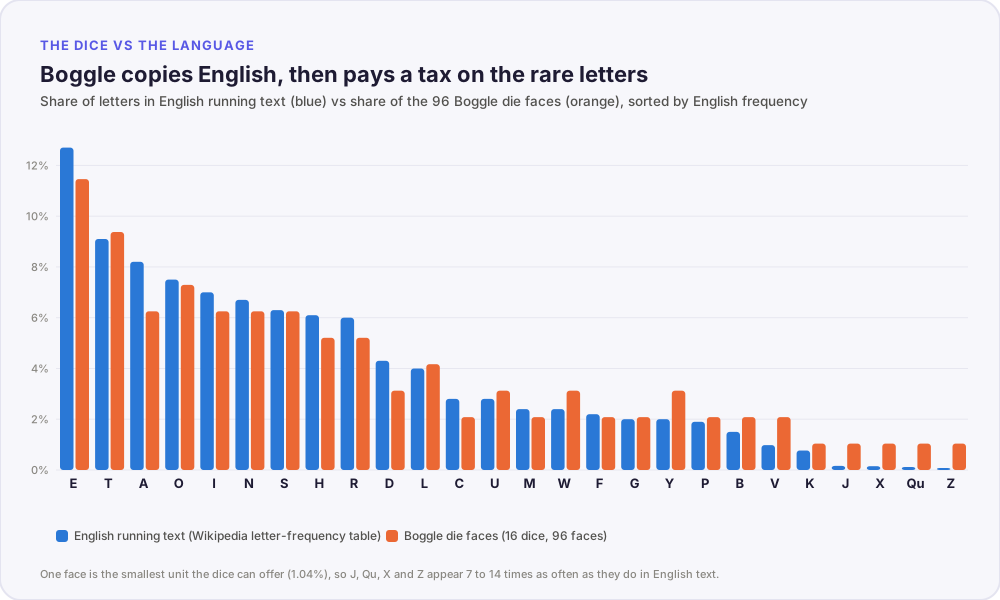
| Letter | Share of English text | Share of Boggle faces | Boggle relative to English |
|---|---|---|---|
| E | 12.7% | 11.5% | 0.9x |
| T | 9.1% | 9.4% | 1.0x |
| S | 6.3% | 6.3% | 1.0x |
| A | 8.2% | 6.3% | 0.8x |
| D | 4.3% | 3.1% | 0.7x |
| C | 2.8% | 2.1% | 0.7x |
| Y | 2.0% | 3.1% | 1.6x |
| V | 1.0% | 2.1% | 2.1x |
| J | 0.16% | 1.04% | 6.5x |
| X | 0.15% | 1.04% | 6.9x |
| Qu | 0.12% | 1.04% | 8.7x |
| Z | 0.07% | 1.04% | 14x |
For the letters that matter most, the dice are a faithful copy of the language. E, T, O, I, N and S are all within about ten percent of their English rate. The E-S and E-R advantages from earlier in this article are not something the dice manufacture. They are English itself, showing through. The dice do not favour common letters beyond what the language already does.
Where the dice diverge is at the bottom of the alphabet, and the reason is mechanical. One face is the smallest unit a set of dice can offer, and one face out of 96 is 1.04%. Z appears in English text at 0.07%, so a single Z face over-supplies it fourteen times. J, X and Qu are over-supplied six to nine times. V gets two faces and is doubled. The rare letters are on the dice because leaving them off entirely would make words like QUIZ, JOKE and ZERO impossible, but including them at all makes them far more common on a board than in a book. That is the tax you pay for having them.
The other direction is quieter. A, D and C are the most under-supplied common letters, each about a quarter below their English rate, and that is where the space for the rare letters came from. If you ever feel that a board is short of A's, you are right on average: the dice give you one A per board where English would give you 1.3.
The comparison uses the running-text frequencies from Wikipedia's letter frequency table. Dictionary headword frequencies differ a little (fewer H's and T's, more C's and S's), but the shape of the result is the same either way.
The Qu die
The Qu die lands face-up on about one board in six, and when it does there is at least one Qu word to be found 72% of the time, with about five Qu words on average. Overall, 12% of boards have any Qu word at all.
The everyday Qu words that turn up most often are QUIT, QUOTE, QUEST, QUAD, QUIET, QUEEN, QUITE, QUOTA, QUID, QUART and SQUAT. Notice that they are all four or five letters. QUIT is worth one point and QUEST two, so the Qu die is not a jackpot. It is a modest bonus that most players ignore out of habit. If you want to know what happens when the U is missing, our words with Q but no U piece covers it, but on a Boggle board that never comes up: the die gives you the U for free.
The best board we rolled
Out of 100,000, this one scored highest. Try it before you read on.
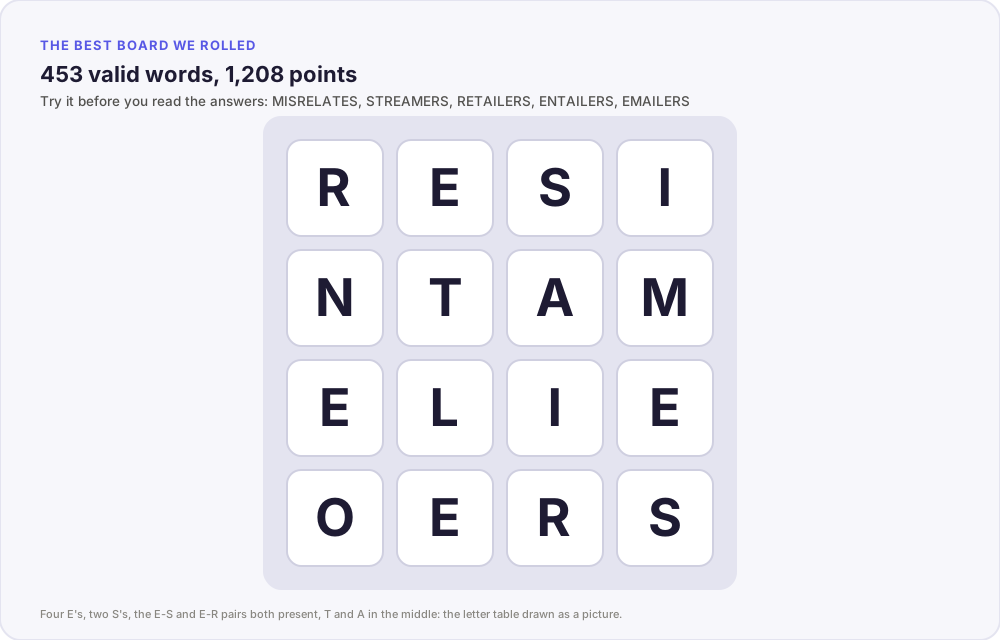
It holds 453 valid words worth 1,208 points, including MISRELATES, STREAMERS, RETAILERS, ENTAILERS and EMAILERS. Look at what it is made of: four E's, two S's, the R-E and E-S pairs both present, T and A in the middle. It is the pattern from the letter table drawn as a picture.
Show all 453 words on this board
The list is sorted longest first. 114 of the 453 are everyday words; the rest are the Scrabble-dictionary tail (TAE, OES and friends) that a solver credits and a kitchen table would not.
The board with the most words rather than the most points was S I A P / M T R V / A A E I / L G S H, with 494 words, including PRIMATES, PRIVATES and PARIETAL. Same idea: six vowels, an S in a corner and another on the bottom edge.
What this means for how you play
Put the numbers together and a three-minute plan falls out of them.
- First five seconds: read the dice, not the words. Count the E's and S's. Find the E-S and E-R pairs if they exist. You now know whether this is an 80-word board or a 130-word board, and where its centre of gravity is.
- First minute: harvest the cluster. Work outward from the E-S or E-R pair. Write TEN, NET, TEE, TOE, SET, and their four-letter extensions TEEN, TENT, TONE, NOTE, NEST, SENT. On most boards this is a dozen words in under a minute.
- Every word you write, check for an S. Sixteen free words per board hide in plurals. Then check for ER and ED. Do not check for ING.
- Second minute: extend to five and six letters. Six-letter words exist on 88% of boards and are worth three points. TENSE, STONE, ONSET, TEETH, STREET, ESTATE, SENATE are the shapes to look for.
- Last thirty seconds: one shot at seven. A seven-letter word exists on 57% of boards. Try to extend your best six-letter word by one die. If it is not there, it is not there.
- Reorient constantly. Words run in any direction, so a string that looks backwards or diagonal is just as valid. That flexible eye is the same skill behind how anagrams work.
If you want to practise on a fresh board, our printable Boggle board generator rolls one from the real dice, prints it with a word sheet, and reveals every word on it when the timer runs out. And if a word you were sure of never seems to appear, it may be one the dice cannot spell at all: the full list is in Why Boggle Hates Coffee, Pizza and the Bible.
Common mistakes
- Non-adjacent words. Still the most frequent error. Double-check that the chain touches at every step.
- Reusing a die. Each die counts once per word. ESSES needs three different S dice and two E's.
- Hunting for -ING. It is on one board in forty.
- Ignoring plurals. They are a third of the words on the board.
- Tunnel vision on one corner. Sweep the whole grid. The best board above hides EMAILERS across three rows.
Why Boggle makes you a better word-gamer
Of all the word games, Boggle is the best trainer for raw speed. The clock is short and every word counts, so it forces you to recognise letter patterns instantly rather than reasoning them out, which is exactly the instinct that pays off in Scrabble, Wordle and anagram puzzles. Now you also know which patterns to train: the E-T-S-N-A-R cluster, the S on the end, and the ability to write off a J in the first two seconds. Boggle sits right next to the word search genre too, and our roundup of the best word search games covers the untimed cousins.
If you like the grid-hunting part of Boggle without the timer, Pairdle Hunt is our version of the same skill on a 6x6 board with no clock and a persistent grid, and a daily round of Pairdle keeps the quick word-spotting instinct sharp between games.
Related articles
How to Use a Word Unscrambler Without Spoiling the Puzzle
A word unscrambler will hand you 348 words you did not ask for. The skill is narrowing it to the six that fit, without spoiling the answer.
Boggle Got Easier in 1987. It Also Lost 735 Words.
Parker Brothers replaced every Boggle die in 1987 and never said why. We simulated 100,000 boards on both sets: more words per board, 735 words lost.
How to Play Klondike Solitaire: Rules, One Deal, Tips Tested
The rules of Klondike in plain words, one deal played move by move, and 50,000 computer games that measure how much each common strategy tip really helps.