
If you learned Boggle on a set from the 1970s or early 1980s, you were playing a different game from the one sold today. In 1987 Parker Brothers replaced all sixteen dice with a new letter distribution. There was no announcement, no note in the box, and as far as anyone has found, no explanation then or since. Most players never noticed. The dice look the same, the tray is the same, the timer is the same.
The two sets are not the same, and the difference is large enough to measure. This is the third piece in a series that started with a 100,000-board simulation of Boggle strategy and continued with the words the modern dice can never spell. Here we run both sets of dice through the same machinery and report what changed.
Two sets of sixteen dice
The classic faces are not printed anywhere official. They come from a 2013 post on the Bananagrammer blog, whose author bought a classic set on eBay, transcribed the wooden dice, and published both distributions side by side. Dan Lewis's Now I Know newsletter relied on the same transcription for its piece on the redesign, and the new set matches every other source we have, so we are treating both as accurate.
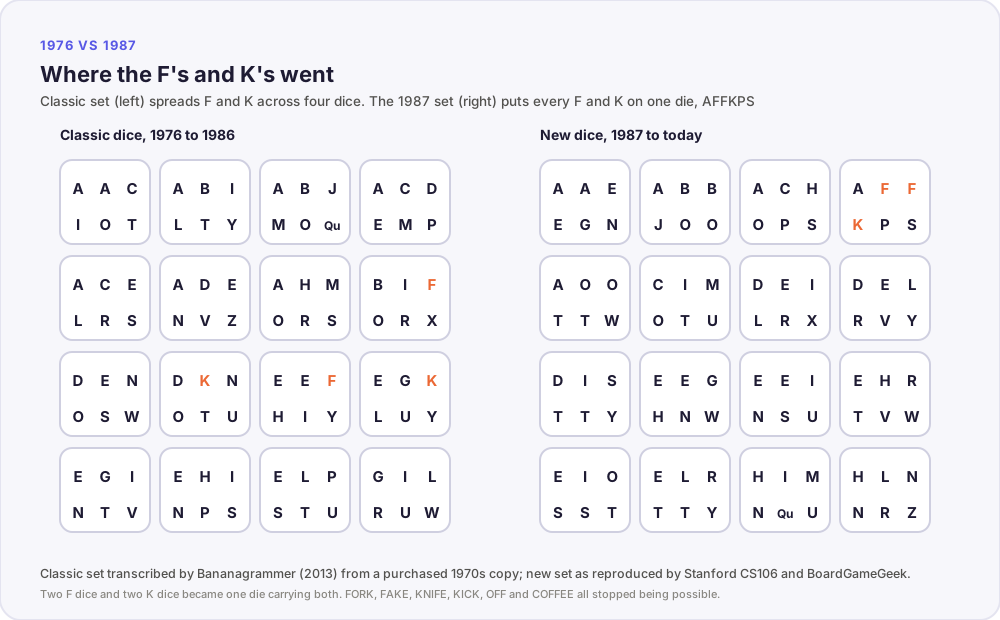
Counting the 96 faces in each set shows what the redesign actually did.
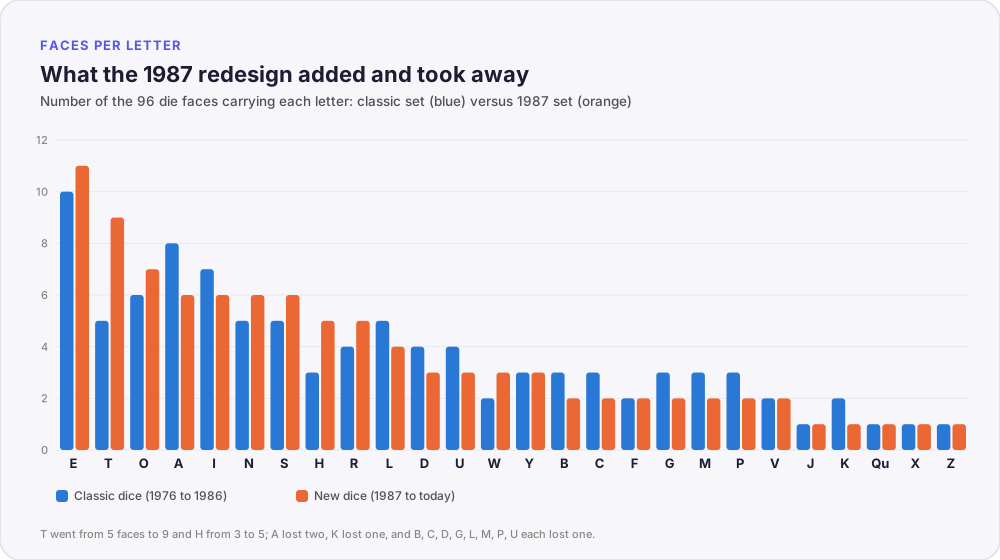
| Letter | Classic faces | New faces | Change |
|---|---|---|---|
| T | 5 | 9 | +4 |
| H | 3 | 5 | +2 |
| E | 10 | 11 | +1 |
| N, O, R, S, W | 5, 6, 4, 5, 2 | 6, 7, 5, 6, 3 | +1 each |
| A | 8 | 6 | -2 |
| B, C, D, G, L, M, P, U | 3, 3, 4, 3, 5, 3, 3, 4 | 2, 2, 3, 2, 4, 2, 2, 3 | -1 each |
| K | 2 | 1 | -1 |
| F, J, Qu, V, X, Y, Z | unchanged |
Eleven extra faces went to T, H, E, N, O, R, S and W. Eleven were taken from A, K and eight consonants. The obvious reading is that the new set was tuned toward the letters that carry English text. T and H in particular are the backbone of THE, THAT, THIS, WITH and THEN, and we showed in the strategy article that the modern dice track the frequency of written English very closely for the common letters. TH itself is one of the most common letter pairs in English, so loading extra faces onto T and H pays off across the whole board. The classic set did not: it had more A's than English wants and half as many T's.
There is one more structural change, and it is the one with teeth. In the classic set, F was on two dice (BIFORX and EEFHIY) and K was on two dice (DKNOTU and EGKLUY). In the new set every F and every K is on a single die, AFFKPS. We will come back to that.
What it did to the board
We rolled 100,000 boards with each set, using the same random seeds so the comparison is fair, and solved every board against our 187,000-word dictionary.
| Classic dice | New dice | Change | |
|---|---|---|---|
| Valid words per board (average) | 95 | 103 | +8% |
| Points available per board (average) | 131 | 147 | +12% |
| Everyday words of 4+ letters per board | 19 | 22 | +14% |
| Boards with a 7-letter word | 53% | 59% | |
| Boards with an 8-letter word | 18% | 23% | |
| Best board found, points | 984 | 1,208 | |
| Boards with fewer than 20 words | 1.4% | 1.1% |
So the redesign made Boggle easier, in the specific sense that any given roll holds more words, more long words and more points. Bananagrammer's much smaller 2013 simulation, 10,000 boards with a different solver and dictionary, found about 93 words on classic boards against 104 on new ones. Our numbers land within a couple of words of that on both sides, which is reassuring for two runs built independently.
Where does the gain come from? Mostly from T and H. A T is present on 60% of classic boards and 83% of new ones. An H is on 42% of classic boards and 60% of new ones. Given how much of the found-word list runs through TE, ET, TH and HE pairs, adding four T faces and two H faces lifts everything. The cost was paid mainly by A, which fell from a 78% presence to 68%, and by the consonants that lost a face each.
What it cost: 735 everyday words
Here is the part that never made it into the box.
In the earlier article we showed that the modern dice make 10,359 dictionary words impossible on any roll, 771 of them everyday words, because a board can never hold more copies of a letter than there are dice carrying it, and two letters that share their only die can never appear together. Running the same check on the classic set gives a very different picture.
| Classic dice | New dice | |
|---|---|---|
| Dictionary words no roll can produce | 884 | 10,359 |
| Everyday words no roll can produce | 39 | 771 |
| Letters that live on a single die | J, Qu, X, Z | B, F, J, K, Qu, X, Z |
| Letter pairs that can never share a board | J and Qu | J and B; K and F |
The classic set's 39 impossible everyday words are almost all double-Z words (BUZZ, JAZZ, PIZZA, PUZZLE, DIZZY, FUZZY, BLIZZARD), plus XEROX, FLUFF and a handful of fifteen-letter words nobody has ever found in three minutes. Everything else was fair game. The classic dice could spell BABY, BIBLE, HOBBY and RABBIT, because B was on three dice. They could spell OFF, OFFER, OFFICE, COFFEE, EFFORT and STAFF, because F was on two. They could spell KICK, KNOCK and KAYAK, because K was on two. And they could spell FORK, FAKE, FOLK, KNIFE, FLAKE and JOB, because F and K, and J and B, were not locked together.
The 1987 set removed 735 everyday words from the reachable vocabulary. It added three: MICROPROCESSOR, INTERDEPENDENCE and UNPRECEDENTEDLY, each of which needs fourteen or fifteen specific dice and has, we can say with some confidence, never been written down on a Boggle scorepad.
The lost words that sting most, roughly in order of how often people use them: OFF, DIFFERENT, JOB, OFFICE, PROBABLY, BABY, OFFICIAL, STUFF, STAFF, DIFFICULT, OFFER, EFFECT, SUBJECT, EFFORT, COFFEE, TRAFFIC, KICK, FAKE, FORK, KNIFE, BIBLE, HOBBY, RABBIT, BOMB.
The swear-filter theory
Why put every F and K on one die? Dan Lewis at Now I Know has a theory, and he is scrupulous about calling it one: the consolidation makes a particular four-letter expletive impossible to spell, and a family game company in the mid-1980s might have found that appealing. He looked for evidence, a memo, an interview, a press mention, and in a follow-up reports finding none. Bananagrammer offers a different reading: the redesign reduced the frequency of hard letters like K and G to make words easier to find, which our +8% supports.
The two explanations are not exclusive. A designer rebalancing the dice toward common letters has to put the rare consonants somewhere, and a single die that holds F, F, K, P, S and A is a tidy place to park two of them. Whether the expletive was the point or a happy accident, the arithmetic is the same. That one die carries 58 everyday words with it: every word that needs both an F and a K. If you have ever felt that FORK should be on the board and it never is, the 1987 redesign is why.
Which set is better?
It depends on what you want from the game.
The new set gives you more words, more long words, more points and a letter mix that reads like English. Games are livelier, and a beginner will find more on a typical board. Those are real improvements and they are probably why the redesign happened.
The classic set gives you a bigger legal vocabulary. Almost nothing an ordinary player would write down is structurally impossible, where the modern set rules out several of the hundred most common words in the language. Rounds are a little leaner, with about 8% fewer words to find, and A-heavy boards are more common. Every letter-distribution game hides a rulebook like this one; Scrabble's version is its 100-tile bag, covered in the Scrabble words that win games.
Two practical notes if you own an older copy. First, the classic set is the one with wooden dice and a yellow box in most markets, and it plays as a coherent design of its own. Second, never mix dice from the two sets. Each set is balanced as a whole, and a hybrid tray inherits the constraints of neither and the gaps of both.
Method
Both dice sets were rolled 100,000 times with identical seeds and solved exhaustively against the Logic Loft definitions master, the 187,000-entry dictionary behind Pairdle Slide, Pairdle Hunt and Word Slots, with our moderation blocklist removed. "Everyday words" are the roughly 20,000 four-plus-letter words we flag as common in our word pipeline. Impossible words were found by bipartite matching of each word's letters to distinct dice, ignoring adjacency, so those counts are the most generous possible reading for each set. The scripts and summary data are in our repository alongside the earlier articles, and the modern-set numbers here are the same runs reported there.
If you want to see the modern set in action, our board generator rolls boards from the 1987 dice and reveals every word they hold; the strategy article's best board is one of those rolls, and the impossible-words list for the modern dice is here. For the same grid-hunting instinct without a timer, Pairdle Hunt is our own take on it.
Related articles
How to Use a Word Unscrambler Without Spoiling the Puzzle
A word unscrambler will hand you 348 words you did not ask for. The skill is narrowing it to the six that fit, without spoiling the answer.
Why Boggle Hates Coffee, Pizza and the Bible
COFFEE, PIZZA, BIBLE, OFF, JOB, KICK and about 10,000 other words can never appear on a Boggle board. Three rules built into the dice explain every one.
The Most Common Letter Pairs in English (And What They Reveal About How We Read)
Which two-letter combinations appear most often in English? We analyzed thousands of six-letter words to find out, and the results explain why some Pairdle puzzles feel easier than others.