
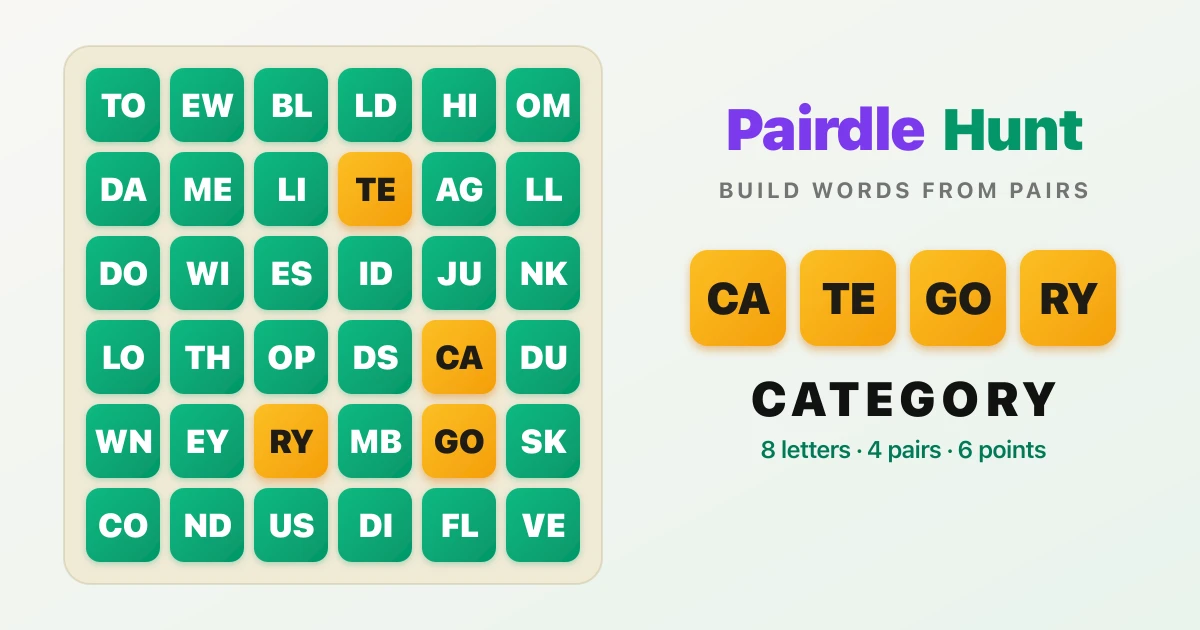
We've been building a new game, and I can finally talk about it. It's called Pairdle Hunt, and it's the third title in the Pairdle family: a daily word-hunt puzzle that's coming soon to the App Store and Google Play, free on iPhone and Android. If you haven't played the original yet, here's how it differs from Wordle.
If you like the "how many words can I find?" feeling of games like Spelling Bee but want a different way to build the words, Hunt was made for you. This post covers how it plays, how the scoring works, and then the part I enjoy most as the person who built it: how many words hide in a single board. A typical grid hides around 300 findable words, and the richest boards go past 600. Here is where those numbers come from.
What Makes Pairdle Hunt Different: You Build Words From Pairs
Most word-hunt games hand you a pile of single letters. Pairdle Hunt hands you letter pairs.
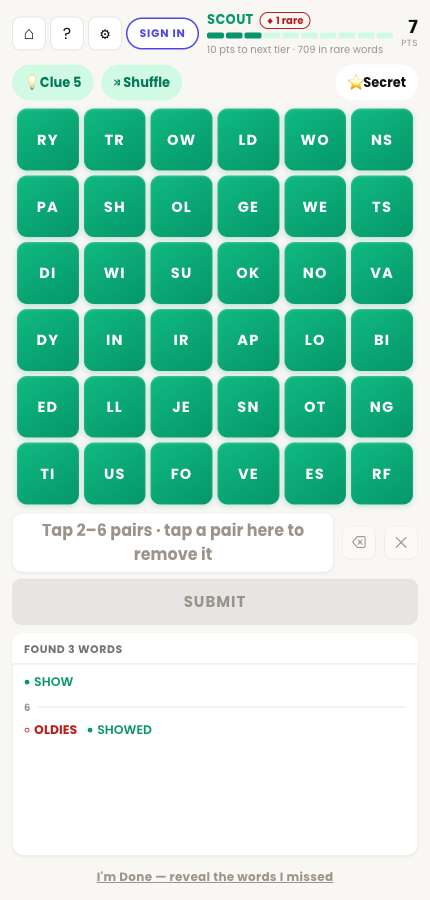
The board is a 6×6 grid of 36 tiles, and every tile is a two-letter chunk: SH, OW, ED, OL, DI, and so on. To build a word, you tap pairs in order and they snap together left to right. Tap SH, then OW, and you've spelled SHOW. Add ED and you've got SHOWED.
Using pairs instead of single letters changes how the game feels, the same way it does in the original Pairdle. You spend less time recalling words and more time seeing which two-letter chunks fit together.
It also produces a rule that trips up first-timers: every word you build is an even number of letters long. Because each tile is exactly two letters, valid words are 4, 6, 8, 10, or 12 letters (two to six pairs). There are no five-letter or seven-letter words in Hunt. Once that clicks, you start reading the board differently.
How to Play, Step by Step
The whole loop takes about 60 seconds to learn:
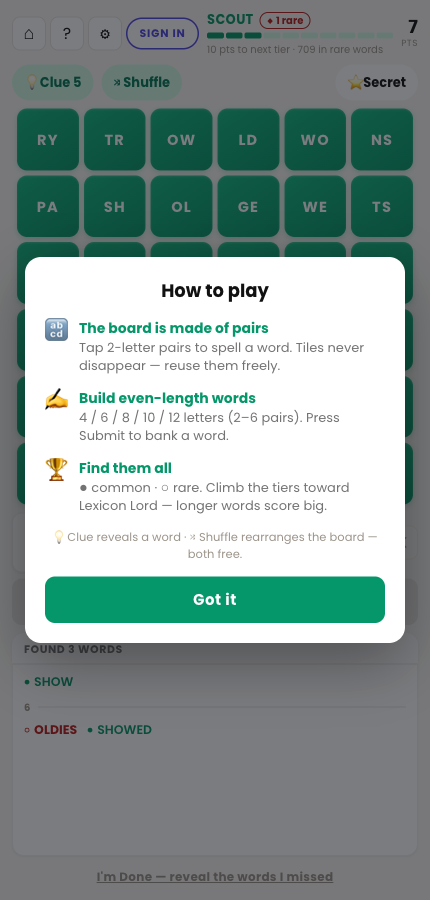
- Tap 2–6 pairs to spell a word. They assemble in the order you tap.
- Press Submit to bank it. Valid words drop into your Found list and add to your score.
- Keep hunting. There's no timer and no way to lose. Your score only goes up.
Two rules make Hunt easy on you:
- Tiles never disappear. Unlike games where letters get "used up," every pair stays on the board the whole time. You can reuse
OWin a dozen different words. You can even use the same pair twice inside a single word. - Shuffle is free and unlimited. Stuck? Rearrange the grid as many times as you like: it only moves the tiles around, it never changes which words are possible.
Scoring: Long Words Are Jackpots
You earn points for every valid word, and the points go up fast with length. Short words keep you moving. Long words are where most of the score comes from.
| Word length | Pairs used | Points |
|---|---|---|
| 4 letters | 2 pairs | 1 |
| 6 letters | 3 pairs | 3 |
| 8 letters | 4 pairs | 6 |
| 10 letters | 5 pairs | 15 |
| 12 letters | 6 pairs | 30 |
A single 12-letter word is worth as much as thirty 4-letter ones. We set it up that way on purpose. Players who slow down and look for long words get paid for it, and the short words still count.
As your score grows, you climb a ladder of seven tiers: from Scout at the very start, up through Tracker, Hunter, Wordsmith, Ranger, and Sage, to the top rank of Lexicon Lord. The ladder is measured against each board's supply of common words, so finding (nearly) every common word is a goal you can actually reach.
You also get five free clues per board. A clue points you at the shortest word you haven't found yet (showing its first pair and length), so you're never stuck for long. And every board hides a bonus word (finding it gives you an extra clue) plus a secret word easter egg that's just for bragging rights.
The Math: How Many Words Are Actually in There?
I kept coming back to this question while building the game. You look at 36 small tiles and wonder how much can be hiding in them. It is a lot more than it looks.
One rule decides it all. A word is findable on a board if, and only if, every two-letter chunk it's made of appears somewhere on the grid. Position doesn't matter. Reuse is allowed. So to spell an eight-letter word, you just need all four of its pairs to be somewhere among the 36 tiles.
Start with the raw counts. If you're building a 4-letter word, you're choosing 2 tiles in order from 36: that's 36 × 36 = 1,296 possible pairings. For a 6-letter word it's 36³ = 46,656 possible chains, and for a 12-letter word it's 36⁶ ≈ 2.2 billion possible combinations. Only a tiny fraction of those spell real words, but the space is so large that even a tiny fraction is a lot of words.
To turn that space into a real game, every board is checked against a full Scrabble dictionary. We list every valid English word (of length 4, 6, 8, 10, or 12) whose pairs are all on the board, and store it. Then we did that one thousand times and hand-filtered the boards, so no puzzle ships thin.
Here's what those 1,000 boards actually contain, measured:
| Per board | Typical (median) | Range |
|---|---|---|
| Total findable words | ~310 | 142 – 624 |
| "Common" everyday words | ~110 | 53 – 201 |
| Rarer / expert words | ~200 | 72 – 456 |
So the board in the screenshot above is not unusual. A grid that fits on one phone screen typically hides around 300 valid words. About a third are everyday words and the rest are for word nerds and Scrabble players. That is why most players never hit a "you found them all" wall. The top Lexicon Lord tier is something to aim for, and clearing a whole board is hard.
Two design details fall out of this math. First, we enforce that all 36 pairs on a board are distinct (no duplicate tiles) because findability depends only on the set of pairs on the board, so a repeated tile would be a wasted slot. Making all 36 different gets the most words out of a board (it raised the average count by around 40% when we switched to it). Second, we don't show a "found / total" counter. When a board hides 300 words, a "12 / 300" readout just makes you feel behind. Hunt shows your tier and your points going up instead.
A Few Tips Before You Start
- Look for verb endings and plurals. If
ED,ES,IN, orNGis on the board, it turns short words into longer, higher-scoring ones (SHOW→SHOWED). Our reference on which pairs are common in English overall lists the rest worth watching for. - Play short words to keep moving and long words for points. Bank easy 4-letter words to climb early tiers, then slow down and hunt 8- and 10-letter jackpots.
- Shuffle often. It doesn't change what's possible, but a new arrangement can make you spot a word you missed. It's free, so use it.
- Read in pairs, not letters. Stop scanning for single letters and look at which two-letter chunks you have to work with.
Coming Soon
Pairdle Hunt is in the final stretch before launch and will be coming soon to the App Store and Google Play. It comes from the team behind Pairdle and uses the same letter pairs.
If you want to try the Pairdle way of reading words while you wait, you can play Pairdle right now in your browser or on your phone, and if you're new to reading letters in pairs, our guide on how to get better at Pairdle covers the same mindset, or see it in action in one reader's pen-and-paper Pairdle solve diary. Keep an eye on this blog: I'll post here the day Hunt goes live.
Happy hunting.
- Tim
Related articles
How to Master Pairdle, Column by Column
I counted the letter pairs in every answer on the Pairdle 1.5 schedule. The three boxes are nothing alike, and the last one is by far the easiest to call.
The 10 Hardest Pairdle Puzzles, According to Player Data
We pulled real player results to rank the hardest Pairdle boards from the game's first months, before Pairdle 1.5, then dug into each day's letter-pair pool to work out why they hurt.
Pairdle Is More Than Guessing: A Pen-and-Paper Solve Diary
A reader's real-time diary of solving Pairdle with pen, paper, and three handwritten columns, including the note-taking mistake that cost her a one-guess win.