
Yahtzee is five dice, three rolls and thirteen boxes to fill. You can learn it in five minutes. What takes longer is knowing your chances: how often a large straight really comes, whether to keep a pair or a run, and whether the 35 point bonus is worth chasing.
We worked those out two ways. For a single turn, we calculated the exact chances over every possible roll, with no guessing. For whole games, we had five computer players play 20,000 solo games each, 100,000 in all, and compared how they did.
How to play Yahtzee
You need five dice and a scorecard for each player. Highest total of all five dice goes first, and play moves to the left.
- Roll all five dice.
- Keep any dice you like and roll the rest. You can do this twice, so a turn has up to three rolls. You may also pick up dice you kept earlier and roll them again.
- After your last roll, write a score in one empty box. You can stop early if you like what you have.
- Every box is used once. If your dice fit no open box, or none that you want to use, you must write a zero in one.
- The game ends after 13 turns, when the scorecard is full. Highest total wins. You can also play alone and try to beat your best score.
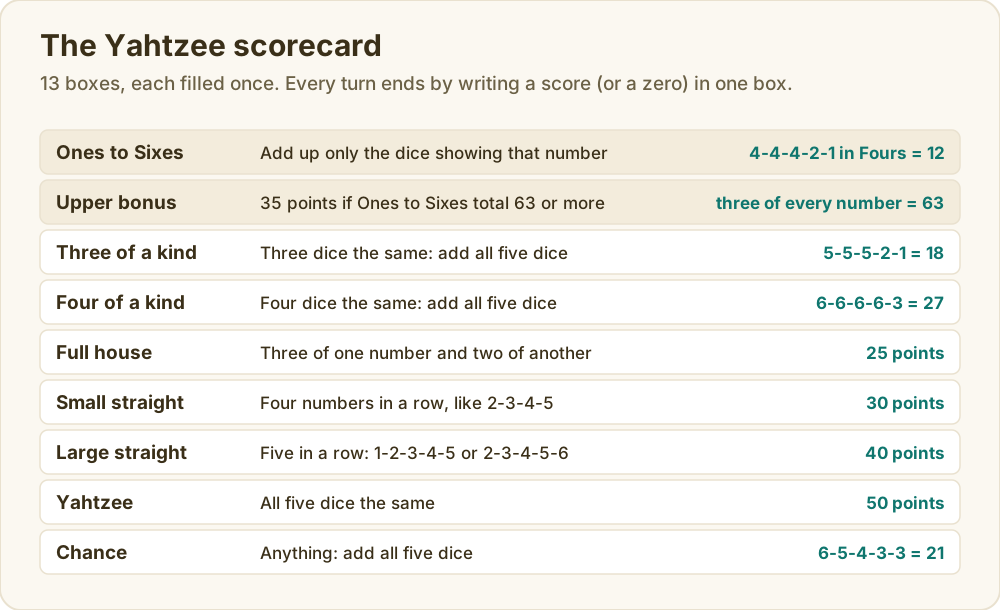
The scorecard has two halves. The upper half has a box for each number, Ones through Sixes. In the Fours box, for example, you add up only the dice showing 4. If those six boxes total 63 or more, you get a 35 point bonus. 63 is exactly three of every number: 3 + 6 + 9 + 12 + 15 + 18.
The lower half is for the poker-style hands: three of a kind, four of a kind, full house, small straight, large straight, Yahtzee (all five dice the same) and Chance, which takes any roll.
Extra Yahtzees. If you roll a second Yahtzee after already scoring 50 in the Yahtzee box, you get a 100 point bonus. You still fill a box with it. If the upper box for that number is open, it goes there. If not, it can go in any lower box, and in full house or a straight it scores as if it fit. If your Yahtzee box has a zero, there is no 100 point bonus.
Your real chances in one turn
The first thing to know is what each box costs. Here is the best possible chance of filling each lower box in one turn, when you keep the right dice every time and go all out for that box.
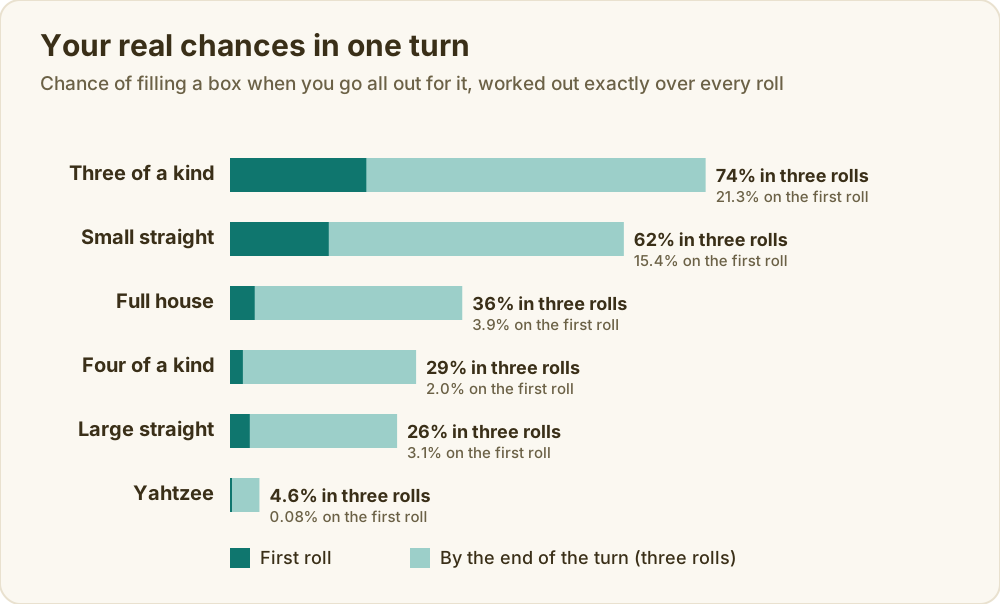
A Yahtzee on the first roll is 1 in 1,296, or 0.08%. With all three rolls and the best play it is 4.6%, about 1 turn in 22. A large straight comes 26% of the time, and a small straight 62%. Three of a kind, the easiest scoring hand, comes 74% of the time.
Those numbers explain the usual advice. When three of a kind is that easy, a weak roll is better put in Three of a Kind or Chance than in Yahtzee. A large straight is about one turn in four, so there is no need to give up on it in the first half of the game.
For the upper half, the number to know is three of a kind of a single number. Going all out for three or more of one face, you get it 35% of the time in one turn. That is why 63 is hard: you need to average three of each number, and you only hit three of a chosen number about one turn in three.
Which dice to keep
Most choices in Yahtzee come down to what to keep after the first roll. These four spots come up all the time. The chances are exact, with two rolls left.
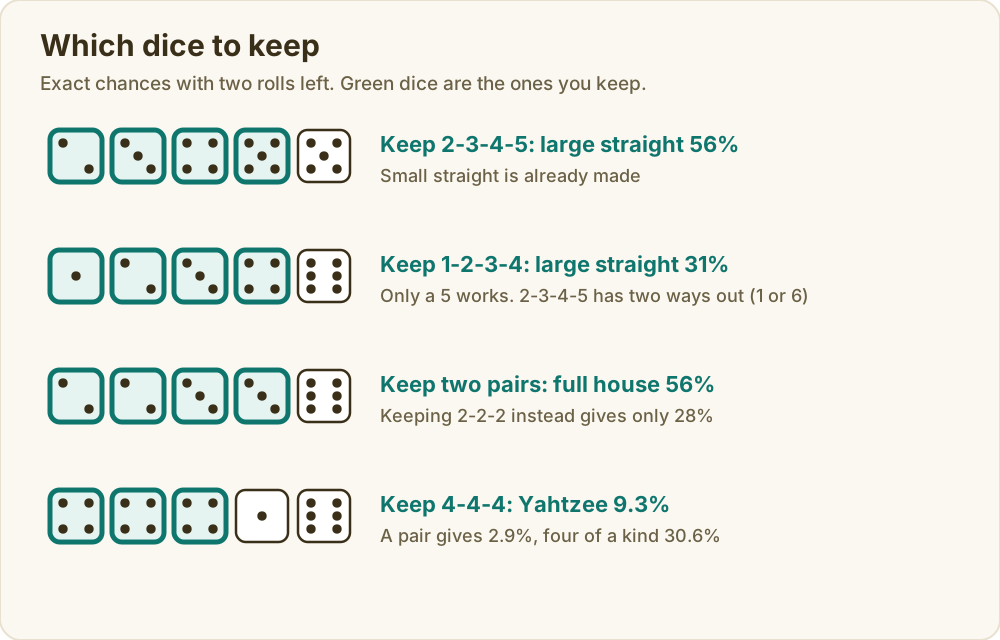
Open runs beat closed runs. 2-3-4-5 can become a large straight with a 1 or a 6, so it hits 56% of the time with two rolls. 1-2-3-4 needs a 5 and nothing else, so it hits only 31%. The same goes for 1-2-4-5, which needs a 3: 31%.
For a full house, keep two pairs. With 2-2-3-3 you need one die to be a 2 or a 3, and you get two tries: 56%. Keeping three of a kind instead and rolling two dice for a pair works only 28% of the time.
For a Yahtzee, three of a kind is the real start. Keeping three matching dice gives you a 9.3% chance. A pair gives 2.9%, and four matching dice give 31%.
How hard should you chase the bonus?
The 35 point bonus is the most argued-about part of the game. Take it too lightly and you throw away 35 points. Chase it too hard and you give up the big lower boxes.
To test this we built five computer players. Each one picks its dice and its box by working out the exact best play for the current turn. The only difference between them is how much extra value they give to scores at or above "par", three of each number, in the upper boxes. One ignores the bonus completely and one chases it with everything.
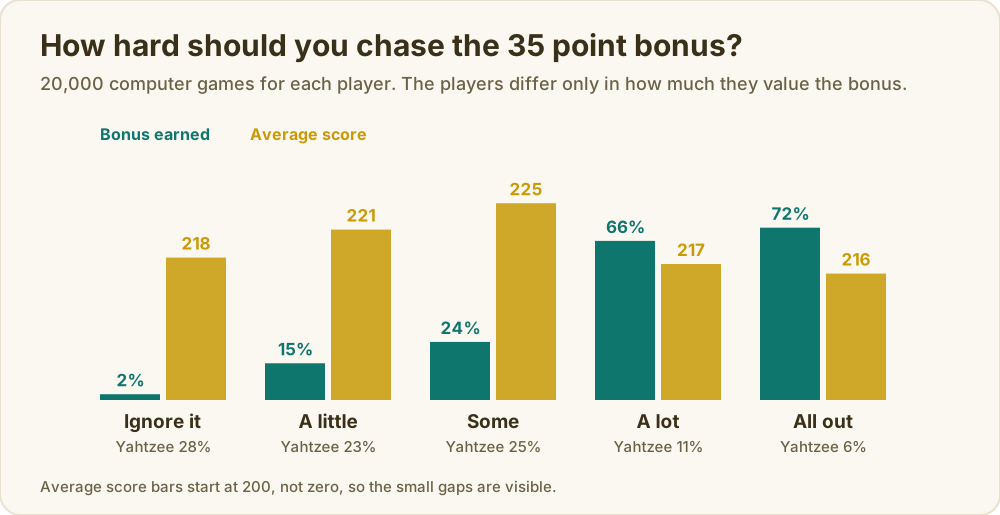
The player that ignored the bonus got it in only 2% of games. The player that chased it all out got it in 72% of games, and still had a lower average score: 216 against 225 for the best player, which chased the bonus "some" and got it 24% of the time.
The reason is in the Yahtzee column. The all out player got a Yahtzee in only 6% of games, against 23% to 28% for the three players that chased it least. To land three 6s for the upper box, it kept giving up on four of a kind, the straights and the Yahtzee itself. A Yahtzee is worth 50, more than the bonus, and a second one adds 100 more.
The best player in our test treated the bonus as something worth working toward, not something to buy at any price. In plain terms:
- Score three or more of a number in its upper box when you can. Those are the "par" scores the bonus needs.
- Do not throw away a large straight or a good four of a kind just to protect the bonus.
Our players only look one turn ahead. A perfect player, one that plans the whole game, scores more than any of them. The comparison still holds: chasing the bonus at any cost scored worse than a middle path.
What a game of Yahtzee scores
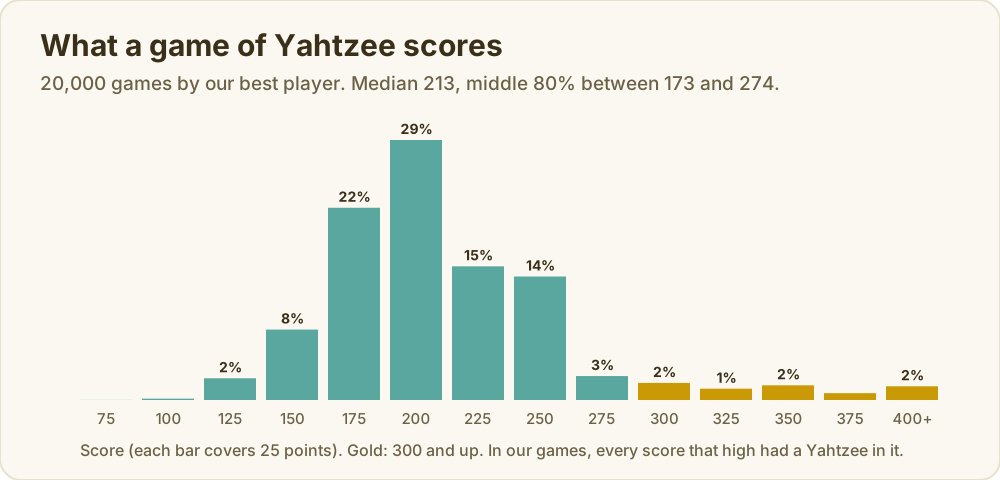
Our best player's median score was 213. The middle 80% of games landed between 173 and 274. About 7% of games reached 300 or more, and in our games every score that high had a Yahtzee in it. So if you are scoring around 200 to 250, you are playing a normal game. 300 needs luck.
The boxes our best player most often had to fill with a zero were Yahtzee (75% of games), four of a kind (33%) and large straight (17%). If you end a game with a zero in the Yahtzee box, that is the usual result, not a mistake.
Tips that come straight from the numbers
- A Yahtzee is a 4.6% shot in any one turn. Go for it when you start with three of a kind, not with a pair.
- Keep open-ended runs. 2-3-4-5 or 3-4-5-6 fill a large straight 56% of the time. 1-2-3-4 is only 31%.
- Keep two pairs for a full house, not three of a kind. 56% against 28%.
- Use Chance and Three of a Kind for bad rolls. Three of a kind comes 74% of the time, so it is a safe place for a high total.
- Aim for three of each number in the upper boxes, but do not give up the lower boxes for the bonus. The player that chased it hardest scored least.
- Zeros are part of the game. When you must take one, put it where you were least likely to score: Yahtzee late in the game, or Ones.
Where Yahtzee came from
Yahtzee was first sold in 1956 by Edwin S. Lowe, a New York toy maker. The story goes that he got the idea from a Canadian couple who played their own dice game on their yacht, which is where the name comes from. Lowe's company later became part of Milton Bradley, and the game is now made by Hasbro. Similar dice games such as Yacht and Yatzy are played around the world, with small differences in the scoring.
Frequently asked questions
How many times do you roll in Yahtzee? Up to three times per turn: one full roll, then two more where you choose which dice to roll again.
What are the odds of rolling a Yahtzee? 1 in 1,296 on a single roll of five dice. With all three rolls and the best play, 4.6% per turn.
How many dice do you use in Yahtzee? Five.
How do you get the upper bonus? Score 63 or more in Ones to Sixes. That is the same as three of every number, and it is worth 35 points.
What is a good Yahtzee score? Around 200 to 250 is a normal game. Our best computer player had a median of 213, and 300 or more came in about 7% of games.
Play Yahtzee now
Here is a full solo game to try the tips on. Press Roll, tap the dice you want to keep, and roll again up to twice. Then pick a box: the score each open box would get is shown on its button. The small number next to each box is your exact chance of filling it by the end of the turn from the dice you have now, keeping the best dice on every roll left, worked out the same way as the odds in this article. For Ones to Sixes it is the chance of three or more, the pace the 35 point bonus needs. Untick "Show my chances" to play without them. The game keeps your best score on this device.
If you like this kind of game
Yahtzee is a game of odds you can learn, like Minesweeper, where we also worked out when you are forced to guess. If you would rather play with letters than dice, Scrabble and Hangman reward the same habit of keeping the pieces that give you the most ways to score. For more games that reward clear thinking, see our list of brain training and logic games.
Related articles
How to Play Skyline Bounce: Flick and Climb 20 Towers
The official guide to Skyline Bounce for iPhone and Android: the flick, the safety floor, bank pockets, and all 20 towers from 12 to 180 floors.
Pairdle Hunt: How to Play and the Math of Hidden Words
Pairdle Hunt is Logic Loft's new word-hunt game, coming soon to iOS and Android. How to play, how scoring works, and how many words hide in one grid.
How to Solve a Crossword: A Mini Puzzle Solved Step by Step
Watch a five by five crossword get solved one pass at a time, see how many words really fit once you have three letters, and learn the clue tricks and the words that turn up most.