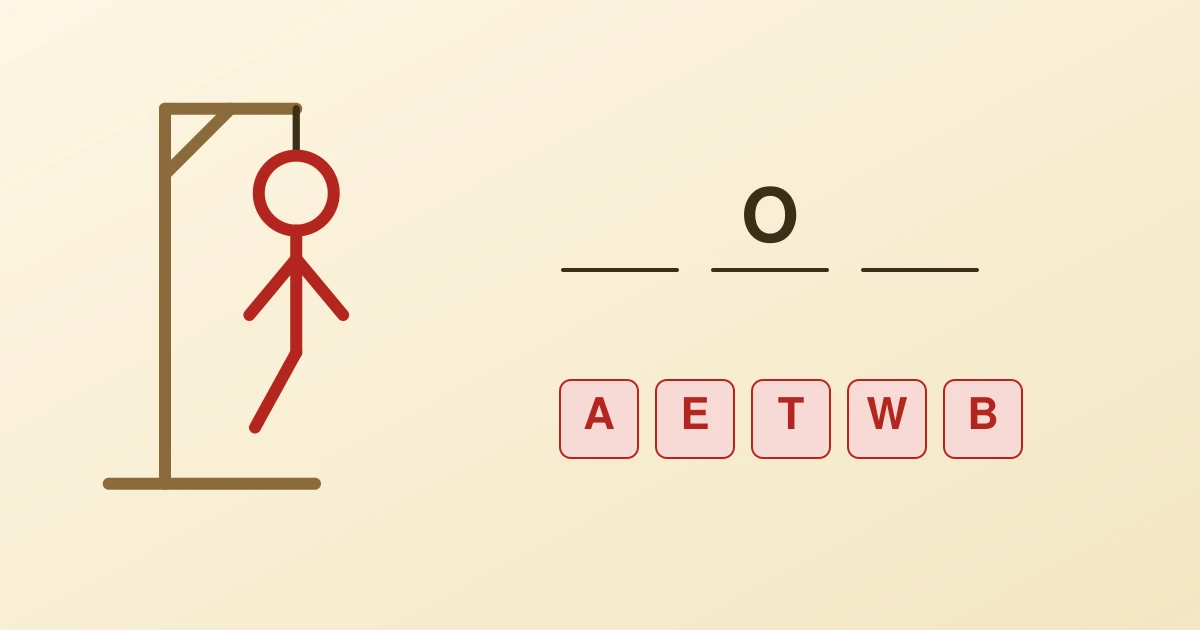
Ask anyone for the hardest word in Hangman and they will say JAZZ. It is a good pick. But when we ran every everyday English word through a computer guesser, JAZZ was not the hardest common word. MOM was. It took twelve wrong letters to find, twice the six a guesser is allowed.
This guide covers the rules, then what the numbers say about playing well: the best first letter for each word length, why short words are the dangerous ones, and the words to pick when it is your turn to set the puzzle.
How to play Hangman
Hangman needs two people, a pencil and paper.
- The setter thinks of a word and draws one blank line for each letter. A five letter word gets five blanks.
- The guesser calls out one letter at a time.
- If the letter is in the word, the setter writes it on every blank where it belongs. Guess A against BANANA and three A's appear at once.
- If the letter is not in the word, the setter writes it to one side, so nobody guesses it twice, and adds one part to the drawing of a hanged man.
- The guesser wins by filling in every blank, or by saying the whole word at any time. A wrong whole-word guess usually costs a body part too.
- The setter wins when the drawing is finished.
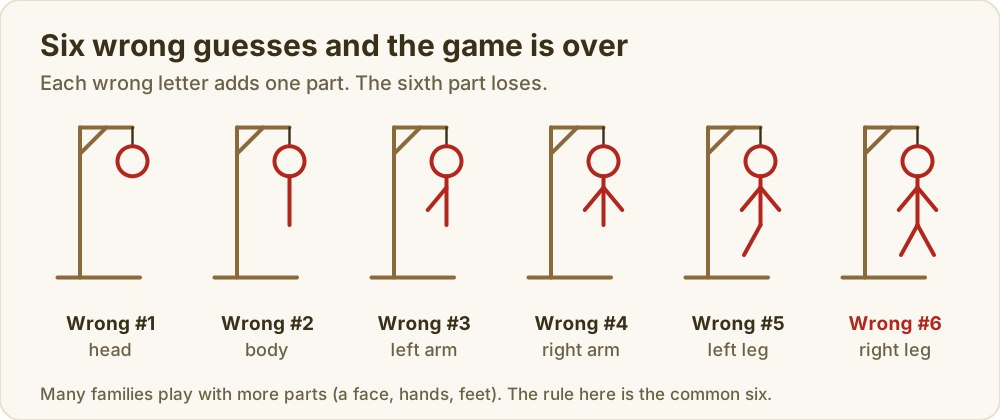
The usual drawing has six parts: head, body, two arms, two legs. That gives the guesser six wrong letters, and the sixth one loses. Plenty of families add a face, hands, feet or the gallows itself to allow more mistakes. Every number in this article uses the common six.
House rules worth agreeing before you start: whether names and places count, whether the setter tells you the topic, and whether plurals are allowed. All of them change how hard the game is.
A full game, guess by guess
Here is a real game played by the computer guesser described below. The hidden word is PIZZA. The last column shows how many everyday five letter words still fit the board after each guess.
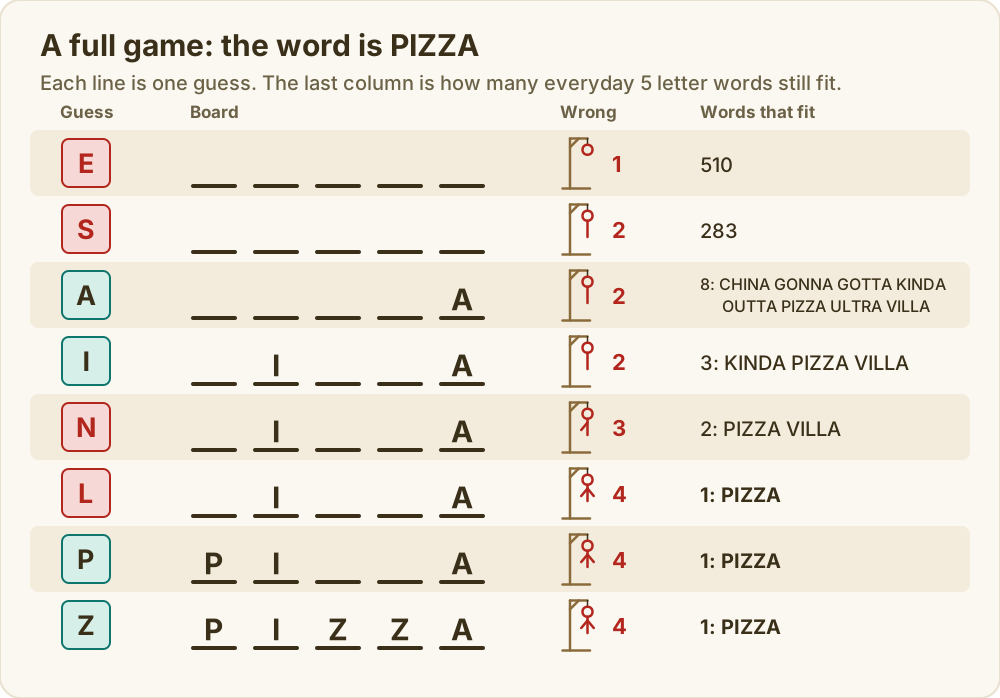
Watch what the A does. Before it, 283 words were possible. After it, a lone A at the end of the word leaves only eight: CHINA, GONNA, GOTTA, KINDA, OUTTA, PIZZA, ULTRA and VILLA. One right letter in the right place does more work than any number of lucky vowels. That is the whole skill of the game: every guess should be the letter that splits the words still in play, not the next letter on a list.
How we checked
We took the dictionary behind our own word games, kept every word of 3 to 12 letters that scores 4.0 or higher on the wordfreq word frequency scale (roughly, words you meet at least once in every 100,000 words of English), and removed anything offensive. That left 6,298 everyday words, the kind people actually choose when it is their turn to set the puzzle.
Then two computer guessers played every one of those words:
- The board reader knows the length of the word and the 6,298 everyday words. Each turn it guesses the letter that appears in the most words still possible. That is the same thing a good human player does by feel.
- The list caller calls E, T, A, O, I, N, S, H, R, D, L and so on, the famous order of the most common letters in English text, and never changes course.
Both get six wrong guesses. The script and its full output are saved with this post, so every number below can be checked.
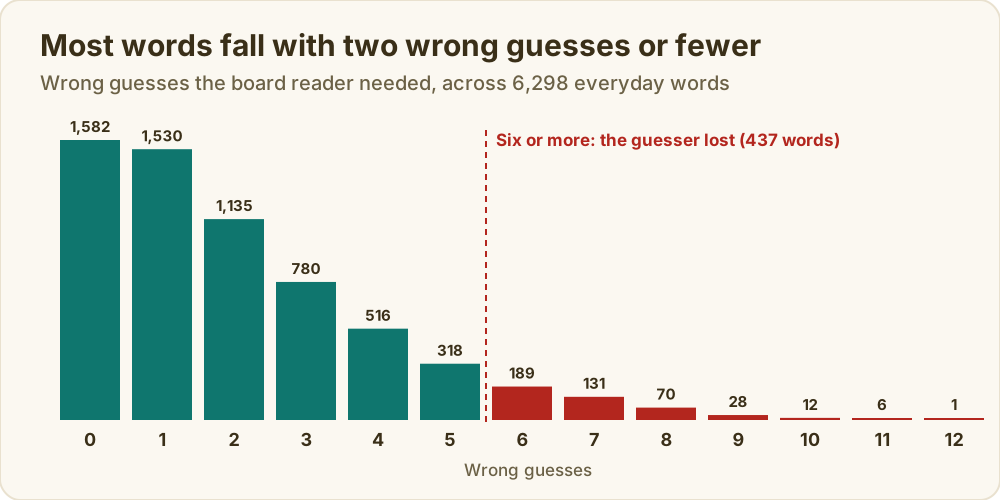
Almost half of all everyday words (3,112 of 6,298) fell with one wrong guess or none. The losses sit in a thin tail on the right, and every one of them is a word of six letters or fewer.
| Board reader | List caller | |
|---|---|---|
| Words won (of 6,298) | 93.1% | 10.1% |
| Average wrong guesses | 2.04 | 11.09 |
| Words solved with no wrong guess at all | 1,582 | 4 |
The list caller got through only four words without a miss: ATE, EAT, TEA and ATTENTION, which happen to be spelled entirely from its first letters. It is not a straw man. Calling letters in a fixed order is the strategy in a lot of Hangman advice. Its problem is that it ignores the board. Once you know the word is _ I _ _ A, the next most common letter in English does not matter. The letter that matters is the one that tells PIZZA from VILLA.
The best first letter depends on the length
Most advice says to start with E. For everyday words that is right more often than not, but not always, and the length of the word decides it.
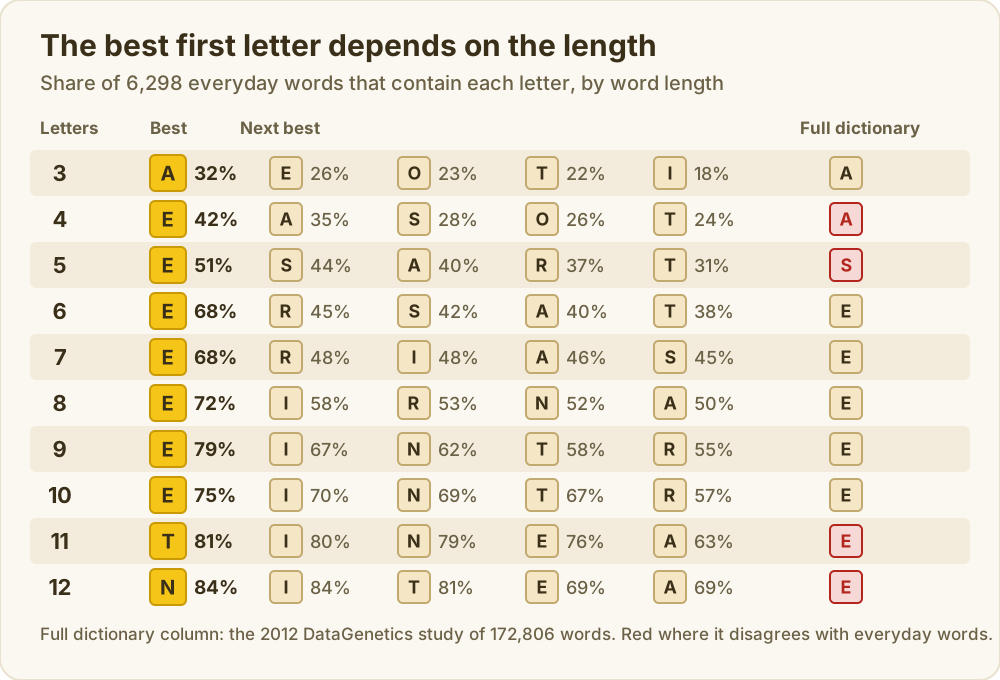
- Three letters: start with A. It is in 32% of three letter everyday words against 26% for E.
- Four to ten letters: start with E. At five letters E is in 51% of words, and by nine letters it is in 79%.
- Eleven letters: start with T. Twelve letters: start with N. Long words are packed with endings like TION and MENT, so T, I and N catch up with E and pass it.
The best known study of this, DataGenetics in 2012, used a 172,806 word dictionary and found A best up to four letters and S best at five. Our answers differ at four, five, eleven and twelve letters, and the reason is the word list. A full dictionary is crowded with plurals and rare words, which pushes S up. People setting a Hangman puzzle rarely pick an obscure plural, so for a real game the everyday list is the better guide.
Short words are where the guesser loses
Long words feel scary, but the board reader won every single word of seven letters or more. All 437 of its losses were words of three to six letters, and most were three or four. Jon McLoone at Wolfram saw the same pattern in 2010 with a bigger gallows and a 90,000 word dictionary. With the common six part gallows and everyday words, the gap is even starker.
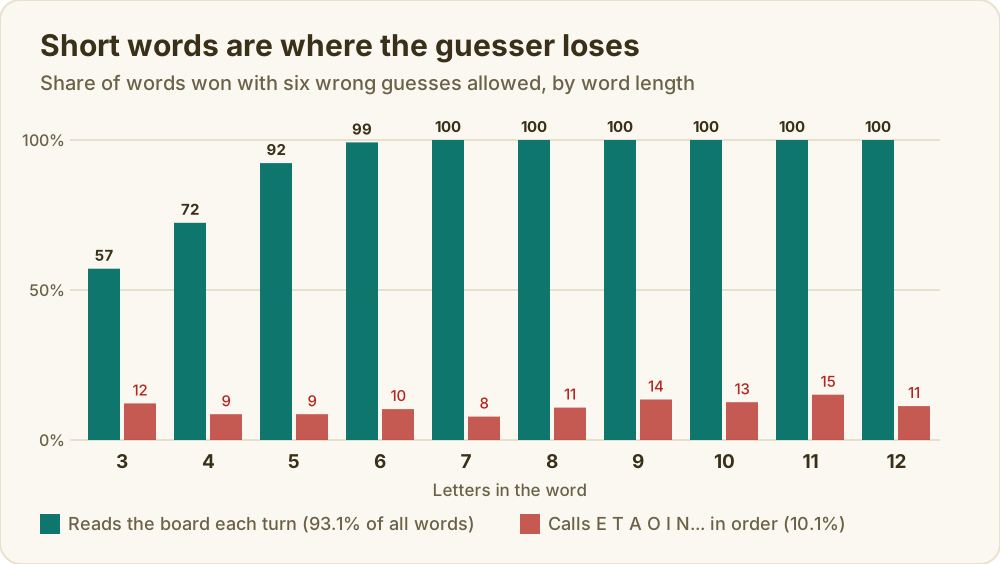
| Letters | Everyday words | Board reader wins | Average wrong guesses |
|---|---|---|---|
| 3 | 296 | 57.1% | 5.06 |
| 4 | 801 | 72.4% | 4.26 |
| 5 | 1,038 | 92.3% | 2.99 |
| 6 | 1,085 | 99.2% | 2.01 |
| 7 | 1,032 | 100% | 1.40 |
| 9 | 565 | 100% | 0.52 |
| 12 | 115 | 100% | 0.20 |
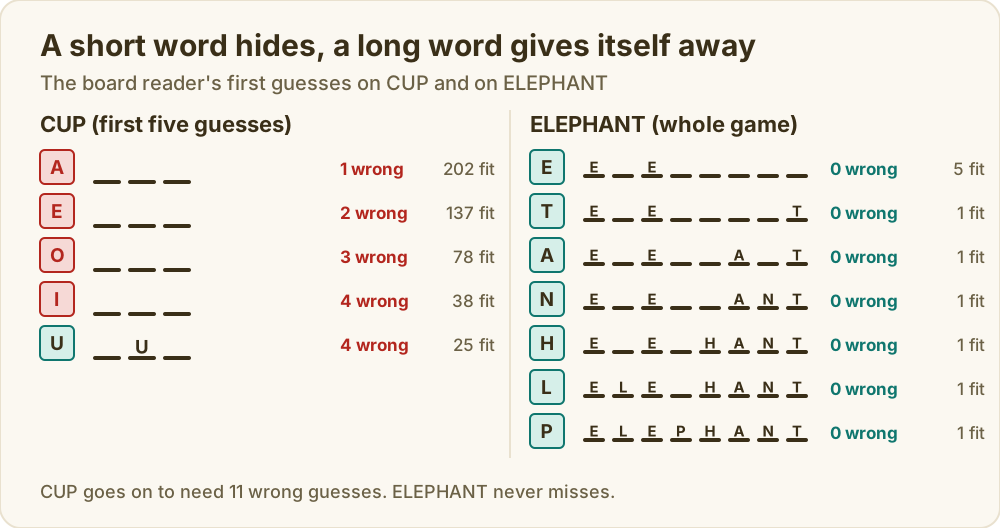
A long word gives away a lot with every hit. Guess E against ELEPHANT and two E's appear in a pattern that only five everyday words share. The guesser finished ELEPHANT without a single miss. A three letter word gives almost nothing. Even when you land a letter, you have filled one blank out of three and dozens of words still fit.
Why MOM is the hardest everyday word
Here is the guesser working on MOM. A misses. E misses. O lands in the middle. T misses. Now the board reads _ O _ with three body parts drawn, and 33 everyday words still fit.
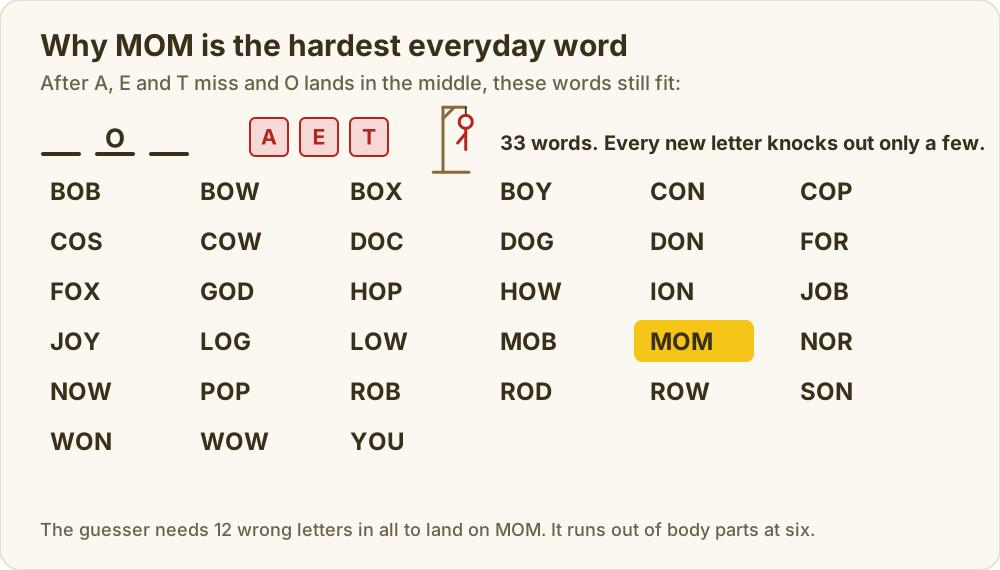
Every guess from here only knocks out a few. W removes BOW, COW, HOW, LOW, NOW, ROW, WON and WOW, and still misses. B, N, D, P, F, Y and S all miss in turn. By the end only LOG and MOM are left, which is a coin toss, and the guesser calls L first. That makes twelve wrong letters in all. With six allowed, it never comes close.
JAZZ is hard because of its rare letters. MOM is hard for a plainer reason: it is short, it has one vowel, and dozens of other words share its shape (BOB, POP, MOB, ROD, LOG), so no single guess can split them. The 2010 Wolfram study of Hangman words found JAZZ the hardest word at every gallows size it tried, from a 90,000 word dictionary. JAZZ is still hard against everyday words. It is just not the hardest. Counting everyday words only, the hardest dozen are:
| Word | Wrong guesses needed | Word | Wrong guesses needed |
|---|---|---|---|
| MOM | 12 | BIG | 10 |
| CUP | 11 | BILL | 10 |
| KILL | 11 | FIX | 10 |
| BIKE | 11 | JAZZ | 9 |
| BUZZ | 11 | FOX | 9 |
| LOG | 11 | YOU | 9 |
CUP is a nasty one for a different reason. A, E, O and I all miss before U lands, so the guesser has four body parts drawn before it has a single letter. JAZZ, for comparison, gives up its A on the second guess and then hides behind the J and the double Z: S, L, R, N, T, C, I and Y all miss before the guesser tries J.
Tips for the guesser
- Match your first letter to the length. A for three letters, E for four to ten, T or N for very long words.
- After the first hit, stop thinking about letters and start thinking about words. List the words that fit the board in your head, then pick the letter that appears in about half of them. That is all the board reader does, and it wins 93% of the time.
- Count the blanks in short words carefully. A three letter word with a vowel in the middle has dozens of answers. Go for the consonant that the most of them share, not the rarest one.
- Guess the whole word only when you are sure. A wrong full guess usually costs a part, and on a short word you cannot spare it.
Tips for the setter
- Pick a short word. A three letter word beat the board reader 43% of the time. A seven letter word never did.
- Pick a word with one vowel and a crowded pattern. MOM, CUP, BIG, FIX and LOG all hide among dozens of look-alikes.
- Repeated letters help you, but only in short words. BUZZ and KILL use the repeat to give away less. In a long word like BANANA, a repeat hands over three blanks at once.
- Avoid long words, however odd they look. RHYTHM has no A, E, I, O or U, and it still fell with only four wrong guesses.
Where Hangman came from
Nobody knows who invented it. The earliest written version usually cited is a slate game called Birds, Beasts, and Fishes in Alice Bertha Gomme's The Traditional Games of England, Scotland, and Ireland from 1894. One child wrote the first and last letters of an animal's name with crosses in between, and said whether it was a bird, a beast or a fish. There was no drawing. Players kept score in marks instead. The hanged man came later. Wikipedia's history of the game cites a 1902 Philadelphia Inquirer article describing a version with the hanging picture, played at children's parties.
Hangman also gave television one of its longest running shows. Merv Griffin wrote in his memoir that he came up with Wheel of Fortune after remembering the Hangman games he played with his sister on long car trips as a child.
Teachers who would rather not draw a gallows often swap in apples falling off a tree, or slices taken from a pie. The rules and the math stay the same.
Play Hangman now
Try what you just read. The game below picks a word from about 3,100 everyday English words and gives you the usual six wrong guesses. Choose short words if you want the hard game, or long words if you want to see how much a long word gives away. Under the board it shows how many words in its list still fit, which is exactly what the board reader counts. If you get stuck, you can ask the board reader for its pick once per word. When the game ends you get the word's meaning, and your wins and streak are kept on this device.
If you like this kind of puzzle
Hangman and Wordle are cousins. In Hangman you guess one letter at a time and learn whether it is in the word and where. In Wordle you guess whole words and learn about five letters at once. Our guide to how to play Wordle covers that side, and why Wordle hates the letter N uses the same kind of letter counting as this post. If you want a daily puzzle where you build the hidden word out of two letter tiles, try Pairdle, the word game we make.
Related articles
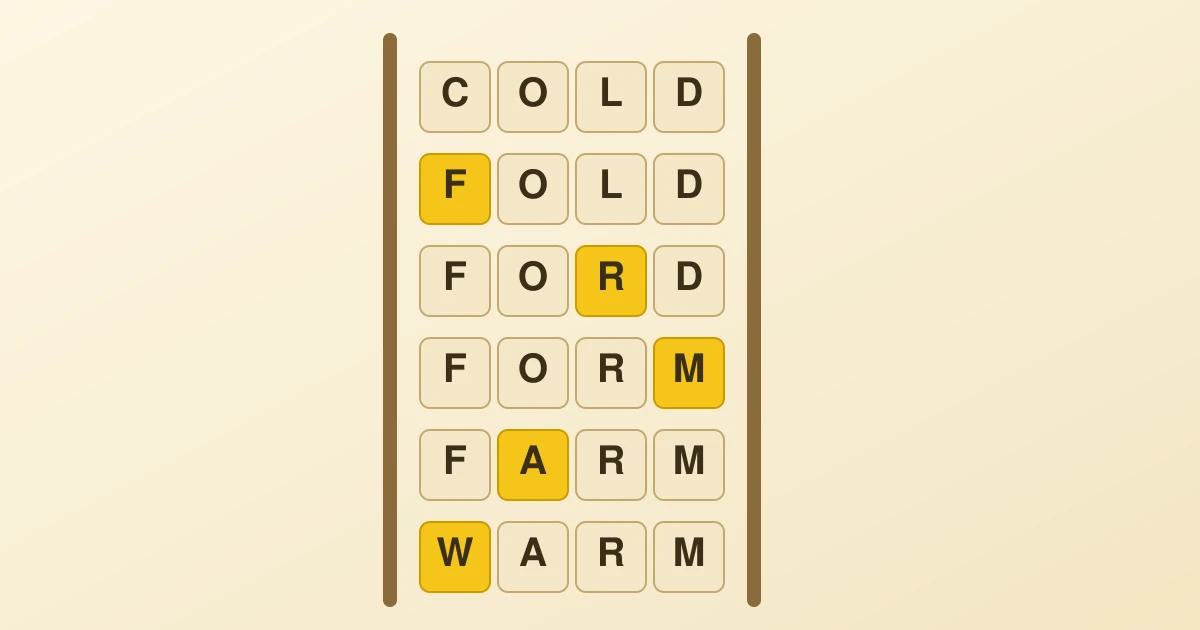
How to Play Word Ladder, and Why Some Words Can't Be Reached
The rules of word ladder, Lewis Carroll's own tip tested on 3,100 everyday words, the hub words that make ladders easy, and why ABOUT and PEOPLE can never be used.
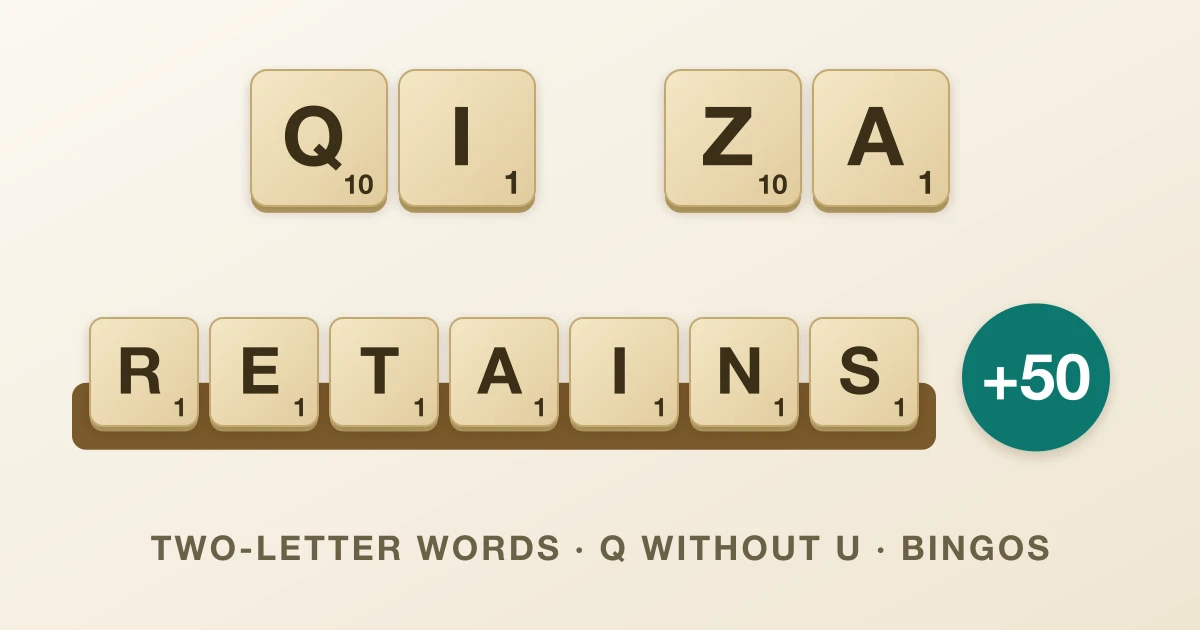
Scrabble Words That Win: 2-Letter Words, Q Without U, Bingos
All 107 two-letter Scrabble words, the Q words with no U, vowel dumps, where J, X and Z score most, and how to set up a 50-point bingo.
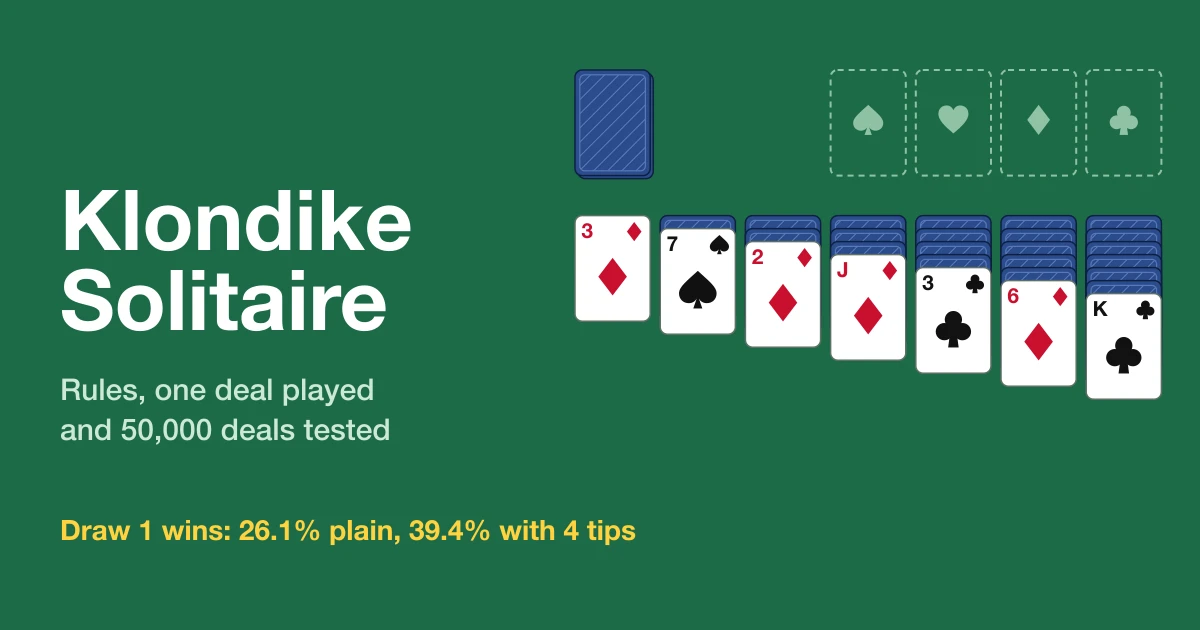
How to Play Klondike Solitaire: Rules, One Deal, Tips Tested
The rules of Klondike in plain words, one deal played move by move, and 50,000 computer games that measure how much each common strategy tip really helps.