
2048 is a 4 by 4 grid of numbered tiles. You swipe, the tiles slide, and two tiles with the same number join into one worth double. Make a tile that says 2048 and you win. Gabriele Cirulli put it online in 2014, borrowing the sliding idea from Threes, and it has been copied many times since.
Every guide gives the same advice: keep your biggest tile in a corner. We wanted to know how far that advice gets you, so we had four computer players play more than 40,000 games between them. We also worked out the math that sits under every game: how many moves a 2048 takes, what your score will be when you get there, and the biggest tile the board can ever hold.
Play it here: Number Slides in Game Attic, free in your browser, with five difficulties from Easy to Master, all open from the start, and no sign-up.
How to play 2048
- The board starts with two tiles, each a 2 or a 4.
- Swipe up, down, left or right (or use the arrow keys). Every tile slides as far as it can in that direction.
- Two tiles with the same number that slide into each other join into one tile worth their sum. Two 2s make a 4, two 4s make an 8, and so on.
- After every move, one new tile appears in a random empty square. Nine times in ten it is a 2, and one time in ten it is a 4.
- A swipe that moves nothing does not count. No tile appears and you have to try another direction.
- You win when you make a 2048 tile. You can keep playing after that.
- You lose when the board is full and no swipe can join or move anything.
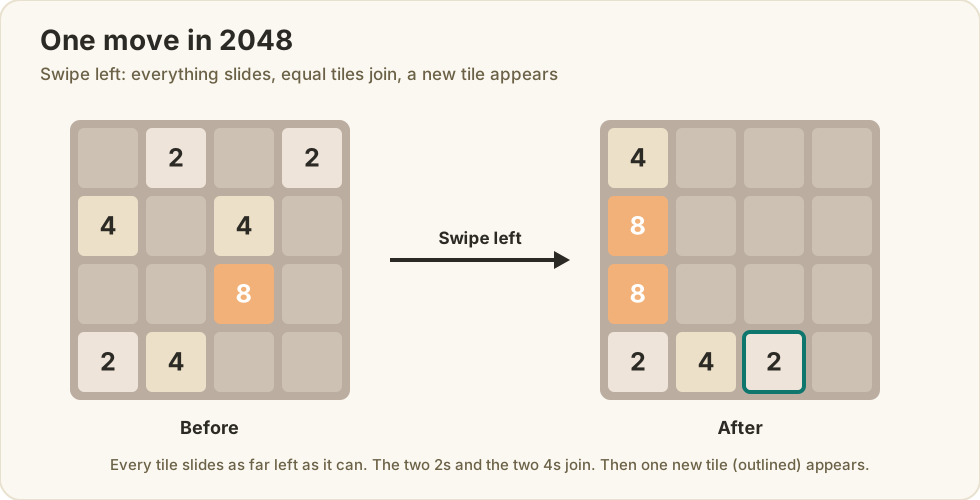
Your score goes up each time two tiles join, by the value of the new tile. Join two 8s and you score 16.
How tiles join
Most of the time joining is obvious. Three cases catch people out, and they matter once the board gets crowded.
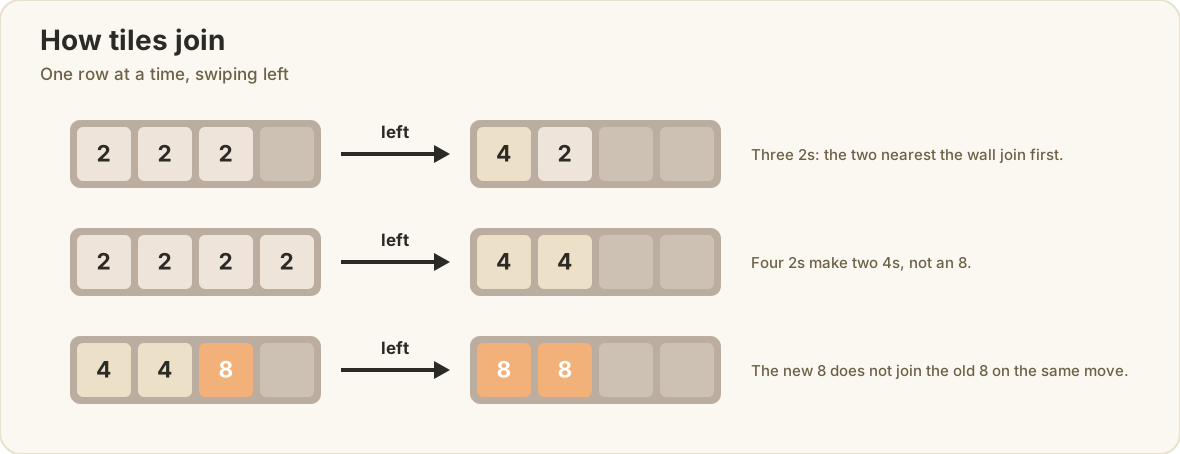
- When three equal tiles are in a row, the two nearest the wall you swipe toward join first. Swipe left on 2, 2, 2 and you get 4, 2, with the 4 against the left wall.
- Each tile joins only once per move. Four 2s in a row make two 4s, not one 8.
- A tile made on this move cannot join again on the same move. 4, 4, 8 becomes 8, 8. You need one more swipe to make the 16.
The math under the tiles
Joining two tiles never changes the total of all the numbers on the board. Two 8s become a 16: the total stays the same. The only thing that adds to the total is the new tile after each move, which is worth 2.2 on average (nine 2s and one 4 in every ten).
So you can work out three things before you play.
How many moves a 2048 takes. To have a 2048 tile, the numbers on the board have to add up to at least 2048. At 2.2 per move, that is about 930 moves, and it can't be fewer than about 510 even if every new tile were a 4. In our computer games, the first 2048 tile came after 935 to 1,267 moves, 1,005 on average. The extra moves are the smaller tiles still sitting on the board when the 2048 appears.
What your score will be. To make one 2048 out of 2s, you make 1,024 fours, 512 eights, and so on up to one 2048. Each of those ten layers adds exactly 2048 points, so a 2048 built from 2s alone is worth 20,480 points. New 4s skip a layer and save a little, and the other tiles on the board add a little. In our games the score when the first 2048 appeared was always between 20,120 and 25,272, and 20,829 on average. So if your score is around 10,000, you are about halfway there.
The biggest tile possible. To make a tile you need two of the tile below it, which means the board has to hold a chain of smaller tiles at the same time: to make a 131,072 you need a 65,536, a 32,768, and so on down to two 4s. That chain fills all 16 squares exactly. A 262,144 would need 17 squares, so 131,072 is the largest tile the game can ever show, and only if a 4 lands in the last square at the right moment.
We tested the corner trick
The usual advice is to pick a corner, keep your biggest tile in it, and avoid the one direction that would pull it out. We had four computer players each play the standard game:
- Random swipes in any direction that moves something.
- Corner rule follows the advice to the letter: down if it can, else left, else right, and up only when nothing else moves. The biggest tiles collect in the bottom left corner.
- Corner, thinking keeps the same corner, but when both down and left are possible it picks the one that leaves more empty squares. It swipes up only when nothing else moves.
- Two moves ahead looks at every swipe, every place the next tile could land, and every swipe after that, and picks the move that keeps the most room and keeps big tiles in order along the bottom row.
The first three played 10,000 games each. The last one is slow, so it played 240.
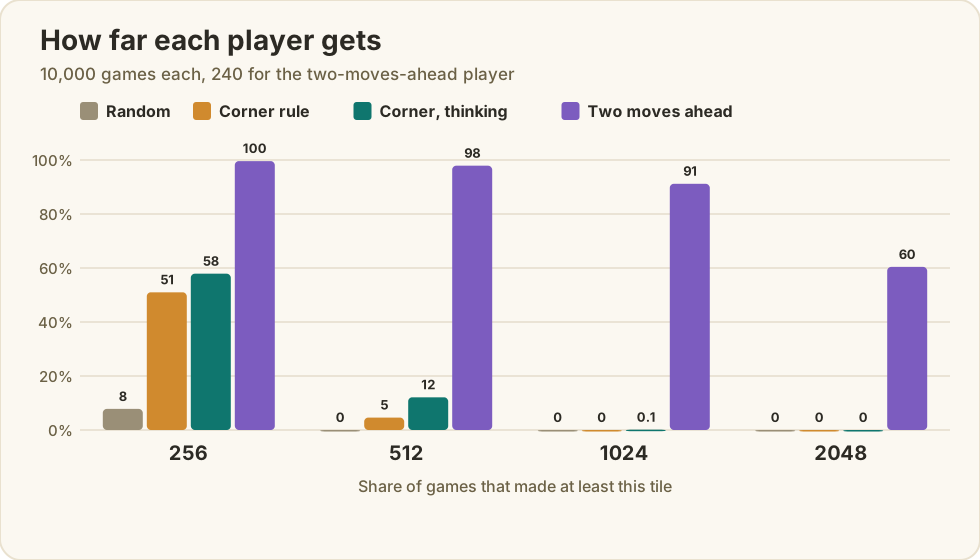
The corner rule on its own is a big step up from swiping at random. Random play made a 256 in 7.8% of games. The corner rule made one in 51%, and doubled the average score from 1,087 to 2,542.
But the corner rule alone does not win. It made a 512 in only 4.6% of games and never once made a 1024 in 10,000 tries. Choosing between down and left with a moment's thought, by asking which swipe leaves more empty squares, made a 512 in 12.1% of games, more than twice as often. Still, it made a 1024 just 9 times in 10,000 games.
The player that looked two moves ahead made a 1024 in 91% of its games and a 2048 in 60%. It reached 4096 in 5%. It keeps its big tiles in a corner too. The difference is that it checks where the next tile might land before it picks a swipe.
What this means for your game
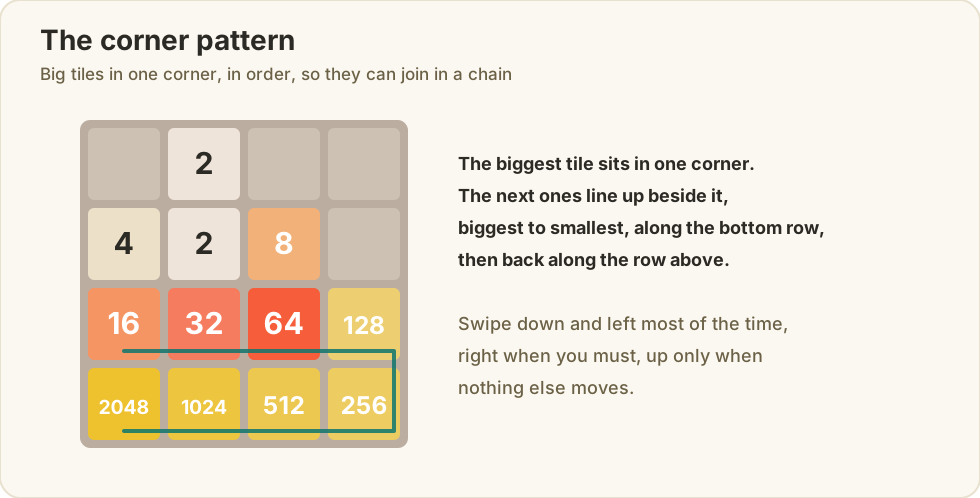
Pick a corner and keep the big tiles in a line from it. The biggest tile goes in the corner, the next biggest beside it, and so on along the bottom row and back along the row above. When they are in order, one join can set off the next: 256 meets 256, the new 512 sits next to a 512, and so on down the line.
Use the "wrong" direction only when you have to, and prefer the side one. If your corner is bottom left, down and left are your main swipes. When neither works, swipe right before you ever swipe up. We tested the reverse order too, with up before right, and that player made a 512 in 2.4% of games against 4.6%. A swipe up lifts your bottom row away from the wall and lets a new 2 drop into the corner.
Before each swipe, count the empty squares it leaves. This one habit is what lifted the thinking corner player above the plain one. Empty squares are your room to work. A swipe that joins nothing and leaves the board fuller is usually the wrong one, even if it keeps the corner.
Look where the new tile can land. This is what the two-moves-ahead player does that the others don't. If a swipe leaves one empty square in your bottom row, a new 2 will probably land there and wreck the order. The next move to make is the one that leaves no hole in the row you care about.
Keep the bottom row full. A full bottom row can't move when you swipe left or right, so your big tiles stay put while you sort out the rest of the board.
Play 2048 now
Here is the standard game to try the corner method on: a 4 by 4 board, a new 2 (or now and then a 4) after every move, and two equal tiles join once per move. Use the arrow keys or W, A, S and D on a computer, swipe on the board on a phone, or tap the arrow buttons. Undo takes back one move, which is handy for seeing what a different swipe would have done. Your best score and your biggest tile are saved on this device. Make 2048 and you can keep going for 4096.
To try the corner method against a goal tile, play Number Slides. Easy is a 5 by 5 board with a goal of 256. The other four difficulties use a 4 by 4 board, and the goal doubles at each step, up to 4096 at Master. All five are open from your first game.
2048 questions
Is 2048 hard to win?
It is hard if you only follow the corner rule. Our computer player that followed it strictly never made a 2048 in 10,000 games. A player that looked two moves ahead won 60% of the time. Most people who win regularly are doing some of that looking ahead, often without calling it that.
How many moves does it take to get 2048?
About 1,000. Every move adds 2.2 to the total on the board on average, so it takes at least about 930 moves for the tiles to add up to 2048. Our winning games took 935 to 1,267 moves.
What score do you get when you reach 2048?
A bit over 20,000. Building one 2048 out of 2s is worth 20,480 points. In our games the score when the 2048 tile appeared ranged from 20,120 to 25,272.
What is the highest tile possible in 2048?
131,072 on the standard 4 by 4 board. To make it you need every one of the 16 squares holding a tile in a single chain, so there is no room for anything bigger.
Can you keep playing after 2048?
Yes. Most versions show a "You win" message and then let you continue. Our two-moves-ahead player went on to make a 4096 in 5% of its games.
Does it matter which corner you pick?
No. The board is the same in every direction, so any corner works. What matters is that you pick one and stick with it.
If you like this kind of puzzle
2048 took its sliding and joining from Threes, and our post four years of Threes: why I can't get past 1536 is about the game that started it. If you like puzzles where planning a few moves ahead beats quick reflexes, our guides to Sudoku and Minesweeper run the same kind of computer tests, and Mahjong Solitaire turned out the same way: a careful player who only looks at the current move cleared about 1 board in 8, and a search that tried many orders cleared at least 85 in 100. Our list of the best brain training and logic games has more.
Where to play: play2048.co
How we checked
Our program plays the standard game: a 4 by 4 board, two tiles to start, and one new tile after every move that changes the board, a 2 nine times in ten and a 4 one time in ten, on a random empty square. Tiles join exactly as described above. The random, corner and thinking corner players played 10,000 games each, and the corner player with up before right played another 10,000. The two-moves-ahead player played 240 games because each one takes a few seconds. Every game is seeded, so rerunning the script gives the same numbers. The move and score counts at the first 2048 come from the 145 games where that player made one.
Related articles
How to Play Skyline Bounce: Flick and Climb 20 Towers
The official guide to Skyline Bounce for iPhone and Android: the flick, the safety floor, bank pockets, and all 20 towers from 12 to 180 floors.
Pairdle Hunt: How to Play and the Math of Hidden Words
Pairdle Hunt is Logic Loft's new word-hunt game, coming soon to iOS and Android. How to play, how scoring works, and how many words hide in one grid.
How to Play Boggle, and What 100,000 Boards Taught Us
Boggle rules and scoring, then real strategy: we rolled 100,000 boards against our game dictionary to find the words, pairs and letters that actually win.