
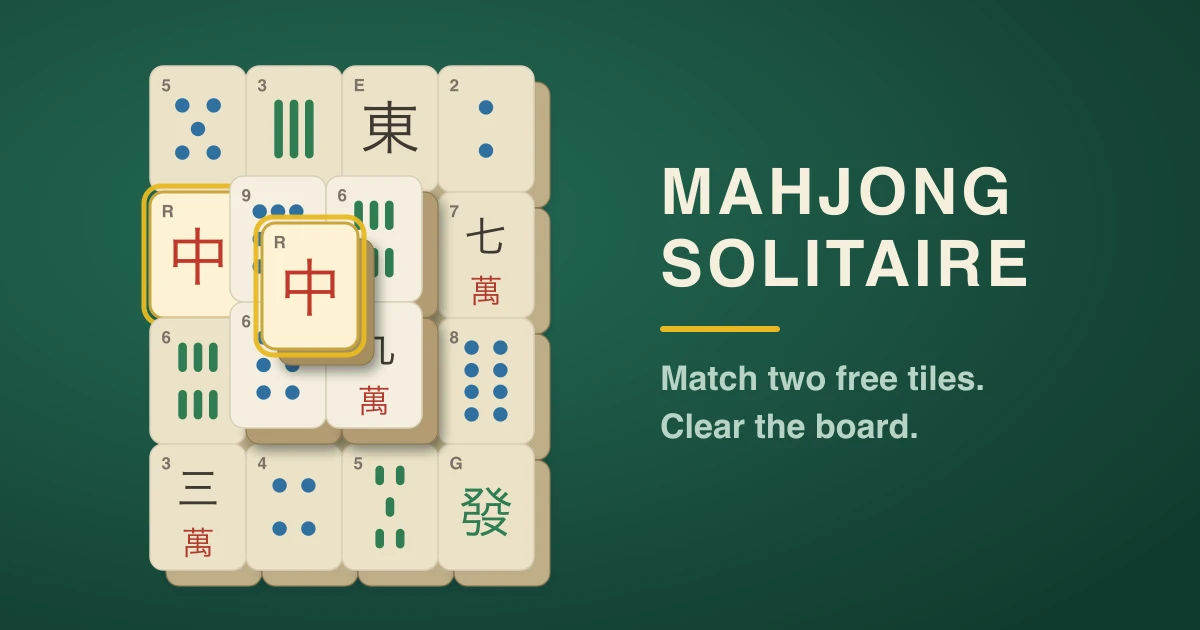
Mahjong Solitaire is not the four-player game your relatives play around a table. The two share a name and a set of tiles, and that is about all. The solitaire version is a one-player matching puzzle, and it has shipped with computers for decades. If you have ever cleared a pile of tiles by pairing them off, you have played it. This guide covers the rules, what a "free" tile is, and how to stop running into dead ends.
We make puzzle games, and this is one we point to a lot. It has one rule, match pairs but only free tiles, and that one rule is enough to make you plan ahead.
The goal
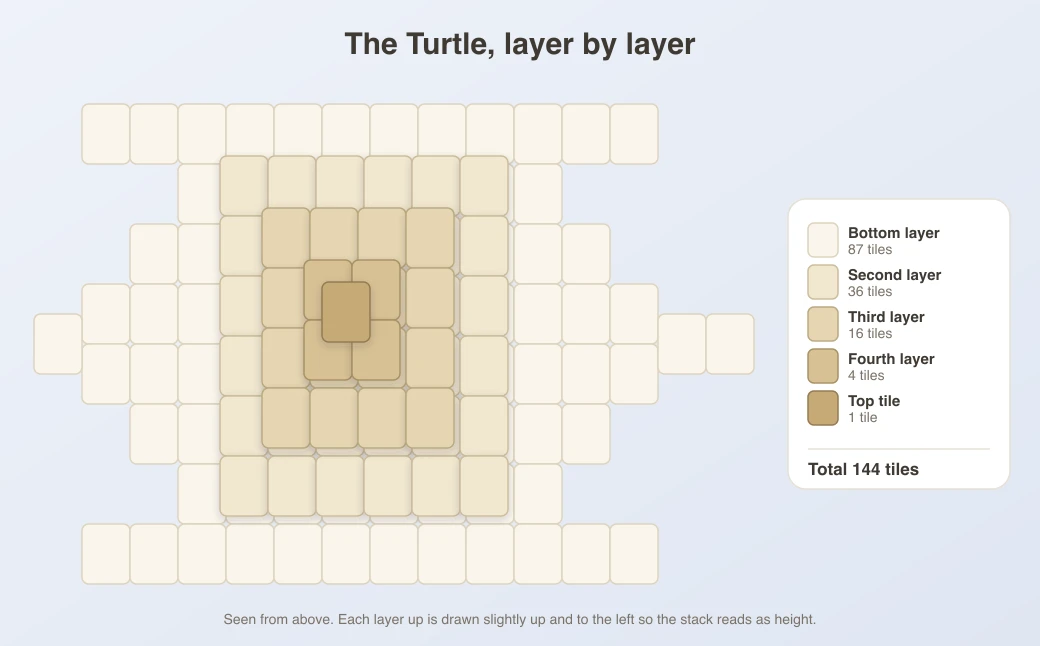
Tiles are stacked in a layout. The classic one is the "Turtle," a low pyramid of 144 tiles. You win by clearing the whole board, taking off matching pairs two tiles at a time. If you run out of legal moves first, you lose.
The matching rule
You take tiles off two at a time, and the two tiles must:
- Match. That means identical, except for two special groups covered below.
- Both be "free."
Most of the game comes down to that second point.
What "free" means
A tile is free when both of these are true:
- No tile sits on top of it.
- Its left side or its right side is open. One open side is enough.
A tile under another tile is blocked. So is a tile with a neighbour on both its left and its right. You cannot touch either one until you clear what is holding it in. Learning to see at a glance which tiles are free is the main skill in this game.
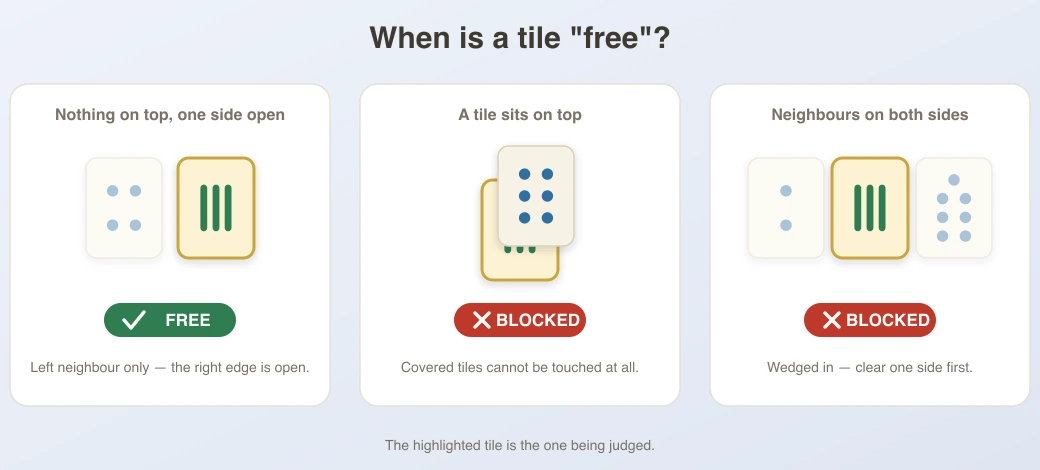
The rule says nothing about where the tile sits. It does not have to be on the outside of the layout, and it does not matter how deep it is. A tile on the bottom layer at the edge of the board can be free on the first turn. A tile near the top can stay blocked all game. Only the two conditions count.
The tiles
A standard set has 144 tiles in these groups:
- Three suits, each numbered 1 to 9: Dots (circles), Bamboo (sticks) and Characters (Chinese numerals). There are four copies of each tile.
- Honor tiles: four Winds (East, South, West, North) and three Dragons (Red, Green, White). Four copies of each.
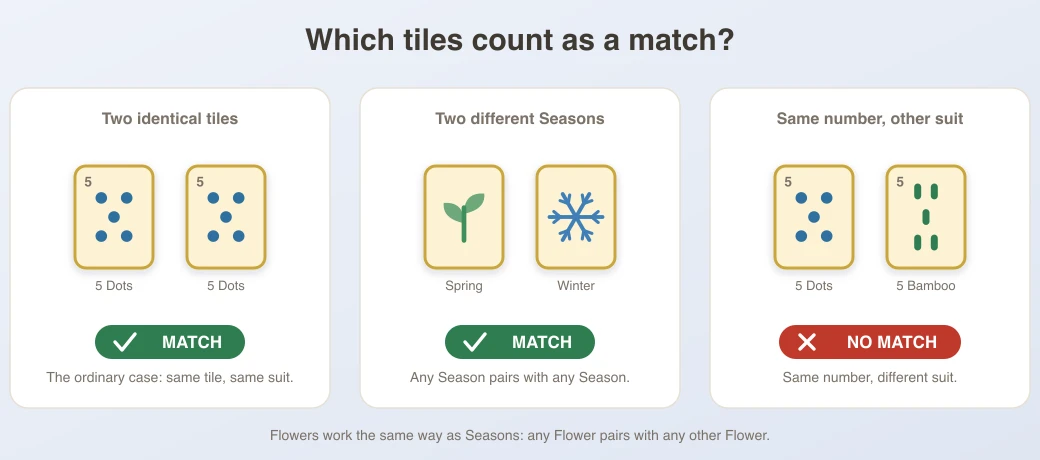
- Flowers (Plum, Orchid, Chrysanthemum, Bamboo). One of each, and any Flower matches any other Flower.
- Seasons (Spring, Summer, Autumn, Winter). One of each, and any Season matches any other Season.
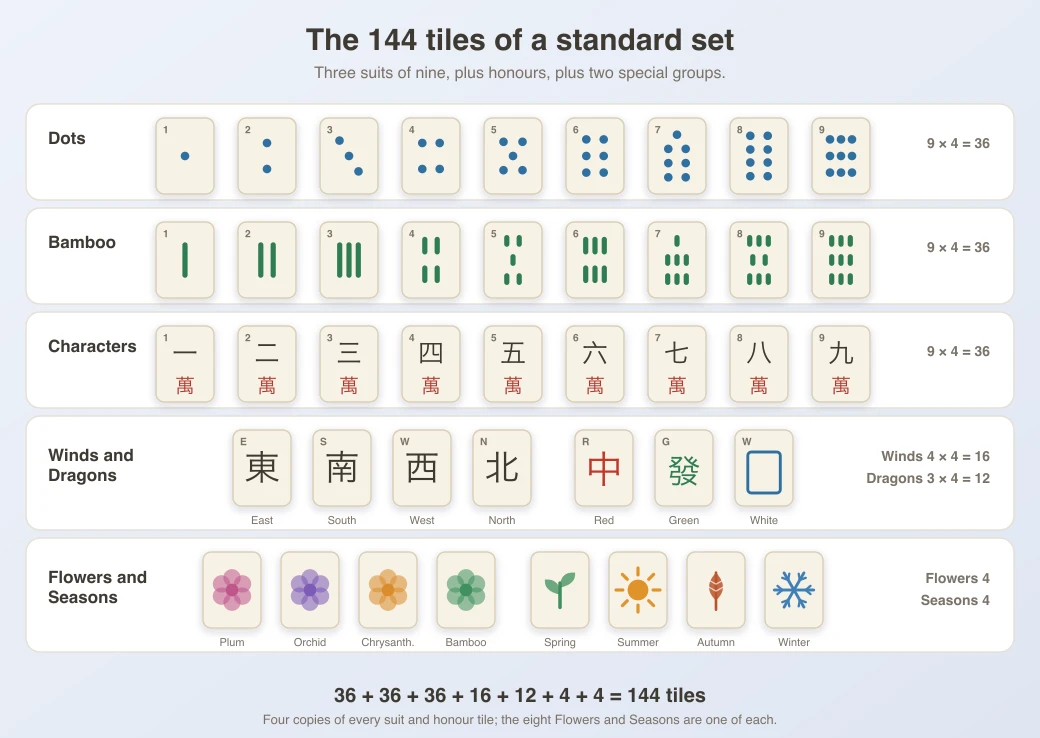
So a Red Dragon only matches another Red Dragon, but Spring can pair with Winter.
A simple turn
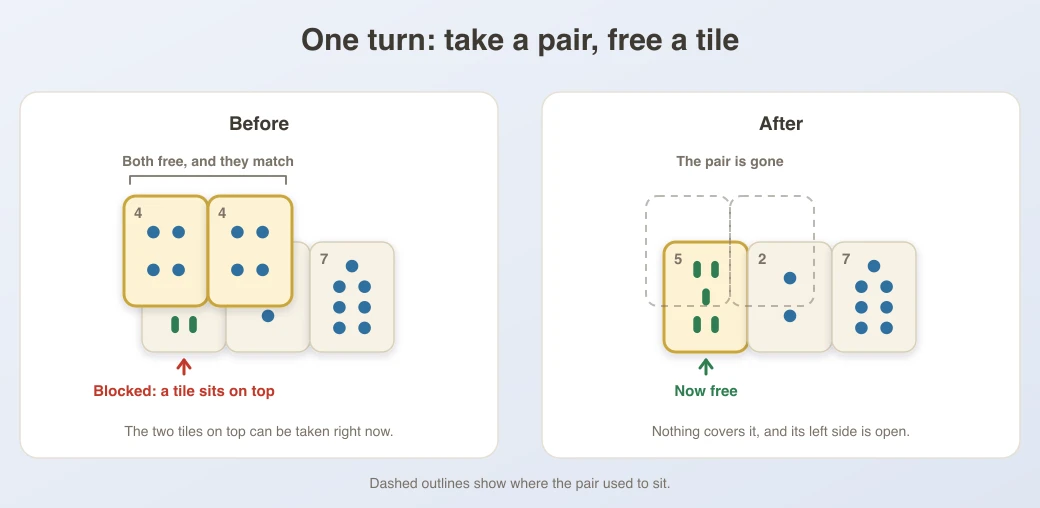
- Look for free tiles: nothing on top, and the left or right side open.
- Find two free tiles that match.
- Take the pair off. This often frees tiles that were under or beside them.
- Keep going until the board is clear, or until no free pair is left.
The layout matters more than you'd think
The Turtle is the default, but most versions come with a dozen or more layouts, and the shape changes how hard the game is:
- The Turtle is the classic one. It is forgiving, because the long open rows on each side give you plenty of free tiles from the start.
- A Pyramid is steep and stacked high. Far fewer tiles are free at any one time, so a bad move order hurts fast.
- A Fortress is a dense block with thick walls. The centre is buried deep, and you have to clear in roughly the right order to reach it.
- Spider and Dragon layouts are long shapes with thin arms. There are lots of free tiles, but the arms can leave a pair stuck at opposite ends.
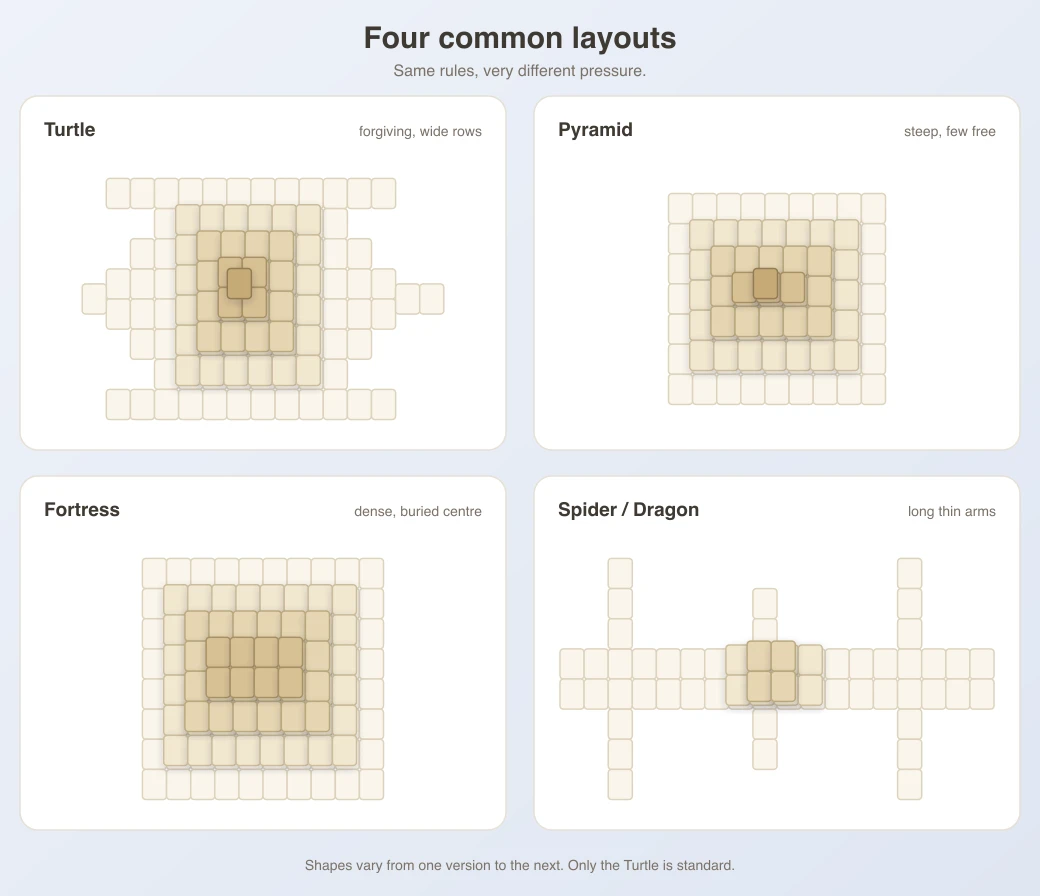
The taller the stack, the fewer moves you have, and the more a careless match costs. If you keep losing, switch to a flatter layout for a while. You will learn to spot free tiles much faster on a board that does not punish every mistake.
How to avoid getting stuck
Most losses come from rushing, not bad luck. These habits help.
Clear the top and the long rows first
Taking tiles from the peak and from the long open rows usually frees the most tiles underneath. Taking edge tiles that do not unblock anything gets you nowhere.
When all four copies of a tile are free
You can take two now and two later. If only two are free and the other two are buried, take the free pair when that helps you dig toward the buried ones.
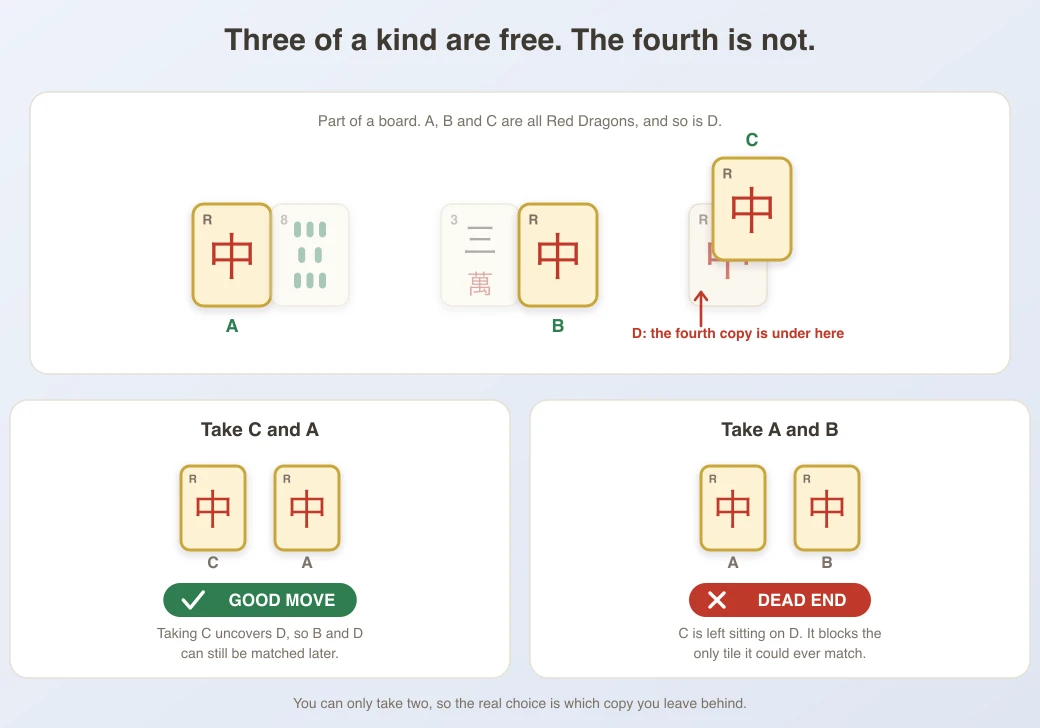
When exactly three copies are free
Stop and look. This spot loses a lot of boards. You can only take two, so you are really choosing which one to leave behind, and the fourth copy is buried somewhere. Take the two that open up the most board, and check that the one you leave can still reach the buried copy later. Get it wrong and the last two can never be matched.
Do not take every match you see
If you can choose between pairs, take the one that frees the most new tiles, or the one that digs toward a tile you know you will need.
Save pairs you may need later
Late losses often trace back to a pair you took early and needed later to unblock a stubborn tile. When you are unsure, take the tiles that are clearly safe and hold on to the pairs that could go more than one way.
Use undo and shuffle if your version has them
Many digital versions let you undo a move or reshuffle a stuck board. Using them to see what a move leads to is good practice, not cheating.
Count what is left, not only what is free
Late in a board, check which tiles are still buried and plan the order that uncovers them. Two free matching tiles taken without thought may have been the only way to reach a pair stuck in the middle row of the Turtle.
Not to be confused with Mahjong Connect
If you go looking for more and find something called Mahjong Connect or Shisen-sho, it uses the same tile art for a different puzzle.
There, nothing is stacked. Every tile sits in one flat layer. In place of the free-tile rule there is a path rule: a matching pair comes off only when you can draw a line between the two tiles, through empty space, that turns at most twice. No tile is ever buried. It can only be fenced in.
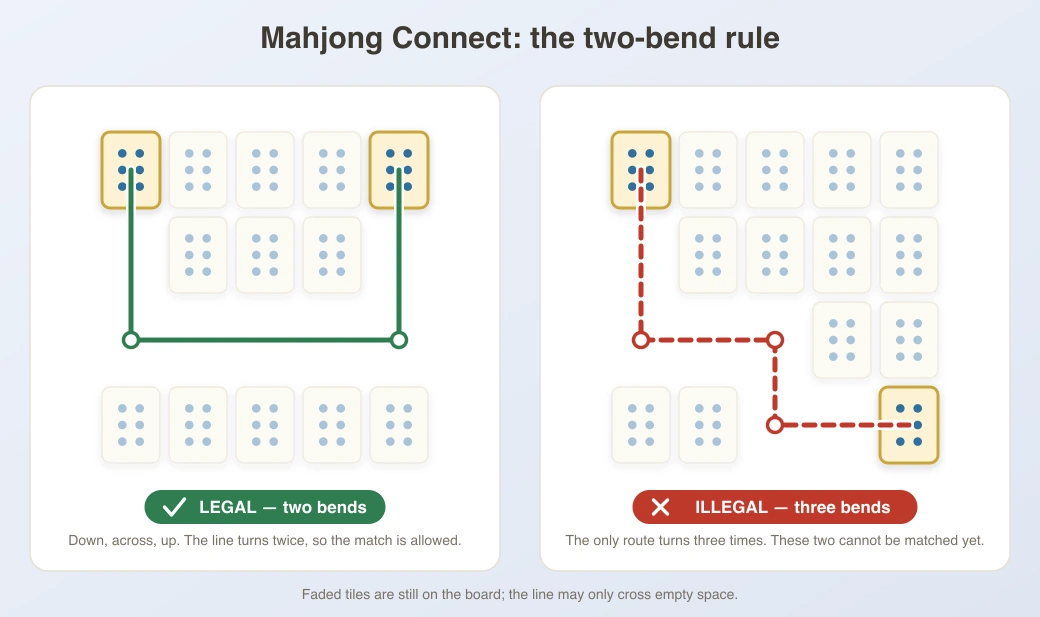
The difficulty runs the other way. Solitaire gets tighter as you go, because your options shrink toward the buried centre. Connect gets looser, because every pair you take opens another lane. Both are worth playing. It helps to know which one you have downloaded.
If you came here wanting the other one
We opened by saying this is not the four-player game. If that is the one you wanted, here is what it involves.
You hold thirteen tiles that nobody else can see. Each turn you draw one and discard one, racing three other players to build four sets and a pair. You watch their discards to work out what they are building, because handing someone their winning tile is how you lose. There is no board and nothing to clear. It is a game about reading people, and it is far older than this puzzle.
Our beginner's guide to real mahjong walks through a turn and covers the four rule sets: Japanese Riichi, Hong Kong, Chinese Official and American. They differ enough to play as separate games.
Why it's so satisfying
Each move is simple, but it changes what you can do next. That is what makes it easy to start one more game. Logic puzzles work the same way: clear what is certain, see what opens up, plan a few moves ahead. Our how to play Sudoku guide covers that side.
If you want a place to play, our list of the best Mahjong games sorts the good versions by which of the three games they are. If you like quiet daily puzzles in general, try our best daily word games list, or our own Pairdle, which does a similar thing with words in place of tiles.
If you are new, spend your first few boards doing nothing but spotting free tiles. Everything else gets easier once that is quick.
Related articles
How to Play Mahjong: The Real Four-Player Game Explained
Not the tile pyramid — the real game. Four players, thirteen tiles, draw and discard. How a hand works, and how Riichi, Hong Kong, Chinese and American differ.
The 10 Best Mahjong Games to Play Online and Mobile (2026)
"Mahjong" means three different games. We sort the 10 best digital versions into solitaire, connect and the four-player game, so you pick the right one.
How to Play Riddlok - Exciting new puzzle game!
Riddlok is a free daily word puzzle with three routes to one answer — a riddle, a set of clues, and a hidden theme linking the clue answers.