
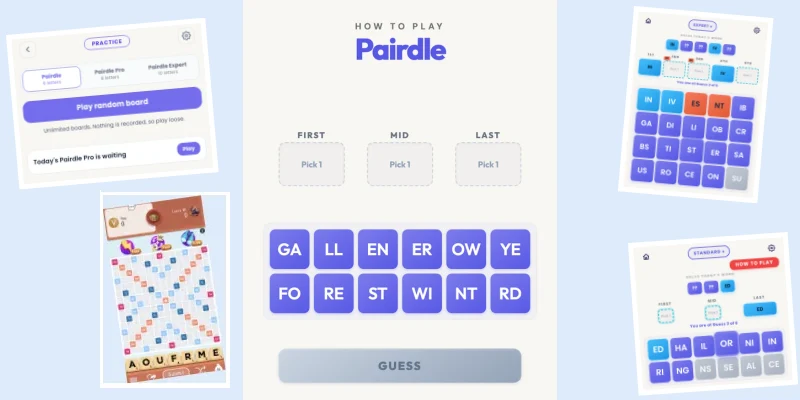
If you've played Pairdle, you've looked at twelve two-letter tiles and tried to see which three of them make a word. Some pairs jump out right away, like TH, ER and IN. Others look strange. Why?
English has strong habits in how it puts letters side by side. Once you know those habits, you get better at word games, crosswords, Scrabble and Pairdle.
We went through our word database of six-letter English words to find the most common and the rarest letter pairs. Here's what we found.
The 20 Most Common Two-Letter Pairs in Six-Letter Words
These pairs show up again and again across thousands of English words:
| Rank | Pair | Example Words | Position Tendency |
|---|---|---|---|
| 1 | TH | THIRST, MOTHER, GROWTH | Start or Mid |
| 2 | ER | BETTER, ERASER, FINGER | End (most common) |
| 3 | IN | INSIDE, RUINED, REMAIN | Start or Mid |
| 4 | AN | ANSWER, ORANGE, PLANET | Mid (most common) |
| 5 | RE | RETURN, DIRECT, FIGURE | Start (most common) |
| 6 | ON | ONWARD, BRONZE, PRISON | Mid or End |
| 7 | EN | ENTERS, HIDDEN, BARREN | End (most common) |
| 8 | AT | ATTACK, STATIC, COMBAT | Mid (most common) |
| 9 | LE | LETTER, MIDDLE, BUNDLE | End (most common) |
| 10 | TE | TEMPLE, LATEST, REMOTE | Mid or End |
| 11 | AL | ALMOST, GLOBAL, SIGNAL | End (most common) |
| 12 | ST | STRONG, MISTER, ALMOST | Start or End |
| 13 | OR | ORIGIN, DOCTOR, MIRROR | Mid (most common) |
| 14 | NG | SPRING, HUNGER, STRONG | End (almost always) |
| 15 | AR | ARCADE, SCARED, GUITAR | Mid (most common) |
| 16 | IT | ITSELF, UNITED, SPIRIT | Mid (most common) |
| 17 | ED | EDITED, WICKED, FISHED | End (almost always) |
| 18 | OU | OUSTED, AROUND, FLOURS | Mid (most common) |
| 19 | ES | ESCAPE, HORSES, DISHES | Start or End |
| 20 | RI | RISING, STRIKE, SAFARI | Start or Mid |
What This Tells Us About English
Endings are predictable
Look at the "Position Tendency" column. A lot of the most common pairs land at the END of words: ER, EN, LE, AL, NG, ED, ES. English loves its endings. In any word game, when you see one of these pairs, try it in the last spot first.
That comes from how English builds words. We take a root word and add an ending: PLAY becomes PLAYER, HIDE becomes HIDDEN, SIGN becomes SIGNAL. Those endings make the same few pairs turn up at the end of word after word.
Starts are distinctive
Start pairs are less common overall, but they are easier to spot. When you see TH, RE, ST or CH, it is usually the start of a word. Very few six-letter words end in TH. GROWTH is an exception, not the rule.
So in Pairdle the FIRST box is often the easiest one to fill. Starter pairs tend to look like starters.
The middle is the wild card
MID pairs are the hardest to guess, because English roots vary so much. AN, AT, AR, OR and IT can sit almost anywhere, depending on the root. That's why the MID box is usually the last one you solve.
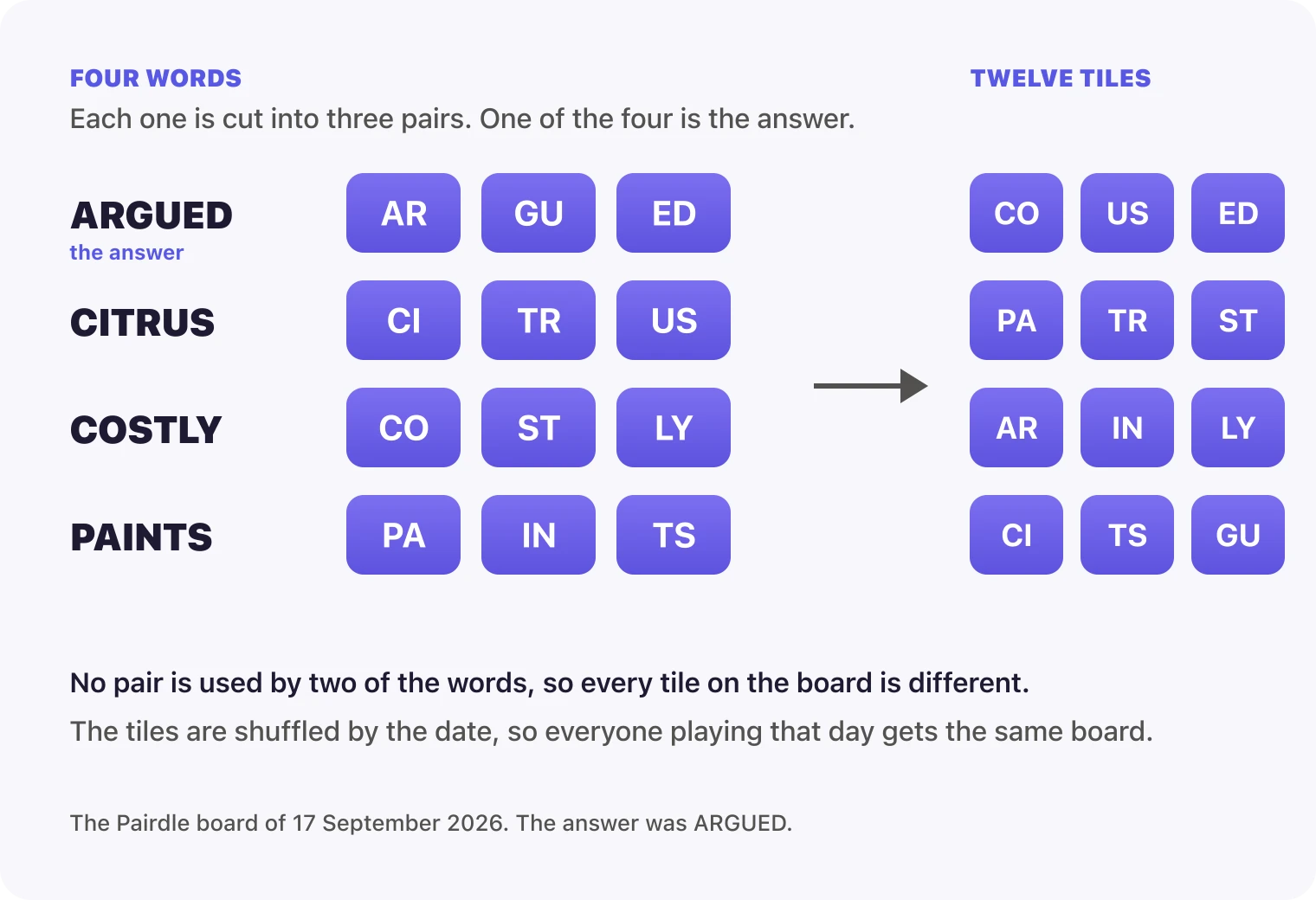
You can see it on a real board. On 17 September 2026 the Pairdle answer was ARGUED, and the other three words on the board were CITRUS, COSTLY and PAINTS. ED, US and LY are all endings. AR, CO and PA all look like starts. The middle pairs (GU, TR, ST, IN) are the ones that could go more than one way.
The Rarest Pairs (And Why They Trip You Up)
Some letter pairs almost never appear inside an English word:
-
QJ, XK and ZV essentially never appear inside English words.
-
JK, WX and ZH almost never do.
-
YZ, VX and JQ you can ignore in any word game.
You won't see pairs like these in Pairdle at all. Each board is built from four real words cut into pairs, with no pair shared between them. One word is the answer and the other three are real words too, so every tile on the board belongs to some real word.
That changes how you should read an odd-looking pair. It is not filler. It came from one of the other three words, and it may not be in the answer. Your guess tells you which. You get six guesses, and after each one a tile turns BLUE if it is the right pair in the right box, RED if the pair is in the answer but in a different box, and GREY if it is not in the answer at all.
On the other side, some pairs that look unusual turn up more often than you'd expect:
-
RR shows up in BARREN, MIRROR, BARREL and PARROT.
-
LL is common in FOLLOW, MELLOW, PILLOW and BALLET.
-
SS is found in LESSON, MISSED, FOSSIL and PASSED.
Double-letter pairs are almost always MID pairs. If you see RR, LL or SS on the board, try it in the MID box first.
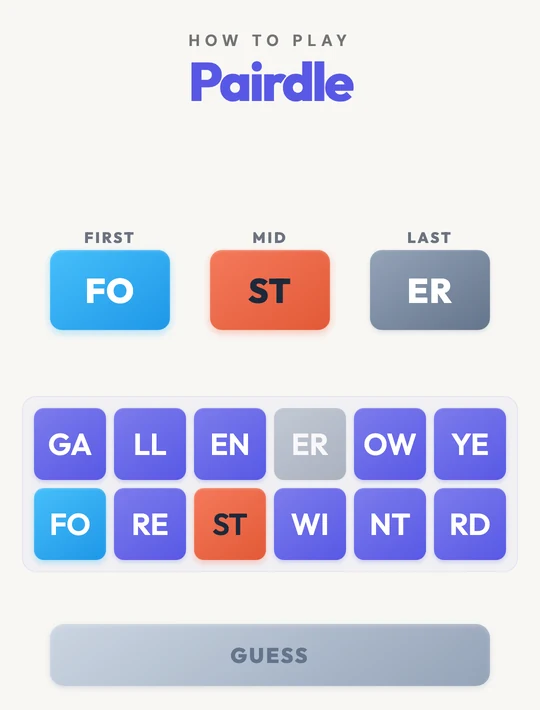
In the guess above, the answer is FOREST. FO is right. ST is in the word but belongs at the end. ER is grey because it came from WINTER, one of the other words on that board.
How This Applies to Other Word Games
The same pair habits help in other games too.
Scrabble and Words With Friends
Knowing that ER, EN and ED are the most common ending pairs helps you spot ways to add to a word on the board. If there's an E on a triple-letter score, think about which pairs could lead into it.
Crosswords
When you have two blank squares next to each other, the common pairs give you a first guess. If the blanks are at the end of a word, try ER, ED or LE first. For the rest of the grid, our crossword-solving guide covers the other techniques.
Wordle and its variants
Knowing which letters sit together helps you pick better starting words. STERN holds ST, TE and ER, three pairs from the top 13 in the table, in one guess. Pairdle and Wordle share this letter logic, yet their guess counts look nothing alike.
Boggle
Letters that touch on the board and form a common English pair are much more likely to be part of a real word. The letters on the Boggle dice changed in 1987, and that change altered which words a board can hold.
Pairdle Pro and Expert
Pairdle has three puzzles a day. Pairdle is a six-letter word in three boxes. Pairdle Pro is an eight-letter word in four boxes, with 16 tiles. Expert is a ten-letter word in five boxes, with 20 tiles. All three are free to play on the web, with no sign-in. Longer words have more middle pairs, so the wild-card problem from above gets bigger.

The Takeaway
English isn't random. Letters fall into set patterns, and those patterns are easiest to see when you look at two-letter pairs instead of single letters.
Try reading words as pairs: TH-IN-GS instead of T-H-I-N-G-S. You'll start to spot pairs on sight instead of guessing at them. Pairdle is built on that skill, and it helps in the other games above too.
Want to put your pair knowledge to the test? Play today's Pairdle at logicloftgames.com/pairdle, or play as many boards as you like in Practice.
For more word game strategy, check out our guide: 5 Strategies to Get Better at Pairdle.
Related articles

The Mobile Gaming Landscape: Every Major Genre, Explained
From puzzle to shooter, slots to strategy, a founder's field guide to the 14 genres that make up mobile gaming today, with the games worth trying in each.
How to Play Riddlok - Exciting new puzzle game!
Riddlok is a free daily word puzzle with three routes to one answer — a riddle, a set of clues, and a hidden theme linking the clue answers.
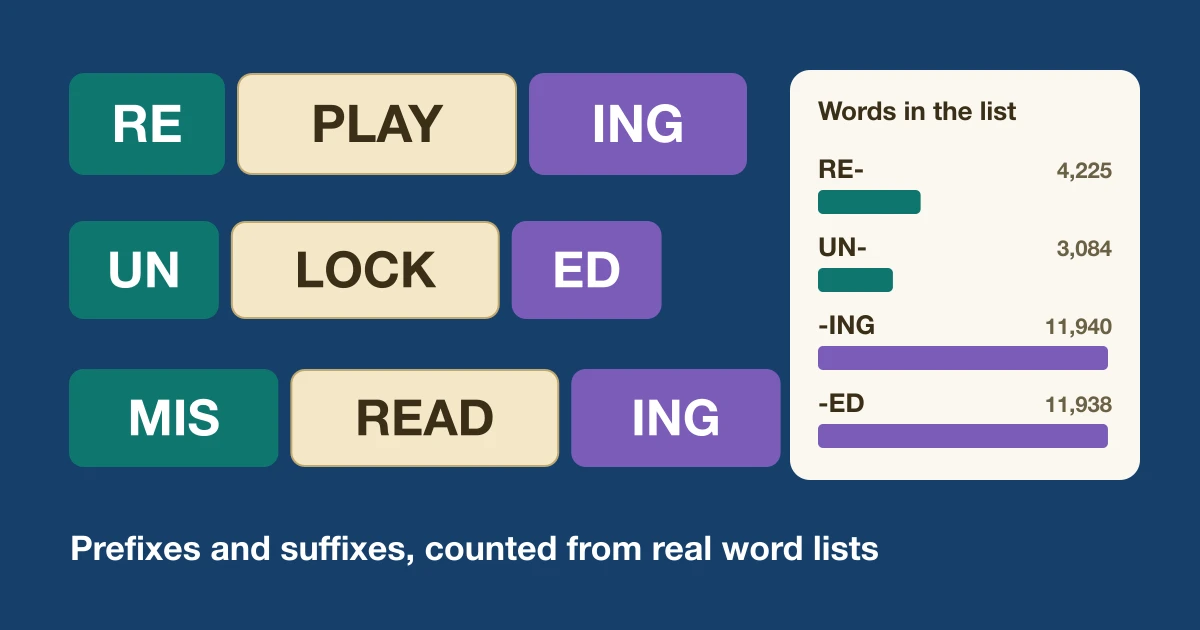
Most Common Prefixes and Suffixes, Counted for Word Games
We counted prefixes and suffixes in a 172,823-word game list and in real Wordle and Pairdle answers. The top 10 of each, and how to use them in play.