
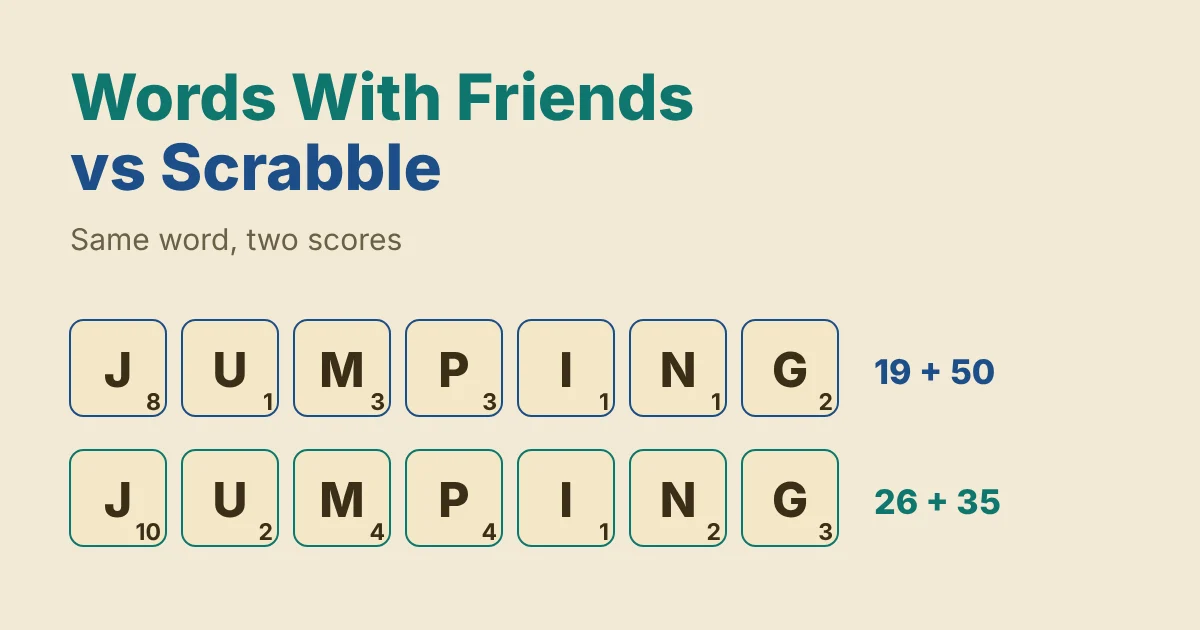
Words With Friends looks like Scrabble on a phone. Same 15 by 15 board, same rack of seven tiles, same idea: build words that cross, score the letters, use the bonus squares. But a Scrabble player who switches games finds the numbers feel off. JUMP is worth 15 in Scrabble and 20 in Words With Friends. WHY drops from 12 to 10. Playing all seven tiles earns 50 extra points in one game and 35 in the other.
We wanted to know how much those small changes add up to. So we took one word list and scored every common word both ways, then drew 200,000 opening racks from each bag. This guide lists every difference between the two games, then shows what the numbers say about playing each one well. At the end you can play one rack under both sets of rules and see the scores change.
The short answer
| Scrabble | Words With Friends | |
|---|---|---|
| Board | 15 by 15 | 15 by 15, different bonus squares |
| Tiles in the bag | 100 (2 blank) | 104 (2 blank) |
| Points in the bag | 187 | 220 |
| Letters that change value | 10 worth more, H and Y worth less | |
| Bonus for using all 7 tiles | 50 | 35 |
| Centre square | Double word | Plain square |
| Word list | Official Scrabble dictionaries | Its own list |
Everything else is the same. You draw seven tiles. The first word must cover the centre square. Every later word must join the words already on the board. You score the letters in each word you make, plus any bonus squares you cover with new tiles, then draw back up to seven. The game ends when the bag is empty and one player uses their last tile. If you have never played either, our guide to how to play Scrabble walks through a whole turn and the scoring step by step. Those rules carry over to Words With Friends.
The letter values
Twelve letters change value. Ten go up in Words With Friends: B, C, M and P go from 3 to 4, G from 2 to 3, L, N and U from 1 to 2, V from 4 to 5 and J from 8 to 10. Two go down: H and Y both drop from 4 to 3. The vowels other than U, and the common consonants D, R, S and T, stay at their Scrabble values, as do F, K, W, X, Q and Z.
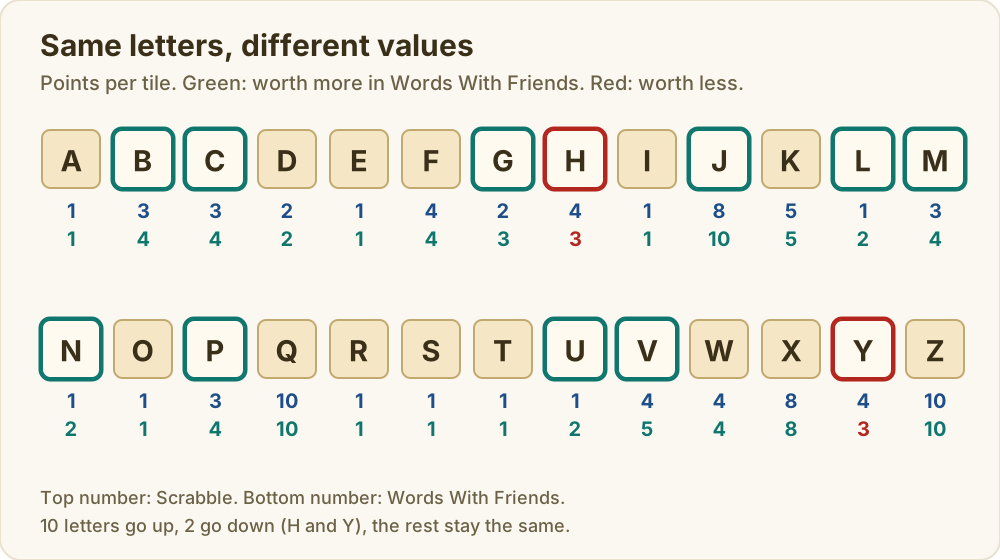
The pattern is that Words With Friends rewards the middle of the alphabet. L, N and U are among the most common letters in English and they double from 1 to 2. In Scrabble they are filler. In Words With Friends they pull their weight.
What is in the bag
The two bags are almost the same mix. Words With Friends adds four tiles: one more D, E, S and T, and two more H's. It takes away one I and one N. Both games have two blanks, which can stand for any letter and score nothing.
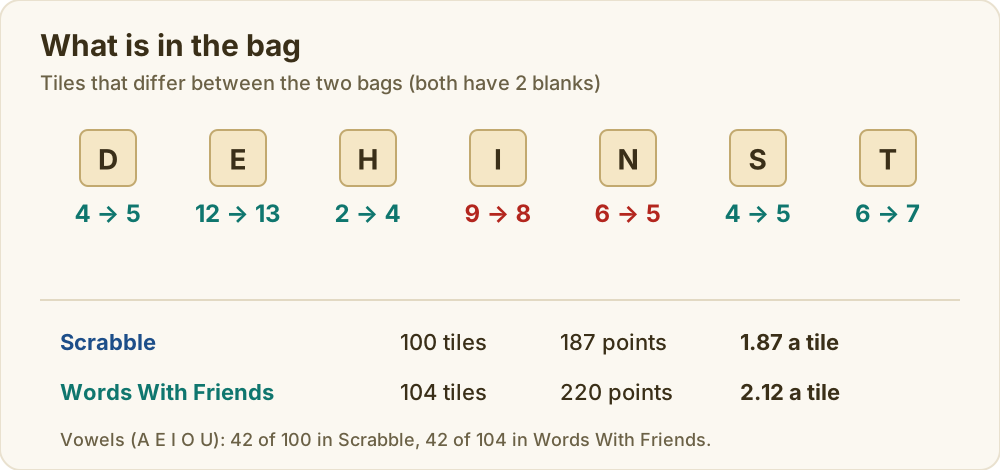
Add up the face value of every tile and Scrabble's bag is worth 187 points, 1.87 a tile. The Words With Friends bag is worth 220, about 2.12 a tile, 13% more. Both bags hold 42 vowel tiles (A, E, I, O, U), which is 42% of the Scrabble bag and 40% of the Words With Friends bag. The extra S is the one Scrabble players notice: five S's instead of four means more chances to hook a plural onto a word already on the board.
The same word, scored both ways
To see what the new values do, we took the 20,015 words marked common in the word list behind our own Scrabble tools and added up each word's letters with both sets of values. No bonus squares, just the tiles.
87.3% of common words are worth more in Words With Friends. 9.7% score exactly the same, because they are spelled only from letters that did not change (HOUSE is 8 in both). Just 3.0% are worth less, and every one of them has an H or a Y. On average a common word is worth 12.65 in Scrabble and 14.84 in Words With Friends, about 17% more.
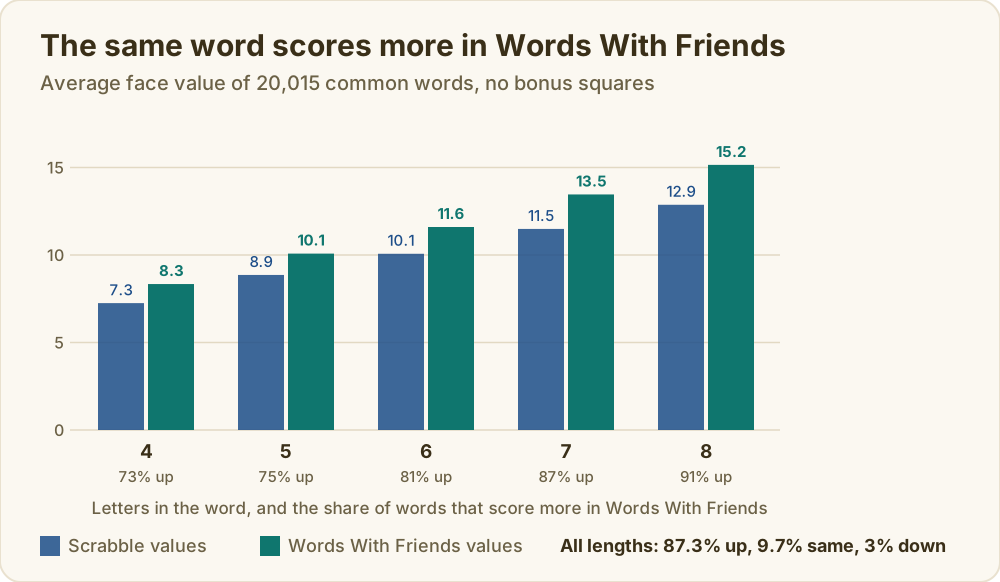
The gap grows with length. Only 73% of four letter words gain, but 91% of eight letter words do, because a longer word is more likely to hold at least one of the ten letters that went up.
The biggest winners are words packed with B, G, J, M, P and U. JUGGLING goes from 18 to 26. JUMPING goes from 19 to 26. PLUMBING and BUBBLING go from 15 to 22. The losers are short words that lean on H and Y: WHY drops from 12 to 10, FISHY from 14 to 12, HEYDAY from 16 to 13.
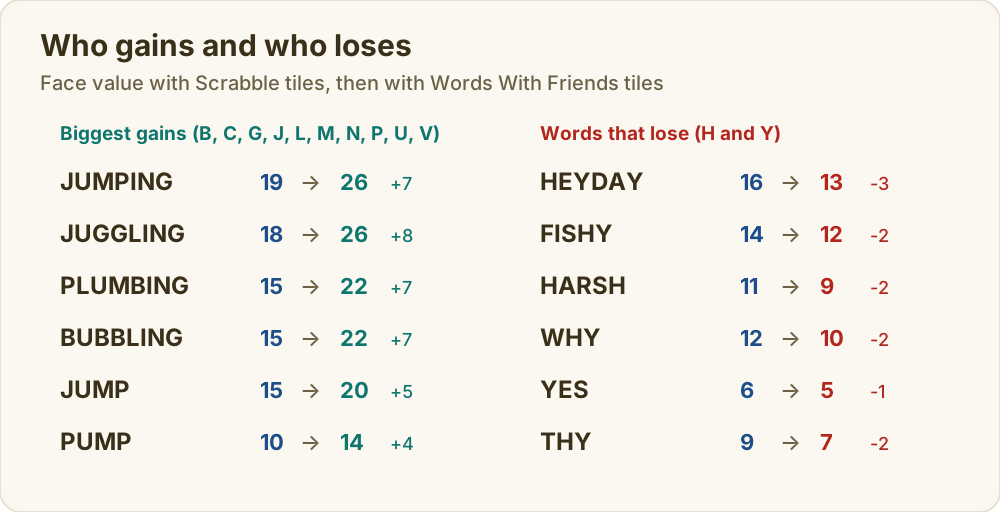
That can change which word is best on the same rack. Take A, E, G, N, P, R and S. With Scrabble values GRAPES and SPRANG tie at 9. With Words With Friends values SPRANG is worth 12 and GRAPES 11, because SPRANG has the N and the G, which both went up. Ties like that are as far as it goes, though. In all 48 racks in the game at the end of this post, the best everyday word under one set of values was also the best, or tied for best, under the other. The new values change how much a word is worth far more than they change which word you should play.
The bonus for using all seven tiles
Using all seven tiles in one turn is called a bingo. Scrabble pays 50 points for it. Words With Friends pays 35.
At first that looks like a 15 point cut and nothing more. But the tiles are worth more in Words With Friends, so the right question is what a bingo is worth compared with an ordinary play. We took the average common seven letter word and the average common five letter word in each game.
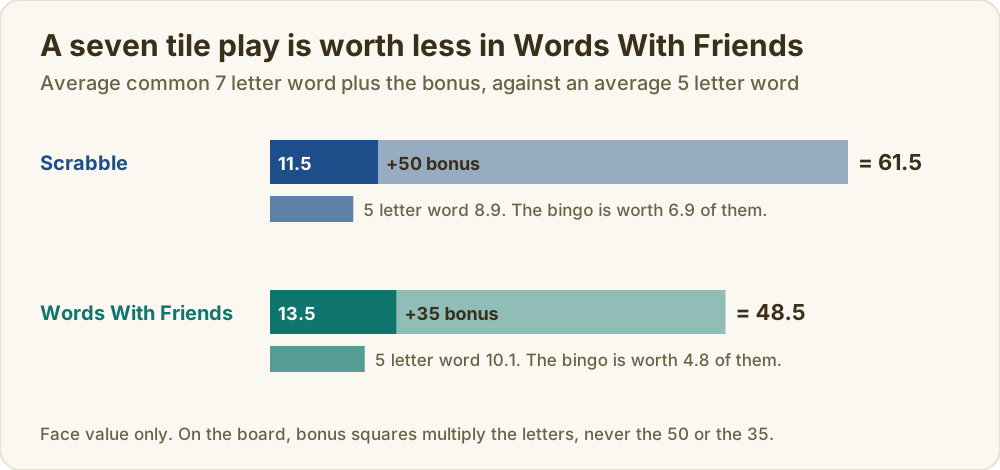
In Scrabble a bingo is worth about 6.9 average five letter plays. In Words With Friends it is worth about 4.8. The bonus shrank and the everyday plays grew, so the gap between them closed from both sides. That is the biggest strategic difference between the two games. In Scrabble, keeping a good rack (holding an S, an E and letters like R, T, N) and waiting for a bingo pays off. In Words With Friends, putting a 4 point tile on a triple letter square now is usually the better trade.
The bonus squares point the same way. According to a count by Scrabble Word Finder, Scrabble has 17 double word squares and 12 triple letter squares, while Words With Friends has 12 double word squares and 16 triple letter squares. More triple letters and fewer double words again favour one strong tile over a long word.
Your opening rack
With different bags you might expect very different racks. We drew 200,000 random seven tile racks from each bag and counted.
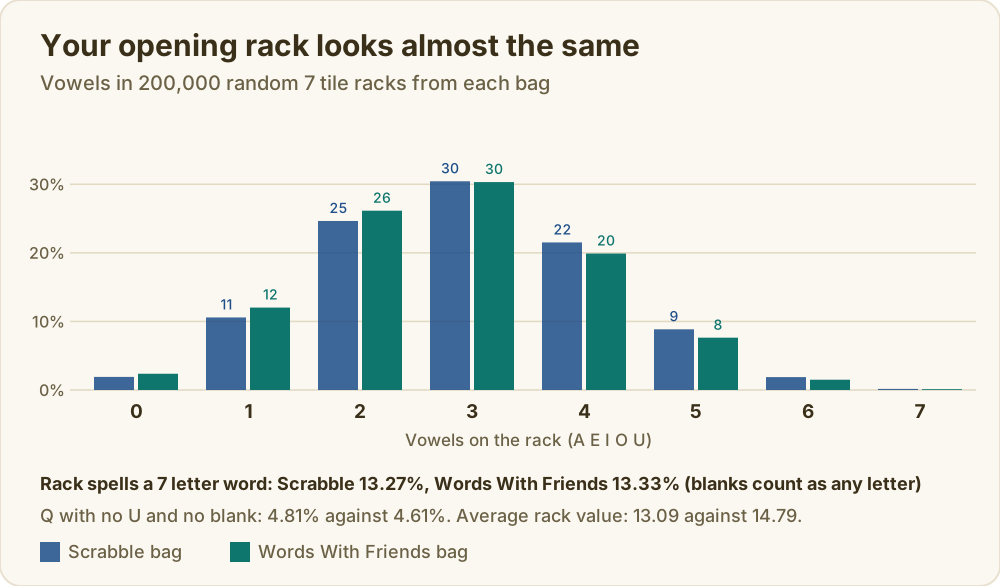
The racks are almost the same. Three vowels is the most common rack in both games, about 30%. The Words With Friends bag leans very slightly towards consonants, because it added consonants and took away an I: a rack with one vowel or none turns up 14.4% of the time against 12.5% in Scrabble.
How often can you play all seven tiles on your very first turn? Treating each blank as any letter, the rack spells a seven letter word in our full list 13.3% of the time in both games. Counting only common words, it is about 3.5% in both. The bag changes the points, not your luck. Holding the Q with no U and no blank, the classic stuck rack, happens 4.8% of the time in Scrabble and 4.6% in Words With Friends. The average opening rack is worth 13.1 points of tiles in Scrabble and 14.8 in Words With Friends.
What this means when you switch games
- Scrabble to Words With Friends: stop treating L, N and U as filler. They are worth 2 each now, the same as D. Spend less effort saving a rack for a bingo, because it pays 35, not 50. Look for the triple letter squares, and put your B, C, M, P or J on them.
- Words With Friends to Scrabble: the H and the Y are worth 4 in Scrabble. A short word like WHY or HEY on a triple letter square is a strong play. Hold on to a good seven letter rack longer, because 50 points is worth chasing. Use the double word squares, since there are more of them, and remember the opening word lands on one.
- In both: the vowel mix and your chance of a bingo are almost the same, so the habits that keep a rack healthy (play off duplicates, keep one S, aim for three vowels) work in either game. Our post on Scrabble words that win games has the short words worth learning for both.
How we checked
We used one word list for both games on purpose: the 194,972 words behind our own Scrabble tools, with the offensive ones taken out. The two games use different dictionaries in real life, but using one list means every difference in our numbers comes from the tiles alone.
- Same word, two scores: we added up the letters of each of the 20,015 words tagged common in that list, once with each set of values. Face value only, no bonus squares.
- Racks: we drew 200,000 random seven tile racks from a full Scrabble bag and 200,000 from a full Words With Friends bag, with a fixed random seed so the run repeats exactly. A rack counts as a bingo when its seven tiles, with blanks filling in for any letter, spell a seven letter word in the list.
- Bingo value: the average face value of the 3,237 common seven letter words, plus the bonus, against the average of the 2,302 common five letter words.
The script and its full output are saved with this post, so every number here can be checked.
Words With Friends and Scrabble questions
Is Words With Friends the same as Scrabble? No, but it is close. The board size, rack and turn order are the same. The tile values, the number of each tile, the bonus squares, the 35 point bonus for using all seven tiles and the word list are different.
Which game gives higher scores? Words With Friends. The bag is worth 220 points against 187, and 87% of common words score more with its tile values. Games are not always higher, though, because the seven tile bonus is 15 points smaller.
How much is a bingo in Words With Friends? 35 points on top of the word's score. In Scrabble it is 50.
Which letters are worth more in Words With Friends? B, C, G, J, L, M, N, P, U and V. H and Y are worth less. All the others are the same as in Scrabble.
How many tiles are in Words With Friends? 104, including two blanks. Scrabble has 100. Words With Friends has one more D, E, S and T and two more H's, and one fewer I and N.
Can you use Scrabble words in Words With Friends? Mostly. Both accept the everyday words you would expect. The two lists differ on some short and unusual words, so check the in-game dictionary before you play one you only know from the other game.
Play: one rack, two rule books
The game below deals you a seven tile rack drawn from one of the two bags. Tap the tiles (or type) to build a word and press Play word. Every word you play is scored under both sets of rules, so you can see JUMP-style gains and WHY-style losses on your own racks. Switch between Scrabble and Words With Friends scoring at the top. Try to find the best scoring everyday word, then press Show the top words to see the best plays and whether the best word changes between the two games. Scores are face value with no bonus squares, and all seven tiles add 50 or 35. Your racks played and top words found are kept on this device.
If you like this kind of game
Our guide to how to play Scrabble covers the full rules, the bonus squares and a scored example turn. For more games in the same family, see our list of the best classic word games. And if you like guessing one letter at a time instead of placing seven, Hangman runs on the same kind of letter counting.
Related articles
How to Solve Cryptograms: Word Shapes, Letter Counts and When E Lets You Down
How to solve a cryptogram step by step, the word shapes that give answers away, and how often E is really the most common letter in a short puzzle, from 140,000 test messages.
How to Play Hangman, and the Best Letters to Guess
The rules of Hangman, the best first letter for every word length, and why MOM, not JAZZ, is the hardest everyday word, from 6,298 words played by computer.
Amaze Go: Addictive and Frustrating in Equal Measure
A board full of twisting arrows, three lives and one job: send each arrow off the board without hitting another. Relaxing until you overlook something.