
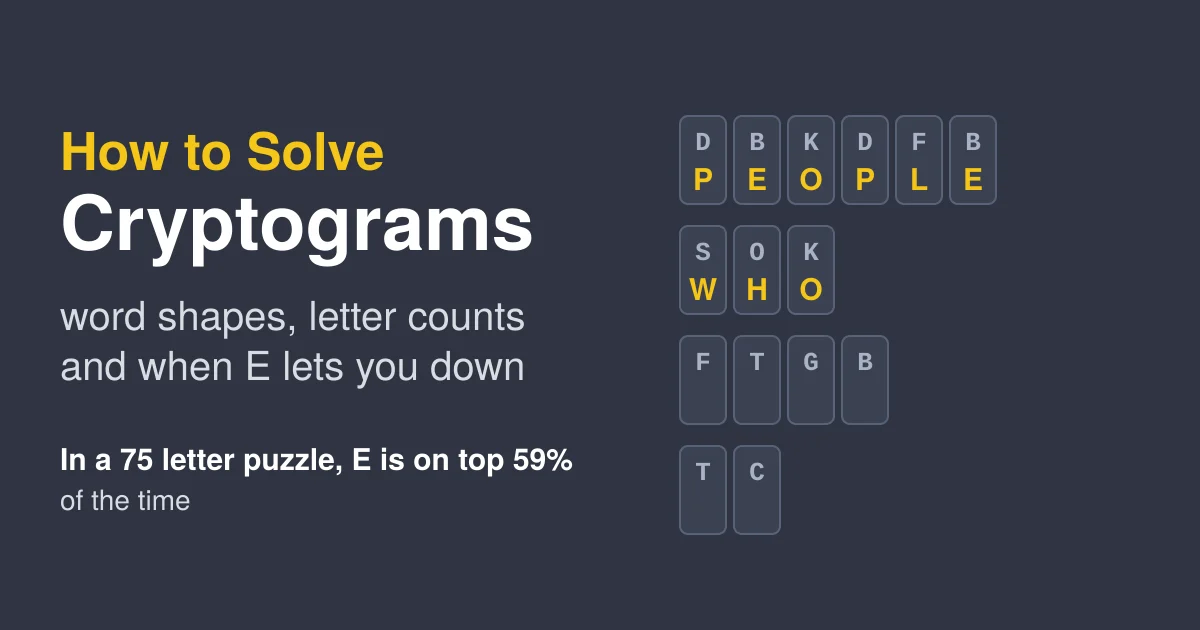
A cryptogram is a short sentence in code. Every letter has been swapped for a different one, the same swap all the way through, and your job is to swap them back. Every guide says to start with E, the most common letter in English. In a short puzzle, that tip is wrong much more often than you would think.
We tested it. We made 20,000 random English messages at each of seven lengths and counted how often E really came out on top. We also checked the 6,332 everyday words in our word list to see which ones give themselves away by their shape alone. Here is how to solve a cryptogram, and what the numbers say about each step.
How a cryptogram works
The puzzle maker picks a code: a list that pairs each letter with another one. A might become Q, B might become X, and so on. Then every letter of a sentence is replaced using that list.
- The same letter is always replaced the same way. If E became B once, it is B everywhere.
- Two different letters never share a code letter. If B stands for E, nothing else turns into B.
- Spaces and punctuation stay put. Word lengths, apostrophes and commas all survive the code, and they are your best clues.
- In most puzzles, no letter stands for itself. A Q in the puzzle is never a real Q.
You solve it by writing your guess for each letter under the code letter, and changing your mind as the sentence takes shape.
The code itself is big. There are about 4 x 10^26 ways to pair up 26 letters, a 4 followed by 26 zeros. Only 36.8% of them leave no letter standing for itself, so puzzle makers who follow rule 4 have to throw most random codes away and try again. That 36.8% is no accident: it is 1 divided by the number e (2.718...), a result first worked out about 300 years ago.
A worked example
Here is a puzzle we made from an old proverb with a random code.
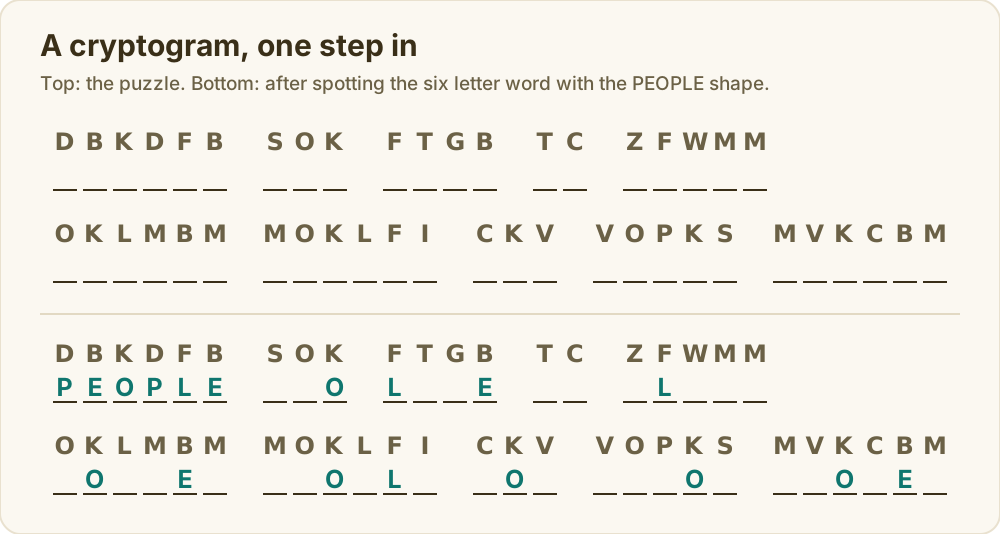
Do not count letters yet. Look at the first word, DBKDFB. Its first and fourth letters match (D), and so do its second and sixth (B). Write that shape as ABCADB. Out of 6,332 everyday words, only two have that shape: PEOPLE and PROPER.
Try PROPER. Then F is E and B is R, so the third word, FTGB, reads E _ _ R with four different letters. No everyday word fits. So it is PEOPLE: D is P, B is E, K is O, F is L.
Now the third word is L _ _ E: LIVE, LIFE, LIKE, LINE, LATE and a few more. The second word, SOK, is two new letters and an O: WHO, TWO and AGO are the common ones. Try them against the other words and the rest falls quickly. The words come out as GLASS, HOUSES, SHOULD, NOT, THROW and STONES, and the full answer is "People who live in glass houses should not throw stones."
One word with a strong shape did the work of a dozen letter counts. That is the main lesson of this guide.
Every word has a shape
A code changes letters, but not the pattern of repeats inside a word. THAT has the same letter first and last, and the code cannot hide it. We call that shape ABCA.
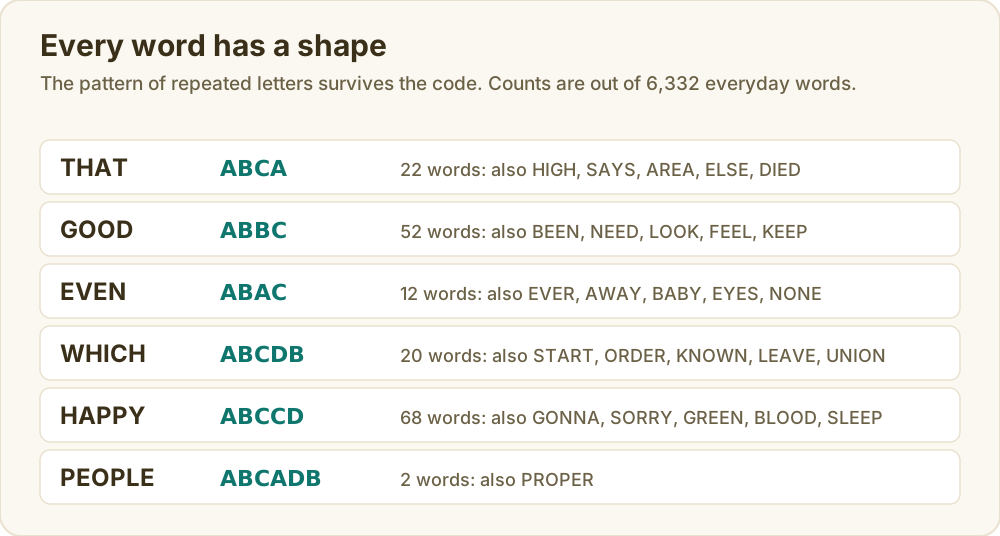
Some shapes are rare. Only 10 everyday three-letter words have the ABA shape: DID, MOM, EYE, WOW, DAD, POP and a few more. Only 15 have ABB, led by ALL, SEE, TOO, OFF and ADD. So a three-letter code word like XYX narrows things down a lot before you know a single letter.
55.6% of everyday words have at least one repeated letter, so most words in a puzzle carry some kind of shape. And the longer the word, the more its shape pins it down.
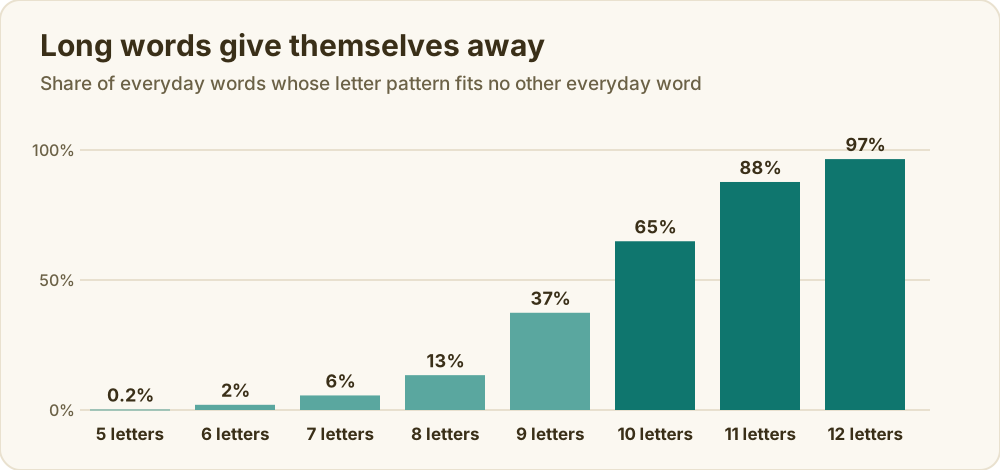
Short words share their shape with hundreds of others. But 65% of ten-letter words, and 88% of eleven-letter words, have a shape no other everyday word has. DIFFERENT, GOVERNMENT, BUSINESS, TOGETHER and REMEMBER are all one of a kind. If a puzzle has a long word with a few repeated letters, try to name it before anything else.
Short words: the other big clue
After shapes, the short words do the most for you:
- One-letter words are almost always A or I.
- The most common two-letter words are TO, OF, IN, IS, IT, ON, BE, AS, AT and HE.
- The most common three-letter words are THE, AND, FOR, YOU, WAS and ARE. A three-letter word that shows up twice in one puzzle is often THE.
- Apostrophes help too. One letter after an apostrophe is usually S, T, D or M (IT'S, DON'T, I'D, I'M). Two letters are usually RE, VE or LL.
Is the most common letter really E?
Every guide says to count the code letters and guess that the most common one is E. Across all of English, E is the most common letter by a wide margin.
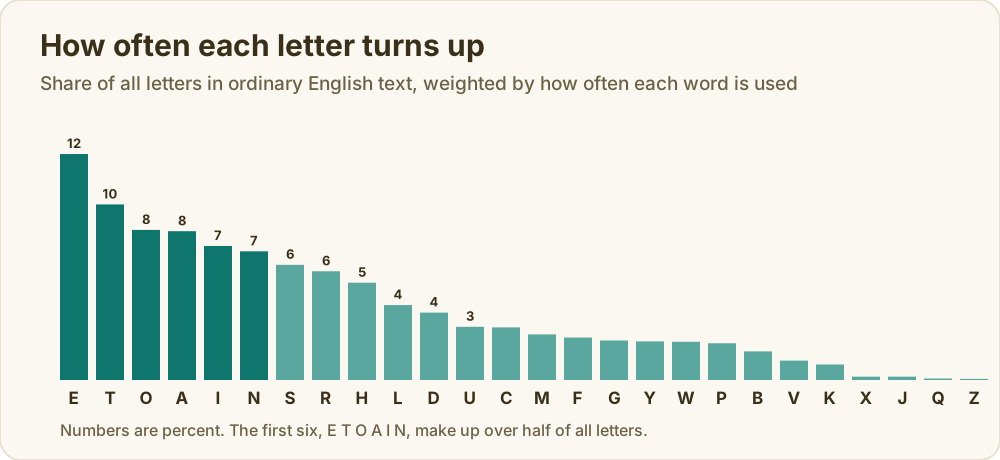
But a cryptogram is not all of English. It is usually a sentence or two, and small samples are noisy. To see how noisy, we built random messages from English words, picking each word as often as it is used in real writing, and counted the letters.
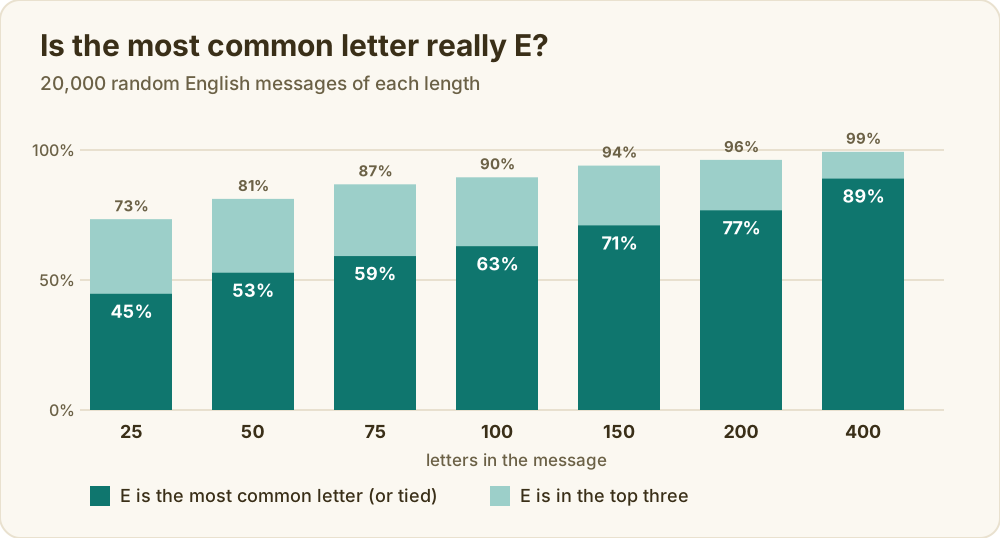
In a 75 letter message, E is the most common letter (or tied for it) only 59% of the time. In a 25 letter message, it is 45%. Even at 200 letters, E fails to come first almost one time in four. When E is not first, T, A or O usually is.
What does hold up is the top three. In a 75 letter message, E is among the three most common letters 87% of the time. So count the letters, but treat the top three as your E candidates, and let a word shape or a short word decide.
Tips that come straight from the numbers
- Look for shapes before you count. A word like PEOPLE (ABCADB) has only one other everyday word with the same shape.
- Start with the longest word that has repeated letters. Most everyday words of ten letters or more can be named from their shape alone.
- Use the short words. One-letter words are A or I. A three-letter word that appears twice is probably THE.
- Do not trust E blindly. In a typical puzzle, the most common code letter is E only about 6 times in 10. Check the top three.
- Remember no letter stands for itself in most puzzles. If a code letter is Q, the answer letter is not Q.
- Test guesses against every word. One wrong letter shows up as an impossible word somewhere else, the way PROPER broke the third word in our example.
How we checked
Our word list has 6,332 everyday words: words in the dictionary behind our games that turn up at least once in every 100,000 words of English, with names and places removed. For each word we worked out its letter shape and counted how many other words share it.
For letter counts, we used the 20,000 most common English words, weighted by how often each one is used, and joined random words until each message reached the target length. That gives messages with real English letter counts, though not real grammar. For each of seven lengths we made 20,000 messages, 140,000 in all. The code for both tests is in our site's repository.
Where cryptograms came from
Breaking letter swaps by counting letters is old. The Arab scholar al-Kindi described it in the ninth century. Edgar Allan Poe made it popular with readers around 1840: he challenged the public to send him codes to crack, and his story "The Gold-Bug" (1843) has its hero solve a cipher by counting symbols. Cryptograms have run in newspapers and puzzle books ever since, often as a famous quote with the speaker's name also in code.
Solve a cryptogram now
Try the tips on a real puzzle. Each one is an old proverb in a fresh random code, and as in most published puzzles no letter stands for itself. Tap a code letter and type the letter you think it stands for: your guess fills in everywhere that code letter appears. Under the keyboard the game counts how often each code letter shows up, so you can test the E rule from this article for yourself, and red letters warn you when two code letters share the same guess. On Easy the two most common code letters are solved for you, on Medium one is, and on Hard none. Check marks your wrong letters, Hint fills in the most common code letter you have not got yet, and Show answer ends the puzzle.
Frequently asked questions
What is the trick to solving cryptograms? Look at word shapes first. Repeated letters inside a word survive the code, and many longer words can be named from their shape alone. Then use short words like A, I and THE, and use letter counts last.
What is the most common letter in a cryptogram? Usually E, but not as reliably as people think. In a 75 letter puzzle it comes first only 59% of the time in our tests. T, A and O are the usual stand-ins.
Can a letter stand for itself in a cryptogram? In most published puzzles, no. Only about 37% of random codes have that property, so puzzle makers pick codes that do.
How many possible codes are there? About 4 x 10^26 for 26 letters, or about 1.5 x 10^26 if no letter may stand for itself. Far too many to try one by one, which is why shapes and short words matter.
If you like this kind of puzzle
Cryptograms reward the same skill as Hangman: working out a word from its length and the letters you already know. If letter counts interest you, we found out why Wordle avoids the letter N. A crossword works the same way from the other side: crossing letters fill in a word you could not get from its clue, and there is a mini to play at the end of that guide. For more pencil and paper favourites, see our list of the best classic word games.
Related articles
How to Play Hangman, and the Best Letters to Guess
The rules of Hangman, the best first letter for every word length, and why MOM, not JAZZ, is the hardest everyday word, from 6,298 words played by computer.
How to Play Word Ladder, and Why Some Words Can't Be Reached
The rules of word ladder, Lewis Carroll's own tip tested on 3,100 everyday words, the hub words that make ladders easy, and why ABOUT and PEOPLE can never be used.
How to Use a Word Unscrambler Without Spoiling the Puzzle
A word unscrambler will hand you 348 words you did not ask for. The skill is narrowing it to the six that fit, without spoiling the answer.