
Lewis Carroll turned HEAD into TAIL in five steps in 1879, and people have been climbing word ladders ever since. The rules fit in one sentence. What the rules do not tell you is that some everyday words have no ladder at all, that one four letter word connects to fourteen others, and that Carroll's own advice for solving them holds up when you test it on thousands of words.
This guide covers the rules, a short history, and then what we found when we built a map of every everyday English word of three to six letters and checked how they connect.
How to play word ladder
You get a start word and an end word of the same length. Your job is to turn one into the other.
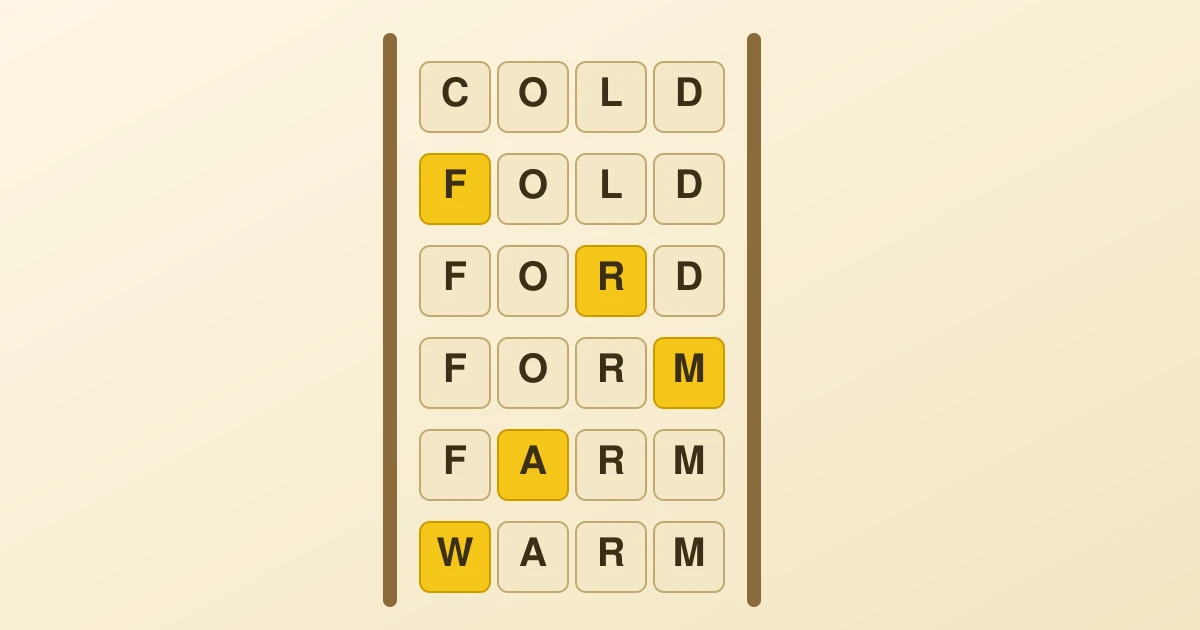
- Change exactly one letter per step. COLD can become CORD or FOLD, but not FORM, because that changes two letters.
- Every step must be a real word. No names, no abbreviations, nothing made up.
- Keep the letters in their places. You swap a letter for a new one; you never shuffle the order or add a letter.
- Fewest steps wins. Any ladder that gets there counts as solved, but the best ladder is the shortest.
Here is the classic, next to the same puzzle solved with everyday words only.
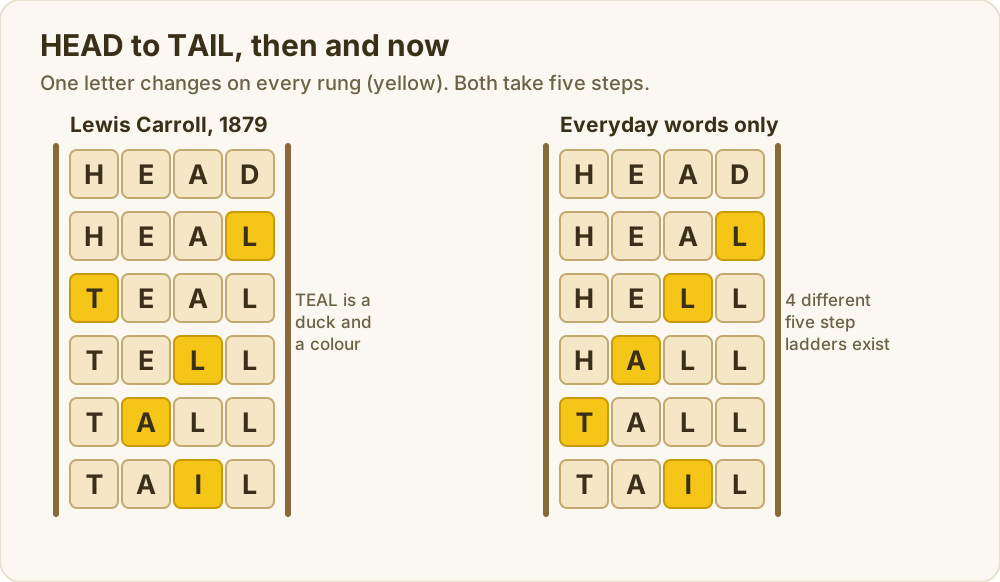
Each rung changes one letter, shown in yellow. Carroll's version goes through TEAL, a duck and a colour. With everyday words you can go through HELL and HALL instead, and there are four different five step ladders in all.
Many newspapers and apps run a daily word ladder. The best known online is Weaver, which uses four letter words. Some versions add twists, such as Weaver X, which lets you add or remove a letter as well as change one.
Where to play: Weaver (website)
Where the game came from
Carroll said he invented the game at Christmas 1877 for two young friends who had nothing to do. He first wrote about it in his diary in March 1878 as "Word-links", and on 29 March 1879 he started printing puzzles in Vanity Fair under the name Doublets. In his letter introducing them he called the given pair a Doublet, the words in between Links and the whole thing a Chain, and asked that the links be words "such as might be used in good society".
The game has had plenty of names since. A 1927 puzzle book called it Laddergrams. Vladimir Nabokov called it word golf in his novel Pale Fire, where the narrator brags of turning HATE into LOVE in three steps and LIVE into DEAD in five. Donald Knuth, the computer scientist, studied five letter ladders with a computer and found that many common words had no neighbours at all. He called them aloof, and noted that ALOOF is one of them. (Wikipedia's word ladder page has the sources for all of these.)
How we checked
We took every word of three to six letters that scores 4.0 or higher on the wordfreq frequency scale (roughly, words you meet at least once in every 100,000 words of English), kept only real dictionary words, and removed names, abbreviations and anything offensive. That gave 3,103 everyday words: 254 of three letters, 778 of four, 995 of five and 1,076 of six.
Then we linked every pair that differs by exactly one letter in the same place and measured the result: which words have no links, how many words sit in one connected group, the shortest ladder between every pair, and the longest of those shortest ladders. The script and its output are saved with this post.
| Letters | Words | No neighbour at all | In the biggest group | Average shortest ladder |
|---|---|---|---|---|
| 3 | 254 | 4.7% | 92.5% | 4.3 steps |
| 4 | 778 | 11.3% | 80.8% | 7.1 steps |
| 5 | 995 | 36.8% | 12.7% | 7.5 steps |
| 6 | 1,076 | 64.2% | 1.7% | 4.9 steps |
The six letter average looks short only because the few six letter words that do connect sit in tiny groups.
Longer words fall apart
This is the biggest thing the numbers show. Three and four letter words form one large web. Almost any two of them can be joined. By five letters the web has broken into 470 separate pieces, and by six letters almost nothing is left.
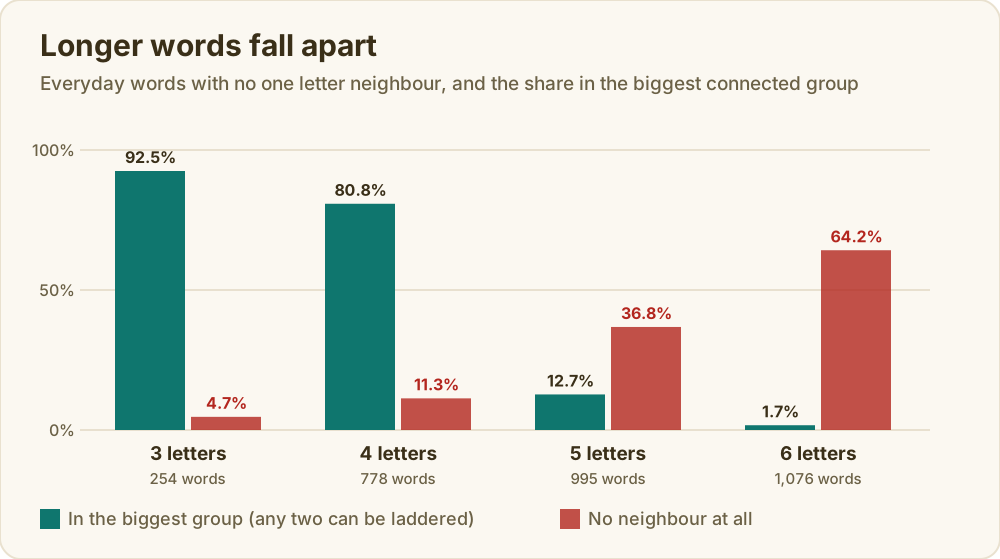
That is why almost every word ladder you will find uses four letter words. Knuth thought four was too easy and preferred five, but he was using 5,757 words, many of them rare. Stick to everyday words and five letter ladders mostly do not exist. WHEAT to BREAD and BLACK to WHITE, two pairs you might expect in a puzzle book, cannot be joined at all with everyday words.
The biggest six letter group is a small cluster of words ending in ING, plus DIVIDE and DIVINE: MOVING, LOVING, LIVING, DIVING, DINING, MINING, MIXING, FIXING, FIRING, HIRING, HIDING, RIDING and RISING are all in it. That is 18 words out of 1,076.
Some words can never be used
Knuth's aloof words turn up in everyday English too, and they are some of the most common words we have.
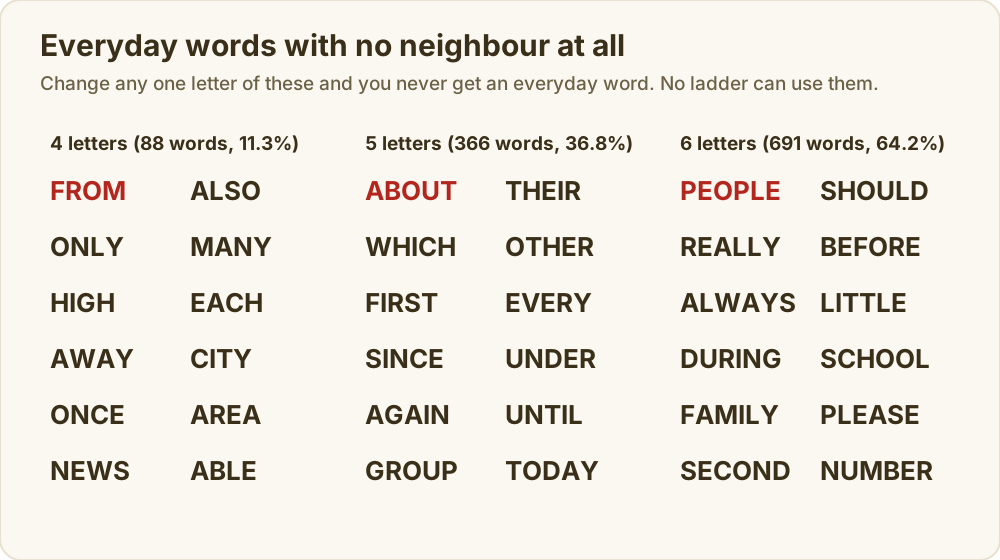
Change any single letter of FROM, ONLY or CITY and you never land on another everyday word. The same goes for ABOUT, WHICH and FIRST, and for PEOPLE, SCHOOL and FAMILY. A ladder cannot start, pass through or end on any of them. Among three letter words the lonely ones are few, and they include YOU, OFF, USE and OIL.
If you are ever stuck on a rung and none of your ideas works, check whether the word you are aiming for is one of these. Sometimes the puzzle is not hard. It is impossible.
Carroll's tip, tested
In the same 1879 letter Carroll gave one piece of advice. The easiest Doublets, he said, are the ones where consonants in one word line up with consonants in the other, and vowels with vowels. HEAD and TAIL are like that: consonant, vowel, vowel, consonant in both. HEAD and HARE are not. When the shapes do not match, he said, first change one word until they do, and the rest is easy.
We tested that on every pair of connected words.
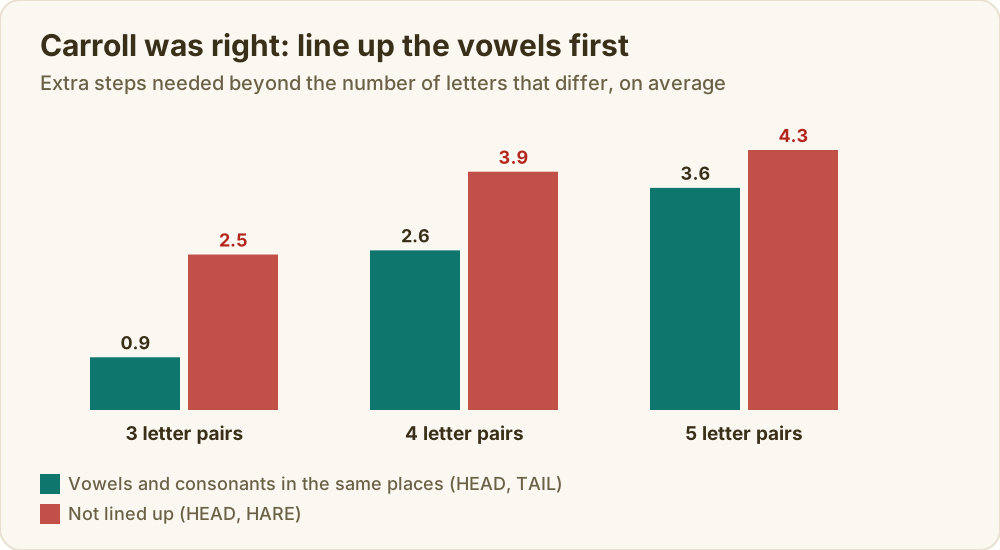
The measure is extra steps: how many more steps the shortest ladder needs than the number of letters that differ. When the vowels and consonants line up, three letter pairs need under one extra step on average. When they do not, they need two and a half. Four letter pairs show the same gap, 2.6 against 3.9. Carroll was right, nearly 150 years before anyone could check it by computer.
Head for the hubs
Some words are crossroads. CARE has 14 everyday neighbours, more than any other four letter word, and CAKE has just as many.
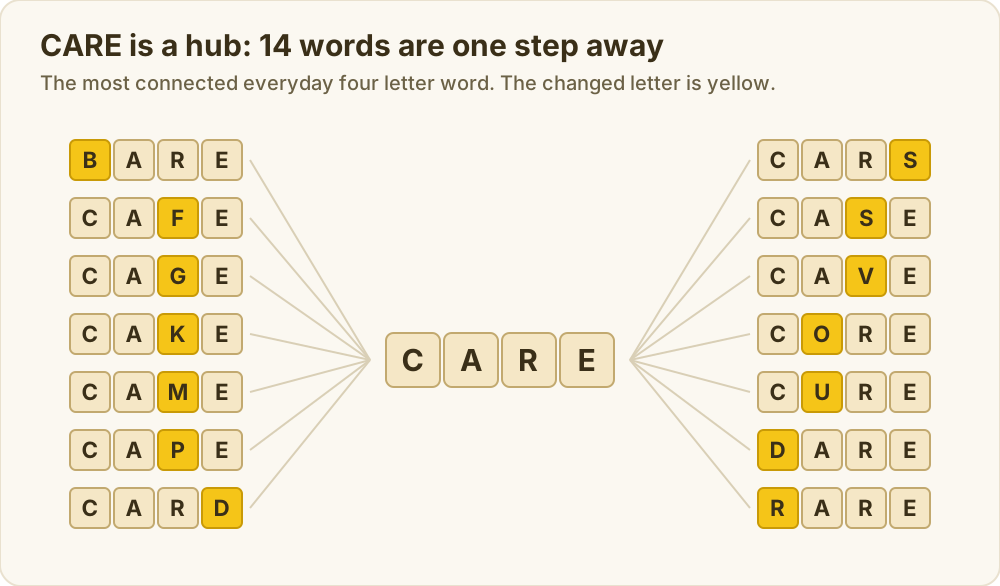
Words like these are good stepping stones. From CARE you can change the first letter (BARE, DARE, RARE), the second (CORE, CURE), the third (CAFE, CAGE, CAKE, CAME, CAPE, CASE, CAVE) or the last (CARD, CARS). If you can reach a word shaped like CARE, a consonant, a vowel, a consonant and a final E, you have opened a lot of doors. Among three letter words the busiest is BET, with 15 neighbours, followed by SET, BAY and BAT.
Five letter words have fewer hubs. The busiest is SHARE, with nine, then the IGHT family (RIGHT, MIGHT, NIGHT, LIGHT, FIGHT) with seven each. Plurals do a lot of the work: 72% of the words in the biggest five letter group end in S, against 26% of five letter words overall.
The longest everyday ladder
Most pairs of connected four letter words are about seven steps apart. A few are much further. The longest shortest ladder we found joins ACTS and KNEE, and it takes 22 steps.
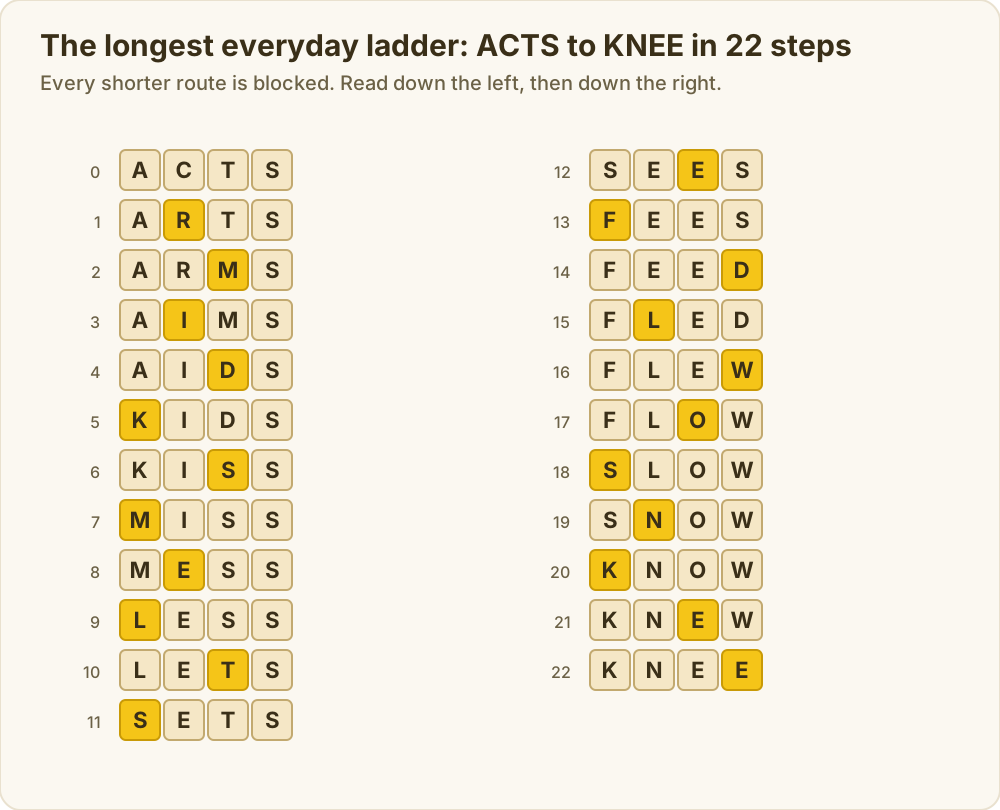
There may be other 22 step routes, but there is no shorter one. Among three letter words the longest is EGG to WHO in 13 steps, and among five letter words ROCKY to SIZED in 20.
Nabokov's records look different with this in mind. With everyday words only, HATE to LOVE takes five steps, not three, and LIVE to DEAD takes eight, not five. His narrator must have used some rare words along the way. COLD to WARM is harder than it looks too: the Wikipedia page lists seven four step ladders from COLD to WARM using a full Scrabble dictionary, but with everyday words the shortest takes five steps, and there are only two of them.
| Pair | Shortest everyday ladder | Steps |
|---|---|---|
| HEAD to TAIL | HEAD, HEAL, HELL, HALL, TALL, TAIL | 5 |
| COLD to WARM | COLD, FOLD, FORD, FORM, FARM, WARM | 5 |
| HATE to LOVE | HATE, GATE, GAVE, GIVE, LIVE, LOVE | 5 |
| POOR to RICH | POOR, POOL, POLL, PILL, MILL, MILE, MICE, RICE, RICH | 8 |
| LIVE to DEAD | LIVE, FIVE, FILE, FILL, FELL, HELL, HEAL, DEAL, DEAD | 8 |
Tips for solving
- Line up the vowels first. If the start and end words have vowels in different places, spend your first steps fixing that. It is Carroll's tip and the numbers back it.
- Count the letters that differ. That is the fewest steps the ladder can possibly take. If you are well over it, look for a shorter route.
- Work from both ends. Write a few neighbours of the end word as well as the start word, and look for a word that appears on both lists.
- Aim for a hub. Words shaped like CARE, BET or SHARE connect to many others, so they make good middle rungs.
- In five letter ladders, go plural. Plurals and S endings hold the five letter web together.
- Know when it is impossible. If the end word is FROM, ABOUT or PEOPLE, no ladder of everyday words reaches it.
Make your own
Making a good ladder for a friend is a puzzle of its own. Pick two words with the same vowel shape, such as HEAD and TAIL or COLD and WARM, so the puzzle is fair. Check that neither word is aloof by trying every one letter change. And aim for five to eight steps: shorter is too easy, and longer, like ACTS to KNEE, tends to feel like a slog.
Play word ladder now
Try it here. Each puzzle joins two common four letter words, and par is the shortest ladder that uses everyday words. Any real four letter word is allowed on a rung, so if you know a rare word that cuts a step, you can beat par. Under the ladder the game shows the fewest steps still needed from where you are, which is the same count the map in this article uses. Stuck? Hint fills in the next step of a shortest route, Undo takes back a rung, and Show a solution ends the puzzle with a par ladder. Easy puzzles have a par of three or four, Medium five or six, and Hard seven to nine.
If you like this kind of puzzle
Word ladders are about how words sit next to each other, one letter apart. Our Hangman guide uses the same everyday word list to find the best letters to guess, and why Wordle hates the letter N looks at letter patterns in five letter words. If you want a daily puzzle where you build the hidden word from two letter tiles, try Pairdle, the word game we make.
Related articles
How to Play Hangman, and the Best Letters to Guess
The rules of Hangman, the best first letter for every word length, and why MOM, not JAZZ, is the hardest everyday word, from 6,298 words played by computer.
Scrabble Words That Win: 2-Letter Words, Q Without U, Bingos
All 107 two-letter Scrabble words, the Q words with no U, vowel dumps, where J, X and Z score most, and how to set up a 50-point bingo.
How to Play Word Search and Find Every Word Faster
The rules of word search, the scan order that clears a grid fastest, the extend-until-blocked trick, and a chart of the letter chunks that give words away.