
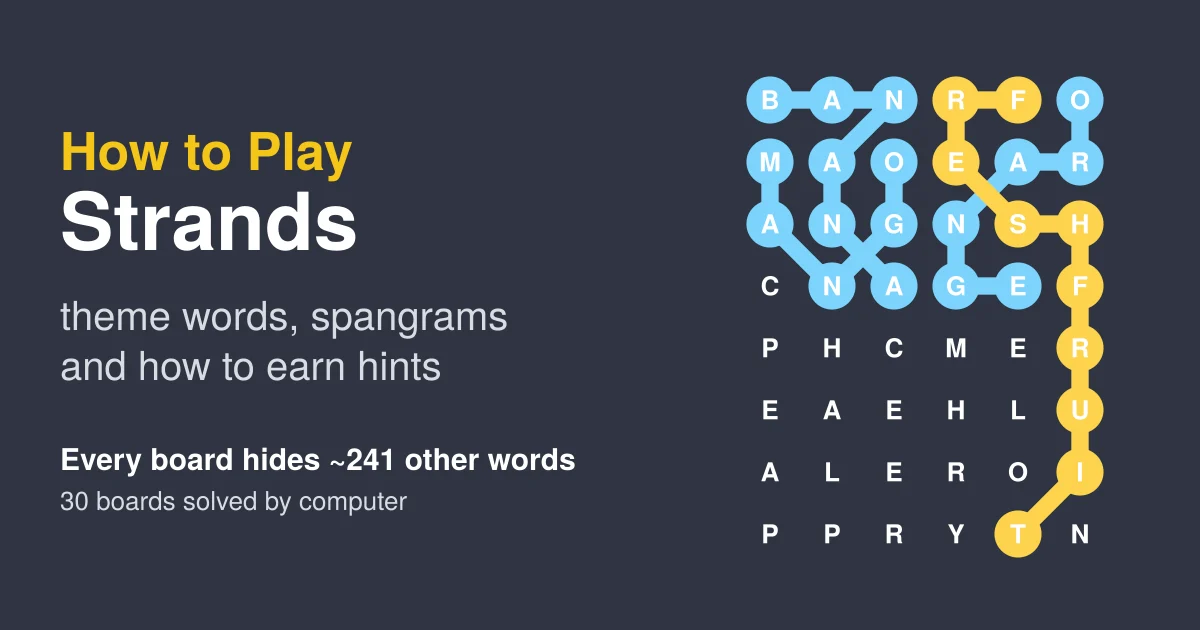
Strands looks like a word search, but it plays like a puzzle. There is no list of words to find. You get a short clue, a grid of 48 letters, and one rule that sets it apart: every letter in the grid belongs to exactly one answer. Nothing is filler.
This guide covers the rules, how the spangram works, how to earn hints, and a set of tips. To back them up we built 30 Strands-style boards of our own, solved each by computer, and counted what else hides in them. There is a playable version at the end, with all 30 boards.
How to play Strands
Strands is a daily puzzle from the New York Times Games app. Our version below works the same way.
- You get a grid of 6 columns and 8 rows, 48 letters in all, and a theme clue. The clue is often a pun or a hint rather than a plain label.
- Find the theme words. Each one is traced through touching letters: up, down, across or on a slant. A word can turn corners, but it cannot use the same letter twice.
- Find the spangram. It is one word or phrase that names the theme, and it stretches from one side of the grid to the opposite side.
- Every letter is used exactly once. When the theme words and the spangram are all found, the grid is completely filled. No letters are left over and no answers overlap.
- Other words earn hints. Any real word of four or more letters that is not an answer counts toward a hint.
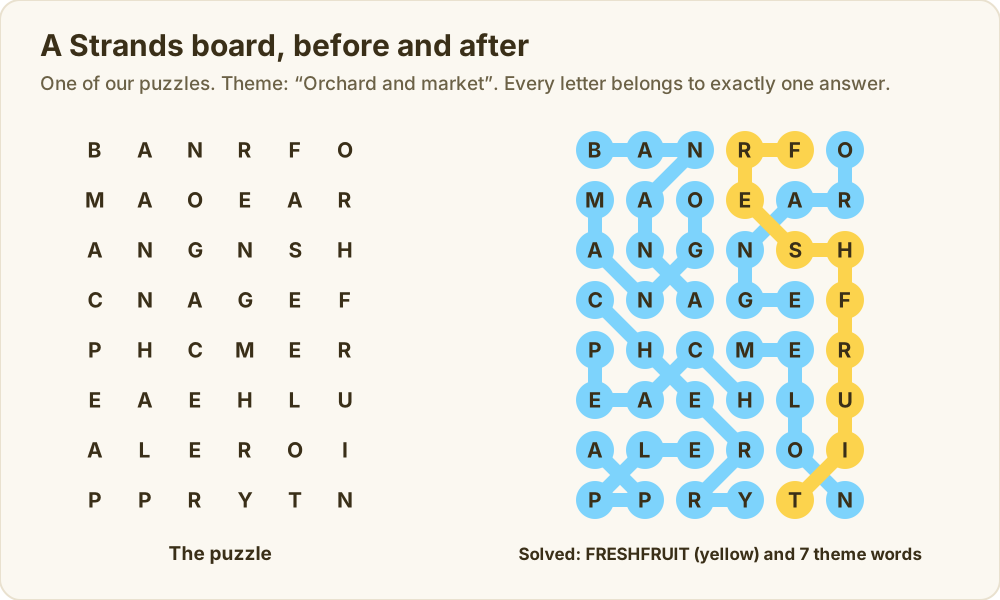
On the board above, the clue is "Orchard and market". The spangram is FRESHFRUIT, which runs from the top of the grid to the bottom, and the seven theme words are fruits. Found answers turn blue, and the spangram turns yellow.
How tracing works
You select letters one at a time, and each new letter has to touch the one before it, in any of eight directions. That means a word can snake around the grid, double back, and cross the line of another word on a slant.
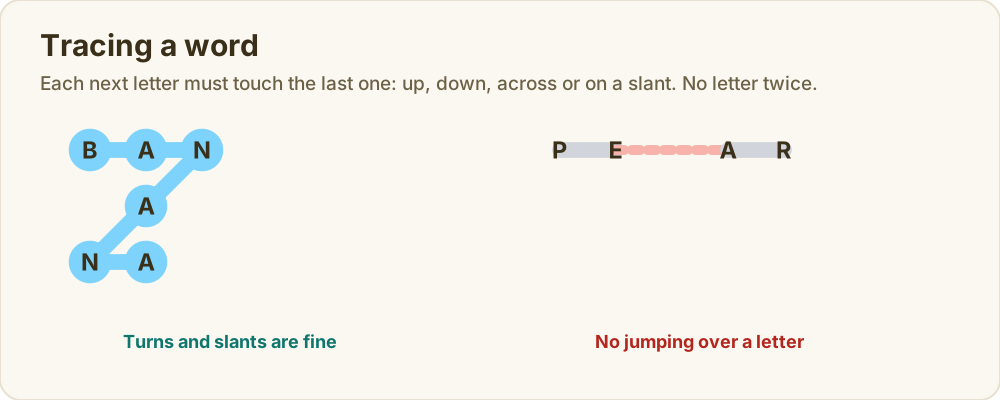
This is why Strands is harder than a normal word search. Answers are rarely in straight lines. A 6 by 8 grid has 9,616 different paths of four letters, counting every turn and slant, and 50,096 paths of five letters. You cannot check them all by eye, so you need a plan.
The spangram
The spangram is the key to every board. It names or describes the theme, it is usually two or more words run together, like FRESHFRUIT or OCEANLIFE, and it must touch two opposite sides of the grid: left and right, or top and bottom.
That last rule is the most useful clue in the game. The spangram is long, often 8 to 12 letters, and it has to cross the whole board. If you can guess the theme from the clue, look for its first letter near one edge and follow it across. Once the spangram is in place, it splits the grid into two smaller areas, and the theme words have to fit inside them exactly.
How hints work
If you are stuck, you can earn a hint by finding words that are not answers. In the Times version, every three non-theme words of four or more letters fill the hint meter. Use a hint and the game shows you the letters of one theme word, but not their order, so you still have to trace it.
You might think hints are rare. They are not. We counted every real word of four or more letters, other than the answers, hiding in each of our 30 boards.
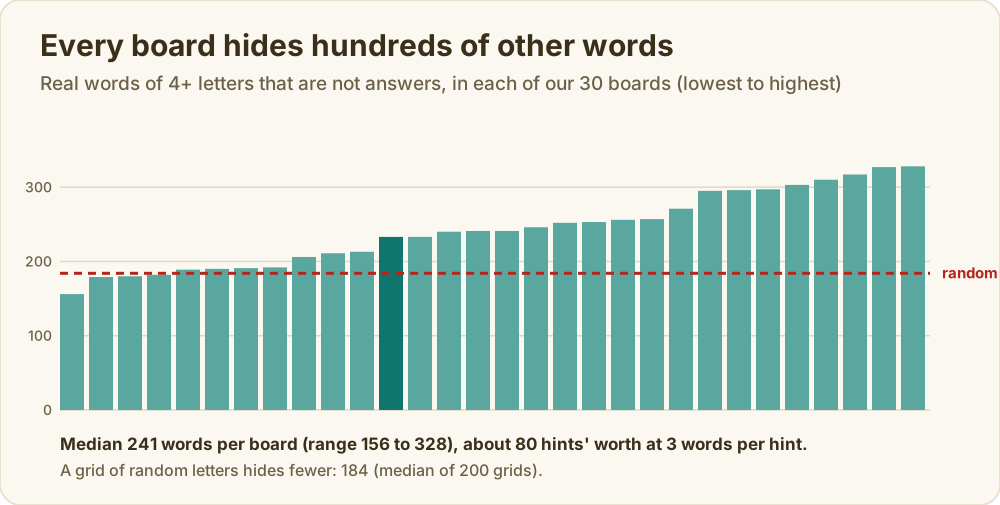
The typical board hides 241 other words, from 156 on the hardest board to 328 on the easiest. At three words per hint, that is about 80 hints' worth on a board that has only seven or eight answers. About half of those extra words (53%) are just four letters long, so short words are the fastest way to fill the meter.
Real puzzles also hide more words than random grids do. A grid of 48 random letters, with letters drawn by how often they appear in English words, hid 184 words in the middle case. A Strands board is built from real words packed together, so the joins between them form more words by accident.
Watch out for near misses
The most common trap is a longer word that wraps around a real answer. The game accepts it as a hint word, but it does not count as the answer, and the letters stay unsolved.
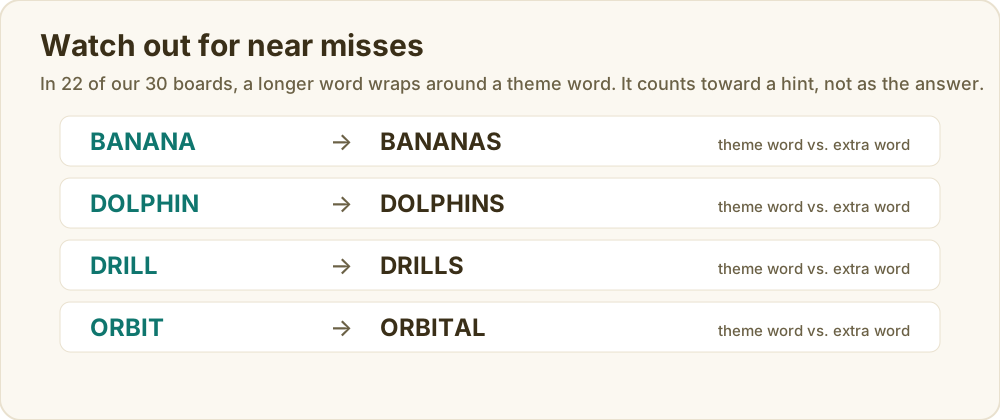
In 22 of our 30 boards, at least one theme word could be stretched into a longer word using a touching letter: BANANAS and ORANGES on the fruit board, DOLPHINS and CORALS on the ocean board, ORBITS and ORBITAL on the space board. If you trace a plural and it only counts toward a hint, try again without the last letter. Since every letter belongs to exactly one answer, that extra S belongs to a different word.
Strands tips that come from the numbers
- Read the clue twice. It is often a pun. Try to name the theme before you trace anything.
- Go for the spangram early. It crosses the whole grid and splits the rest into two smaller puzzles.
- Start in the corners. A corner letter touches only three others, so the word that uses it has few ways to go. A middle letter touches eight.
- Look for rare letters. A Q, J, X, Z or K usually belongs to only one possible answer. Work out which.
- Count the leftovers. Every letter is used once. If a pocket of letters is cut off by found words, it must spell exactly one answer or a few that fit together.
- Use short words for hints. Every board hides hundreds of extra words, and half of them are four letters long.
- Drop the S. If a plural counts as a hint, the singular is probably the answer.
How we checked
We wrote 30 themes, each with a spangram and a list of theme words, and a program packed them into 6 by 8 grids so that every letter was used exactly once. For the counts, a second program traced every possible path through each grid and checked it against a word list of about 23,500 common English words, leaving out the answers, names and rude words. The random grids are 200 grids of letters drawn by how often they appear in English words, searched the same way. The path counts are exact: we counted every path of four and five letters, from every starting cell, that never reuses a cell. The boards are our own and are not copies of any Times puzzle. The code is in our site's repository.
Where Strands came from
The New York Times added Strands to its Games app in 2024, after a beta test, alongside Wordle, Connections, the Mini and Spelling Bee. It borrows the grid of a word search, but the rule that every letter must be used, and the spangram that ties the theme together, make it a different kind of puzzle. A new board comes out every day.
Frequently asked questions
What is a spangram in Strands? A word or phrase that names the theme and stretches from one side of the grid to the opposite side. Every board has exactly one.
How do hints work in Strands? Find three real words of four or more letters that are not answers, and the hint meter fills. A hint shows the letters of one theme word, but you still have to trace it.
Can words go diagonally in Strands? Yes. Each letter can touch the next one in any of eight directions, and words can turn corners. You cannot reuse a letter in the same word.
Does every letter get used in Strands? Yes. When the puzzle is solved, every one of the 48 letters belongs to exactly one theme word or the spangram.
How many words are in a Strands puzzle? Usually six to eight theme words plus the spangram. Our boards hide about 240 other real words as well, which is why hints come so easily.
Play a Strands puzzle now
Here are our 30 boards. You get a random one with its theme clue. Tap letters that touch to build a word, then tap the last letter again or press Enter to submit. On a phone or with a mouse, you can also drag across the letters. Theme words turn blue and the spangram turns yellow. Every three extra words earn a hint, which circles the letters of one theme word. "Show answers" reveals the board, and "Next puzzle" deals a new one.
You might also enjoy: Word Bend in Game Attic, free in your browser. Every letter in its grid also belongs to exactly one word, but there is no theme clue and no spangram, and words only step up, down, left or right, never on a slant.
If you like this kind of game
Strands sits between a word search and a crossword. If you like tracing words through a grid, try our guide to Boggle, which uses the same rule of touching letters. For more letter puzzles, see Letter Boxed and Spelling Bee, or go back to where daily word games started with Wordle.
Related articles
How to Play Skyline Bounce: Flick and Climb 20 Towers
The official guide to Skyline Bounce for iPhone and Android: the flick, the safety floor, bank pockets, and all 20 towers from 12 to 180 floors.
Pairdle 1.5: What's New, What's the Same, and an Exciting New Level
Pairdle 1.5 puts every level on one row, unlocks Pro, adds Expert and endless Practice, and introduces Olly the owl. Plus what a 12-tile board really holds.
How to Play Sudoku: A Complete Beginner's Guide
New to Sudoku? Learn the one rule behind the game, how to read the grid, and the beginner techniques that take you from stuck to solved. No math required.