
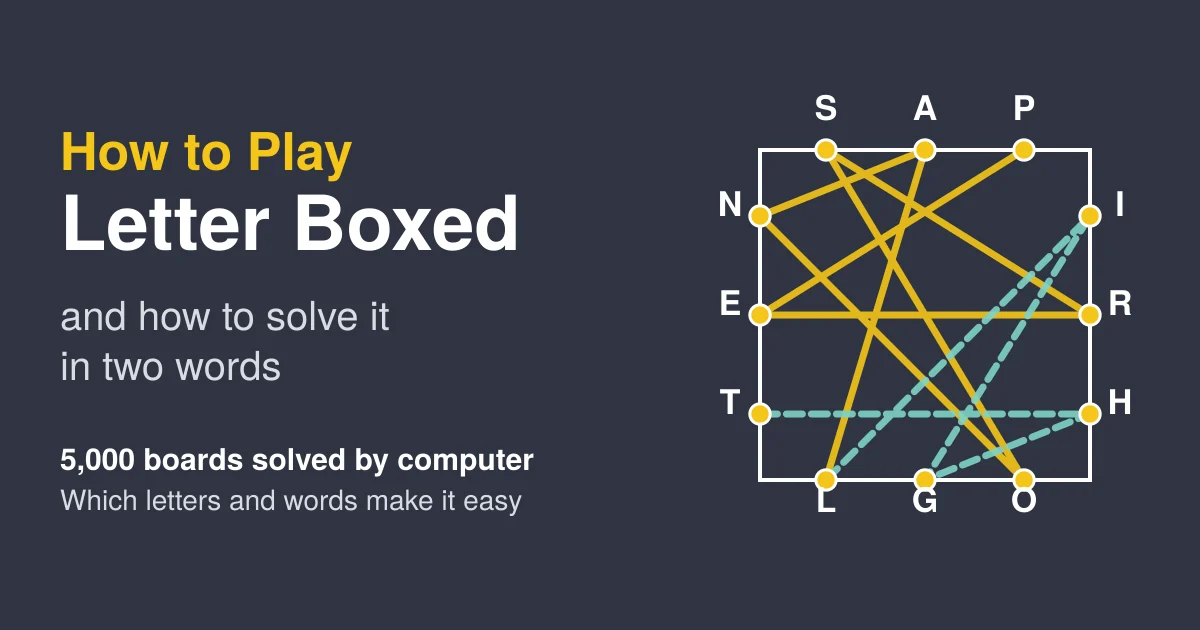
Letter Boxed gives you twelve letters around a square and asks you to use all of them. The rules fit in four lines. The hard part is the goal the game sets you each day: use as few words as you can. Strong players try for two.
So we asked a computer the question people type into Google: can every Letter Boxed board be solved in two words? We made 5,000 random boards and searched each one for its shortest answer, using three word lists, from everyday words up to a full dictionary. The answer depends a lot on how many words you know, and it points to a few habits that make two-word answers much easier to find.
How to play Letter Boxed
The board is a square with three letters on each side, twelve letters in all, and no letter appears twice.
- Spell a word by tapping letters. Words need at least three letters.
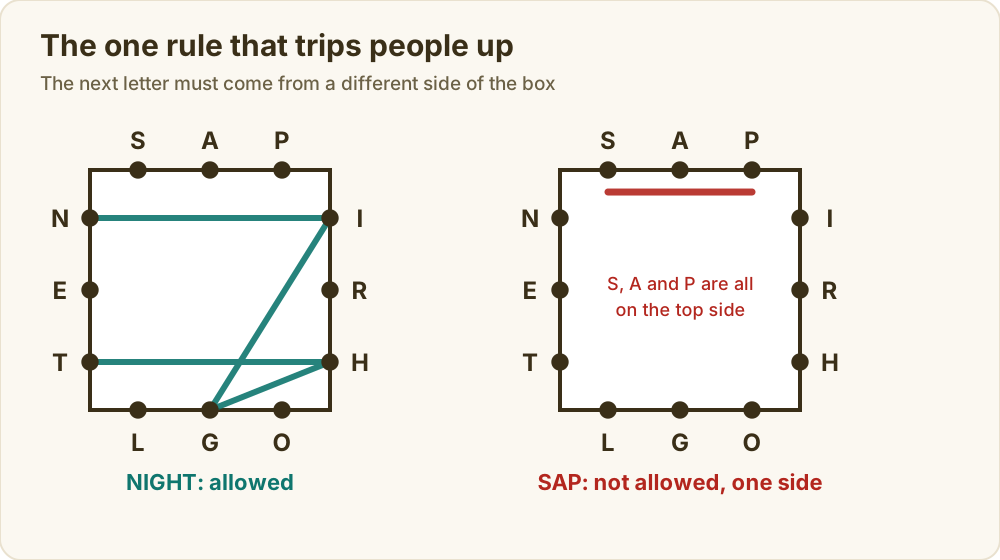
- Each next letter must come from a different side of the square. You can go to any side except the one you are on. Two letters from the same side in a row are never allowed.
- Each new word starts with the last letter of the word before. If your first word ends in L, your second word begins with L.
- You can use a letter as many times as you like.
- You win when every one of the twelve letters has been used at least once.
Names, places and words with hyphens do not count. Plurals and other everyday word forms do.
The New York Times shows a target each day, "Try to solve in 5 words" or similar. Beating it is up to you. The answer the Times posts the next day is usually just two words.
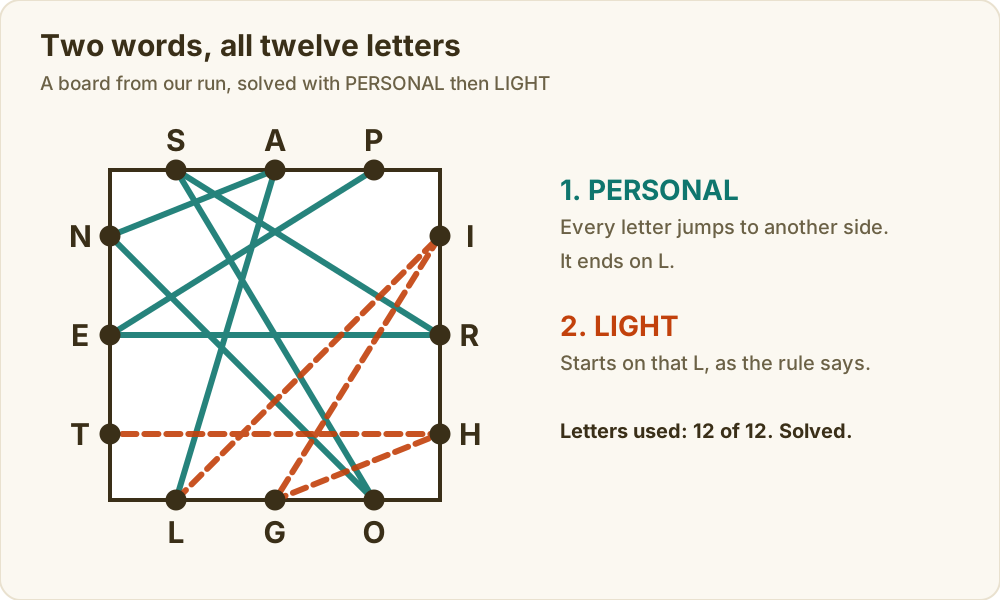
Here is a board from our run. PERSONAL zigzags from side to side and ends on L. LIGHT starts on that L and picks up the four letters PERSONAL missed: I, G, H and T. Twelve letters, two words.
The side rule, and the words it bans
The side rule is the one that catches new players. On the board above, SAP is a real word, and all three of its letters are right there on the top side. You still cannot play it, because every step would stay on the same side.
The same rule also bans every word with a double letter. The second L in ALL sits on the same side as the first L, because each letter appears once on the board. That knocks out a big share of English. Of the 6,337 everyday words in our list (words you meet at least once in every 100,000 words of English), 17% have a double letter and can never be played. That includes some of the most common words there are.
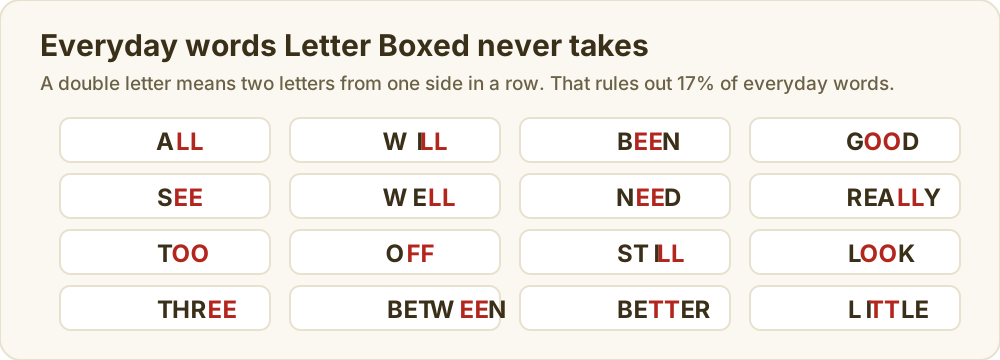
When you are stuck, check whether the word you are reaching for has a double letter. BETTER, LITTLE and SCHOOL feel like they should work. They never will.
How we checked
We built boards the way the real game looks: four vowels from A, E, I, O and U, plus eight different consonants. Common consonants like T, R, S and N turn up more often than rare ones like X and K, in the same proportion as in everyday words. Then the letters were shuffled onto the four sides.
For every board, a computer found the fewest words that use all twelve letters, trying everything up to six words. It did this three times, with three word lists:
- Everyday words: 6,337 words, the ones you see every day.
- Common words: 22,594 words that most adults know.
- Full dictionary: 185,660 words, the kind of list a word game checks against.
All three lists leave out names and places, as the game does. The code and its full output are in our site's repository, and every number below comes from that run.
Can every board be solved in two words?
Not with the words most of us use. With a big enough dictionary, nearly.
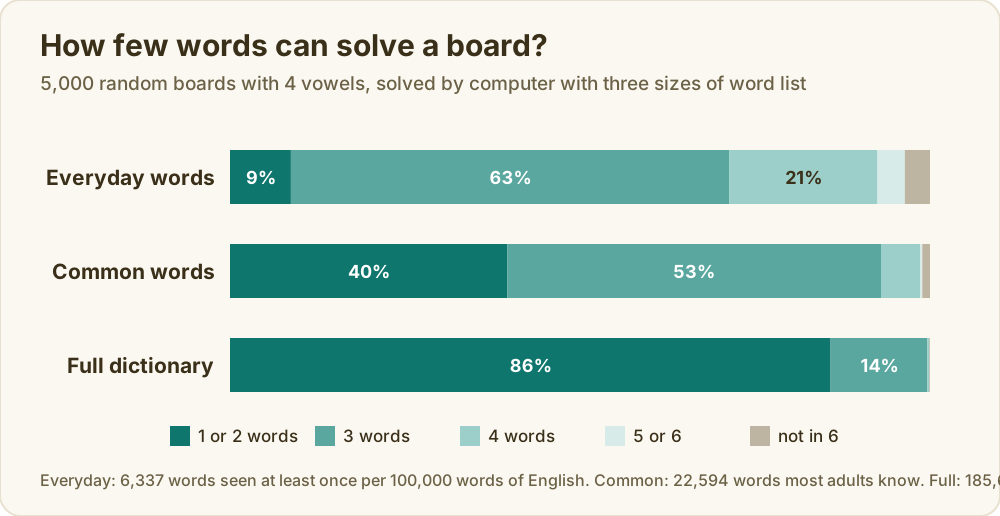
With everyday words alone, only 9% of boards have a two-word answer. Three words is the normal best: 63% of boards. With the 22,594 common words, two-word answers jump to 40%. With a full dictionary it is 86%, and a handful of boards (0.3%) could even be solved with one long word.
So the two-word answer is almost always there, but it often uses a word you would not say out loud on a normal day. When a puzzle feels impossible in two, the missing piece is usually one less common word, not a trick you have not seen.
A typical board allows about 168 everyday words, 441 common words and 1,496 dictionary words. Most of those are short, and short words are what fill your list when you go for five or six. The long ones are what make two possible.
For a fair three-word target on our example board, everyday words give 2,205 different ways to finish. PERSON, NATIONAL, LIGHT is one. NIGHT, TOP, PERSONAL is another.
Why the Times boards are easier than random letters
Twelve letters picked at random would be a different game. When we drew all twelve from the whole alphabet, 86% of those boards could not be solved in six everyday words at all, and only 2.5% had a two-word answer even with the full dictionary. Getting four vowels and mostly common consonants is what makes a board playable.
Within that, the number of vowels still matters.
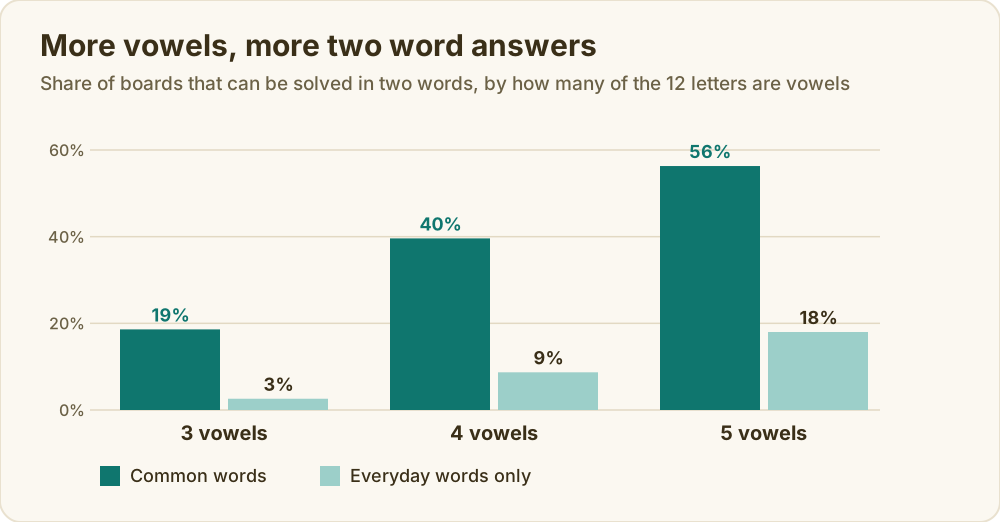
A board with three vowels has a two-word answer in common words 19% of the time. With five vowels it is 56%. So when you see only three vowels, expect a harder day and count on three words unless you know some unusual ones.
The letter where two words meet
In a two-word answer, the first word ends on the letter the second word starts with. We looked at every two-word answer in common words, across all the boards, and checked which letter that was.
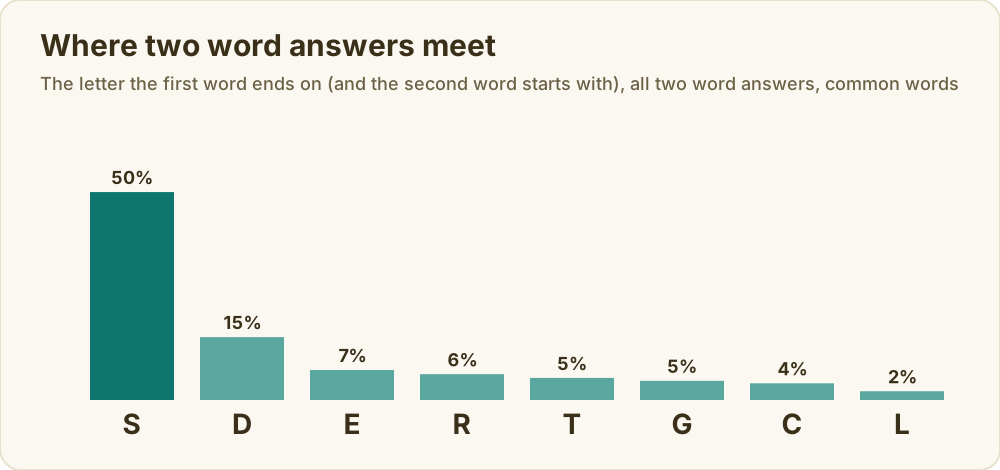
Half of all two-word answers meet on S. The next most common meeting letter is D, at 15%. Both make sense once you see why. Lots of words end in S (plurals, and verbs like RUNS) and lots of words start with S. D works for the same reason: past tenses end in D, and plenty of words start with it.
This is the most useful habit we found. When there is an S on the board, look for a long first word that ends in S, then look for a word starting with S that covers what is left. Same with D and words ending in -ED.
Letters that make a board hard
Some letters drag a board down. For each letter, we checked how often boards with that letter could be solved in two common words.
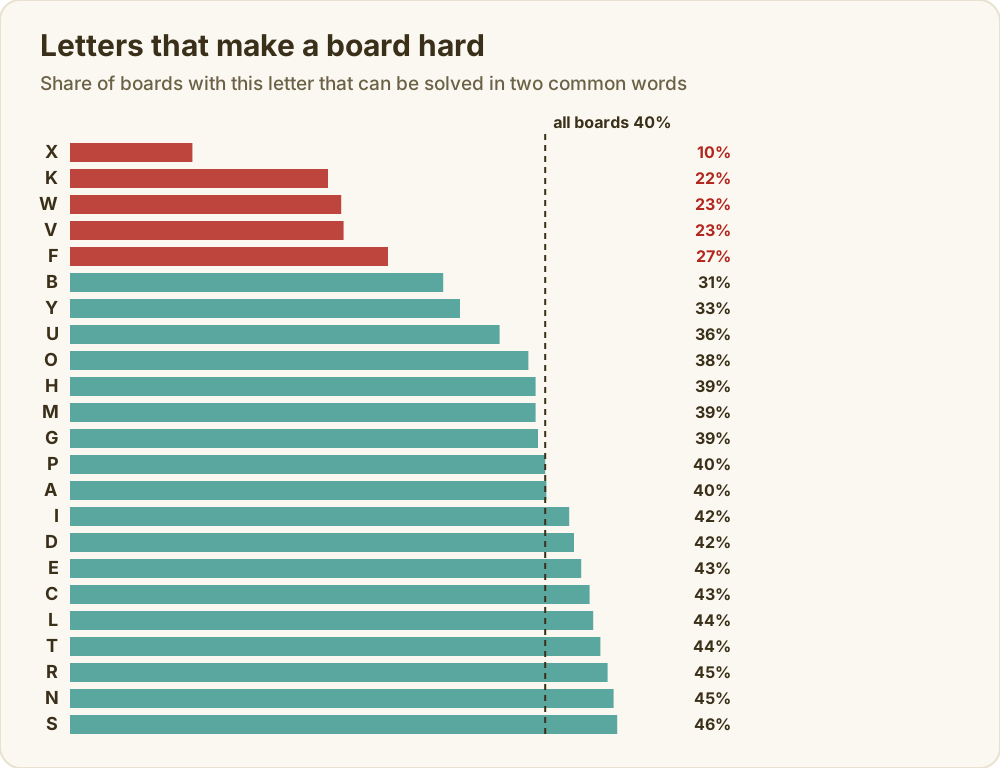
Across all boards the rate is 40%. With an X on the board it falls to 10%. K, W and V cut it to about 22%, and F to 27%. These letters sit in few words, and the words they do sit in often have the wrong neighbours.
The fix is to plan around them first. Before you look for a long word, find a word that uses the X or the K and see where it can end. Then build the rest of the answer from that word.
How long are two-word answers?
Two-word answers in common words add up to between 15 and 19 letters about three times in four. The most common totals are 16 and 17, and no two-word answer in our run was shorter than 13 letters. Twelve different letters need room, and most words repeat a letter or two along the way.
Most boards have more than one two-word answer. When a board has any, the usual number is four, but 23% of those boards have exactly one, so on some days there really is only one way.
Tips that come straight from the numbers
- Skip any word with a double letter. ALL, GOOD and BETTER are banned by the side rule, and 17% of everyday words have one.
- Use the rare letter first. X, K, W, V and F make a board hard. Find a word for them before you plan anything else.
- Look for an S or D hinge. Half of all two-word answers meet on S. End your first word in S or -ED and start your second word there.
- Aim for a total of 15 to 19 letters across two words. A pair that adds up to 12 or less almost never covers the board.
- Count the vowels. With three vowels, three words is a good score. With five, there is very likely a two-word answer.
- If you are stuck at three, think of the less common word. With everyday words, three is the best you can do on most boards. The two-word answer usually needs one word from a bigger vocabulary.
Where Letter Boxed came from
The New York Times added Letter Boxed to its puzzle site in 2019. Its puzzles are made by Sam Ezersky, who also edits Spelling Bee, the Times' other letter-based daily game. A new board comes out each day, and the Times shows its own answer the next day.
Frequently asked questions
Can every Letter Boxed be solved in two words? Not always, but nearly. In our 5,000 boards, 86% had a two-word answer using a full dictionary. With everyday words only it was 9%. The answer the Times posts the next day is usually two words.
Can you use a letter twice in Letter Boxed? Yes. Letters can be used as many times as you like, just never twice in a row, since two letters in a row from the same side are not allowed.
Why can't I play a word with a double letter? Each letter appears once on the board, so a double letter means two letters from the same side in a row, which the rules do not allow.
Do plurals count in Letter Boxed? Yes. Plurals are fine, and they are why S is the letter where most two-word answers meet.
What is a good score? Matching the daily target is a solid game. Three words is very good with everyday words. Two words is the best you can do on most boards.
Play Letter Boxed now
Try it here. There are 180 boards in three levels, and every one can be solved in two words. On Easy the two-word answer uses everyday words, on Medium common words, and on Hard less common ones. Tap the letters on the box or type them, and press Enter to play a word. Each new word starts on the last letter of the one before, just as in the real game, and the box will not let you take two letters from the same side in a row. Any real word counts, so a word you know that we did not expect is fine. Hint gives you the start of a two-word answer, Undo word takes back your last word, and Show answer ends the board.
If you like this kind of puzzle
Letter Boxed rewards the same skill as Spelling Bee: seeing which letters a word can use from a small set. If you like the chaining, Word Ladder builds a whole game on one-letter steps between words, and Hangman is about which letters split the words that are left. If you would rather fill a grid, our guide to solving a crossword walks through a mini one pass at a time and has eight minis to play. For more daily puzzles in the same vein, see our list of the best daily word games.
Related articles
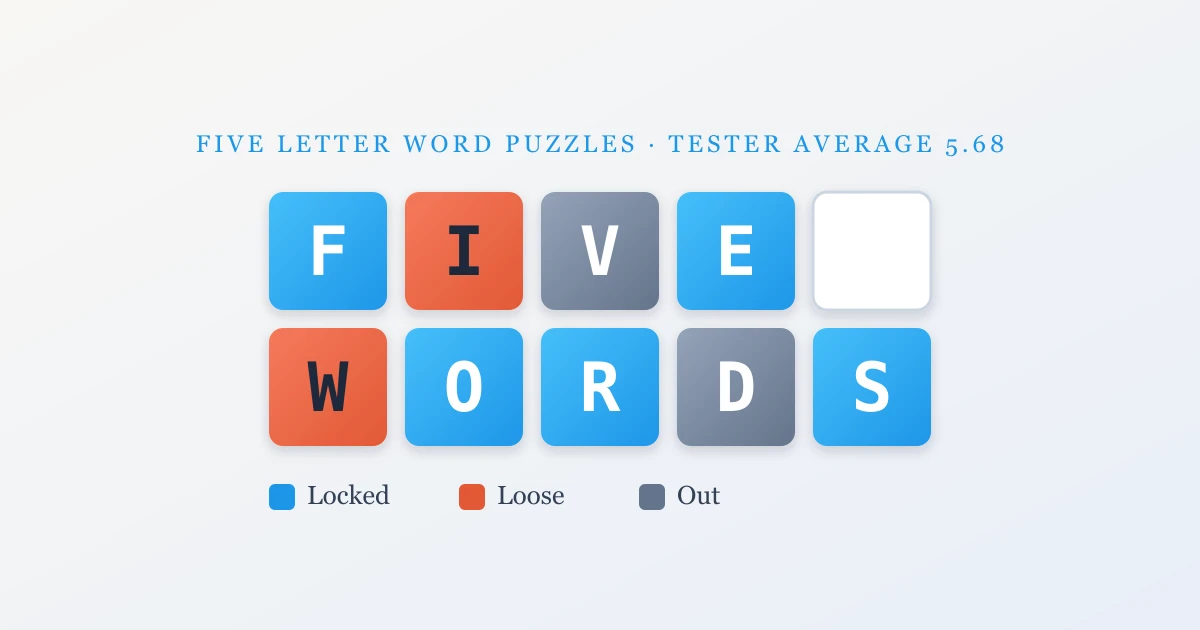
The Hardest Wordle Words on Record: Can You Solve Them?
We ranked 502 Wordle answers by the guesses they actually took, found the five worst, and built a five-round test so you can play them against the average.
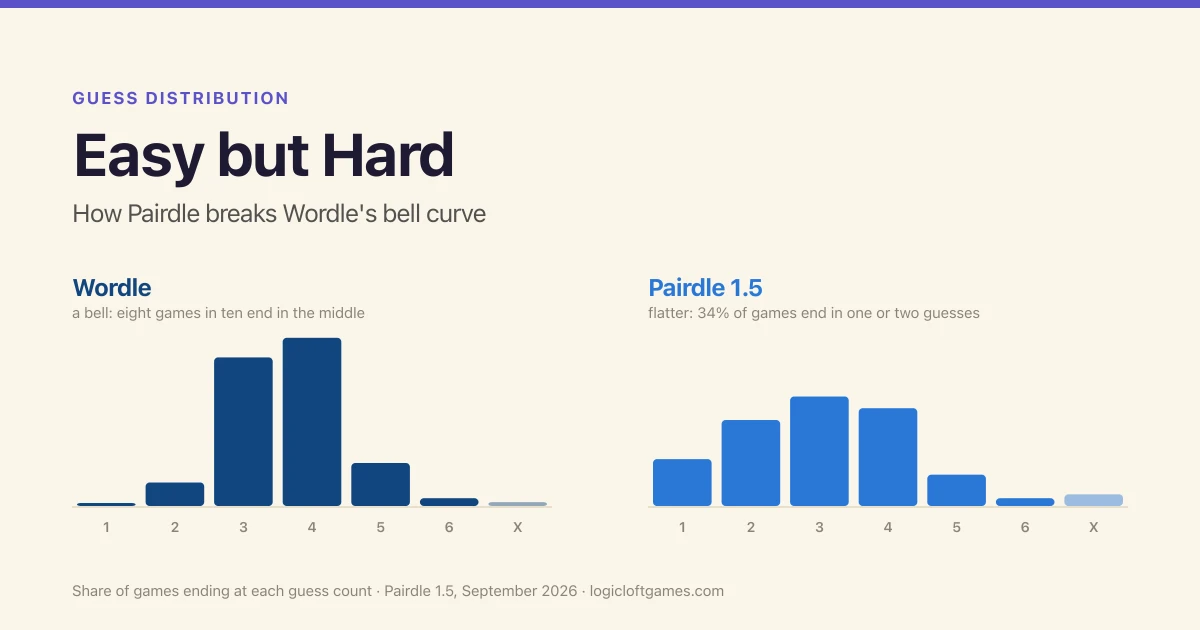
Easy but Hard: How Pairdle Breaks Wordle's Bell Curve
Wordle's guess distribution is a tight bell. Pairdle's isn't. Players win faster and lose more often. We pulled real data to find out why.
How to Play Mahjong: The Real Four-Player Game Explained
Not the tile pyramid — the real game. Four players, thirteen tiles, draw and discard. How a hand works, and how Riichi, Hong Kong, Chinese and American differ.