
Pairdle 1.5 is the biggest change to the game since it launched, and the shortest to explain: one board, one row, three levels.
Here is the note I wrote for the update itself, because it is still the most accurate summary of why any of this happened. "After a lot of feedback from you, our users, we decided to simplify the game without removing the challenge." And: "We have also unlocked Pairdle Pro and added a new level, Pairdle Expert."
The rest of this post is what that looks like in your hands, what carried over untouched, and then a section I have wanted to write for a year: the actual arithmetic of a Pairdle board, measured rather than guessed.
What was confusing, and what replaced it
The old game gave you three difficulty tiers every day (Standard, Challenge and Championship) for Pairdle, and then the same three again for Pairdle Pro. Standard showed two stacked guess rows, which was meant to read as one guess holding two candidate words. It did not read that way. New players saw two puzzles and asked which one counted. Pro, meanwhile, sat behind a sign-in wall on the web.
So 1.5 collapses all of that. One board per level per day. One box per position. Three levels that go up in size rather than sideways in tier names.
| Level | Word length | Boxes | Tiles | Route |
|---|---|---|---|---|
| Pairdle | 6 letters | 3 | 12 | /pairdle/ |
| Pairdle Pro | 8 letters | 4 | 16 | /pairdlepro/ |
| Pairdle Expert | 10 letters | 5 | 20 | /pairdle/expert/ |

Every board is built the same way it always was. Four real words of that length are sliced into letter pairs, those pairs become your tiles, and one of the four words is the answer. You get six guesses. Tap a pair to place it, or drag it into a box. Tap a filled box to take the pair back. GUESS stays disabled until every box holds a pair, so a half-built guess can never be submitted by accident.
The three levels are a ladder now, and the home screen shows it as one: today's Pairdle, today's Pro, today's Expert, with a done count and whichever rung is next.

Pairdle Expert, the new level
Expert is a ten-letter word in five boxes, built from twenty tiles. The columns are labelled 1ST through 5TH rather than FIRST / MID / LAST, because at that width the middle needs a number.

I like that screenshot because it is the clearest three-colour frame in the game. IN and IV are blue and locked. ES and NT are red, both pairs are in the word, both are in the wrong box. SU is grey and gone. Two guesses in, you already know an enormous amount, and you still have to find the word.
Expert is harder, though not in the way most people assume. More on that in the numbers section, because it turns out the difficulty is not where I expected it.
Meet Olly
Olly is the owl, and this is his first outing under his own name.

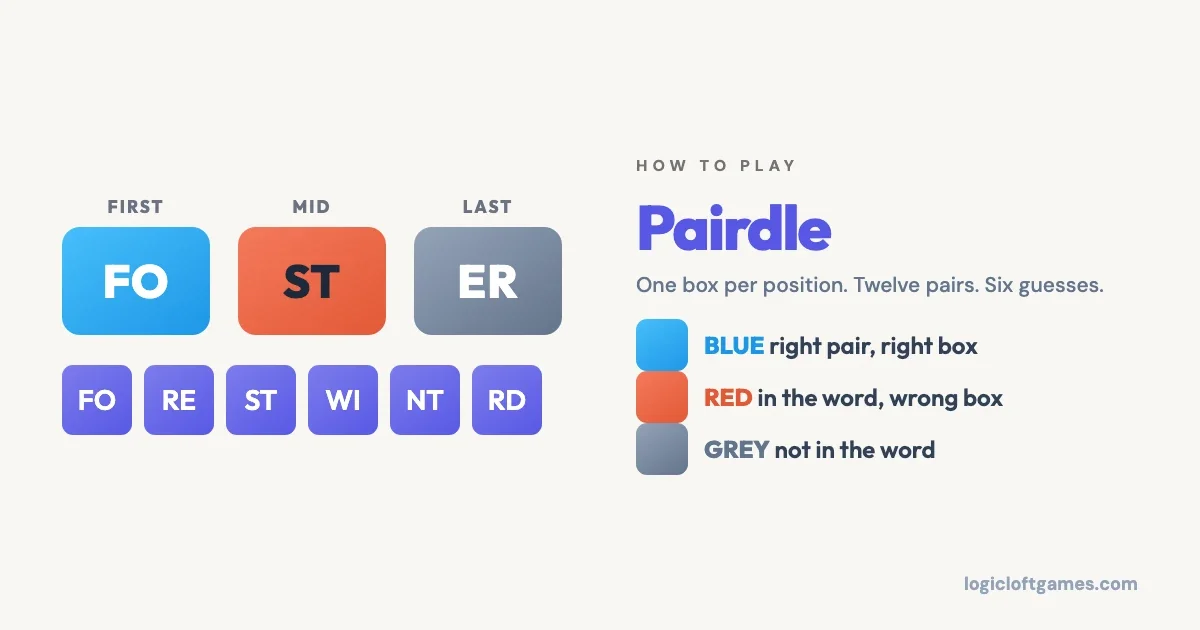
He shows up on your very first board and nowhere else after that. The first-puzzle board is fixed (its four words are FOREST, WINTER, GARDEN and YELLOW) so Olly can teach against a board he knows. He offers a "Show me", places FOSTER as a first guess, and lets the colours do the explaining: FO comes back blue, ST comes back red, ER comes back grey. Then he coaches box by box. If you try a pair that cannot open a word he says so ("No word starts with XX, try it in the other box") and if you reach for GUESS early he tells you every box needs a pair first.
That is the whole tutorial. One board, one demo guess, three colours. There is also a new how-to video of about thirty seconds, and the how-to page at /about/how-to-play-pairdle/ has been rewritten around a full walkthrough of solving FOREST.
If you are a returning player you get a one-time "What's new in Pairdle 1.5" note on your first launch instead, and you never see Olly's tutorial. Brand-new players get Olly.
The new win card
The end-of-game card got the most visible work outside the board itself.

Three things are new there. The scorecard grid (the colour-by-guess picture of how you got home) used to exist only as emoji inside the share text, invisible unless you shared. Now it is on the card, for wins and for losses. Underneath it sits the computer-solver line, "Computer solved in N guesses", so you have something to measure yourself against on days when three guesses felt slow. And the headline scales with how you did: 1 guess is GENIUS!, 2 is Word Wizard!, 3 is Amazing!, 4 is Great job!, 5 is Nice work!, and 6 is Phew! Just in time!

Olly turns up here too. After the first puzzle, the win card is the only place you see him.
Practice: play as many as you want
This is the feature I expect to change how people use the app.

Practice lives at /pairdle/practice/. Pick a level, hit "Play random board", and keep going for as long as you like. Nothing is recorded. Your streak is untouched, your stats are untouched, the leaderboard never hears about it. The hub says it plainly: "Unlimited boards. Nothing is recorded, so play loose."
That last phrase is doing real work. A daily puzzle is tense because it is the only one you get, which makes experimenting expensive. Practice removes the cost. Burn a guess on a probe you are unsure about, try opening from the middle, find out what a wrong answer teaches you when nothing is on the line. Then go and play the real one.
The hub also nudges you back to the daily ladder when you are done: either "Today's Pairdle Pro is waiting" with a Play button, or a countdown reading "Next puzzles in" with the hours, minutes and seconds until midnight Pacific.
What has not changed
Quite a lot, deliberately.
The colours mean exactly what they always did. Blue is the right pair in the right box, and it locks. Red is a pair that is in the word but in the wrong box. Grey is not in the word at all.
It is still a daily puzzle, and it still resets at midnight Pacific. Streaks carry over: the Pairdle level records to the same ledger the old Standard tier used, so nobody's streak resets because of this update. Leaderboards and stats are still there, now with Pairdle, Pro and Expert tabs plus a lifetime strip across the top. Badges carry over, with exactly one rename: "Efficiency Expert" is now "Efficiency Ace", so that the word Expert means the level and nothing else. The share grid still shares. And all of it runs on the web, on iOS and on Android.
The numbers: what a 12-tile board actually holds
Here is the part I have been wanting to measure properly. How big is a Pairdle board?
The obvious answer is wrong in an interesting way. Choosing 3 tiles from 12 gives C(12,3) = 220 combinations. But the game does not ask you to choose a set of tiles, it asks you to place them in order (FIRST, MID, LAST) and RE-ST-ED is a different guess from ST-RE-ED. So the real guess space is P(12,3), which is 12 × 11 × 10 = 1,320 ordered placements. Pro has 43,680 of them. Expert has 1,860,480.
| Level | Tiles | Boxes | Unordered sets | Ordered placements |
|---|---|---|---|---|
| Pairdle | 12 | 3 | 220 | 1,320 |
| Pairdle Pro | 16 | 4 | 1,820 | 43,680 |
| Pairdle Expert | 20 | 5 | 15,504 | 1,860,480 |
Which raises the better question: how many of those placements spell an actual word?
To find out I replayed the real board builder over every scheduled date in every level (1,124 Pairdle boards, 1,082 Pro boards and 1,124 Expert boards) and tested every board against the game's 7,656-word solver dictionary. Nothing below is estimated.
| Level | Min | Max | Mean | Median |
|---|---|---|---|---|
| Pairdle | 4 | 16 | 5.944 | 5 |
| Pairdle Pro | 4 | 14 | 5.073 | 5 |
| Pairdle Expert | 4 | 21 | 4.722 | 4 |
Four is the floor everywhere, and it is a hard floor. No board in any level yields fewer than four findable words, because every board is built from four real words and those four are always still in there. Here is how the boards spread out:
| Words findable | 4 | 5 | 6 | 7 | 8 | 9 | 10+ |
|---|---|---|---|---|---|---|---|
| Pairdle | 255 | 323 | 211 | 140 | 89 | 47 | 59 |
| Pairdle Pro | 495 | 291 | 148 | 76 | 42 | 16 | 14 |
| Expert | 656 | 283 | 106 | 44 | 16 | 11 | 8 |
Which means a sizeable share of boards contain nothing but their own four construction words: 22.7% in Pairdle, 45.8% in Pro, 58.4% in Expert. On those days, if you build a real word out of the pool, it is one of the four: a one-in-four shot at the answer outright.
The extremes are worth seeing. The richest Pairdle board on the schedule is still a year away, answer HACKED, built from HACKED, POWDER, STRAND and RELICS. Twelve tiles, sixteen findable words: ERRAND, HACKED, HACKER, HANDED, LICKED, LISTED, PONDER, POSTED, POSTER, POWDER, RACKED, RELICS, RELIED, RENDER, RESTED, STRAND. At the other end, the board of 2025-11-04 (answer LITANY, alongside AWAKEN, AFFECT and BOOTED) yields those four and nothing else. The richest board anywhere is an Expert one, answer CONCERNING, with twenty-one findable words hiding in twenty tiles.
Now the finding that surprised me. The bigger board is the emptier one. Going from Pairdle to Expert, the pool grows from 12 tiles to 20 and the guess space grows by a factor of 1,410. The number of real words you can actually build goes the other way, from 5.944 down to 4.722. The share of your possible guesses that spell anything at all falls by a factor of 1,774.
| Level | Ordered placements | Mean findable words | Share that are words |
|---|---|---|---|
| Pairdle | 1,320 | 5.944 | 0.4503% |
| Pairdle Pro | 43,680 | 5.073 | 0.0116% |
| Expert | 1,860,480 | 4.722 | 0.000254% |
That is what makes Expert hard. Not that there is more to consider. There is less to find. A twenty-tile board looks like an ocean and holds fewer islands than the twelve-tile one. Long words are rarer, they share fewer of their pairs with each other, and so the pool coheres into far less. When you stare at an Expert board and feel like nothing is there, you are reading it correctly.
Two smaller things fell out of the same measurement. First, the tile alphabet is narrower than you would think: across each level's whole corpus, only 363 distinct pairs ever appear as a Pairdle tile, 375 in Pro and 350 in Expert, out of 676 possible two-letter combinations. Roughly half of all pairs never appear on a board at all, which is why the pool starts to feel familiar after a few weeks. Second, there is what I have started calling the BANANA rule. An answer keeps every copy of its own pairs, so if the answer is BANANA the board carries two NA tiles. It is rare: 3 Pairdle answers do this across the whole schedule, 23 in Pro, and none at all in Expert, whose word list happens to contain no ten-letter answer that repeats a pair.
If you want the strategy that sits on top of all this, How to Master Pairdle, Column by Column counts every letter pair in every answer we have ever scheduled, and 5 strategies to get better at Pairdle is the tactical version. For how Pairdle's wins and losses compare with Wordle's, we pulled the real guess data. New to the whole thing? Start at how to play Pairdle.
By Tim Nye, Logic Loft Games
Related articles
How I Came to Build Pairdle and Accidentally Made It EPIC
I loved Wordle but refused to clone it, so I built a puzzle out of letter pairs instead. Then, fact-checking this very article, I found the generator had been throwing away seven of every eight words since December.
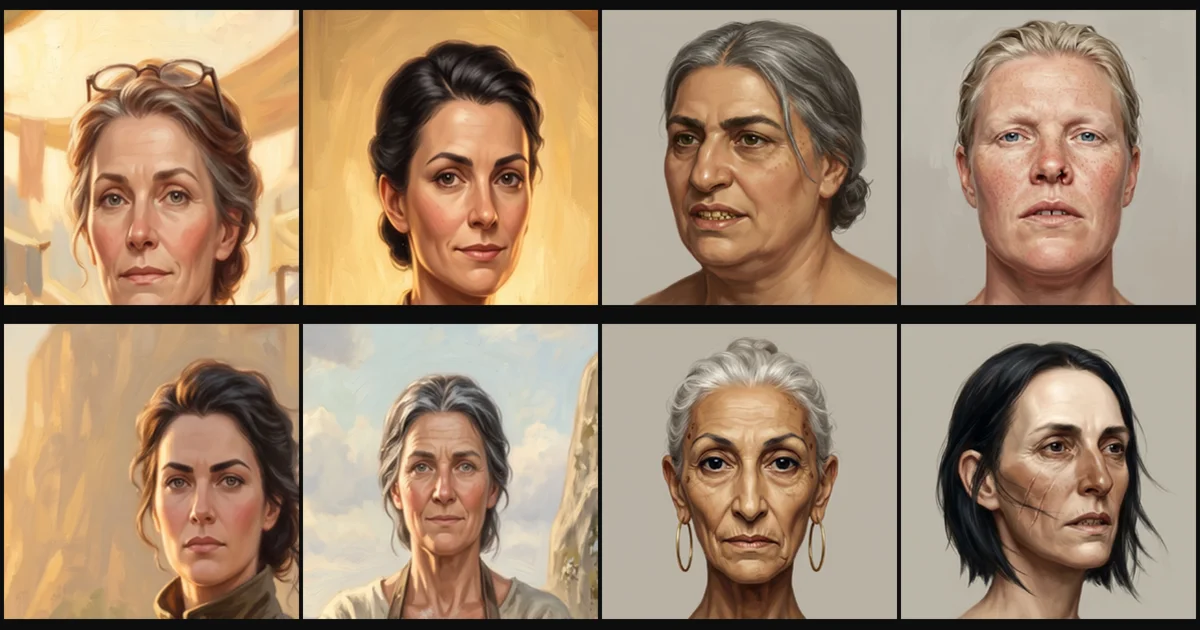
Making 52 Consistent AI Character Portraits: What Went Wrong
I used AI to make the art for my word game, and reviewers called it AI slop. Here is what 52 portraits took, with the failed pictures.
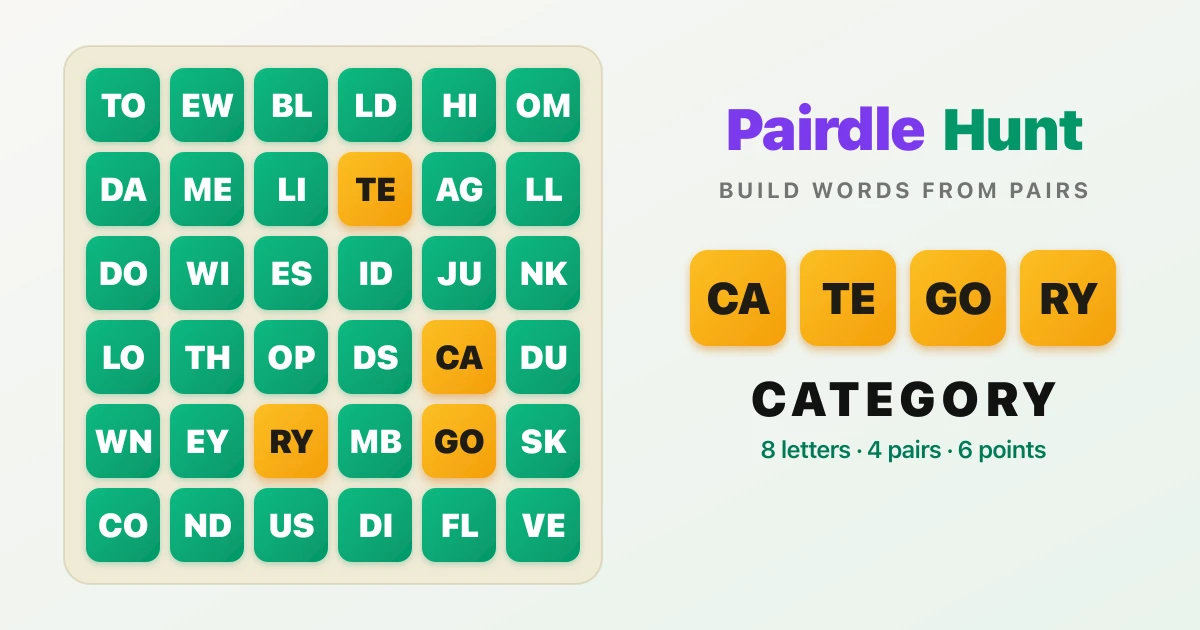
Pairdle Hunt: How to Play and the Math of Hidden Words
Pairdle Hunt is Logic Loft's new word-hunt game, coming soon to iOS and Android. How to play, how scoring works, and how many words hide in one grid.