
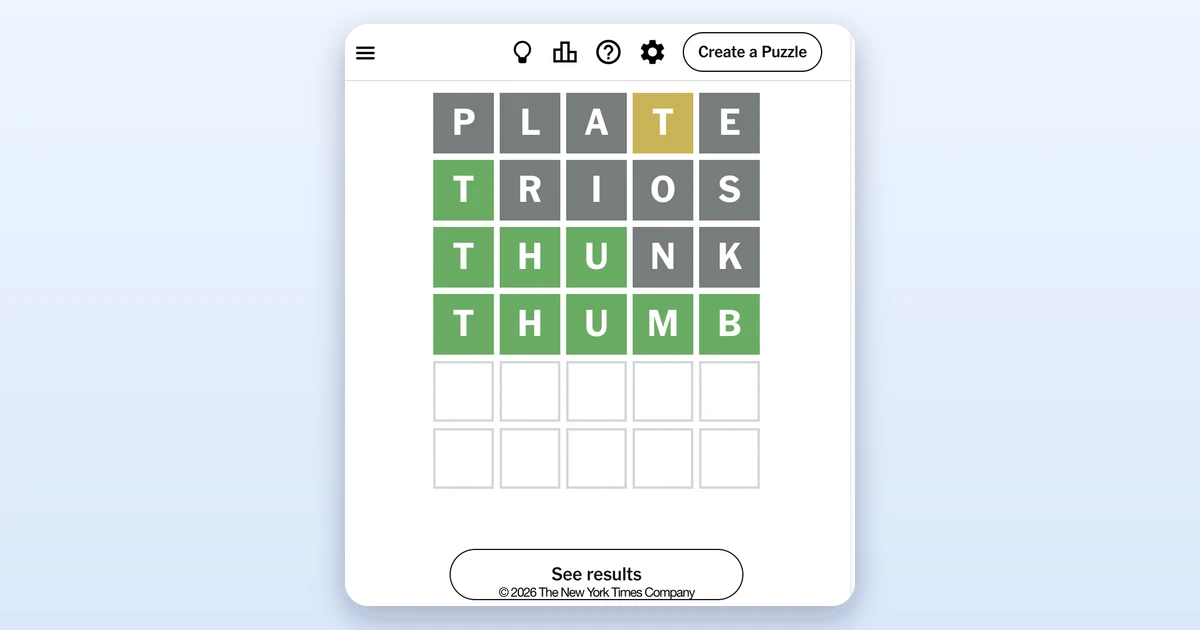
Wordle is a daily word puzzle: one five-letter word, six guesses, and a fresh puzzle every day at midnight. It looks simple, and the rules are. What makes it stick is that "simple" hides a lot of deduction. That is why we love it, and why we build games in the same family.
Where to play: Website · App Store · Google Play
This guide covers everything a first-time player needs: the rules, what the colored tiles mean, and a full walkthrough of a real game so you can see the logic in motion. We build daily word games for a living, so we'll also point out the small habits that separate a lucky solve from a reliable one.
The rules in 30 seconds
- You have six guesses to find one five-letter word.
- Every guess must be a real five-letter word (Wordle won't accept random letters).
- After each guess, every tile turns one of three colors. Those colors are your only feedback.
- Everyone in the world gets the same word on the same day. That's why people share scores.
That's the whole game, and it matches the rules on the New York Times Wordle page. The skill is in reading the colors.
What the tile colors mean
This is the only thing you must understand, so let's be precise.
| Color | Meaning |
|---|---|
| 🟩 Green | Right letter, right position. It's locked. |
| 🟨 Yellow | Right letter, wrong position. The letter is in the word, just somewhere else. |
| ⬛ Gray | The letter is not in the word at all (with one exception below). |
The exception that trips up new players: duplicate letters. Say the answer is ROBOT and you guess OZONE. ROBOT has two Os (positions 2 and 4), but neither of your Os (positions 1 and 3) lands on one of them, so both come back yellow. If a word has only one of a letter and you guess two, the "extra" copy comes back gray. Wordle is telling you "there's only one of these."
A full walkthrough
Let's play one game the way we'd actually play it. The answer (you don't know this yet) is CRANE.
Guess 1: SLATE. We open with a word packed with common letters and no repeats. Result:
S⬛ ·L⬛ ·A🟩 ·T⬛ ·E🟩
We learned a lot: an A locked in slot 3, an E locked in slot 5, and S, L, T all out. Two greens and three letters eliminated in one move is a great start.
Guess 2: BRACE. We keep the locked A and E exactly where they are and test three brand-new letters (B, R, C). Result:
B⬛ ·R🟩 ·A🟩 ·C🟨 ·E🟩
Now it's clicking. R is locked in slot 2, joining the A and E we already had. C is in the word but not in slot 4. B is out.
Guess 3: CRANE. The pattern so far is _ R A _ E, plus a C that can't sit in slot 4, which leaves slot 1. That gives C R A _ E with a single unknown letter in slot 4. CRANE fits perfectly.
C🟩 ·R🟩 ·A🟩 ·N🟩 ·E🟩
Solved in three. We never guessed randomly. Every move used the previous colors to shrink the possibilities.
The one habit that matters most
Beginners try to win on every guess. Strong players try to learn on the early guesses and win on the later ones. Your first guess especially should be about gathering information: pick a real word with five different common letters and no repeats, so a single guess can rule in or rule out as much as possible.
If you want the specifics, which opening words give you the most information and why, we wrote a companion piece on the best Wordle starting words, and built a starting word calculator that rates any opener you type. And if you like having the raw material handy, our list of the most common 5-letter words is a useful cheat sheet for when you're stuck on the last guess.
Common beginner mistakes
- Reusing gray letters. If a letter came back gray, it's gone. Don't put it in another guess. You'd be wasting a slot.
- Ignoring yellow positions. Yellow says "this letter is in the word," and it also says "not here." Move it.
- Forgetting locked greens. Once a tile is green, keep it in that exact spot for every future guess.
- Burning a guess on a word you already know is wrong. Every guess should be consistent with all the color feedback so far.
Why we're fans
Wordle proved something we believe deeply: a daily puzzle with dead-simple rules and real deduction underneath can become a habit millions of people look forward to. That's the same itch our own games scratch. If you want to see how far that deduction can be pushed, we ranked the toughest answers Wordle has ever used and built a test out of them. If you enjoy the deduction in Wordle, you'll probably like Pairdle. It keeps the daily-word format but you place letters two at a time, which changes the logic in a fun way (here's how the two compare), and our five strategies to get better at Pairdle will get you started once you try it. And if word-guessing games in general are your thing, our roundup of the best daily word games has more to try.
Wordle takes two minutes to learn and a long time to master. Now you know the rules. Go read those colors.
Related articles
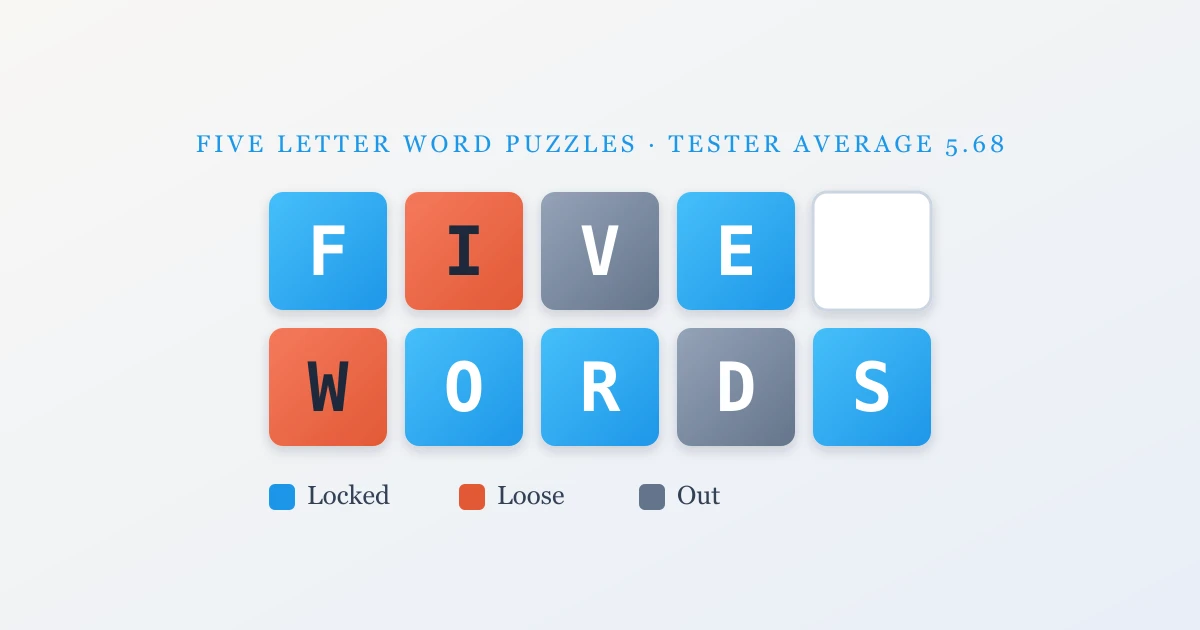
The Hardest Wordle Words on Record: Can You Solve Them?
We ranked 502 Wordle answers by the guesses they actually took, found the five worst, and built a five-round test so you can play them against the average.
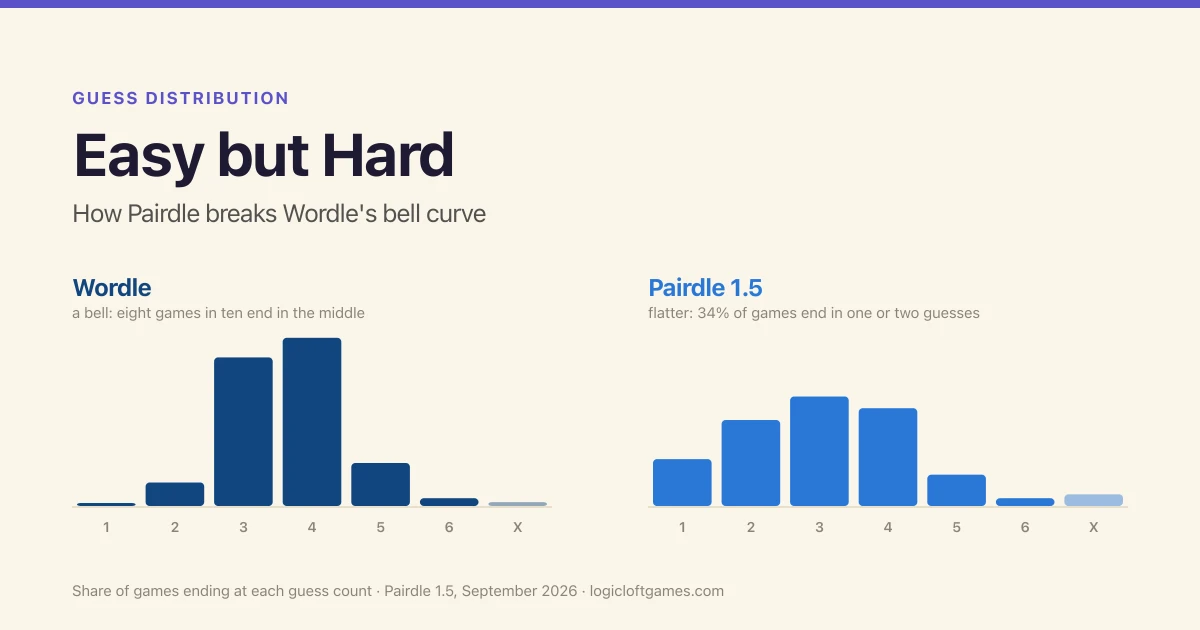
Easy but Hard: How Pairdle Breaks Wordle's Bell Curve
Wordle's guess distribution is a tight bell. Pairdle's isn't. Players win faster and lose more often. We pulled real data to find out why.
How to Solve a Crossword: A Mini Puzzle Solved Step by Step
Watch a five by five crossword get solved one pass at a time, see how many words really fit once you have three letters, and learn the clue tricks and the words that turn up most.