The Chronicle of Epic Words
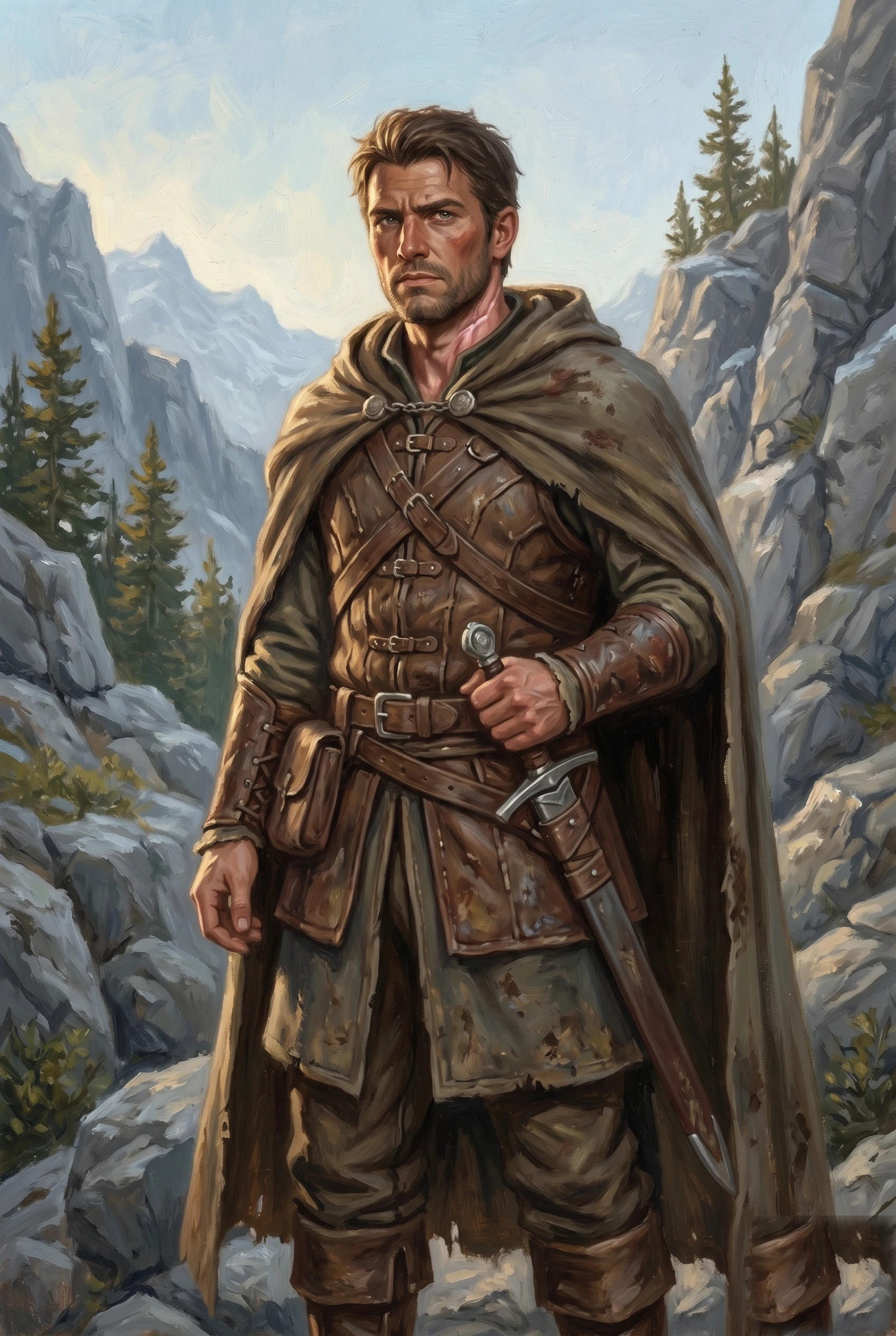
Corvin, the Bandit Chief
The boy you judged once, grown up to hold the road you need.
At a glance
Old enough to command thirty men who chose him. Young enough that a judgment passed on him at twelve still sets the terms of everything.
- Home The pass above Tongue's Landing
- Kingdom V (The Babel Tower)
- Faction Neutral · Road-captain
- Ally Geva
Corvin does not tell you who he is. He lets you work it out — the scarred neck, the grey-and-blue company fanned through the pines, the unhurried way he looks at you a moment too long before he decides anything. And somewhere in that moment, if you're the sort who remembers faces, you'll place him yourself: the boy at the gate. Twelve years old, arms crossed over a thin chest, wearing the expression of someone who has decided not to cry and is winning, barely.
He came from Murklin, the year after his father was hanged for poaching. He walked the river road alone and was caught a mile short of Aldren's Mill with a half-sack of ducal grain — the kind of small, hungry crime that the law is built to make an example of. Duke Aldren needed a third witness to attest the judgment, and he found one in a traveler who'd shown good sense that day. Whatever that traveler said — mercy, or the letter of the law, or some quieter third thing whispered aside to the Duke — became the hinge the rest of Corvin's life turned on. He did not look back at the door. Children have a particular clarity when they are memorizing something for later, and he was memorizing all of it.
What grew out of that boy is a road-captain, and a good one. He holds the contested stretch above Tongue's Landing, where the river cuts a narrow ledge into red-clay cliffs and the jurisdictions blur so thoroughly that a man of the right temperament can make himself the only authority that matters. Thirty men answer to him — mismatched leathers, faded banners, weapons clean and well-oiled, wolves carved from pine-knot at their collars. They chose him. That is the thing to understand about Corvin: nobody appointed him, no charter names him, and the men in the trees hold still not because he'll punish them but because he's earned the arithmetic where his stillness is theirs. He wears a worn silver wolf at his own throat and calls the whole business ancient woodcraft, and he isn't entirely joking.
He is not, whatever the epithet suggests, a cruel man. He robs the road, yes, but he has a code that runs deeper than the take. "I don't fight people I've already met," he'll say, letting a traveler pass empty-handed. "Not worth the story." He releases couriers he has no reason to release. He keeps only what he judges his — and he has a very exact idea of what is his, because somewhere he keeps a ledger as careful as the Duke's, ruled not in red ink but in memory: who owed whom, who spoke when it counted, who looked away.
Which is why the standoff on the pass belongs, in the end, to you. If you spoke for that boy at the gate — for leniency, for a hunger the law had no column for — he remembers, and he will tell you so, carefully, the way people are with things they've carried a long time: "You spoke for me when I had nothing. I don't forget debts." If you handed him to the law's full weight, he remembers that too, and there is no debt to lean on, only a man who has stopped respecting the precedents you're quoting. Either way the road opens. It's only the terms that change — whether you leave as an equal, a stranger he's decided isn't worth the trouble, or something colder.
There is one more thing, and Corvin is the first to feel its shadow without being able to name it. Someone hired him onto this road. The sealed letter in the stolen pouch bears a crest with a letter deliberately scraped from the wax before the stamp came down — not worn, removed — an old house, an old name, half-erased on purpose. He doesn't know whose. He only knows the coin was good and the road was worth holding, and that whoever paid him would rather not sign a name to anything. It is the first thread of a much larger unraveling, and Corvin, who forgets nothing, has quietly filed it away with all the rest.
Tales & Rumors
He came to power the hard way, which for Corvin means the only way he was left. His father was hanged one winter for poaching; the boy walked the river road alone from Murklin and was caught a mile short of Aldren's Mill with a half-sack of ducal grain, and hauled before Duke Aldren to be judged. Whatever verdict fell on him at that barred alcove, he carried out into the world and built a life around — and he has never once mistaken mercy for weakness or law for justice, having been handed both by strangers who never learned his name.
His company wears faded grey and blue and swears to a banner nobody official recognizes; the men carve small wolves from pine-knot when they take the oath, and Corvin wears a worn silver one at his own collar. He calls it ancient woodcraft and means it — the trappings of a brotherhood older and stranger than a band of road-takers has any business claiming. Show him something the wolf recognizes and the archers in the pines simply melt back into shadow, no toll asked.
He passed once through the Worn Index and left an impression on Geva the Glossary-Keeper, who does not impress easily and remembers him still — a road-captain who knew a word he had no business knowing, spoken without hesitation, as though it had been waiting in his mouth the whole time.
How They Measure Up
A road-captain keeps a ledger too — of faces, and of who owed whom what, and of exactly how it was paid.
Has held a hilt since his twelfth winter, and it shows in the shoulders. Not the biggest man in the pines — just the one nobody in them wants to be first at.
Moves like a man who has learned exactly how much noise thirty armed men make, and how to make less.
Walked the river road alone at twelve with a hanged father behind him and a half-sack of stolen grain. Everything since has been easier, and none of it has been easy.
Reads a road the way a clerk reads a ledger — where the jurisdictions blur, where the money's really coming from, which letter of a name has been filed away.
Knows which fights aren't worth the story. Lets more travelers pass than he stops, and the ones he stops, he remembers.
Doesn't raise his voice. Thirty men in the trees hold still because he's holding still, and that arithmetic took years to earn.
The Long Memory — he forgets nothing — not a debt owed to him, not a debt he owes, not the face of a stranger who once spoke for a boy at a gate. His loyalty and his grudge are the same faculty, pointed in opposite directions, and which one you meet depends entirely on a choice you may not even remember making.
Where you'll meet him
You'll find Corvin holding the high stretch between Tongue's Landing and Confluence Watch, in Kingdom V (The Babel Tower) — a place where three sign-systems point three different ways and the question of whose law applies is, at best, a matter of interpretation. That is presumably why he chose it. Thirty men step out of the pines above the road; the one who walks forward has a scarred neck and the unhurried bearing of a man who has held power long enough to forget it feels like anything. He'll look at you a beat longer than is comfortable — placing you — and then, unbothered, he'll lift the Duke's dispatch pouch clean off Pell's saddle without breaking eye contact. Inside it: a land-deed, and a sealed letter with one letter of the sender's name filed carefully out of the wax. How the standoff ends is mostly up to what you did years ago, at a gate, to a boy.