The Chronicle of Epic Words
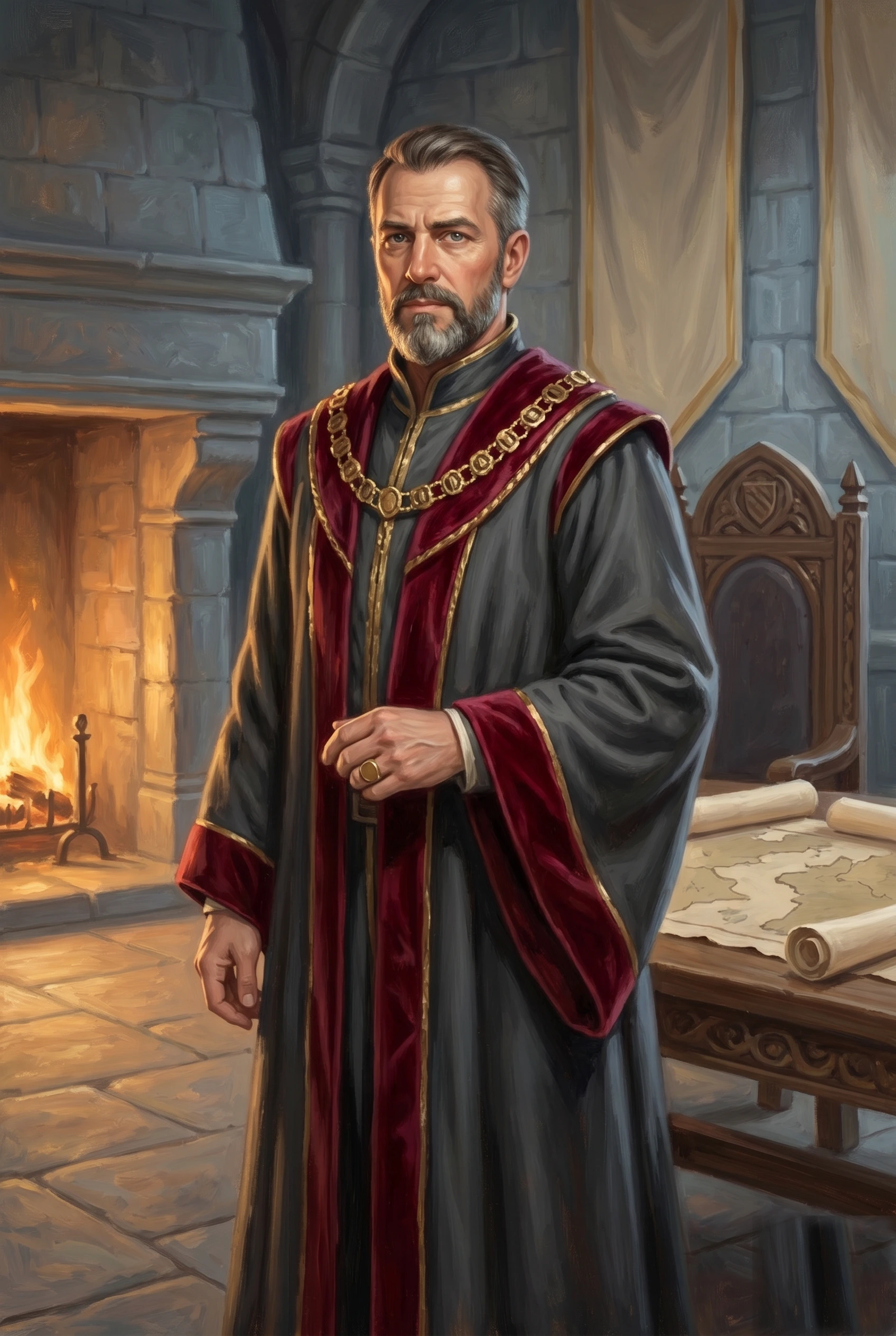
Duke Aldren
He won't stamp what he can't read — and he remembers, regardless, who asked him to guess.
At a glance
Old enough that the grey in his beard was earned almost entirely by paperwork, and only occasionally by people — and old enough that either kind of debt, once filed away, does not get forgotten for being small.
- Home Murklin
- Kingdom II (The Murmuring Brook)
- Faction The Crown
Duke Aldren does not raise his voice, and he has never needed to. Word of what he rewards — and what he remembers — travels ahead of him down every road in the East, which saves him the trouble of repeating himself.
He is head of House Aldren, an old Eastern house whose name turns up on land grants, river tolls, and the wax of half the seals between here and the border — including, these days, the correspondence of a junior courier named Pell, who has learned the hard way that "the Duke's business" outranks nearly everything else on a courier's schedule.
The image most people carry of him isn't wrong: a man in a stone hall beside a fire, a rolled map going soft at the edges on the table before him, a heavy chain of office he seems to have long since stopped noticing the weight of. His study is crowded with maps that are mostly river-courses and border lines, their curling edges pinned down against the draft by lead weights shaped like anchors, as though the whole room were quietly convinced that a frontier, like a boat, needs mooring or it drifts. He wears a signet ring he uses often and lends to no one; it is the last word in every dispute he settles, and disputes, on the Duke's roads, take their time getting settled.
That patience is not gentleness. It's arithmetic. Duke Aldren rewards results and remembers slights, in that order and without much ceremony about either, and the rest of his reputation follows from a habit simple enough to startle people the first time they see it: he will not put his seal on a word he cannot read.
For seven years, one petition sat on his desk because of exactly that. A land-grant claim out of a mill-parish east of Aldren's Mill — the family's own name, Hallet, sealed under a millstone crest — had gone damp-eaten off the document until nothing legible remained where the name should be. A lesser administrator guesses. A busier one delegates the guessing. Aldren, by a habit he never advertised, spent three months signing around the gap on every paper that touched the case, leaving a small deliberate blank in his own official hand rather than commit a wrong name to a right claim. When the true reading finally reached him, he did what he always does with something that matters: read the reasoning behind it twice without expression, and then once more. "Hallet. Yes," he said, and stamped it, and dropped a purse on the table without further comment — which those who know him will tell you is the closest thing to an apology the Duke has ever been caught making.
He holds his hearings in Murklin, where petitioners queue deep enough that the gossip about who's waiting outlasts the wait itself — by the time a case is called, half the town already has an opinion about how it'll go, usually the wrong one. He listens the same way to a duke's cousin and a mill-parish farmer: carefully, slowly, without any particular warmth, because warmth was never the point. Results were.
Not every gap gets solved by patience alone. Aldren keeps a short list of paid archivists on retainer for exactly this trouble — fussy, thorough men, an Owain among them, who can coax a name back out of ruined ink for a fee. He pays them precisely what the petitioner already paid, not a coin more, a policy petitioners read as either scrupulous fairness or a very small insult, depending on how generous they'd hoped he'd feel that day. So when word reached his hearing hall that a wandering healer's road-tincture had done, freely, what his paid men couldn't — restored ink an archivist would have charged handsomely to fail at — something shifted in the Duke's face. Not quite surprise. More the look of a man watching an old, half-believed report about someone called Mara — a refused-payment fever cure, filed and nearly forgotten — quietly confirm itself. He has never met her. He has, it's now fairly clear, been keeping track.
That's the whole of him, on the roads that bear his name: a lord who won't guess, won't forget, and won't be rushed — and who has learned, the expensive way, that the space around a missing letter is worth more patience than the letter itself.
Tales & Rumors
For seven years, a land-grant dispute out of a mill-parish east of Aldren's Mill sat unresolved on the Duke's desk — not for lack of merit, but because the petitioner's own name, Hallet, had gone damp-eaten off the document until only a smear of ink survived under a millstone seal. He had spent three months, by his own quiet habit, signing around the gap rather than guess wrong. When the true reading finally reached him, he read the reasoning behind it twice without expression, then once more, said "Hallet. Yes," stamped it, and dropped a purse on the table without another word.
His study is crowded with maps that are mostly river-courses and border lines, their curling edges pinned against the draft by lead weights shaped like anchors — a fitting habit for a lord whose entire office amounts to keeping a frontier moored roughly where the ink says it should be. He wears a signet ring he uses often and lends to no one; it is, in Murklin, the last word in most disputes that reach him.
He keeps paid archivists on retainer for exactly this kind of trouble — fussy, thorough men, an Owain among them, who can coax a name back out of ruined ink for a fee. He pays them precisely what the petitioner already paid, not a coin more. So when a wandering healer's road-tincture was credited, freely given, with restoring ink his archivists would have charged handsomely to fail at, something shifted in his face — less surprise than the look of a man watching an old, half-believed report about someone called Mara quietly confirm itself.
How They Measure Up
A pragmatic lord keeps his own ledger, same as any petitioner who queues for it.
Enough to hold a chain-of-office upright through a four-hour hearing. He has never needed more, and has never once had less.
Precise enough to turn a signet ring exactly true against wax, and not a fraction more precise than that requires.
Can sit through the third hearing of a gossip-heavy day without his face admitting to the first sign of boredom.
Reads a petition twice without expression, then once more — and it's the third reading that actually decides anything.
Knows the difference between a name he can't read and a name someone's hoping he'll guess at. Has never once guessed.
Not warm, and not trying to be. A dropped purse says more than a compliment ever has, and he's aware of it.
Won't Guess — He would rather let a dispute sit seven years unresolved than commit a name he isn't certain of to parchment. The gap outlasts the impatience of everyone waiting on it — his own included.
Where you'll meet him
You'll find Duke Aldren in Kingdom II (The Murmuring Brook), holding court in Murklin — seated at the head of a hearing hall with a queue of petitioners stretching past the door and fresh gossip circulating for every case that's already been heard (it runs three hearings deep by the time yours is called). He doesn't rise for you and doesn't apologize for the wait; he listens, reads whatever you've brought him twice without expression, and decides. Arrive with paperwork he can actually read, and you'll leave with more than you expected. Arrive with a gap where a name should be, and you'll learn exactly how patient — and how immovable — a pragmatic lord can be.