The Chronicle of Epic Words
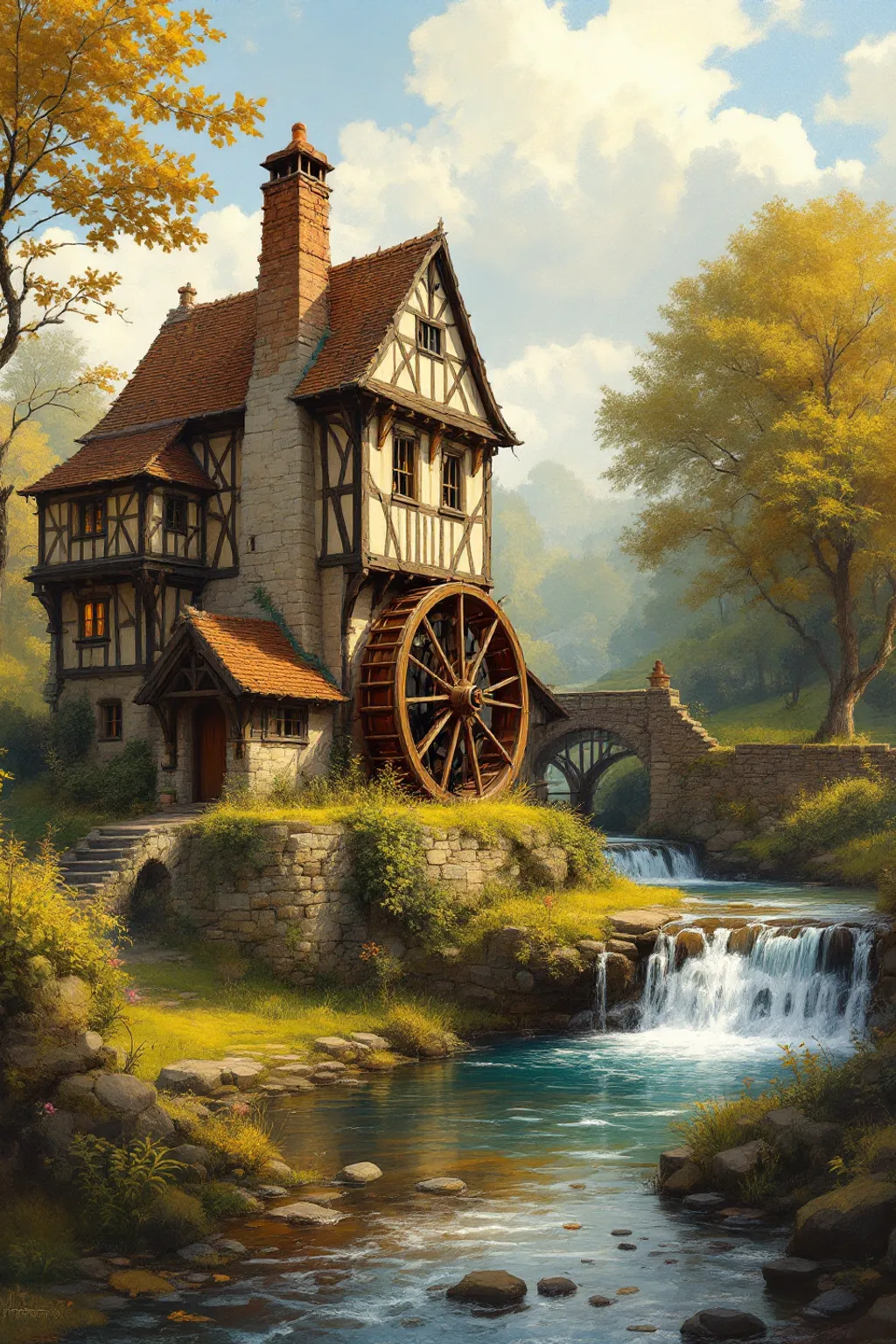
Aldren's Mill
The Duke's great wheel, where the water grinds grain, gossip, and the occasional missing word.
At a glance
- Kingdom II (The Murmuring Brook)
Every domain has a fixed point — a thing so reliably there that the countryside gets measured against it rather than the other way around. On the Duke's roads, that thing is Aldren's Mill. Ask a steward where a parish begins and he won't reach for a map; he'll tell you it lies "a mile short of the mill," or "the third holding east of it," and expect you to know exactly what he means. You will, soon enough. The mill is the ruler the whole valley is laid against.
It is, first and most honestly, a working mill: a great water-wheel turning under the river's fall, a pair of millstones grinding steadily beneath it, and the flour of half the Duke's holdings passing out its door in ducal sacks. The wheel does not stop for weather or for stories, which is more than can be said for most of the things in this valley. Water turns it, stone shapes it, and — as a riddle chalked by the wheel likes to point out — the baker cannot do without what comes off it. That would be flour. Though the locals, who cannot resist a joke at their own expense, will tell you the mill grinds sense too, and grinds it just as fine.
That claim has some evidence behind it. Above the great wheel, a single word stands carved into the beam — or stood, once, before the damp got at it and loosened two of its letters clean out of the wood. G — I N —, it reads now, with the patience of a thing waiting to be finished. The answer is grind, which is either the mill telling you its trade or the valley telling one of its favorite kinds of joke: a place that can't keep the letters in its own signage, warning you what it does to nonsense and grain alike. On the Duke's roads, half the words have gone soft at the edges, and this beam is only the most on-the-nose about it.
The mill's real weight, though, is administrative. This is millstone country, and the fact runs deeper than the wheel. East of Aldren's Mill the land breaks into mill-parishes, and the oldest families there carry a millstone on their seals the way other houses carry a lion or a tower — the Hallets among them, whose name once went missing off a seven-year petition and had to be ground back out of the parish records one worn letter at a time. When Duke Aldren needs to know whose holding is whose, the answer nearly always circles back to the mill: who grinds where, whose grain, on whose account. The wheel doesn't just make flour. It makes the map legible.
It makes the map dangerous, too, in small ways. Ducal grain moves along this road in ducal sacks, and a road that carries grain also carries the temptation to take some — which is how a hungry boy out of Murklin came to be standing in a barred alcove, having walked the river road alone and misjudged, by exactly one mile, how close he'd come. The mill is a landmark for the desperate as much as the honest. It is simply the last thing you pass before the gatehouse decides what to do with you.
For all that, it keeps good company. The river road threads on from here toward Twice-Told Ford, where the current is said to hum the old tongues, and the poolside cider at The Bowed Reed is close enough that Hallowell the archivist treats the alehouse as an office annexe when the deed-registry gets thirsty. Stand by the wheel long enough and the whole of the Duke's roads seems to route through the grind of it — grain going one way, gossip the other, and the valley, as ever, measuring the distance in mills.
Where you'll find it
Aldren's Mill sits on the river road in Kingdom II (The Murmuring Brook), a measured mile or so out from the gatehouse and the same again shy of Murklin — close enough to the Duke's seat to grind his grain, far enough that a boy on foot can misjudge the distance and get caught a mile short with a half-sack he shouldn't be carrying. Come down the river road from Murklin and the mill announces itself before you see it: the low, patient grind of stone on stone, and the great wheel turning under the fall of the water. You'll pass it early, on the Duke's business, and you'll likely pass it again — it is that kind of landmark, the sort other places are measured against.