The Chronicle of Epic Words · Founder’s Deck
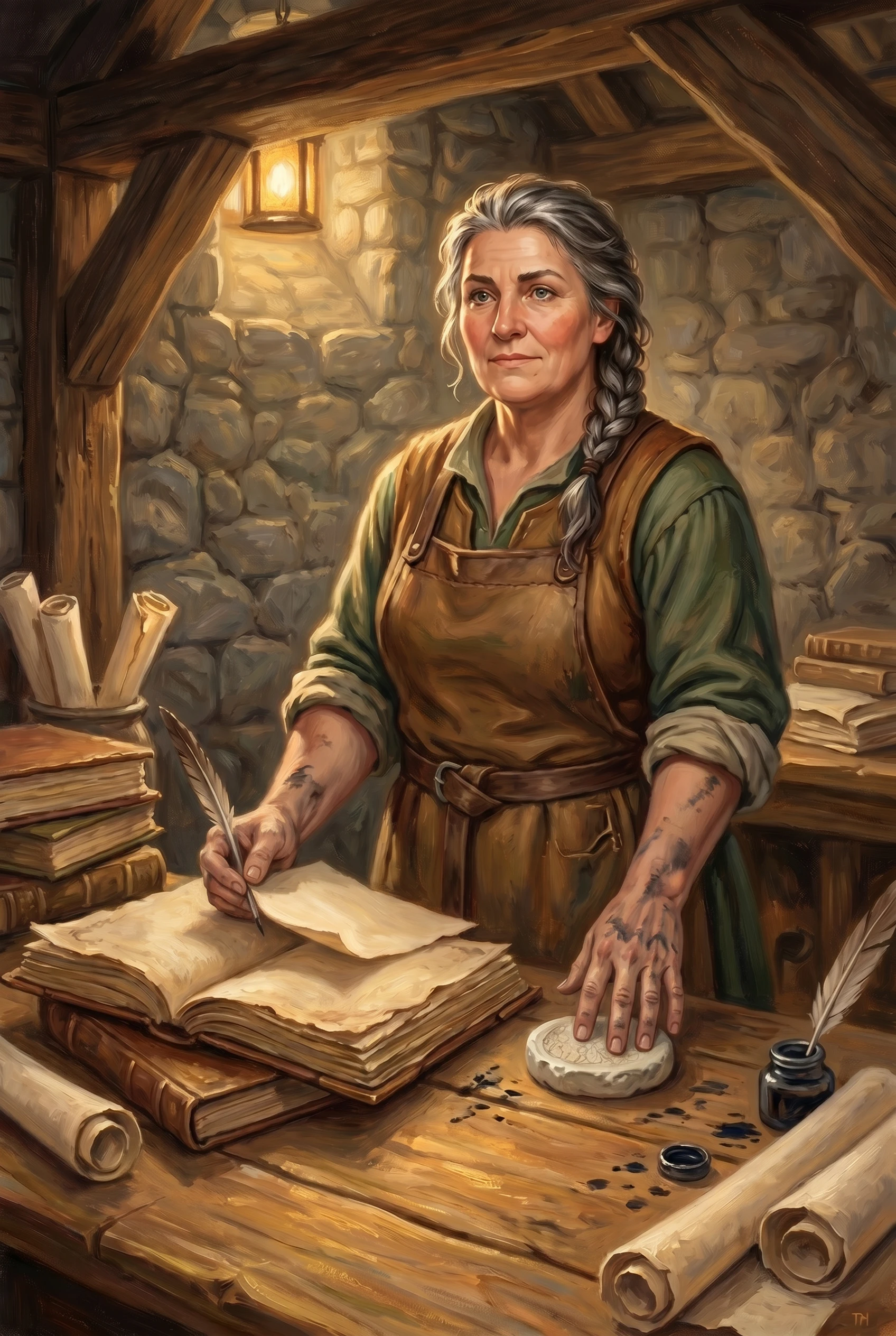
Geva, Keeper of the Worn Index
A lexicographer who has spent fifteen years arguing, by post, that words are never destroyed — only misplaced.
At a glance
Old enough to have spent twelve years walking to villages that keep their oldest words in their mouths and nowhere else. Young enough to still make the walk when a word needs chasing.
- Home The Worn Index
- Kingdom X (The Lexicon Forge)
- Faction The Lexicographers
- Founder’s card Eight of Diamonds
- Ally Aldwyn
Geva will tell you, if you give her the opening, that she is not a collector of books. She is a collector of the words inside them, which is a different and — she will insist — a more honest occupation, because a book can be shelved and forgotten but a word has to keep being used or it goes quietly missing, and she takes the going-missing personally. She keeps the region's definitive glossary of root-words at the Worn Index, a low building at the foot of Lexicon Ridge that looks as though it was pressed up out of the bedrock rather than laid upon it. When you see how the mortar joins the stone, you understand why she never bothers to lock the door. The building feels less like it needs protecting than like it is doing some protecting of its own.
She was not born to the desk. For twelve years she was a field lexicographer, which is a grand title for a woman who walks a very long way to write down how people talk. She went to wilderness villages that keep their oldest words in their mouths and nowhere else, and she wrote them down before the last person who used them stopped — and in the writing she learned the thing that has organized the rest of her life: that a root-word does not stay put. It drifts. It travels a valley over and comes out reshaped, a letter softened, a meaning bent, and if you lay the two versions side by side you can watch the same ancient thing wearing two faces. To Geva this is not decay. It is a family. She catalogues families.
Which is the heart of her long argument. For fifteen years she has traded letters with a scholar named Calder over one deceptively small question — when a word disappears from a place, is it destroyed, or only misplaced? He says destroyed; things end, the world forgets, that is what forgetting is. She says misplaced, and means it with a conviction that has cost her a great deal of ink: nothing that was truly made is ever wholly gone, only mislaid, and a mislaid thing can — with patience, with a good index, with someone willing to walk far enough — be found again. They had never met until this month, when he arrived in person, warm and easy and forever making you feel you'd reached a conclusion together when the conclusion was always his. She likes him. She does not trust his conclusions, which have a smoothness to them she has learned, over fifteen years, to distrust on principle.
The stone disc is the newest entry in that argument. She dug it out of the inner chamber of the Rootword Barrow — coin-sized, pale, a single letter-form on its face that she says is not obscure so much as prior to recognition, the ancestor of a mark rather than the mark itself. She treats it exactly as she treats everything: as a linguistic artifact, a very old member of a family, one she means to trace back however far it goes. She has not connected it to anything larger. Why would she? To Geva it is not a portent; it is a puzzle, and a lovely one, and she is delighted by it in the specific way certain scholars are only ever delighted — when the world becomes stranger and more orderly at the same instant.
If she gives you one thing to carry away, it will be the distinction she circles back to when she thinks you're ready for it. The word for a piece of a larger thing that was deliberately separated — not broken, separated — is "fragment." Most people use it to mean accident. I've been using it to mean intention. There's a difference, and I think it matters. She won't explain further. She doesn't yet know how much she's said. She only knows, with a lexicographer's certainty, that she has the right word for it — and that a right word, once you've found it, is very hard to misplace again.
Tales & Rumors
Before the Index, Geva was a field lexicographer — twelve years spent walking to wilderness villages and writing down the words people used there, watching how a single root drifts and re-shapes itself as it travels from one valley to the next. She arrived at the Worn Index to find a superb collection of dictionaries and not one soul who had ever thought to ask where the words in them came from. She has been asking ever since, which is either a public service or a nuisance, depending on whether you are the one being asked.
For fifteen years she has traded rebuttals by post with a visiting scholar named Calder over a single question — whether a word, once lost, is destroyed or merely misplaced. He holds the former; she the latter, with a stubbornness she considers a virtue and he considers a symptom. They had never once met in person until he turned up at her door this month, warm and specific and already agreeing with himself. She finds his conclusions, as ever, a little too tidy. Fifteen years: never wrong, never won.
Her few friendships are paid in etymologies. Aldwyn forged the clasps that hold her heaviest indexes shut, and she settles the debt by telling him the true root of words like 'timber,' which he pretends not to care about and remembers exactly. And she has never forgotten a bandit named Corvin who passed through once and knew the river's crossing-word without being told — a thing, she'll say, that ought not to be possible for a man who reads as little as he claims to.
How They Measure Up
A lexicographer keeps a definition of herself, too — precise, footnoted, and under permanent revision.
Broad enough across the shoulders to shift a crate of bound dictionaries without asking for a hand, which is fortunate, because it never once occurs to her to ask.
Writes faster than she means to, always outrunning the thought before it can escape — which is why half her marginalia is legible only to Geva.
Twelve years walking to villages that aren't on any map to write down words that aren't in any book. Whatever that takes, she has a surplus of it.
Knows the root of a word the way other people know the way home. Ask her the ancestor of 'timber' and clear your afternoon.
Reads a stone disc for exactly what it is, and a visiting scholar for exactly what he is. Has not yet thought to ask why the two subjects keep arriving in the same week.
Doesn't win rooms. Wins arguments — eventually, in writing, over the course of years, by the sheer refusal to be roughly right when she could be precisely right slowly.
The Long Argument — her finest quality and the reason no one at the Worn Index will start a sentence near her that they cannot finish. She would rather be exactly correct in fifteen years than approximately correct today, and she has the correspondence to prove she means it.
Where you'll meet her
You'll find Geva at the Worn Index, in Kingdom X (The Lexicon Forge) — a low stone-and-timber building at the foot of Lexicon Ridge that looks less built than grown, its mortar joined straight into the bedrock. She'll be at a desk of organized catastrophe, turning over a small pale-grey stone disc she pulled from the Rootword Barrow and cannot, for the life of her, classify. Two institutions called it decorative; one called it Valdric-period; the visiting scholar called it a curiosity. Geva has decided she'd rather have a witness than a verdict, and you've arrived at a convenient moment to be one.