The Chronicle of Epic Words
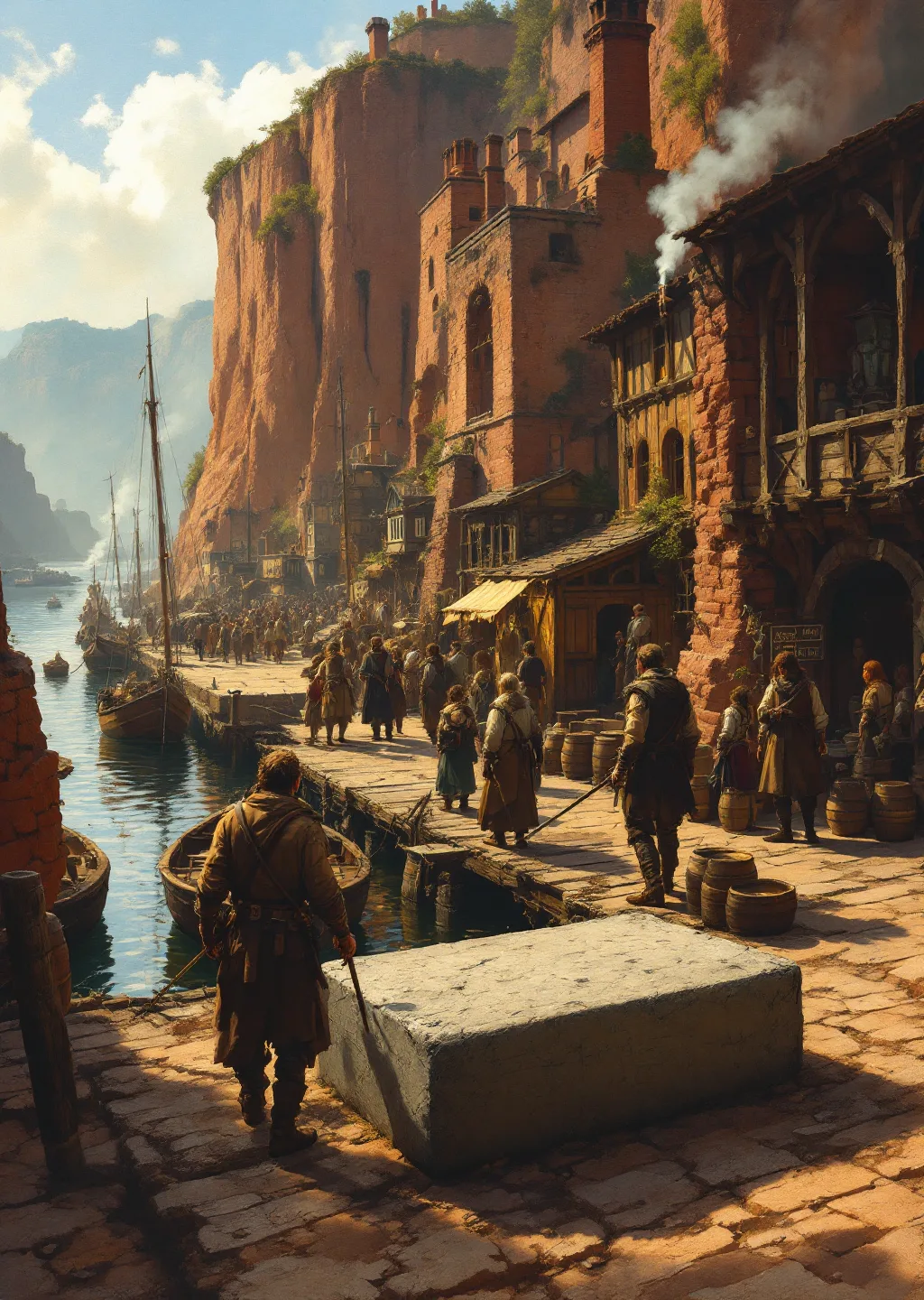
Tongue's Landing
A river-port where eleven dialects dock, and not one of them agrees with the others.
At a glance
- Kingdom V (The Babel Tower)
Every river town claims to be a crossroads. Tongue's Landing is the one that means it. It sits where the current slows enough to let a boat tie up, at the foot of the red-clay cliffs that climb toward the pass, and it has spent its whole existence being the first dry ground travelers touch after a long haul upriver — which means it has spent its whole existence listening to strangers. Eleven dialects dock here on a busy day. None of them answer in unison.
You feel it the moment you step off the boards. The dock-stone names the harbour in six different scripts, carved one above the other by whoever came through and decided their own alphabet deserved a turn — and the common version has lost two letters to rope and salt, so even the word harbour arrives half-worn before you've finished reading it. A mooring post nearby is scratched with a traveler's riddle about the gap "between what you mean and what I hear," which is as close to a civic motto as a place this fractured is ever going to get. If you want a single word every trader here agrees on, you'll be a long time waiting. Babble is the harbour's native tongue, and it's proud of it.
That confusion is exactly why the road above it is worth holding. The track from Tongue's Landing up to Confluence Watch is a narrow ledge cut into cliffs that crumble into the river a little more each season, and along it three separate sign-systems point three separate directions — so the question of whose jurisdiction this actually is has never once been settled. A man who wanted to stop travelers without technically breaking anyone's law could hardly choose better ground. The Bandit Chief chose exactly here. His thirty men, in their faded blue-and-grey cloaks, know the pass turns nobody's writ into an argument, and an argument is all the cover they need.
So the landing is a place of arrivals that don't quite land. Couriers reach it and cannot get past it. Cody, the cheerful centaur who runs dispatches over mountain and river both, spent the better part of two days circling the switchbacks above the port, half-convinced the pass didn't go anywhere at all — a four-day-late letter for Duke Aldren still in his satchel. Pell came galloping down the Tongue's Landing road on a winded bay, green-and-gold flag streaming, and rode straight into the standoff before he understood there was one. Two couriers, two letters, and a seal on each with the same fourth lobe scraped clean out of the printing matrix — a name someone would very much prefer not to sign. The landing sees more of that than it lets on. A port where everyone speaks differently is a port where a filed-down crest can pass unremarked.
And it is a doorway, though a quiet one. Past Confluence Watch, where the river forks, the ways open onto the founding-era ruins beyond: The Babel Steps, a giant stone staircase to nowhere left standing when its tower fell, and the Mudflat Market out on the grey flats, where relics of the first days change hands under six inches of silt and discretion. Beyond all of it, thirty miles off through the river-haze, lies the Lake of Whispers. Someone paid good coin to make sure travelers stopped here, at the last place before the pass, among the eleven tongues that never quite agree. They will not keep the road closed forever. But for now, this is where the words run out — and the harbour, in six scripts and none of them finished, has never pretended otherwise.
Where you'll find it
Tongue's Landing sits at the mouth of Kingdom V (The Babel Tower), the river-harbour that gives its name to the whole contested road above it. You'll pass it on the ledge-track climbing toward Confluence Watch — the stretch where thirty men step out of the pines and a boy you once judged holds the only way through. Come at it from the water and you arrive at the docks; come at it overland and you arrive at the trouble. The port is the last ordinary place before the pass stops being ordinary.