The Chronicle of Epic Words · Founder’s Deck
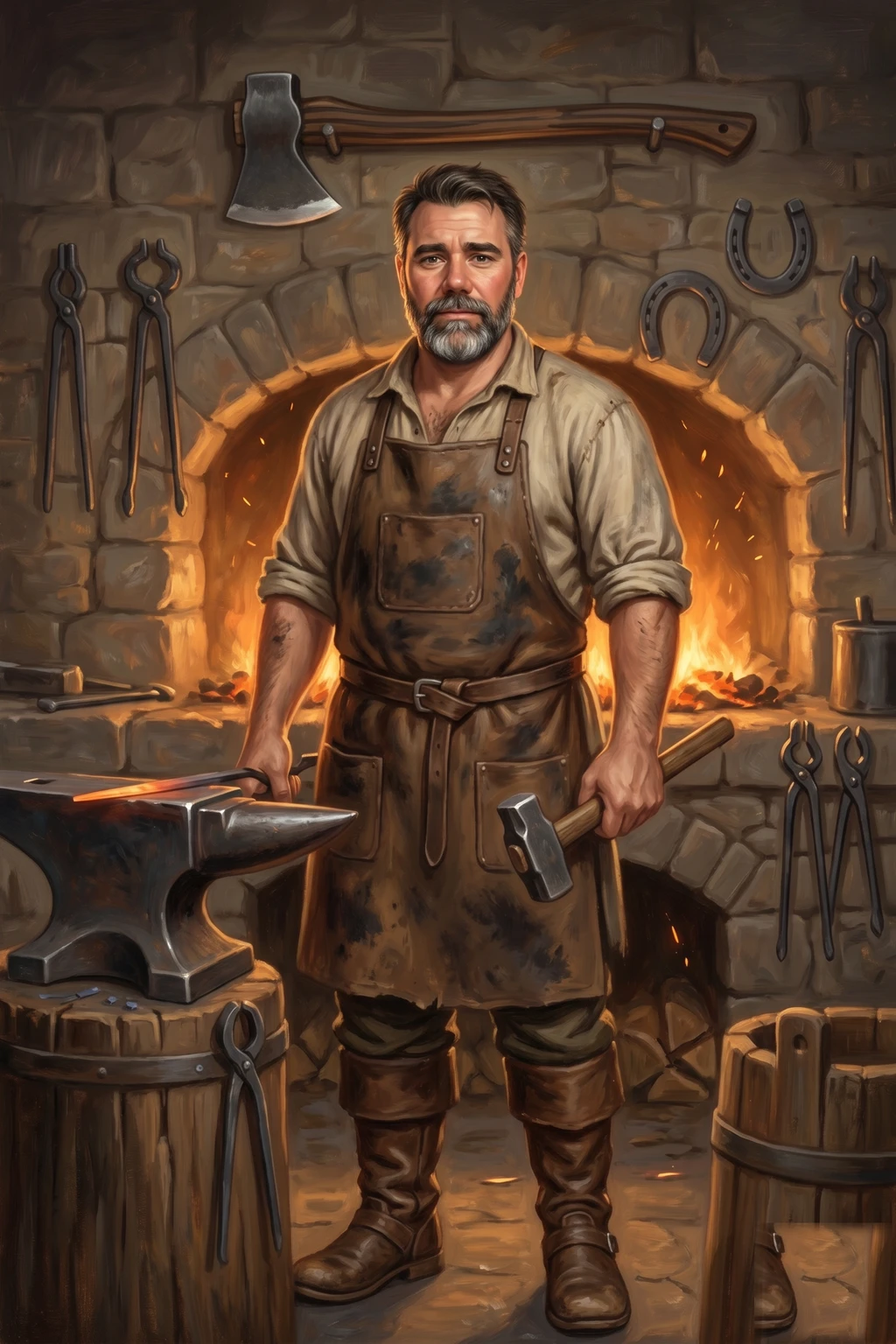
Aldwyn the Blacksmith
A broad, deliberate man who spends words like iron — and hands you his full attention only once you've earned it.
At a glance
Old enough that the forge keeps his hours now, not the other way round. The grey came into his beard the same shade as cold iron, and he made his peace with both a long time ago.
- Home The Forge Wharf
- Kingdom IX (The Word Forge)
- Faction Neutral · Smith
- Founder’s card Seven of Spades
- Ally Cody
Aldwyn will not waste a word on you until he's decided you're worth one. He is a broad, deliberate man who speaks as though every sentence is drawn from a limited supply, and he studies a stranger the way he studies a bar of iron — turning it slowly in the furnace-light, watching for the hidden flaw that will betray it under stress. Wait him out and you'll find the silence isn't unfriendly. It's just how a careful man decides things. When he finally hands you his full attention, it arrives all at once and without ceremony, and it is the most valuable thing he owns.
He keeps his forge at The Forge Wharf, where the air smells of charcoal, iron filings, and the particular ambition of people who believe a word struck in metal will outlast any word written on paper. His anvil is a single block of meteoric iron with a faint blue-grey sheen, and he works it the way a man works a thing he trusts to outlast him. Above the wharf, over the structure they call The Iron Vowel, a wagon-wheel-sized iron "O" turns slowly in the updraft like a letter searching for the rest of its word — and Aldwyn, who has worked beneath it his whole life, has never once found the sight strange. To him the whole trade is exactly that: giving shape to things that are waiting to be finished.
The thing he is waiting to finish is a tree. At the edge of The Cold Letter — a forge-ruin so old the foundation stone beneath it predates the building by a margin no one has bothered to measure — stands the Ironwood Ash, three hundred years of wood so dense it will not float and leaves whose undersides look like hammered zinc. Six axes have shattered against it. Two men were wrong about it in ways that cost more than pride. Aldwyn does not call it alive, nor exactly dead. He calls it a word waiting to be completed, and he is quietly certain that the only thing that can complete it is the word his father struck into the head of the long-handled axe on his wall. His grandfather believed the tree grew up through a broken word in the first place. Three generations have minded the problem. Aldwyn talks about it the way a man mentions a draft under a door he's decided not to investigate — steadily, without drama, as a fact of the house.
He will not simply hand you the axe. He'll chalk seven strokes on the cold forge wall, tap the single gap, and tell you it's the word you shout when the tree begins to fall — and only when you've finished it yourself, proving you already half-know it, will he lift the blade from the wall and hold it out flat across both palms, the way a man presents something he's proud of and won't say so. "Good," he'll say, which from him is a great deal. And then, because he can't help correcting a misunderstanding about his own life's work: the word is a completion, not a destruction. He means you to remember that when you swing.
For all the granite in him, Aldwyn's loyalties run warm and specific. He shod Cody the centaur for free one cold morning, purely because Cody was carrying a letter whose seal he recognized and he didn't want it late — and he will not say whose seal, only that the centaur's hooves want looking at again. He forged a set of index-clasps for Geva over at her worn shelves, and in exchange she once told him the deep root of the word "timber"; he has asked her to say it again more times than is dignified. He won't finish striking his family's maker's-mark while you watch — a mark made in front of an audience, he insists, comes out wrong — and he'll set the half-stamped die face-down on the anvil like something he intends to return to, once he's sure who else might want to use it.
Take the axe and it rides awkwardly in your pack, the handle jutting past your shoulder like a question mark cut from ash-wood. On your way out from under the slow-turning iron vowel, you may notice the "O" isn't a pure circle — there's a small notch at its crown, as though one letter of a longer word was all anyone could lift. Aldwyn has noticed too. He simply hasn't decided yet what to do about it, and Aldwyn is not a man you can hurry to a decision.
Tales & Rumors
The long-handled axe on his wall is a family inheritance made of patience. His father struck the word into the head; his grandfather showed that same tree to his father before him; and by Aldwyn's own flat accounting, they have been 'minding this problem for a while.' He does not consider three generations of guardianship a hardship. He considers it a job that isn't finished yet.
He shod Cody for nothing on a cold morning, because the centaur was carrying a letter whose seal Aldwyn recognized and he didn't want it arriving late. He will not tell you whose seal it was. He will tell you, if you mention Cody, that the centaur's hooves want attention again — which from Aldwyn is roughly a declaration of friendship.
He won't finish striking his family's maker's-mark while anyone is watching. A mark struck in front of an audience, he says, comes out wrong — and he won't explain how he knows, only set the half-stamped die face-down on the anvil like something he means to come back to. Geva, for whom he once forged a set of index-clasps, once told him the deep root of the word 'timber.' He has asked her to repeat it more times than either of them will admit.
How They Measure Up
A smith weighs everything, himself included — and he reads the flaw long before he reads the shine.
His anvil is carved from a single block of meteoric iron, blue-grey in the furnace-glow. He works it like a thing he trusts to outlast him.
The hands are precise, not quick — a smith who's cut a letter-punch true will never be rushed into cutting one crooked.
Stands at a furnace all day and calls it the cool part of the work. The tree is the part that takes something out of him.
Knows what iron remembers and what it forgets, which stone predates which foundation, and exactly how a word gets into metal so it stays.
Studies iron for the flaw that will betray it, then studies you the exact same way. He is very rarely wrong about either.
Speaks as though every sentence costs him — which is why 'Good,' from Aldwyn, is worth more than a speech from anyone else.
The Weighing — He measures a stranger the way he measures a bar of iron — slowly, for the hidden fault that would betray it under stress. Nothing you say hurries the verdict. But once it lands in your favor, it's structural: his trust holds weight precisely because it was so slow to be given.
Where you'll meet him
You'll find Aldwyn at The Forge Wharf, in Kingdom IX (The Word Forge) — at his anvil before the day has fully committed to being morning, charcoal and iron filings hanging in the air and Bellows Hollow exhaling its perpetual breath down the hillside. He is not a man you interrupt; you wait. Propped behind him is the axe — long-handled, ash-pale, the head dark with age but for one strip of struck iron: a word. He wants it felling the Ironwood Ash, a three-hundred-year tree at the edge of The Cold Letter that has shattered six axes before it. Before he'll trust you with the blade, he'll chalk seven strokes on the cold forge wall, tap the gap, and make you finish the word yourself — the one you shout when a tree begins to fall.