The Chronicle of Epic Words
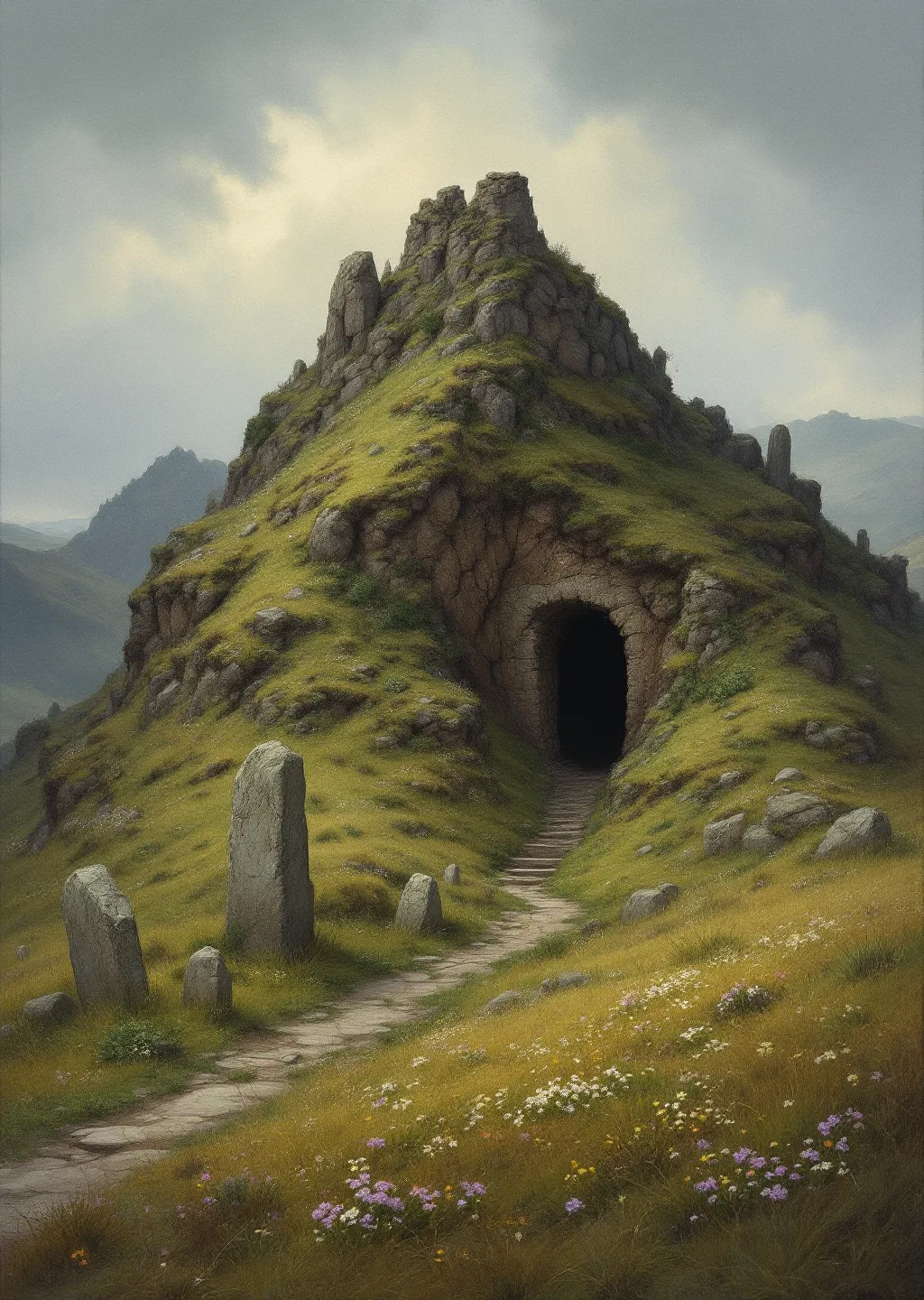
The Rootword Barrow
A burial-mound dug inward toward something that was already there — and older at its heart than at its door.
At a glance
- Kingdom X (The Lexicon Forge)
Most barrows are read from the outside in. You measure the mound, date the outer stones, work your way toward the heart, and by the time you reach the inner chamber you already know the story: oldest at the edge, newest at the center, a thing built up over generations the way a pearl accretes. The Rootword Barrow refuses to be read that way, and the refusal is the whole point of it.
Geva has spent three years on it — corridor by corridor, in the patient, unhurried way she does everything from behind the desk of organized catastrophe at the Worn Index at the foot of the ridge. What she has learned in those three years is that the barrow was dug in the wrong order. The mortar says so plainly, to anyone willing to trust the mortar over the institutions: the inner chamber, deep at the mound's core, is older than the outer corridors that lead to it. The passages were cut later, inward, toward a chamber that was already sealed and already waiting. Nobody built this barrow up. Someone dug down to reach it.
What they reached is a small thing, and that is somehow the most unsettling part. In the inner chamber, last week, Geva found a coin-sized stone disc — pale grey, cool, a single letter-form pressed into one face. Hold it to the window and the letter doesn't sit still; it shifts register the way a familiar word does when you've stared at it long enough to see shape instead of meaning. It is not an obscure character. It is something stranger: a form that seems prior to recognition, ancestral to the alphabet, the root beneath a written letter rather than a letter itself. Two institutions ruled it decorative. One called it Valdric period. One sent a scholar. None of them accounted for why a decorative object should behave the way this one does in the presence of certain inks.
Because it is not alone. The disc is one of at least five; Geva has traced evidence of three others in the barrow's outer corridors — the settings that held them, the marks where they sat — but those discs themselves are gone, lifted clean from a mound nobody was supposed to know how to open. She keeps a drawer of polite, recurring letters from what she calls the custodial societies: inquiries after the etymologies of names that no index anywhere records as ever having existed. She does not find any of this frightening, which is either admirable or concerning, depending on what you have learned to make of a Fragment.
The barrow is not a place you spend an afternoon in. It's a place that reframes everything downhill of it. Once you've stood in that inner chamber and felt how the corridors point the wrong way, you walk the rest of Lexicon Ridge differently — past the Glossary Mire, where words are pressed into silt banks that surveyors' numbers can't explain, and past the visiting scholar Calder, who catalogues those inscriptions with easy patience and is wrong, warmly, in three small places you'd only catch if you already knew what the barrow taught you. Somewhere off the ridge entirely, at the Index Spire, there are writ-case charter margins whose ink shares a family with the compound that seals certain redacted entries — the same resemblance Geva catches when the disc is set near ink it was never meant to touch. That resemblance is the thread. The barrow is where you first pick it up.
Geva wrapped the disc and set it facing you, not her — an offering, or a transfer of witness. Take it as the second. This is a place that was built to be found eventually, inevitably, by someone patient enough to notice that its heart is older than its door. It has been waiting a very long time to be that patient with somebody in return.
Where you'll find it
The Rootword Barrow sits uphill from the Worn Index on Lexicon Ridge, the wilderness spine of Kingdom X (The Lexicon Forge), where words are pulled up by the root and some roots run deeper than anyone thought to dig. You don't stumble on it so much as get shown it — Geva, the keeper who runs the Index, has been cataloguing the barrow corridor by corridor for three years, and it's her stone disc, drawn from the inner chamber, that first sends you up the slope to see the place for yourself.