
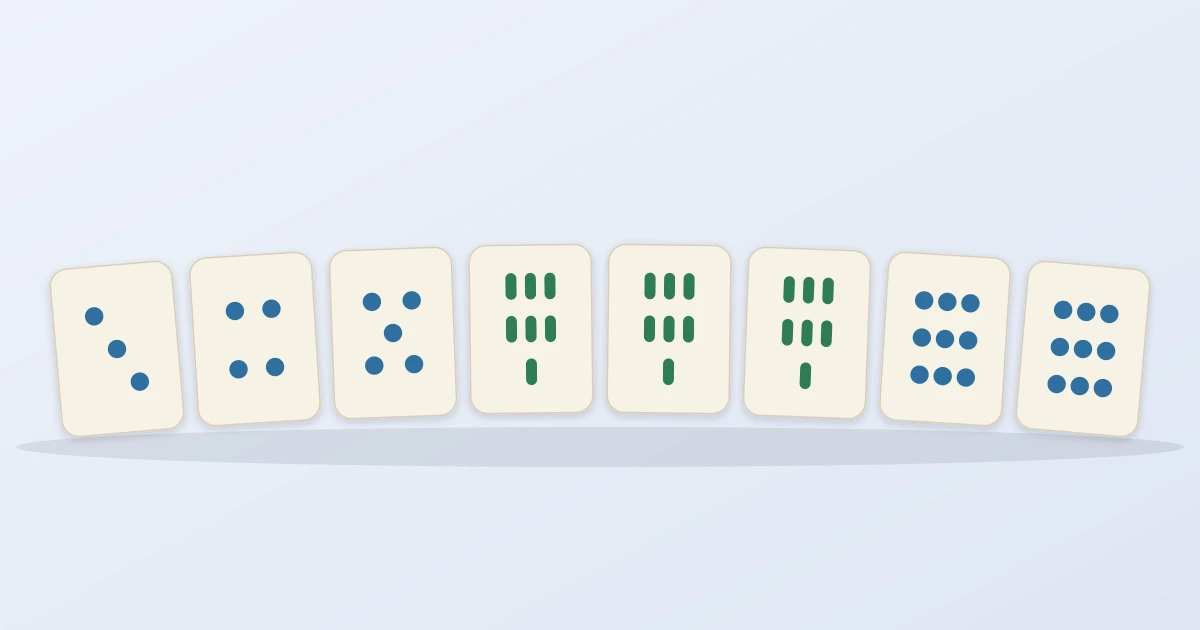
If you've only ever met mahjong through a computer, you have probably been playing the wrong game. The stacked pyramid where you clear identical pairs is Mahjong Solitaire, a one-player puzzle from 1981 that borrowed the artwork. This guide is about the other one: the four-player game that people have been playing around a table since 19th-century China, that ruins friendships, and that is far closer to poker than to any puzzle.
It has a reputation for being impossibly complicated. It isn't. The core loop takes about ninety seconds to learn. What takes years is playing it well.
The whole game in one paragraph
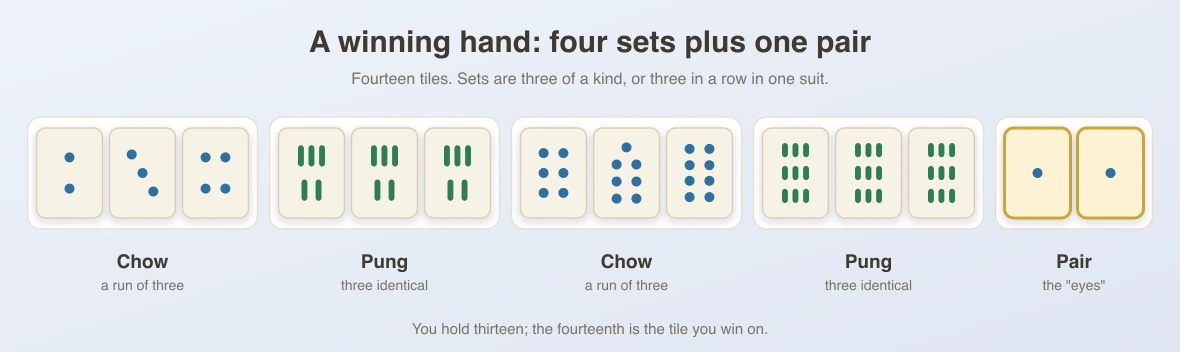
Four players sit around a table. Everyone holds thirteen tiles that only they can see. On your turn you draw one tile and discard one, keeping your hand at thirteen. You are trying to be the first to assemble four sets and one pair (fourteen tiles in total), which is why you win on the tile you've just drawn or claimed. When you get there, you declare it, the hand ends, and you're paid according to how hard the hand you built was.
That's it. Everything else is detail about what counts as a set, what you're allowed to steal, and how the payment is calculated.
The tiles
A full set is 144 tiles, though the Japanese game uses only 136 of them.
The three suits: 1 through 9, four copies of each, 108 tiles total:
- Dots (also called Circles): clusters of circles
- Bamboo (Sticks): bamboo canes, though the 1 Bamboo is confusingly drawn as a bird
- Characters (Cracks): Chinese numerals with a symbol beneath
The honour tiles: no numbers, no sequences, 28 tiles total:
- Winds: East, South, West, North. Four copies each.
- Dragons: Red, Green, White. Four copies each. The White Dragon is often a blank tile or an empty frame.
That's 136. The remaining eight are Flowers and Seasons, which behave like bonus tiles rather than playable ones: you set them aside when drawn, take a replacement, and score a small bonus. The Japanese game leaves them out of the set entirely.
What counts as a set
You need four of these, plus one pair, to win:
- Pung: three identical tiles. Three Red Dragons, three 5 Dots.
- Chow: a run of three consecutive tiles in the same suit. 3-4-5 Bamboo. You cannot make runs from honour tiles, and you cannot wrap 9 around to 1.
- Kong: four identical tiles. It counts as one set, but you draw a replacement tile because a kong would otherwise leave you a tile short.
And the pair is exactly what it sounds like: two identical tiles, sometimes called the "eyes."
A turn, concretely
Play passes counter-clockwise. On your turn:
- Draw a tile from the wall.
- Discard one tile face-up in the middle, announcing it.
Then the next player goes. Simple, except for the part that makes mahjong a game rather than a race:
You can steal other players' discards. When someone throws a tile away, you may claim it if it completes a set for you:
- To claim for a pung or kong, you can take it from anyone at the table.
- To claim for a chow, you can normally only take it from the player immediately before you in turn order.
- Claiming for a win beats everything, from anyone.
When you claim, you reveal that set face-up on the table, discard a tile, and play resumes from you, which means players between you and the discarder get skipped.
Stealing is a genuine trade-off, not free value. Melds you claim are exposed for everyone to read, and in most rulesets a hand built from claimed tiles scores substantially less than one you drew yourself. Fast and cheap versus slow and expensive is the central tension of the entire game.
What actually makes it a skill game
Beginners see mahjong as a race to collect sets. Strong players are doing three other things at once:
Reading the discards. The tiles in front of a player tell you what they aren't collecting. Someone discarding middle Bamboo early is probably not building a Bamboo hand. Someone who suddenly stops discarding a suit has likely switched into it.
Not dealing in. In most rulesets, if you discard the tile someone needs to win, you pay for it, often the whole amount. Late in a hand, the question stops being "what improves my hand" and becomes "what is safe to throw." Folding a mediocre hand to avoid paying out is a real and correct decision.
Judging speed against value. A cheap hand finished in eight turns often beats a beautiful hand you never complete. Knowing when to abandon the expensive plan is most of the difference between a losing player and a winning one.
The four rulesets you'll actually meet
This is where new players get lost, because "mahjong" is not one game with one rulebook. The tiles and the core loop above are shared. Scoring, and the restrictions on what counts as a legal win, differ enough that the versions play as distinct games.
Japanese Riichi: the one to learn if you want to play online
The competitive standard, and the ruleset behind essentially every serious online platform. Riichi uses the 136-tile set with no flowers or seasons.
Three things define it:
- You need a yaku. Four sets and a pair isn't enough. Your hand must also match at least one named pattern from a scoring list. This rules out cheap junk hands and forces you to plan a shape from the very first turns. It's the single biggest hurdle for newcomers, and the reason Riichi feels strict.
- Declaring riichi. With a closed hand one tile from winning, you can declare riichi, betting 1,000 points and locking your hand: you may no longer change it. In exchange the hand scores considerably more, and you've announced to the table that you're dangerous.
- Furiten. If any tile that would complete your hand is already sitting in your own discard pile, you cannot win off another player's discard, only by drawing it yourself. It punishes sloppy hand-reading and catches every beginner at least once.
▶ Watch: How To Play Riichi Mahjong In 3 Minutes by Kurly, the fastest honest overview. For a fuller treatment, A Beginner's Guide to Riichi Mahjong by Xanxust Mahjong.
Hong Kong Old Style: the easiest to start playing
The Cantonese default, and the version most often meant by "Chinese mahjong." It is fast, forgiving and by some distance the friendliest entry point if you have three people and a physical set.
Flowers and seasons are in play and pay bonus faan. The minimum needed to declare a win is low (often as little as three faan, sometimes less by house agreement), so hands complete quickly and the game keeps moving. There's no furiten rule and no riichi declaration to worry about.
The trade-off is that scoring conventions vary from table to table and family to family. Agree on the rules before you start; nobody will have exactly the same set in their head.
▶ Watch: How To Play Hong Kong Mahjong by Gather Together Games, or Mahjong 101: A Beginner's Crash Course by Wong Side of History.
Chinese Official (MCR): the tournament format
Introduced in 1998 to give international competition a single standard. It uses the full 144 tiles including flowers, and a winning hand must reach a minimum of 8 points drawn from a long, formalised list of scoring patterns.
That threshold makes MCR demanding in a different way from Riichi: cheap hands simply aren't legal wins, so you're forced to build something structurally interesting every single time. It's the ruleset of world championships and rather rare at a kitchen table.
American (NMJL): nearly a separate game
If you've seen mahjong played in the United States, particularly in Jewish-American communities where it took hold in the 1930s, you've probably seen this. It diverges far enough that Riichi knowledge barely transfers.
- The card. The National Mah Jongg League publishes a new scorecard every year listing the exact hands that are legal that year. You are not building any valid four-sets-and-a-pair. You are building one of the specific hands printed on this year's card, and last year's card is obsolete.
- Jokers. Eight wild tiles that can substitute into sets. No other major ruleset has them.
- The Charleston. A structured passing ritual before play, where everyone hands unwanted tiles around the table in a fixed sequence. It has no equivalent anywhere else.
▶ Watch: How to Read the NMJL Card by Southern Sparrow, reading the card is the actual skill, so start there. For the basics first, How to play American Mahjong by Triple S Games.
Which should you learn first?
If you want to play online tonight: Riichi. It's where the players are, and the queues fill instantly at any hour. The yaku requirement is a real wall, but you only have to climb it once.
If you have three friends and a physical set: Hong Kong Old Style. You can be playing properly inside an hour.
If your family already plays: whatever they play. Learn their table's house rules and don't argue with them.
If you want to compete formally: Riichi has by far the largest online competitive scene; MCR is the international over-the-board standard.
Where to play
The full roundup goes through every option in detail. The short version: Riichi City is the gentlest starting point thanks to its built-in lessons and instant bot queues, Mahjong Soul has the largest player base once you know the rules, and Kemono Mahjong teaches yaku progressively rather than all at once.
Be aware that the online mahjong world is overwhelmingly Riichi. Hong Kong and American mahjong are played by enormous numbers of people, but mostly in person. The apps for both are thinner on the ground and rougher around the edges.
Common questions
Is Mahjong Solitaire the same game? No, and this trips up nearly everyone. Solitaire shares the tile art and nothing else. If you want that one, we have a separate guide to it.
Do I need to memorise all the scoring? No. Learn the shape of a winning hand and a handful of common patterns, and play. Every online version calculates scores for you, and you'll absorb the patterns by seeing them. Trying to memorise a scoring table before your first game is the most common way people give up.
Is it gambling? It's traditionally played for money, and in some places that's the whole point. It doesn't have to be. Every online platform above plays for points, not cash.
How long does a game take? A single hand runs a few minutes. A full game is a series of hands and typically takes 30 to 60 minutes, depending on ruleset and length.
Do I need a physical set? Not to learn. Play a few hundred hands online, where the rules are enforced for you, and a real table will make far more sense when you get to one.
Enjoy games that reward reading a situation rather than just spotting a match? Try Pairdle, a daily word puzzle built on deduction, where narrowing down what a word isn't matters as much as knowing what it is.
By Tim Nye, Logic Loft Games
Related articles
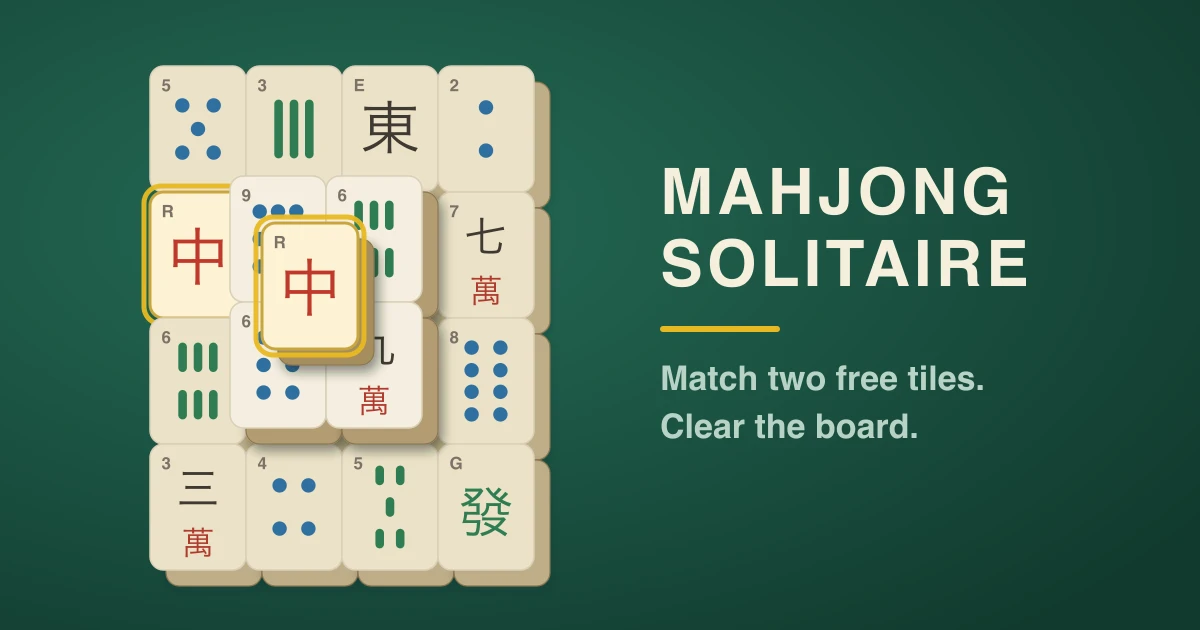
How to Play Mahjong Solitaire: A Beginner's Guide
Mahjong Solitaire is not the four-player game. It is a one-player tile-matching puzzle. Here are the rules, what 'free' means, and how to avoid getting stuck.
The 10 Best Mahjong Games to Play Online and Mobile (2026)
"Mahjong" means three different games. We sort the 10 best digital versions into solitaire, connect and the four-player game, so you pick the right one.
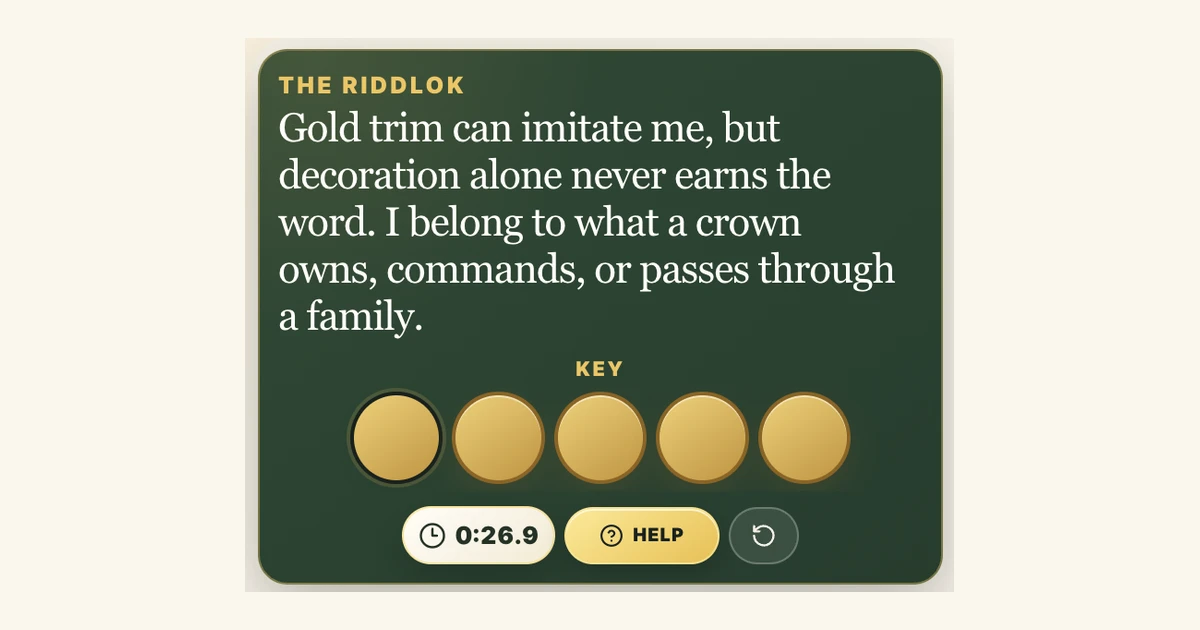
How to Play Riddlok - Exciting new puzzle game!
Riddlok is a free daily word puzzle with three routes to one answer — a riddle, a set of clues, and a hidden theme linking the clue answers.