
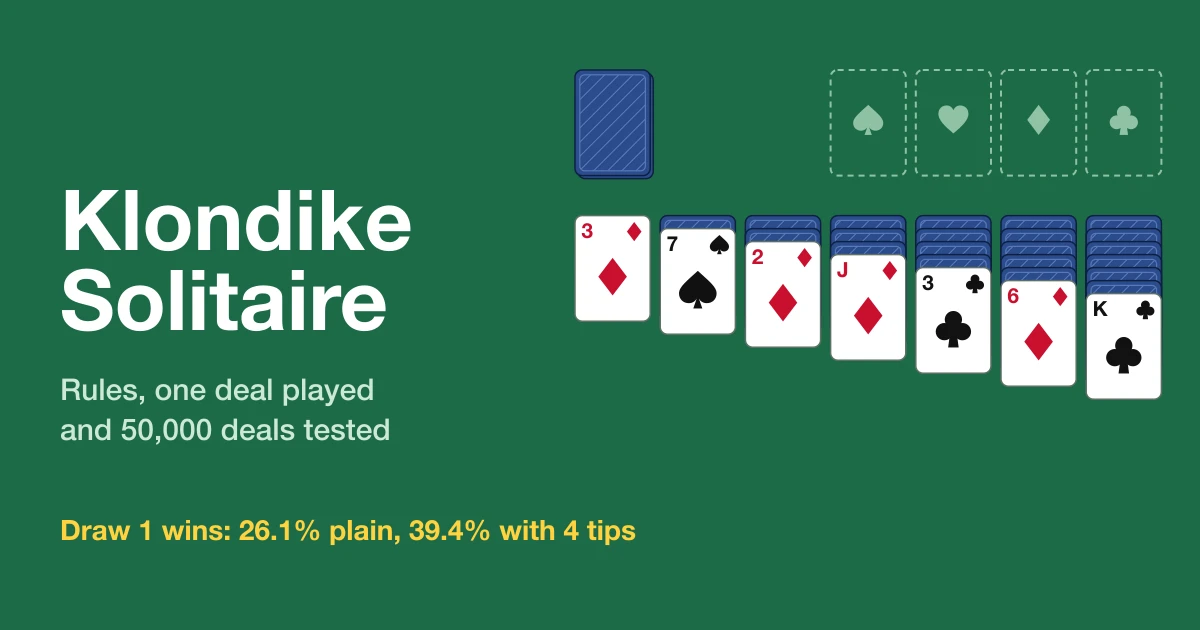
Klondike is the card game most people mean when they say "Solitaire". It is the one that came free with Windows. You deal seven columns, turn cards over, and try to sort the whole deck into four piles, one per suit, from Ace to King.
This page has three parts. First the rules, kept short. Then one real deal, played move by move, with a picture at every choice that mattered. Last, the part you won't find on other rules pages: we wrote a small computer player, ran it on the same 50,000 shuffled deals with and without each well-known tip, and counted how many extra games each tip wins.
The layout
You need one normal deck of 52 cards and no jokers. Deal seven columns from left to right. The first column gets 1 card, the second 2, and so on up to 7 cards in the last one. Only the top card of each column is face up. That uses 28 cards, and 21 of them are face down.
The other 24 cards go face down in a pile called the stock. Next to it is the waste, where cards go when you turn them over from the stock. Above the columns are four empty spots, the foundations. Each one will hold one suit, built from Ace up to King.
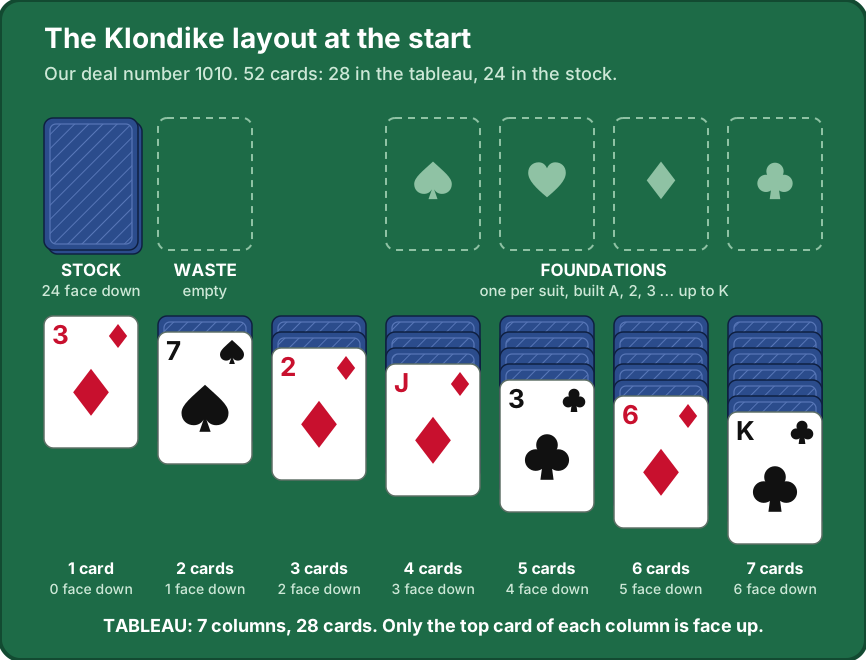
The seven columns together are called the tableau. Every card in the picture above comes from one shuffle we call deal 1010. We play that same deal later on this page.
The rules
You win when all 52 cards are on the foundations. These are the only moves you can make.
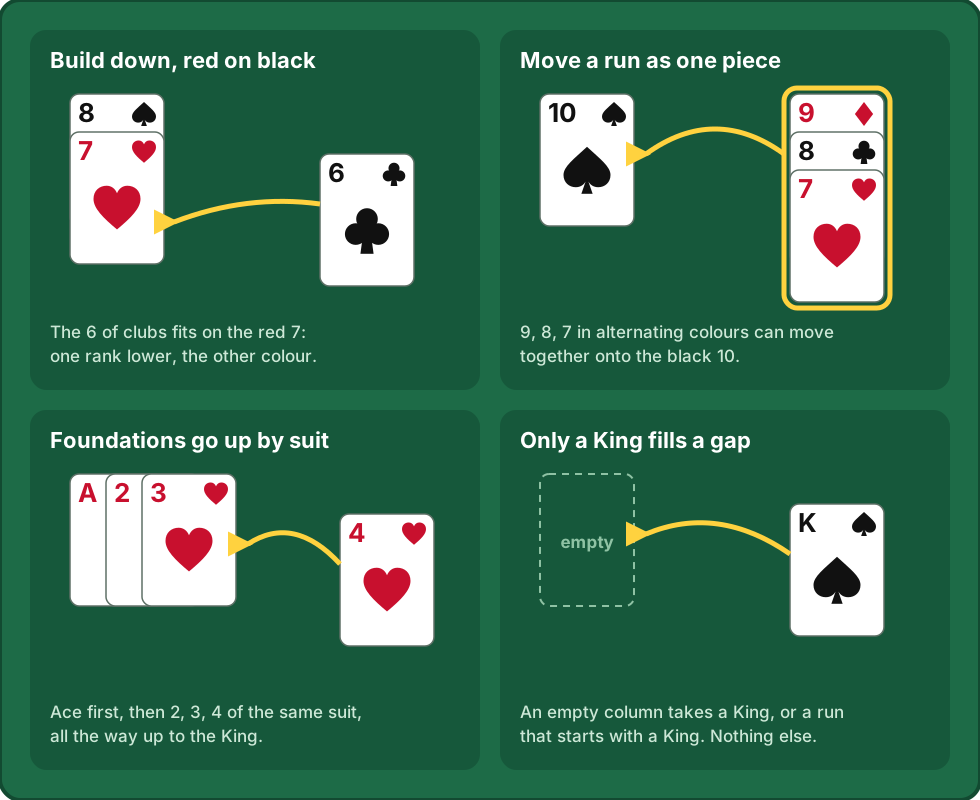
- Put a card on a column if it is one rank lower and the other colour. A red 7 goes on a black 8. A black 6 goes on a red 7.
- Move a whole run of face-up cards at once, as long as the run is in order and the colours alternate.
- Put a card on its foundation if it is the next rank of that suit. The Ace starts it, then the 2, then the 3.
- When you move the last face-up card off a column, turn the face-down card under it over.
- An empty column can only take a King, or a run that starts with a King.
- When you can't move, turn cards from the stock onto the waste. Only the top waste card can be played.
There are two ways to use the stock. In draw 1 you turn one card at a time. In draw 3 you turn three at a time and can only play the top one, so the cards under it stay out of reach until the next time through. When the stock runs out, flip the waste pile over and it becomes the stock again. Some apps limit how many times you can do that. In our tests there is no limit.
One deal, played move by move
To show how choices matter, we played deal 1010 twice with draw 1. Both players are small programs we wrote. Neither one can see face-down cards.
The plain player does what a hurried person does. It sends every card it can to the foundations right away, plays the waste card whenever it fits somewhere, then looks at the columns from left to right, and draws when it finds nothing.
The careful player follows four common tips. We test each of them on its own further down:
- When a column card can be turned over, do that before playing from the waste.
- When there are several ways to turn a card over, pick the column with the most face-down cards.
- Don't rush cards to the foundations. Send up Aces, 2s and any card no other card could still need. Keep the rest on the table while they can still catch a lower card.
- Don't empty a column unless a King is ready to move into it.
Move 1: two ways to turn a card over
The deal opens with two useful moves. The 6 of diamonds can go on the 7 of spades, or the 2 of diamonds can go on the 3 of clubs. Both turn over a face-down card.
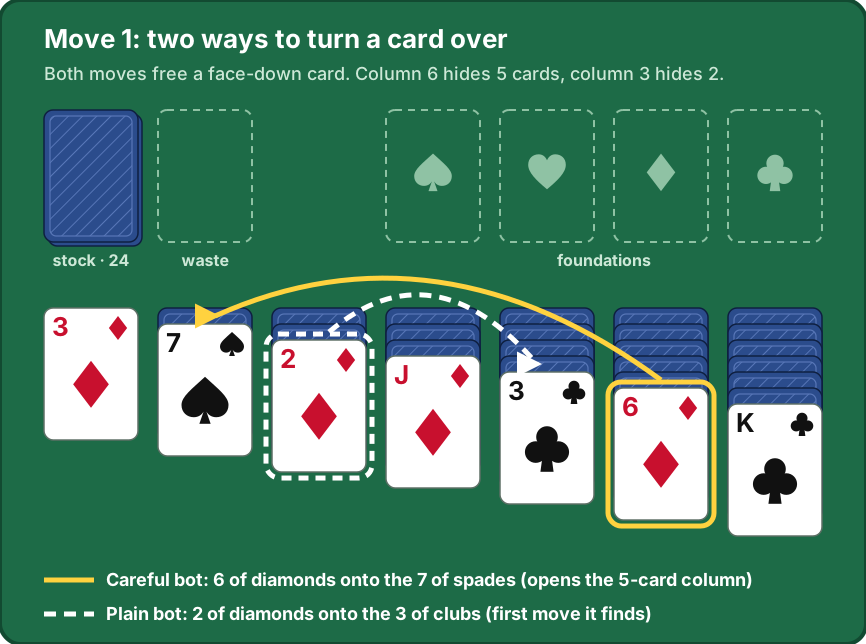
The plain player takes the first move it finds, the 2 of diamonds. The careful player picks the 6 of diamonds, because column 6 hides 5 cards and column 3 hides only 2. Clearing the tall columns early matters. They hold most of the hidden cards, and those are the cards that end games.
Move 5: which King goes in the gap
Four moves later, column 2 is empty. Two Kings could fill it. The King of diamonds sits on 4 face-down cards. The King of clubs, with the Queen of diamonds on it, sits on 6.
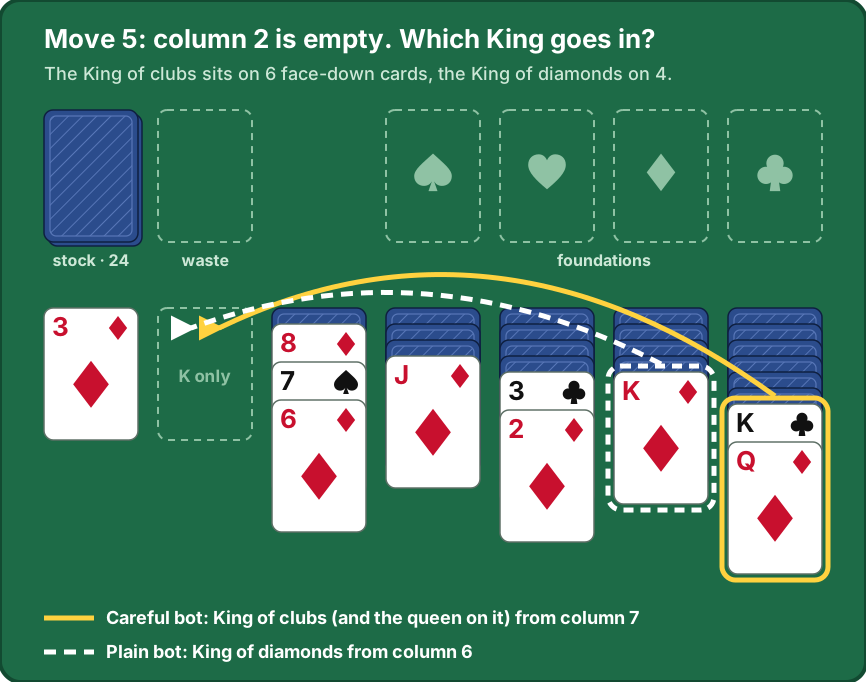
The careful player moves the King of clubs, which opens the column with 6 hidden cards. The plain player, in its own game, moves the King of diamonds at this same point. Keep an eye on that King of clubs. It decides how the plain player's game ends.
Move 42 to 50: holding back a card
At move 42 the 3 of diamonds could go up to its foundation. The plain player would send it. The careful player leaves it alone in column 1, because a black 2 might need somewhere to land. The Ace of spades isn't up yet, so a 2 of spades can't go to a foundation. It can only go on a red 3.
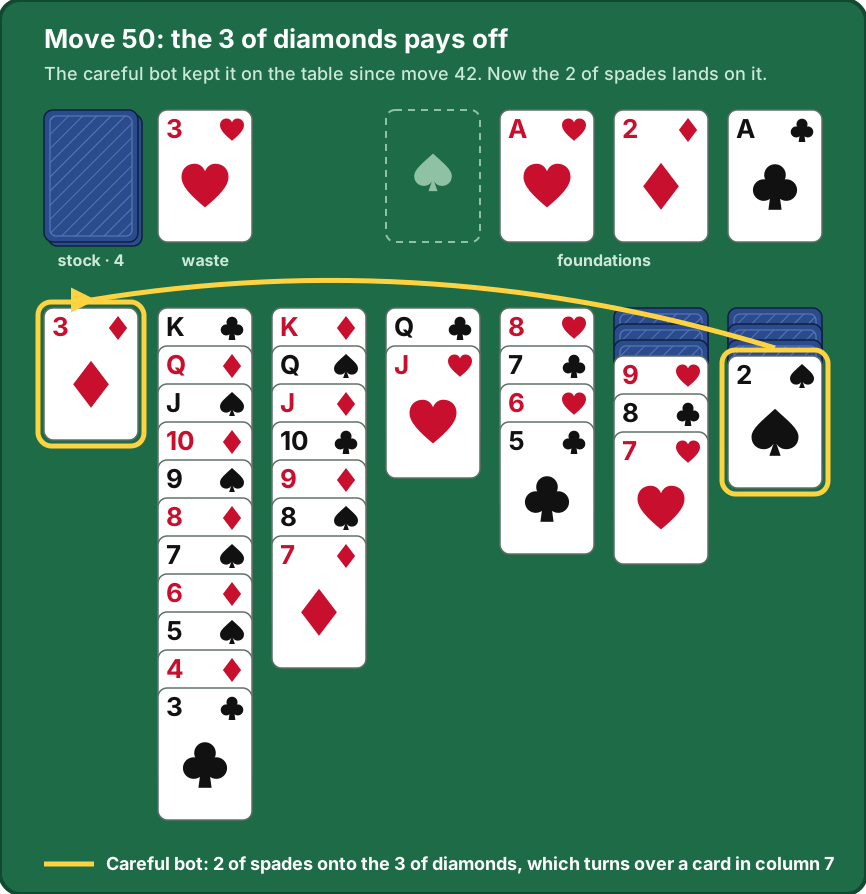
Eight moves later, that is what happens. The 2 of spades turns up on column 7 and moves onto the 3 of diamonds, and the Jack of clubs under it turns over. From there the careful player clears the board and wins in 126 moves, counting every card drawn from the stock.
Where the plain player got stuck
The plain player lost the same deal after 75 moves, with 14 cards on the foundations. The King of clubs it left in column 7 still covers 6 cards it never saw.
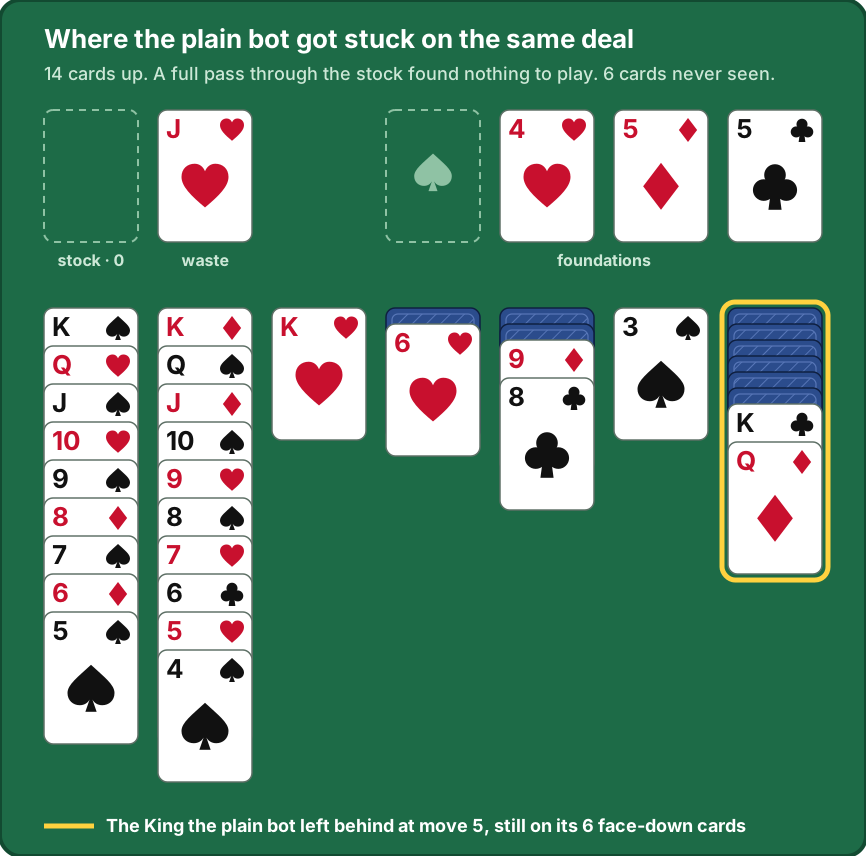
One deal proves nothing, though. The careful player could just have been lucky. So we ran both players, and a player for each single tip, on the same 50,000 deals.
What 50,000 deals say about the tips
Our method: deals 1 to 50,000, each shuffled from a fixed seed so anyone with the script gets the same cards. Every player plays every deal, with draw 1 and again with draw 3. A game ends in a loss when the player goes through the whole stock without making a single move.
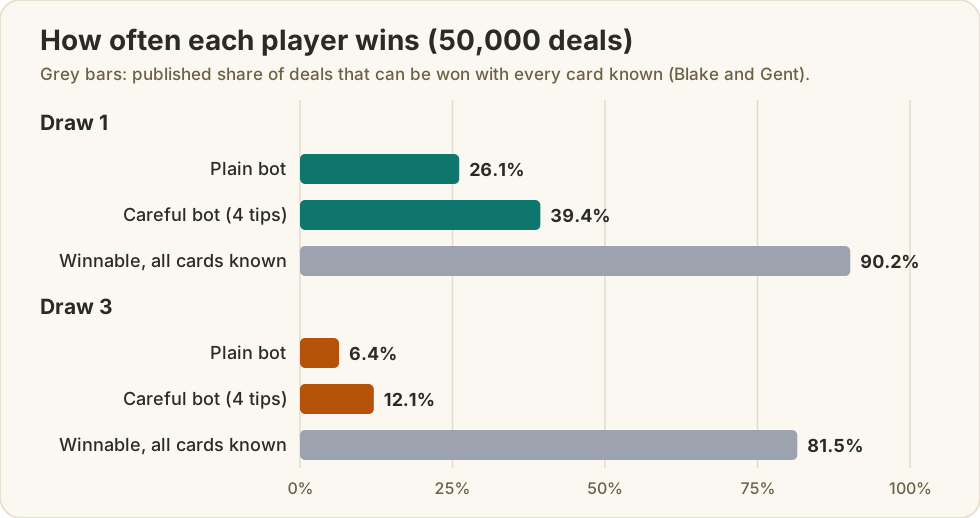
With draw 1 the plain player wins 26.1% of deals and the careful player wins 39.4%. With draw 3 the numbers drop to 6.4% and 12.1%. With 50,000 deals, each of these is within about half a point of what a much longer run would give.
Then we switched on one tip at a time and compared against the plain player on the same deals.
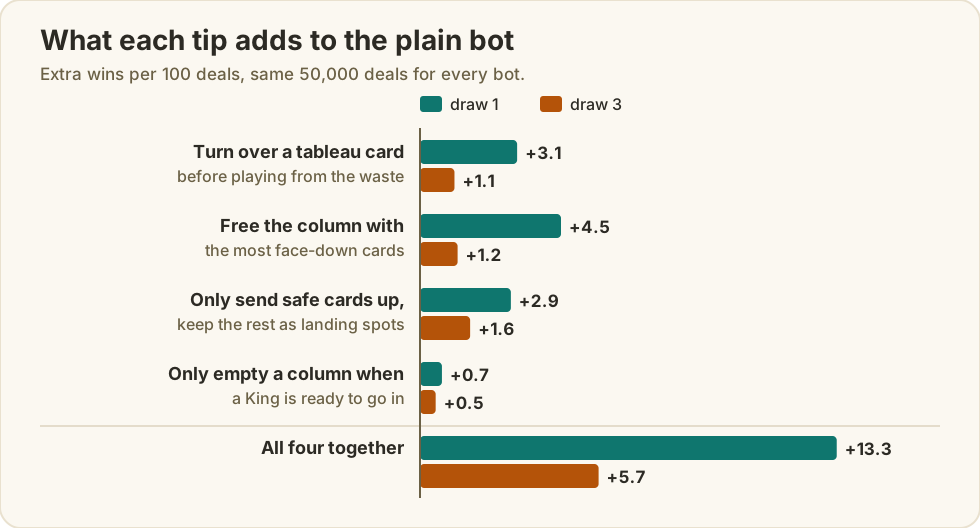
Here is what we read from the chart.
Turning cards over is the whole game. Every draw 1 game the plain player lost ended with face-down cards still on the table, 9.8 of them on average. The two tips about hidden cards are the two biggest single gains in draw 1: picking the tallest column adds 4.5 wins per 100 deals, and turning over a column card before playing from the waste adds 3.1.
Holding cards back helps too, and it helps most in draw 3, where it is the best single tip (+1.6). The cost is time. The careful player's winning games run longer, 134 moves on average against 124 for the plain player.
The King tip barely matters, at +0.7 in draw 1. Our guess at why: an empty column can only take a King anyway, so an early empty column rarely costs you anything.
No tip is a sure thing. Picking the tallest column won 4,233 deals the plain player lost, but it also lost 1,952 deals the plain player won. The tips raise your odds. They don't fix every deal.
The tips work better together than apart. Added up one by one they come to 11.2 extra wins per 100 deals in draw 1. All four at once give 13.3.
How our player compares to the best possible
A computer player that follows fixed rules is not the same as perfect play. Ours only sees face-up cards, never plans ahead, never splits a run to free a card, and never takes a card back off a foundation. So these numbers show how much each tip helps a simple player. They are not the most anyone could win.
For the ceiling, the best source we found is a 2026 paper by Charlie Blake and Ian Gent in the Journal of Artificial Intelligence Research, "The Winnability of Klondike Solitaire and Many Other Patience Games". Their solver plays a version where every card is face up from the start. With rules like ours (no taking cards back down from a foundation), they found 90.2% of draw 1 deals and 81.5% of draw 3 deals can be won. With hidden cards the true figure must be lower, and nobody knows it exactly.
People fall well short of that ceiling too. In the 2005 study "Solitaire: Man Versus Machine" by Yan, Diaconis, Rusmevichientong and Van Roy, an expert played 2,000 games of the draw 3 game with every card showing and won 36.6% of them. Their best computer method won about 70%.
Test yourself
Look back at the pictures above and try these.
How many face-down cards are in the tableau at the start?
21, since columns 2 to 7 hide 1+2+3+4+5+6.
At move 50, why couldn't the 2 of spades go to a foundation?
The Ace of spades wasn't up yet, so no spade could go there.
In the stuck board, which pile should the plain player have opened at move 5?
Column 7, under the King of clubs: 6 hidden cards, against 4 in column 6.
What to do at the table
Before you draw from the stock, make every move that turns a column card over. When you have a choice, work on the column with the most face-down cards. Send Aces and 2s up at once, but let a middle card wait if a lower card of the other colour might still need it. Play draw 1 while you learn. Our careful player wins about three times as often with it as with draw 3.
If you want other solo card games once Klondike feels easy, our roundup of the best solitaire and card games covers FreeCell, Spider and a few newer ones. For a tile game that works a lot like Klondike, uncovering pieces and clearing them in the right order, try Mahjong Solitaire.
The rules on this page follow the standard game as set out in Bicycle's Klondike rules. Every number comes from our own script, so you can rerun it and get the same results.
Related articles
The Best Solitaire and Card Games to Play in 2026 (Digital Editions Ranked)
From Microsoft Solitaire to the viral hit Balatro: our ranked list of the best digital solitaire and card games on PC, mobile and browser right now.
Pairdle 1.5: What's New, What's the Same, and an Exciting New Level
Pairdle 1.5 puts every level on one row, unlocks Pro, adds Expert and endless Practice, and introduces Olly the owl. Plus what a 12-tile board really holds.
How to Play Mahjong: The Real Four-Player Game Explained
Not the tile pyramid — the real game. Four players, thirteen tiles, draw and discard. How a hand works, and how Riichi, Hong Kong, Chinese and American differ.