
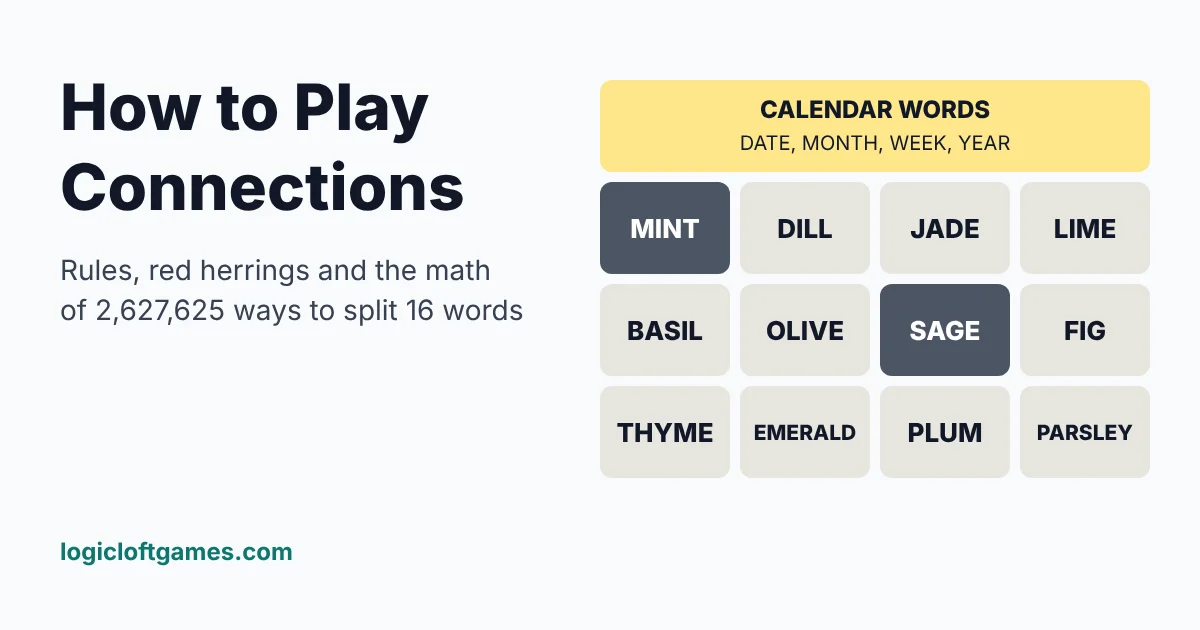
Connections gives you 16 words and one job: sort them into four groups of four. Each group shares something. It might be four kinds of fruit, four words that go before "fish", or four words that hide an animal. You have four mistakes. The fourth wrong guess ends the game.
This guide covers the rules, what the colors mean, how the puzzle sets traps, and a set of tips. To back the tips up, we worked out the math of the board and had a computer play thousands of games without reading the words, to see how far blind guessing gets you. There are 16 boards of our own to play at the end, free.
How to play Connections
Connections is a daily puzzle from New York Times Games. Our version at the end of this page works the same way.
- You see a grid of 16 words, four across and four down.
- Tap four words you think belong together, then press Submit.
- If all four share the hidden link, they leave the grid and form a colored bar with the name of the group.
- If they do not, you lose one of your four mistakes. If three of your four were right, the game tells you "one away".
- Find all four groups to win. Make four mistakes and the game ends and shows you the answer.
There is also a Shuffle button. It moves the words around without changing anything else. It helps more than you would think (see the tips).
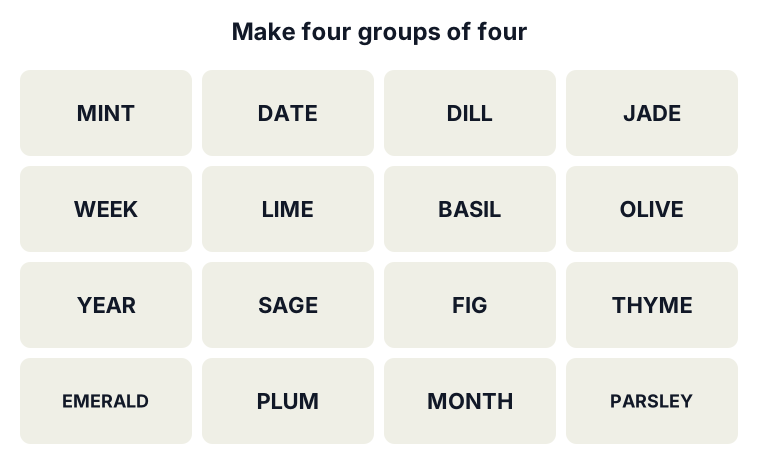
Here is one of our own boards. Have a look before you read on. There are four groups hiding in it, and at least five of the words are there to trip you up.
What the four colors mean
Every group has a color, and the color tells you how hard the group was meant to be.
- Yellow is the easiest. The link is plain, like "Calendar words".
- Green is a little harder.
- Blue is harder again. It often needs a second meaning of a word.
- Purple is the hardest. It is usually wordplay: words that go before or after another word, words that hide something, words that sound like something else.
You do not have to solve them in order. Many good players leave purple for last on purpose, because once the other twelve words are gone, the last four are a group whether you can name it or not.
Red herrings: the words that fit twice
Here is the answer to the board above.
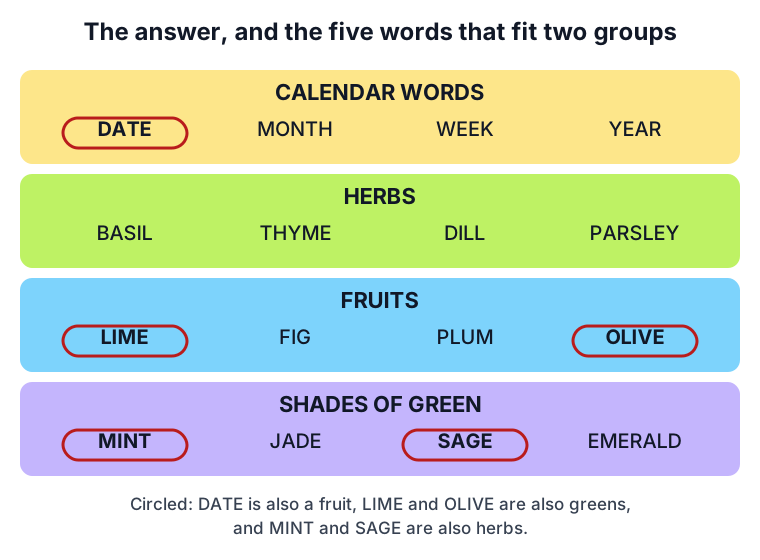
Five of the words could go in two groups. DATE is a calendar word and a fruit. LIME and OLIVE are fruits and shades of green. MINT and SAGE are herbs and shades of green. These are the red herrings, and every good board has them. They are why the obvious group is so often a trap. If you see five or six herbs on the board, that is not luck. One or two of them belong somewhere else.
The way out is to start from the words that can only go one way. THYME, BASIL, DILL and PARSLEY can only be herbs, so herbs is settled and MINT and SAGE are free to be greens. JADE and EMERALD can only be greens. FIG and PLUM can only be fruits. Once you see that, every red herring falls into place.
Each of our 16 boards has exactly one answer. We checked that with a short program that tries every way the red herrings could be placed. Across all 16 boards there are 48 red herrings, three per board on average.
The math of 16 words
How many ways are there to sort 16 words into four groups of four? Take the first word. It needs three partners from the other 15, which is 455 choices. The first word left over needs three partners from the remaining 11, which is 165 choices. Then 35, then 1. Multiply them and you get 2,627,625 ways to split the board.
Only one of them is right. But the count falls fast as you solve.
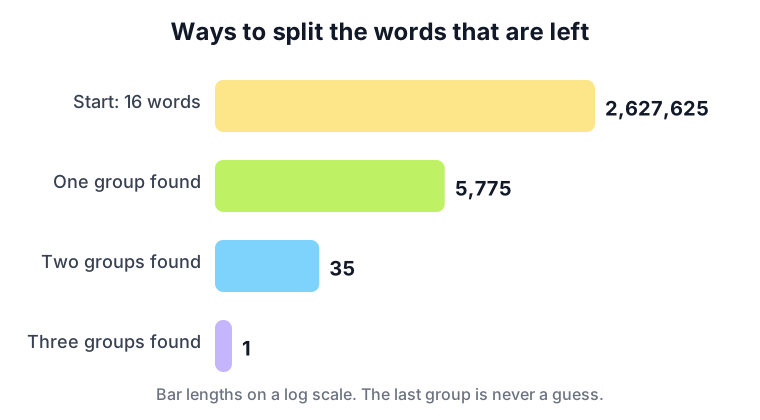
After one group the 12 words left can be split 5,775 ways. After two groups, only 35. After three, there is just one way, which is why the last group is never a guess. Most of the hard work is in the first group. Finding it cuts the count by 455 times. The second cuts it by 165 times, the third by 35.
What happens when you guess
There are 1,820 different ways to pick four words out of 16. Only 4 of those picks are a correct group. Another 192 are "one away", three words from one group plus one stray. The other 1,624 get nothing at all.
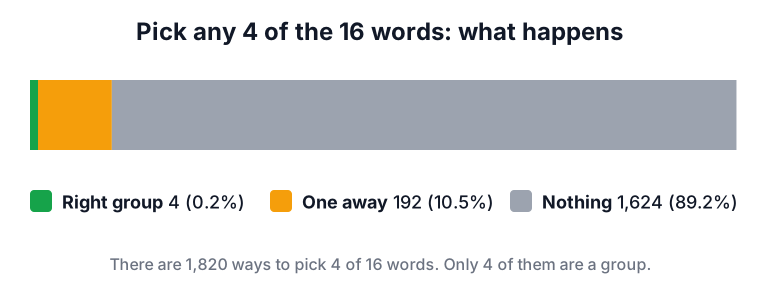
So "one away" is not a near miss in the everyday sense. It is rare. Only about one random pick in ten gets that message, and it tells you something real: three of your four words belong together.
Can you win without reading the words?
We wanted to know how much the game can be beaten by guessing alone, so we had a computer play it blind, without knowing what any word meant.
First, pure random picks. The chance of winning that way works out to about 1 in 135,000. In 200,000 games our random player won exactly once, and in 99.1% of games it did not find a single group.
Then we made the blind player smarter. After every guess it remembered the answer it got, "correct", "one away" or "nothing", and from then on only made guesses that still fit everything it had been told. It kept a list of all 2,627,625 possible answers and crossed off every one the feedback ruled out. That player won 0 of 1,500 games. It found no group at all in 98.4% of them.
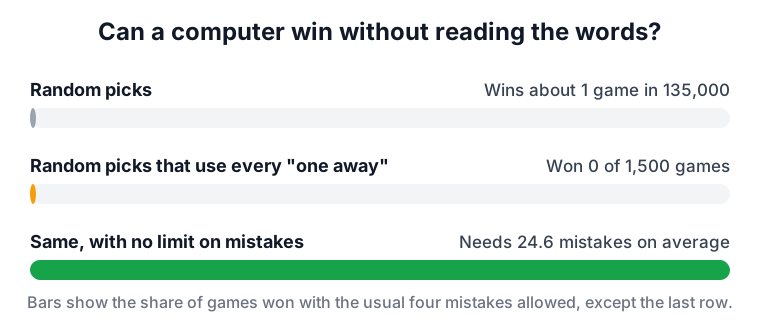
When we took away the limit and let it guess until it finished, it needed 24.6 mistakes on average, and 56 in its worst game. You get four.
The feedback the game gives you is real, but it is far too thin to solve the puzzle on its own. Every win comes from reading the words. Guessing is only useful at the very end, when the board is small.
Tips that come from the numbers
Count before you click. If you can find five or more words that fit one link, there is a red herring in there. Do not submit until you know which word is the odd one out.
Start with the words that only fit one way. A word that has one meaning on this board is your anchor. Build its group around it, and the double-meaning words sort themselves out.
Look for the purple trick early, solve it late. Read each word and ask what it could go before or after, what it sounds like, and what it hides. Spotting the wordplay tells you which words to keep out of the easier groups, even if you do not submit it yet.
Use Shuffle when you are stuck. Words that sit next to each other look like they belong together. Shuffling breaks the pairs your eye has made and often shows a link you missed.
Do not guess early. With 16 words on the board, a guess that gets "nothing" teaches you very little, and you have only four mistakes. With 8 words left there are just 35 ways to finish, and a careful guess is often fine.
Treat "one away" as a clue. It means three of your four words are right. Swap one word at a time and think about which one is the stray before you submit again. Do not send the same four twice. It does not cost a mistake in our version or the real one, but it tells you nothing new.
How we checked
The split counts are exact: 16 words into groups of four is 16! ÷ (4!⁴ × 4!) = 2,627,625, and the same formula gives 5,775 for 12 words and 35 for 8. The 1,820, 192 and 4 come from counting every possible pick of four words. The 1 in 135,000 is worked out exactly for a player who picks four words at random each time. The random games (200,000) and the blind player that uses feedback (1,500 games with four mistakes, and 400 games with no limit) were run by a program that holds every one of the 2,627,625 possible answers and crosses them off as feedback comes in. Our 16 boards are our own and are not copies of any Times puzzle. A second program tried every way their red herrings could be placed to make sure each board has one answer. The code is in our site's repository.
Where Connections came from
The New York Times launched Connections in June 2023, and by November 2026 it had passed 1,250 puzzles. Each puzzle is edited by Wyna Liu. It sits in the Times Games app next to Wordle, Strands, Spelling Bee and the Mini Crossword, and a new board comes out every day at midnight.
Frequently asked questions
How many mistakes can you make in Connections? Four. On the fourth wrong guess the game ends and shows the groups you missed.
What does "one away" mean in Connections? Three of the four words you picked belong to the same group. One word is wrong.
What do the colors mean in Connections? They show how hard each group was meant to be: yellow is the easiest, then green, then blue, and purple is the hardest.
Do you have to solve the groups in order? No. You can find them in any order. Once three groups are found, the last four words are always a group, so the last one is never a guess.
How many ways can 16 words be split into four groups? 2,627,625. Only one of them is the answer.
Can you play Connections for free? Our 16 boards below are free, with no sign-up. The daily Times puzzle is on the New York Times Games site and app.
Play a Connections puzzle now
Here are our 16 boards. You get a random one. Tap four words that you think share a link, then press Submit. A correct group turns into a colored bar, from yellow for the easiest to purple for the hardest. A wrong group costs one of your four mistakes, and if three of your words were right you will see "one away". Shuffle moves the words around, and Deselect all clears your picks. When the board is over, "Next board" deals a new one.
If you like this kind of game
Connections is about the meaning of words. If you like a daily puzzle with a theme, try Strands, where every letter in the grid belongs to a themed word. For puzzles about the letters themselves, see Letter Boxed, Wordle and our roundup of the best daily word games. And if you like narrowing a big list down to one answer, Pairdle does that with two words at once.
Related articles
How to Play Bananagrams: Rules, Dumps and What 4,000 Hands Show
Bananagrams rules for 2 to 8 players: Split, Peel, Dump and Bananas. Plus what 4,000 computer hands say about the Q and vowels, and a free solo game.
How to Play Strands: Theme Words, Spangrams and Hints
How to play Strands, the word search where every letter counts: theme words, the spangram, how hints work, and what 30 computer-solved boards show about finding the answers.
How to Play Hangman, and the Best Letters to Guess
The rules of Hangman, the best first letter for every word length, and why MOM, not JAZZ, is the hardest everyday word, from 6,298 words played by computer.