Bananagrams is a word game with no board and no turns. Everyone grabs a handful of letter tiles at once and builds their own little crossword. The first player to use every tile they are holding, once the bunch in the middle runs low, wins the round.
This guide covers the rules for every player count, the calls (Split, Peel, Dump, Bananas), how to play alone, and some tips. To test the tips, we wrote a computer player and had it build grids from 4,000 random hands at each hand size, using only everyday words. The numbers below come from that. There is a free solo game at the end of the page.
What is in the bag
A game of Bananagrams is 144 letter tiles in a cloth banana-shaped pouch. There is nothing else: no board, no score pad, no timer. The tiles lie face down in the middle of the table, and that pile is called the bunch.
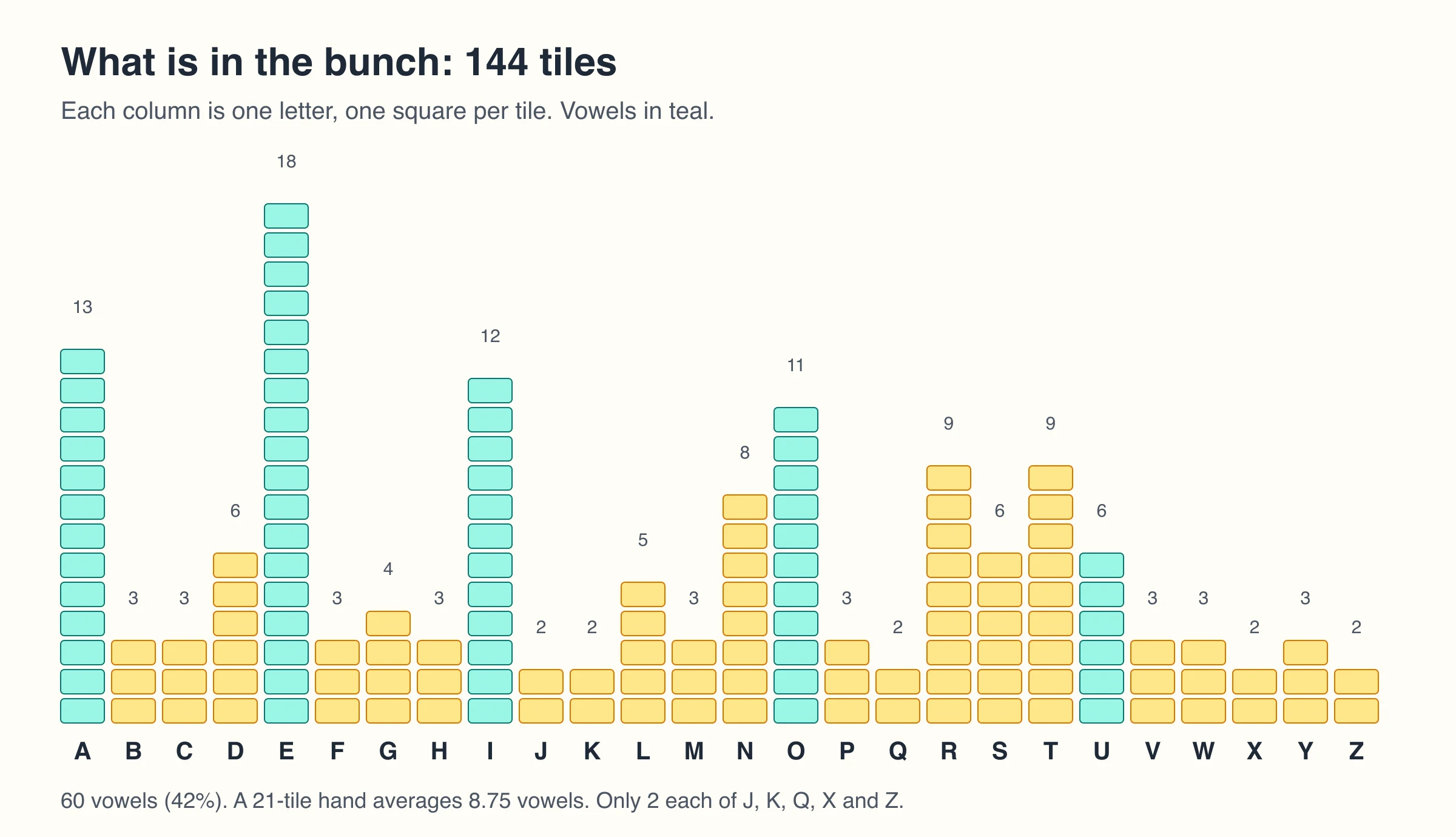
The mix is close to how often letters turn up in English. There are 18 E tiles, 13 A, 12 I and 11 O, and only two each of J, K, Q, X and Z. The five vowels (A, E, I, O, U) make up 60 of the 144 tiles, which is 42%. So a hand of 21 tiles holds 8.75 vowels on average.
How to play Bananagrams
Setup
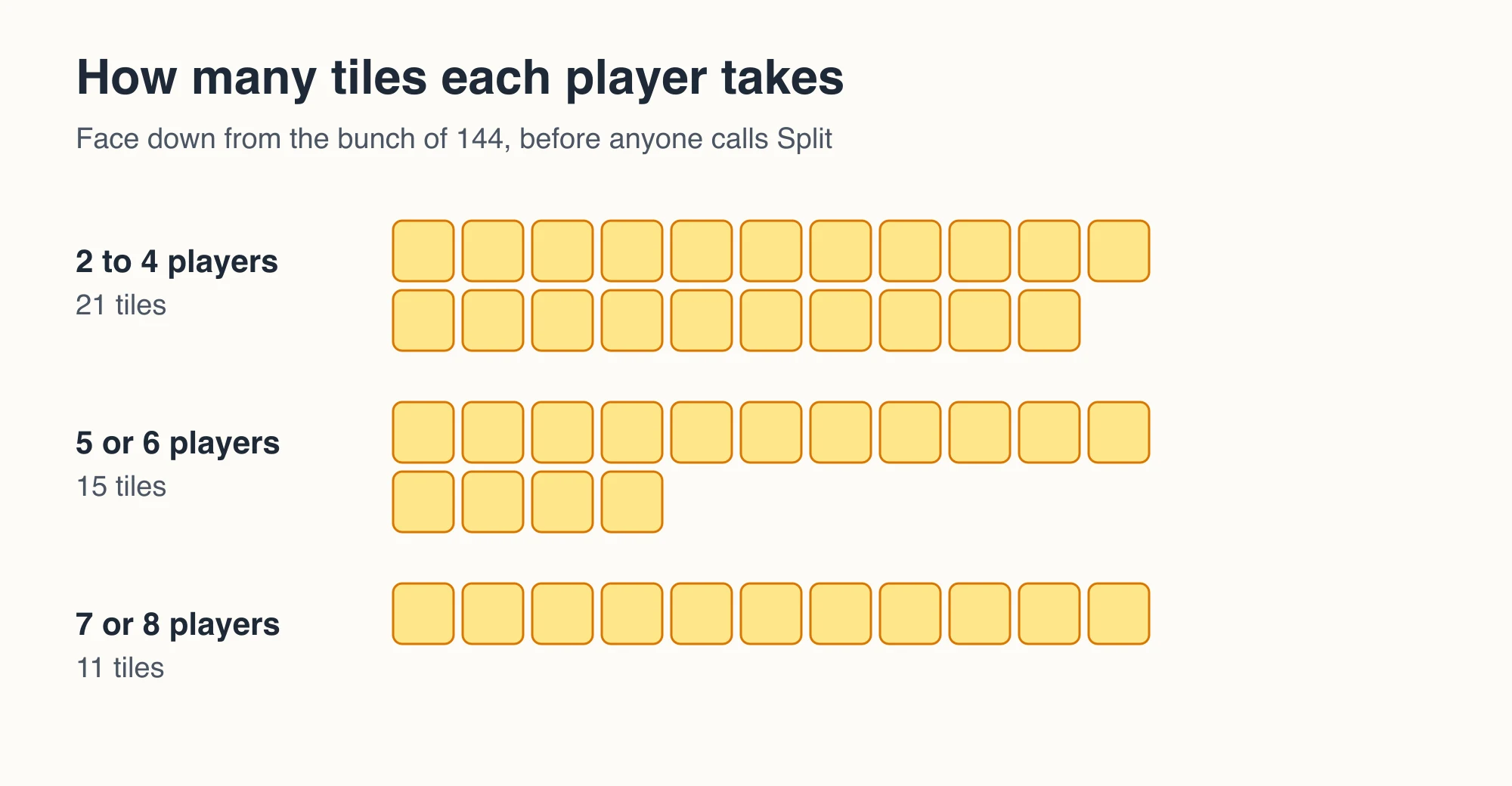
Put all 144 tiles face down in the middle and mix them. Each player takes tiles face down, without looking:
| Players | Tiles each |
|---|---|
| 2 to 4 | 21 |
| 5 to 6 | 15 |
| 7 to 8 | 11 |
Split
When everyone is ready, any player calls "Split!" and everyone turns their tiles face up at the same moment. There are no turns from here on. Everyone plays at once, as fast as they can.
Build your grid
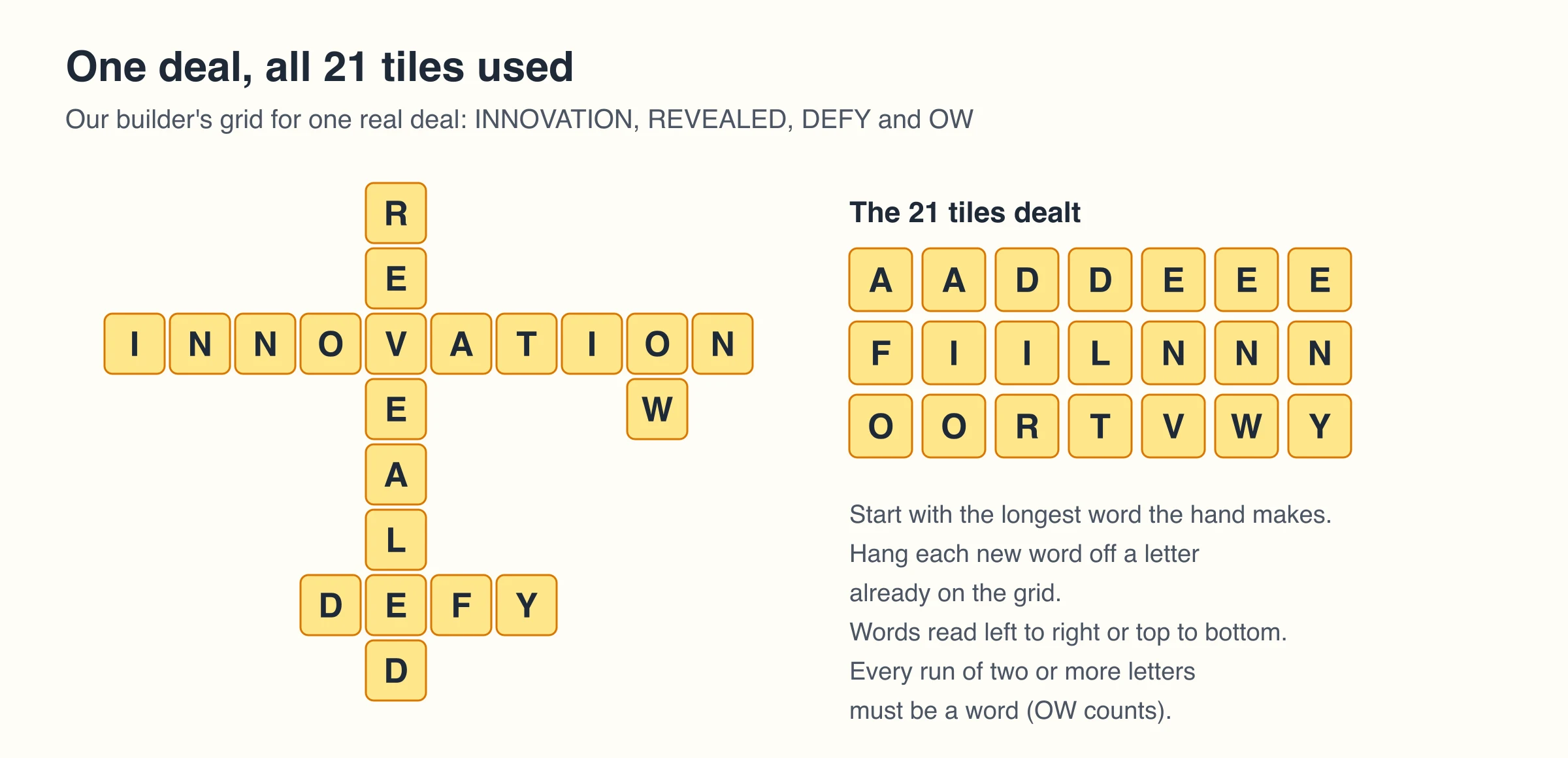
Each player builds their own grid in front of them, the way a crossword fills in. Words read left to right or top to bottom. Every word has to cross or join another word, so the grid stays in one piece. You can move or break up your own words at any time, as often as you like.
Every row or column of two or more touching letters counts as a word, so tiles you put side by side have to spell something both ways. Names, abbreviations and slang are not allowed. Agree on a dictionary before you start if your group likes to argue.
Peel
When you have placed your last tile, call "Peel!". Every player, including you, takes one tile from the bunch and has to fit it in. The game speeds up as the grids grow: whoever is fastest keeps calling Peel, and everyone else gets new tiles before they have placed their old ones.
Dump
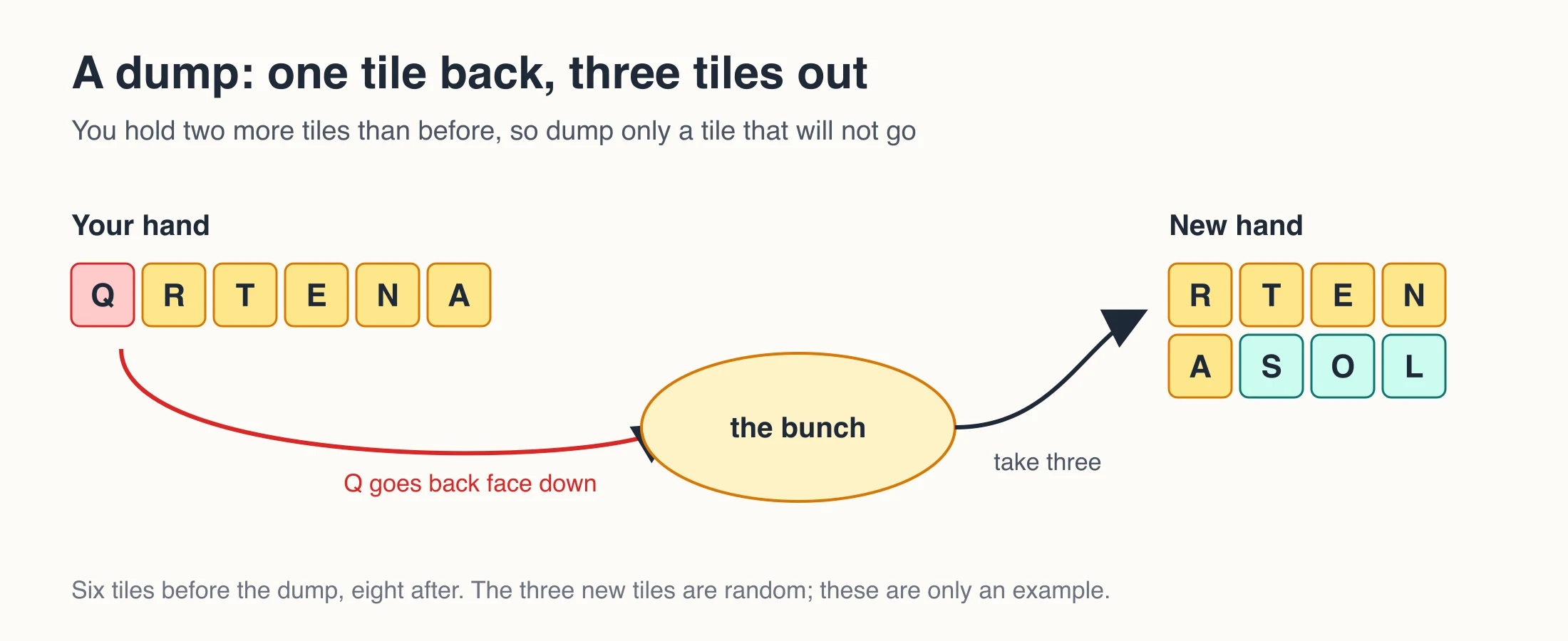
If you hold a tile you cannot use, call "Dump!", put it back face down in the bunch, and take three tiles. You end up with two more tiles than before, so only dump a tile you really cannot use. You can dump as often as you like.
Bananas
When there are fewer tiles in the bunch than there are players, there are no more peels. The first player to use every tile they hold calls "Bananas!" and the others stop. They check that player's grid. If every word is real, that player wins the round. If a word is wrong, it is a "Rotten Banana": that player is out of the round, their tiles go back into the bunch, and the rest keep playing.
Many groups play several rounds and count who wins the most.
Playing Bananagrams alone
Bananagrams works as a solo puzzle. Take 21 tiles, build a grid that uses all of them, then peel one tile at a time and fit each one in. Time yourself and try to beat your time, or see how many tiles you can place before you get stuck. Dumps are allowed, but each one adds two tiles to your hand.
The game at the end of this page plays this way, with a timer and a Peel mode of ten extra tiles.
What 4,000 computer hands taught us
We wanted to know which tips really help, so we had a computer build grids. It deals a hand from a full 144-tile bunch, plays the longest everyday word it can as the first word, then keeps hanging new words off letters already on the grid until the hand is used up or nothing fits. If it gets stuck it can tear the grid down and start again, up to five times, the way a person shuffles their words around. It only uses about 20,000 common words, so it is a careful player, not a perfect one.
How often a whole hand fits
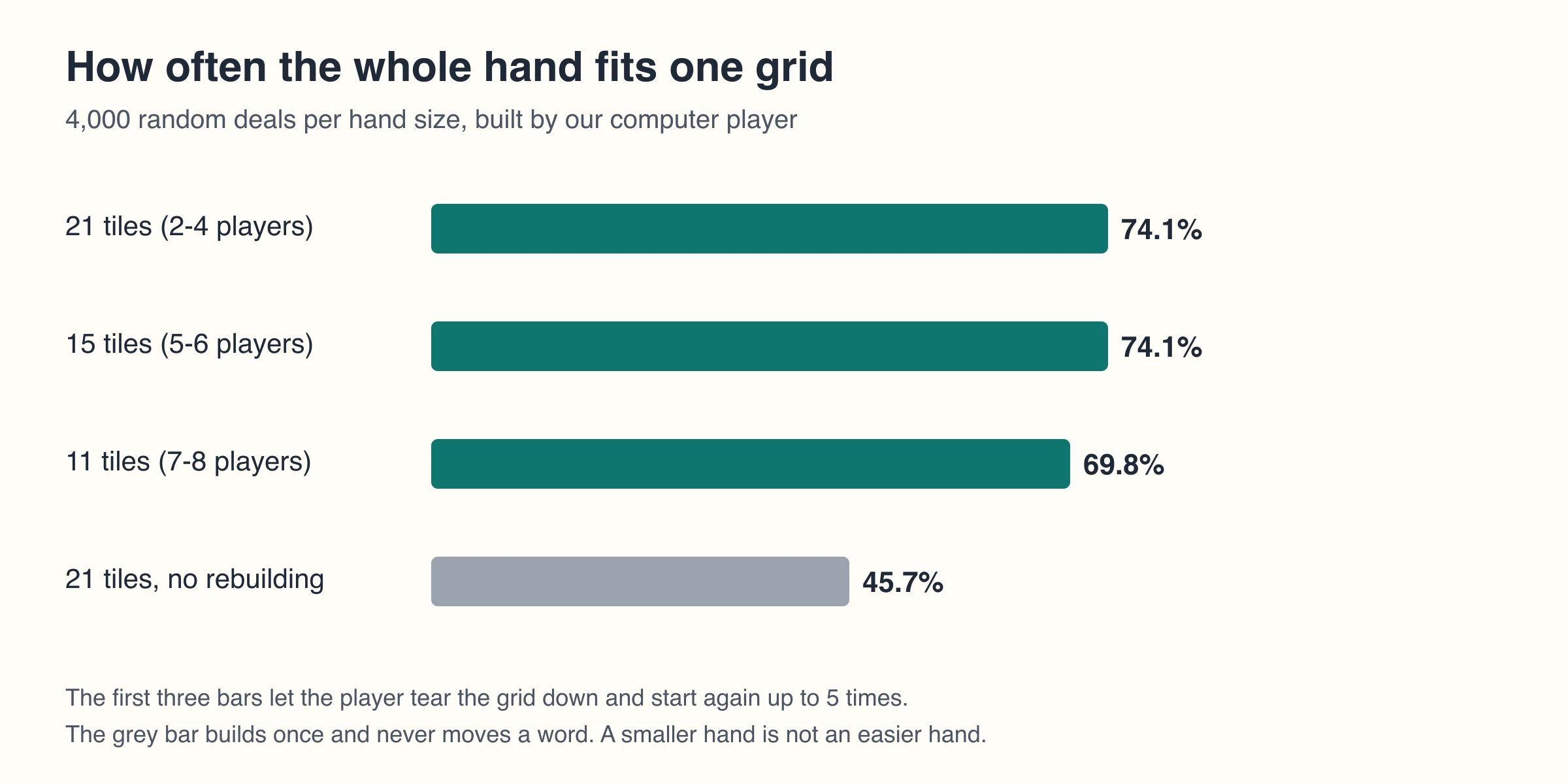
With 21 tiles, the player used every tile in 74.1% of hands. With 15 tiles it was also 74.1%, and with 11 tiles it was 69.8%. A smaller hand is not an easier hand: you have fewer tiles to work around a bad letter, and in the 11-tile games one awkward tile ruins a bigger share of the hand.
Rebuilding matters a lot. When the player built once and never moved a word, only 45.7% of 21-tile hands fit. Letting it break the grid up and try again took that to 74.1%. In a real game, if you are stuck, pull a long word apart before you reach for a dump.
The tiles that get stuck
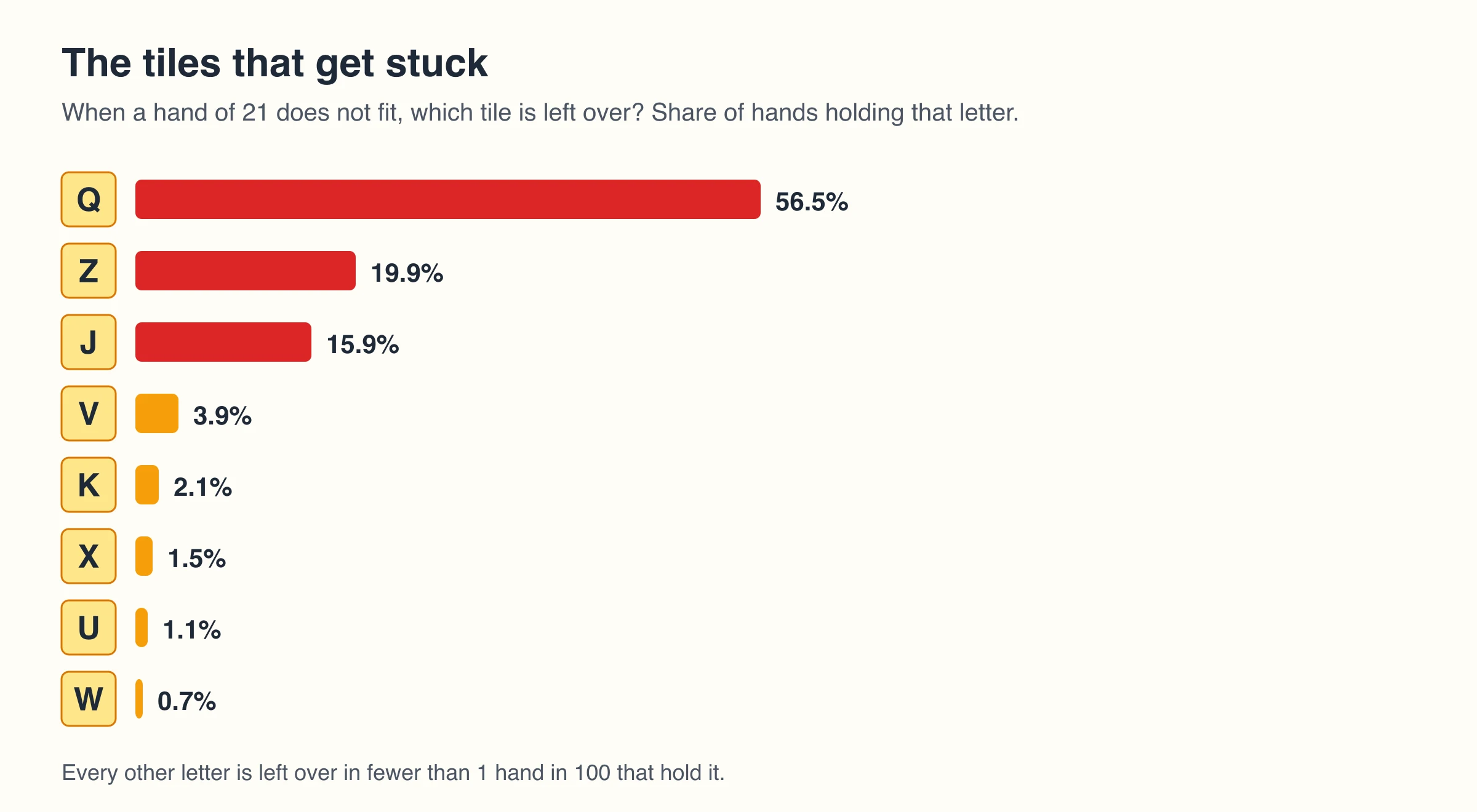
When a hand did not fit, it was nearly always one tile that would not go anywhere: in 83% of the stuck hands (865 of 1,038), a single tile was left. And it was nearly always the same few letters.
- Q was left over in 56.5% of the hands that had a Q. A 21-tile hand holds a Q 27.1% of the time, and 10.8% of hands have a Q with no U at all.
- Z was left over in 19.9% of hands that held one, and J in 15.9%.
- V (3.9%), K (2.1%) and X (1.5%) were rarely a problem.
- Every other letter was left over in fewer than 1 hand in 100 that held it.
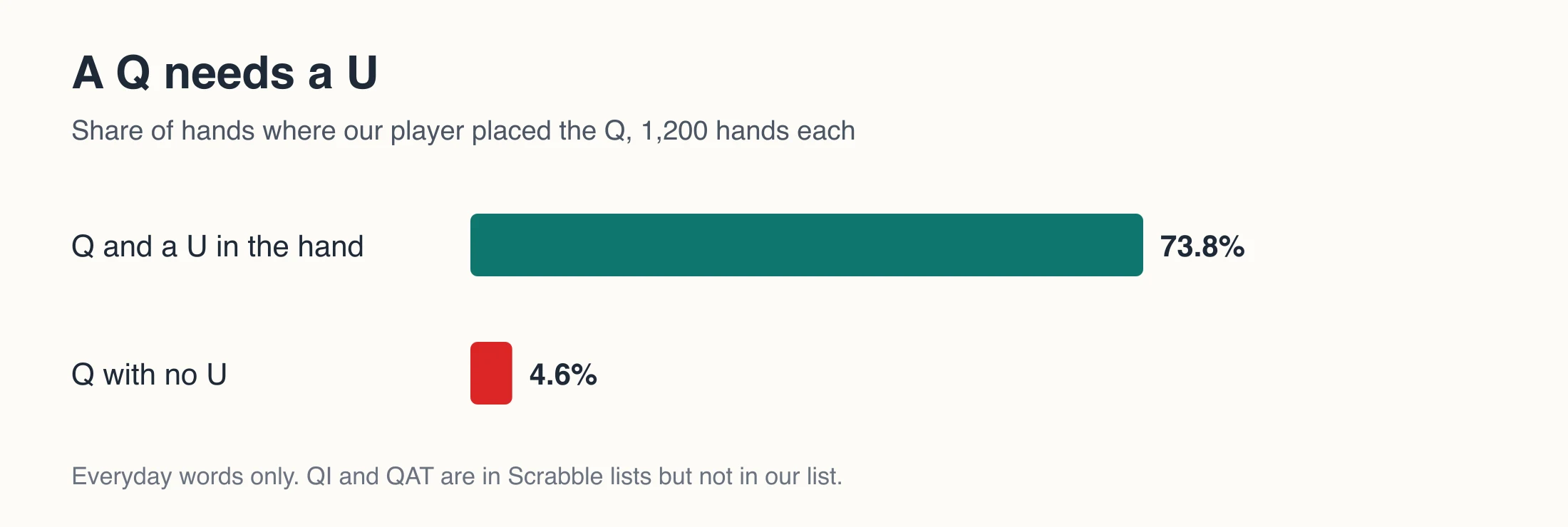
The U makes a big difference to the Q. With a U in the hand, the player placed the Q in 73.8% of hands. With no U, it placed it in only 4.6%. A Q with no U in an everyday word list leaves very little: words like QI and QAT are allowed in Scrabble lists, but our everyday list does not have them, and many home games would argue about them too.
When to dump
For each hand that got stuck, we gave back the hardest leftover tile (the one with the fewest copies in the bunch), drew three, and let the player try again from scratch. It used every tile in 77.5% of those hands (804 of 1,038). So a dump usually works, even though it hands you two extra tiles. A Q you cannot place is the clearest dump in the game.
Count your vowels
Vowels help more than most players think. Hands with six or fewer vowels fit only 47.5% of the time. Hands with nine or more fit 83.9% of the time. Even 12 vowels out of 21 fit 91% of the time.
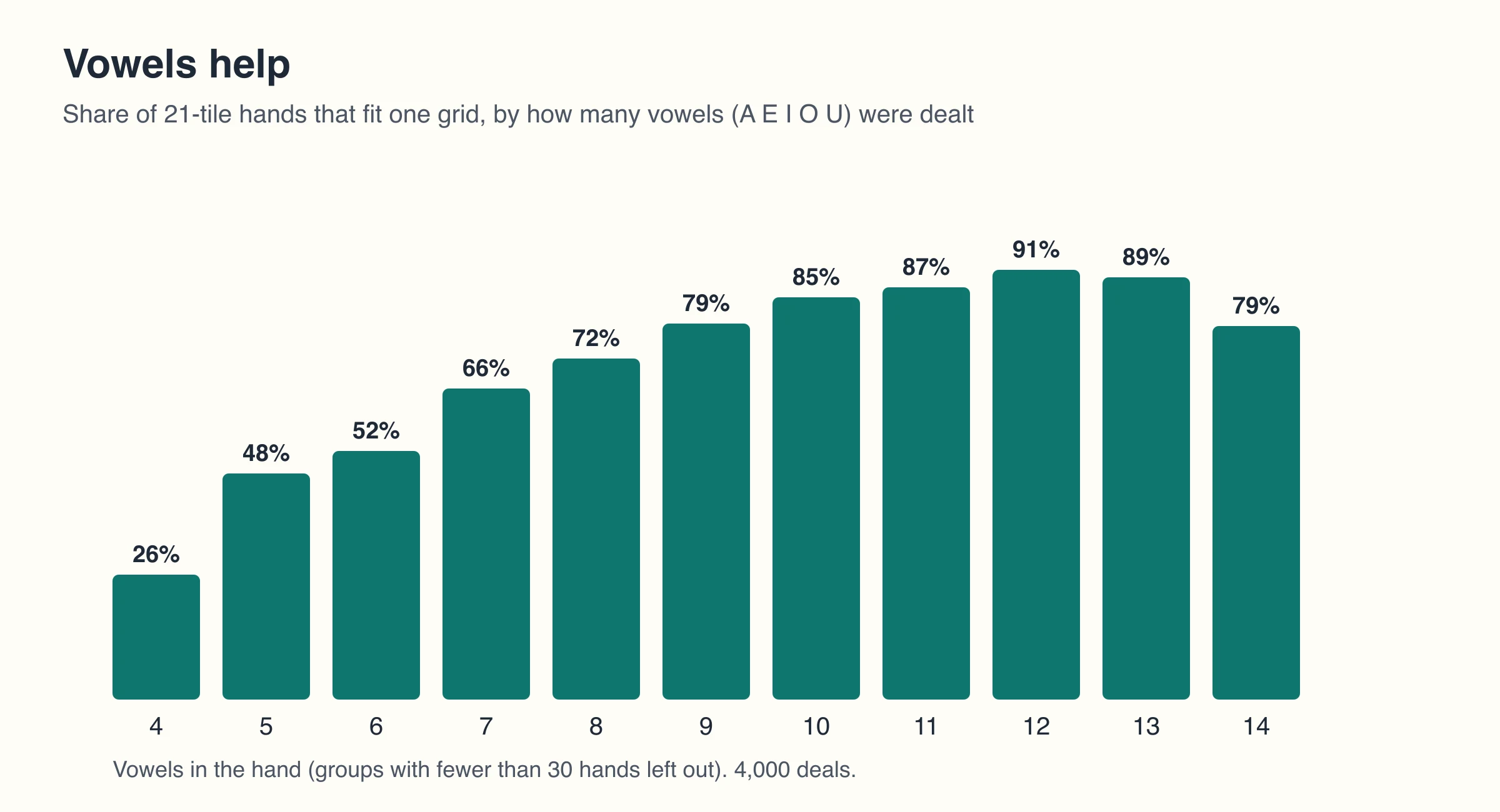
So when you have to choose what to dump, a hard consonant is a better choice than a vowel. And if your hand is short on vowels, plan for one dump early instead of waiting until the end.
Long words beat short words
We tried four ways of building on the same 4,000 deals, with no rebuilding:
- Long first word, then always the longest word that fits: 45.7% of hands fit, 0.8 tiles left on average.
- Short first word (3 or 4 letters), then the longest word: 41.8%.
- Long first word, then always the shortest word: 8.3%, 2.6 tiles left.
- Short first word, then the shortest word: 4.7%, 3.7 tiles left.
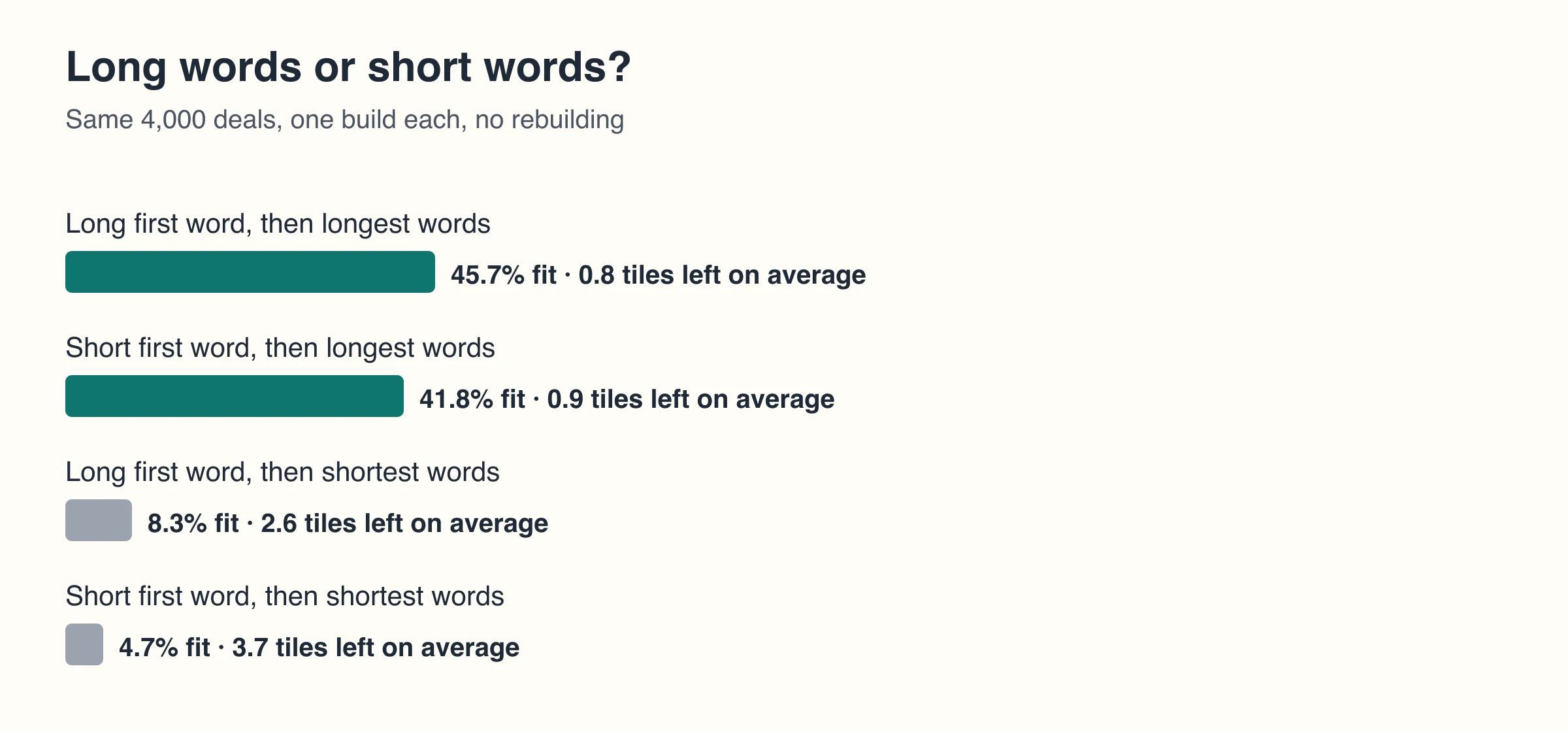
The first word barely matters. What you play after it matters a lot. Short words use up the good letters fast and leave you with a hand of leftovers and few places to hook them. Long words use up awkward letters while there are still plenty of vowels around them.
Tips to play faster
- Play a long word first, but do not freeze over it. A long first word is only a little better than a short one. Get something down in the first few seconds.
- Keep using long words after that. This is the strongest habit we found. It used up the whole hand five times as often as playing short words.
- Pull words apart when you are stuck. Rebuilding took the fit rate from 45.7% to 74.1%. Break the longest word you have; it frees the most letters.
- Place the Q, Z and J early, while you still have vowels. If you have a Q and no U, think about dumping it at once.
- Dump a hard consonant, not a vowel. Hands with nine or more vowels fit far more often than hands with six or fewer.
- Leave room. A word squeezed between two others has nowhere to grow. Spread out so every new tile has an open end to hook onto.
- Learn a few short words for the odd letters. ZA, JO and AX are allowed in most Scrabble word lists, and they finish a grid when nothing else will. Check what your group allows before the game. (The game on this page uses a smaller everyday list, so it takes AX but not ZA or JO.)
How we checked
- The word list is every all-lowercase entry of 3 to 10 letters in the large American English word list (so no names), that scores 3 or more on the wordfreq scale of how common a word is, plus 35 common two-letter words such as AM, AN, AX, GO, OW and OX. That is 20,213 words. QI, ZA and JO are not in it.
- We dealt 4,000 random hands for each of 21, 15 and 11 tiles from the full 144-tile bunch.
- The computer player places the longest word first, then the longest word that crosses a letter already down. It only crosses words; it never lays two words side by side. It may start again up to five times with a different first word. A hand "fits" when every tile is used.
- In the dump test, for every 21-tile hand that did not fit, it gave back the leftover tile with the fewest copies in the bunch, took three from the tiles not dealt, and rebuilt.
- The Q test used 1,200 hands with a Q and a U, and 1,200 with a Q and no U.
- We wrote the simulation ourselves for this post, and every number above is from its output.
A strong human player knows more words than our list and will also place tiles side by side, so real fit rates are higher. The comparisons (long against short, vowels, dumps, which letters stick) are what to take from it.
Common questions
How many tiles do you start with in Bananagrams? 21 tiles each for 2 to 4 players, 15 for 5 or 6 players, and 11 for 7 or 8 players.
How do you play Bananagrams with 2 players? Take 21 tiles each and leave the other 102 in the bunch. Play the same way as with more players: Split, build, Peel. The game ends when fewer than 2 tiles are left in the bunch and one player uses all their tiles.
Can you play Bananagrams by yourself? Yes. Take 21 tiles, use them all in one grid, then peel one at a time. Time yourself or count how many tiles you place. You can play a solo game on this page.
What happens when you dump in Bananagrams? You put one tile back in the bunch and take three. In our test, dumping the hardest tile and rebuilding used up the whole hand 77.5% of the time.
Which letter is hardest to use in Bananagrams? The Q, by far. It was the tile left over in 56.5% of hands that held one. Z and J come next.
Are two-letter words allowed? Yes, if they are real words. Two-letter words are a big help for placing single tiles. Agree on a word list before you play.
What is a Rotten Banana? When a player calls Bananas but their grid has a word that is not real, it is a Rotten Banana. That player is out of the round and the others keep going.
Play solo Bananagrams now
The game below deals you 21 tiles from a shuffled 144-tile bunch. Tap a square on the board, then tap tiles from your hand (or type on a keyboard) to place them. Tap the same square again to switch between across and down. Delete takes the tile under the cursor back into your hand. When your hand is empty, press Peel (or Bananas in the Quick game) and the game checks every word on your grid against the same 20,213 everyday words the simulation used.
Quick mode is one hand of 21 tiles. Peel mode adds ten peels, one tile at a time. Dump gives back one tile for three. Hint finds a word of up to seven letters that fits on your grid and puts the cursor on its first square. Center grid moves your words to the middle if you run out of room.
If you like building words from a handful of letters, try Letter Boxed, where you use 12 letters in as few words as you can, or Boggle, where the letters are stuck on a grid. For a game with a board and points, see how to play Scrabble.
Where to buy: Bananagrams (Moose Toys)
Related articles
How to Play Connections: Rules, Red Herrings and the Math of Guessing
How to play Connections: the rules, what the four colors mean, how red herrings trap you, and the math of guessing. Play 16 free boards at the end.
How to Play Strands: Theme Words, Spangrams and Hints
How to play Strands, the word search where every letter counts: theme words, the spangram, how hints work, and what 30 computer-solved boards show about finding the answers.
How to Play Boggle, and What 100,000 Boards Taught Us
Boggle rules and scoring, then real strategy: we rolled 100,000 boards against our game dictionary to find the words, pairs and letters that actually win.