
The Vault is the collectible draw in Epic Words. You spend Gold, you pull one item, and the item comes out of a tier decided by posted odds. It sits alongside the parts of the game that reward skill rather than spending, and the line between those two halves is drawn deliberately. This guide explains what a roll costs, what can come out of it, what the game guarantees, and (more usefully) what it refuses to sell you. If you have not played a round yet, start with the rules primer; the Vault only makes sense once you know where Gold comes from.
What a roll costs and what the odds are
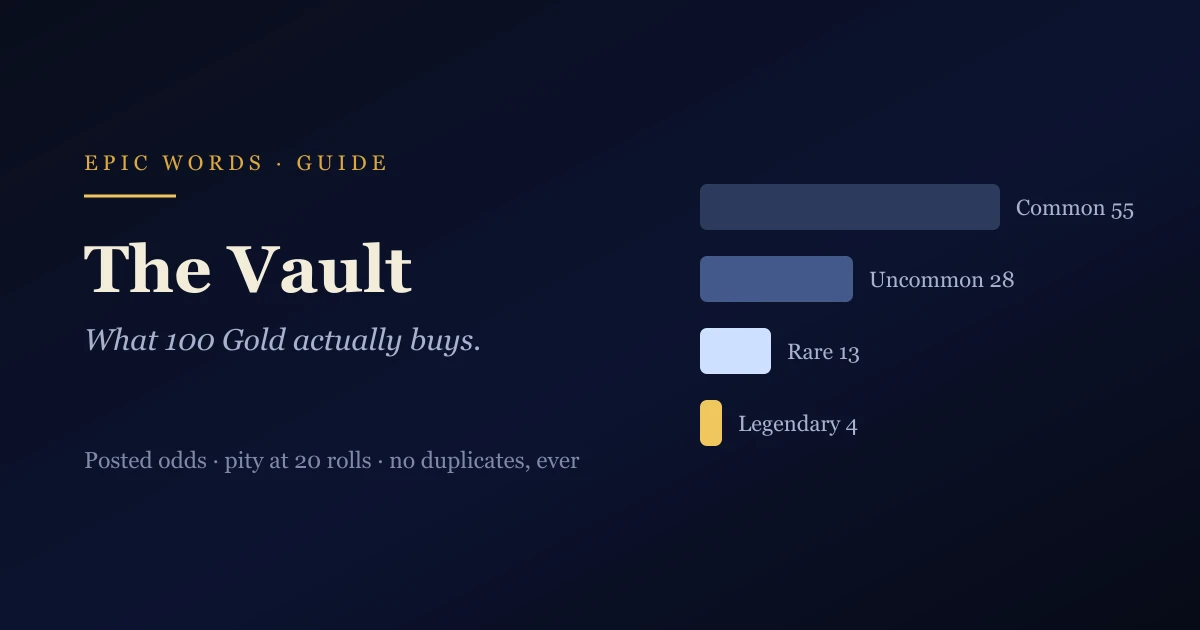
One roll costs 100 Gold. Gold is ordinary spending money: you earn 5 per round plus other sources, and you can also buy it. The tier odds are posted in-app rather than buried, and they are:
| Tier | Chance |
|---|---|
| Common | 55% |
| Uncommon | 28% |
| Rare | 13% |
| Legendary | 4% |
Read those numbers the way they are written. A 4% Legendary rate means most rolls will not be Legendary, and a run of twenty ordinary pulls is a normal outcome rather than a sign that something is broken. Nothing on this page should be taken to imply better rates than the posted ones.
The pity timer
The one adjustment the Vault makes in your favour is a pity timer: a Rare or better is guaranteed at least every 20 rolls. That is a floor, not a schedule. It does not mean a Rare arrives on roll 20 and never sooner: the 13% and 4% chances are live on every pull, so most players will hit a Rare well before the counter matters. The timer exists to cap the worst case, so that a long cold streak eventually ends on its own.
No duplicates, and what happens when a pool empties
The Vault never gives you an item you already own. The pools it draws from contain only unowned items, which means every successful roll moves a collection forward instead of padding a pile of repeats. This is the single most player-friendly rule in the system, and it changes how the tiers behave over time: as you clear out a tier, the remaining items in it get easier to reach, because there is less left to compete with.
The consequence arrives at the end. If a tier is exhausted (you own everything in it), a roll that lands on that tier pays back 25 to 40 Gold instead of an item. That is a partial refund on a 100 Gold roll, not a break-even, so a heavily completed account is spending at a loss on every pull that lands in a finished tier. Worth knowing before you grind toward completion. Free rolls never resolve to Gold back, so a free roll always has something real behind it.
One more throttle: at most one word effect can come out of any 4-roll window. Word effects show up in both the Uncommon and Rare pools, and without the cap a lucky burst could hand you a stack of them at once.
What is in each tier
The tiers are not simply "small prize, big prize": they hold different kinds of things, and a couple of items appear in more than one tier.
| Tier | Contents |
|---|---|
| Common | Gold back, tool charge, curio token, hint credit |
| Uncommon | Word effect, avatar frame, tool charge, Tiltyard pass, Joust entry |
| Rare | Echo Stone, word effect, story card, Streak Freeze, Joust entry |
| Legendary | Founder's Deck face, Echo Stone |
A few of those are worth translating. An Echo Stone replays a completed Chronicle, which is how you take the other branch of a story fork without losing the version you already finished. It is the most functional thing in the Rare pool and it also anchors the Legendary one. A Streak Freeze insures a Daily Quest streak against one missed day. The Founder's Deck is a 52-card collection, and most of its faces come from Legendary pulls, which is why that deck fills slowly by design. Common pulls are consumables and small credits; they keep a roll from feeling empty without moving much.
Free rolls and the 7-and-7 gate
You get one free roll when the Vault is introduced. After that there is a recurring free roll, and it is gated on two conditions at once: 7 played days and 7 calendar days. Both have to clear, so whichever lands later is the one that decides your timing. Play every day and the calendar is your limit. Play sporadically and the played-day count is. There is no way to compress it by cramming several sessions into one day.
Two things the paid roll will not do
Two firewalls are built into the Vault, and both cost the game something.
The first is a spoiler gate: story cards drop only from kingdoms you have already reached. This went in after a player sitting in Kingdom 2 drew a card from Kingdom 14. It means early accounts have a smaller story-card pool than late ones, which is a real restriction on what you can pull, and it exists so the draw cannot spoil a story you have not played.
The second matters more. A Joust entry can only come from the recurring free roll, never a paid one. Joust entries appear in the Uncommon and Rare tables, but a paid pull will not produce one. The reason is the wall between the two currencies. Renown is the permanent record of skill and the only thing the main leaderboard ranks; it cannot be bought and cannot be spent. Gold can be bought. A Joust win mints Renown, so any paid route to a Joust entry would be a paid route to the leaderboard. Closing it keeps the ranking honest, at the price of a reward the store would otherwise be happy to sell.
Native and web
The Vault is on in the native app builds. On the web build it is off by default unless the deployment sets the flag, so if you are playing in a browser and cannot find it, that is the reason rather than a missing unlock. If you want to try a session now, the game is here.
Where to go next
The Vault touches several other systems, and each has its own guide:
- The Joust: what those free-roll entries are actually for, and how Renown is minted.
- Gold and Renown tools: where Gold comes from and what else competes for it before you spend 100 on a roll.
- Collections: how the Founder's Deck and the rest of the collectibles fit together.
For the lore behind the items rather than the mechanics, the Epic Words codex is the encyclopedia: kingdoms, characters, and the stories the Echo Stones send you back through.
Related articles
Chronicles: The Story Under the Epic Words Puzzle
How the Chronicles layer of Epic Words works — when an Encounter interrupts, why some choices permanently close a path, what the Journal records, and how the Echo Stone lets you replay a finished Chronicle.
How to Build Collections in Epic Words
Epic Words keeps six separate collections, and they fill at wildly different speeds. Here is what each one tracks, what it actually costs to complete, and which one is designed never to finish.

Making 52 Consistent AI Character Portraits: What Went Wrong
I used AI to make the art for my word game, and reviewers called it AI slop. Here is what 52 portraits took, with the failed pictures.