
Epic Words runs 50 kingdoms of 64 rounds each, and underneath that run the game keeps six separate collections. They do not share a currency, a pace, or a unit of progress. One of them fills from a daily habit, one from raw play, one from luck, one from patience, and one is deliberately impossible to complete. Knowing which is which saves you from grinding at the wrong thing.
If you have not played a board yet, the rules come first: everything below assumes you know how a round works.
Trophy Case
The Trophy Case runs on the Daily Quest: three rounds a day, the same three for every player, rolling over at midnight Pacific. Each completed quest hands you one collectible icon.
Twelve icons of a single set make a trophy. There are four themed sets (dragons, knights, potions and relics) plus a common pool, for 60 collectibles in total. That structure sets the floor honestly: with one icon per completed Daily Quest, a trophy is at minimum twelve days of quests, and only if every one of those twelve icons belongs to the same set.
Trophies are kept forever. The case, however, only displays 20 at a time, then 50, then 100, and expanding that display capacity costs Gold. It is worth being clear about what that purchase does and does not do: it never gates ownership or progress, only how much of your case is visible at once. If you are indifferent to the shelf, you can skip the spend entirely and lose nothing.
Founder's Deck
The Founder's Deck is 52 cards laid out with playing-card suits and ranks, and it is the collection people most often misread. It is not one card per kingdom. It is 50 kingdom characters plus 2 at-large founders, which means the distribution is lumpy: Kingdom 11 contributes no founder at all, while Kingdoms 6, 25 and 46 each hold two.
Most of these cards come out of the Legendary tier of the Vault, which is a 4% draw. That is the least forgiving number in the game's collecting, and it deserves saying plainly rather than dressing up: the Founder's Deck is the one collection where effort and outcome are only loosely related.
Two cards are the exception, and they are earned outright with a ceremony rather than drawn:
| Card | How it is earned |
|---|---|
| Countess Abby (Q♥) | Complete Kingdom 25 |
| Gerard the Logical (A♠) | Complete Kingdom 50 |
Those two are the only guarantees in the deck, which makes them a useful anchor: no amount of bad luck can keep them from you, and no amount of good luck gets them early. Along the way, free collector titles unlock at 10, 30 and 52 cards.
There is also a Foil Edition, which is currently a waitlist tease and nothing more. Nothing about it is for sale.
Places Deck
The Places Deck is also 52 cards (one place per kingdom plus 2 at-large), but it is earned rather than drawn. You get a card by visiting the place. No odds, no tier, no draw.
It is also, by design, unfinishable. The two at-large cards are No. 51 The Dungeons and No. 52 The Lower Depths. Every other card in the deck is earned by visiting the kingdom it belongs to, and these two have no such place attached: the Lower Depths is a board mode that opens at Kingdom 6, not a kingdom you can travel to. That is intentional, not an oversight, and it is better to know it now than to spend a month hunting for a door that was never built.
Running alongside the deck, and separate from it, a Trail tracks all 250 named places in the game. The deck is the trophy; the Trail is the map of where you have actually been. If you want to know what those places are before you reach them, the Epic Words codex is the encyclopedia for the world's characters and locations.
Guild Registry
The Guild Registry (also called the Trades Deck) covers 52 tradespeople spread across 10 guild halls. A visitor turns up mid-play carrying a commission; fulfil the commission and their card is yours.
This is the collection paced to months, and the pacing is deliberate rather than incidental. A visitor requires 15 minutes of active play to appear. There is a 4-hour minimum between visitors. And there is a hard maximum of 2 cards per day. Stack those together and the arithmetic is unavoidable: 52 cards cannot be finished in fewer than 26 days even by a player who does nothing else, and a realistic pace puts it in months.
The upside of that ceiling is that it makes the Registry the one collection you cannot fall behind on by playing less on a given day. The downside is exactly what it looks like: you cannot push it, and no amount of Gold changes the clock.
Kingdom Atlas
The Kingdom Atlas holds all 50 restored jigsaw maps. Pieces drop as you play, at roughly one every seven rounds, and nine pieces restore one kingdom's map. That ratio is not an accident: nine pieces at seven rounds apiece lands at about 63 rounds, near enough to a kingdom's 64. Play a kingdom through and you have roughly earned its map.
There is no Gold path to a piece, ever. The Atlas is the purest record of play in the game: the only way to fill it is to play the rounds.
One useful side effect: every completed row of three pieces also banks a Joust entry, so Atlas progress feeds the timed mode whether or not you are paying attention to it.
Juice Library
The Juice Library is the lightest of the six. It stores every word effect you have discovered and lets you replay them. It unlocks after your first 3 discoveries, and badges land at 50, 100 and 147.
It has no cost, no gate and no schedule, which makes it the collection that most players fill without ever deciding to. It is a record of what the game has shown you rather than a target to chase.
What completing one is worth
Completing a collection pays 50 Gold. That is a real reward but a modest one, and it should not be your reason for chasing any of these. Gold is spending money; Renown is the permanent skill record, the only thing the leaderboard ranks, and it can be neither bought nor spent. The collections sit outside that ranking entirely. They are a record of where you have been and what you have found, not a lever on your standing.
Where to go next
If you want the mechanics behind the two collections most driven by systems rather than time, read the Vault guide for the draw tiers behind the Founder's Deck, and the Joust guide for what to do with the entries the Atlas keeps banking. For the currencies themselves, the Gold and Renown guide explains what each one can and cannot buy. Barbados, Yorkshire and Canada run their own 9-item collectible trail outside these six, if you want to see how that one compares. Or skip the reading and start a kingdom.
Related articles
Chronicles: The Story Under the Epic Words Puzzle
How the Chronicles layer of Epic Words works — when an Encounter interrupts, why some choices permanently close a path, what the Journal records, and how the Echo Stone lets you replay a finished Chronicle.
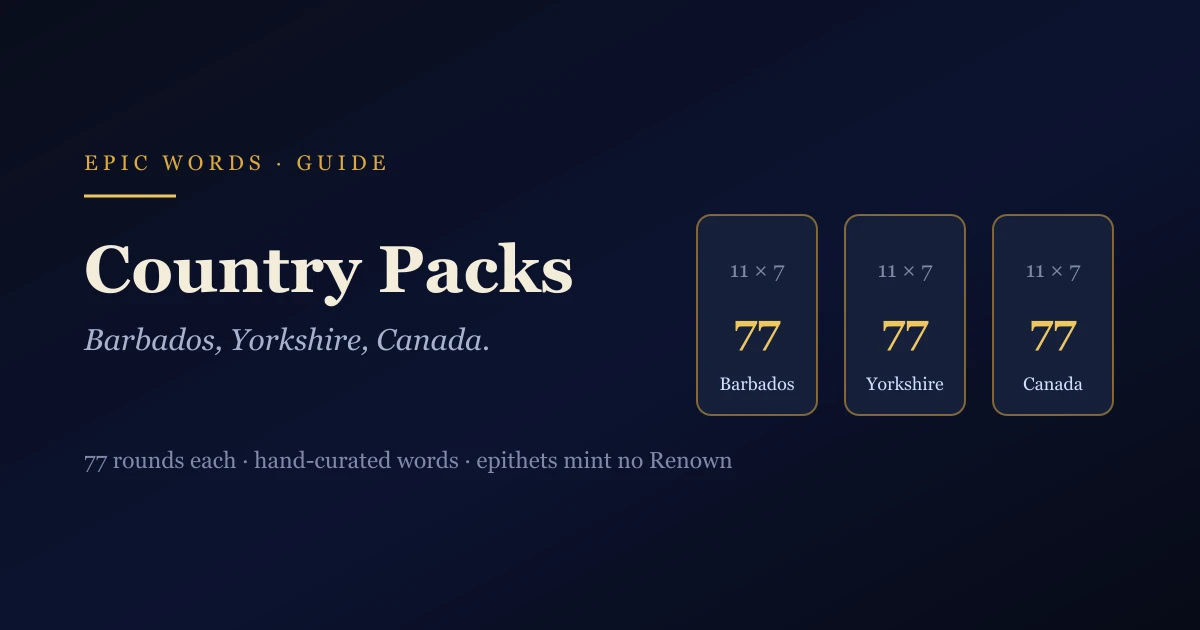
The Epic Words Country Packs: Barbados, Yorkshire and Canada
A plain look at the three Epic Words country packs — what a 77-round pack actually contains, what $1.99 buys you, and why a pack epithet can never move you up the Renown leaderboard.
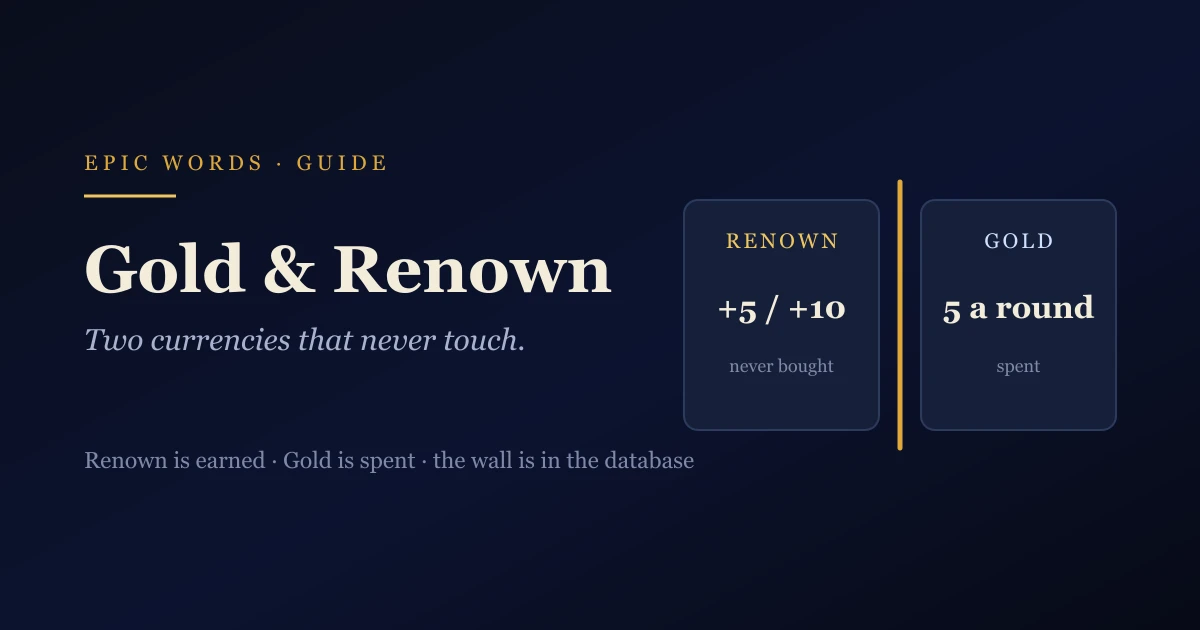
Gold, Renown and the Tools in Epic Words
Epic Words runs two currencies that never touch — Renown, minted only by six skill sources and enforced in the database, and Gold, which pays for hints, tools and Vault rolls.