
Most of Epic Words is unhurried. You work a board, you think, you move on. The Joust is the part that is not. It is a two-minute sprint against a single named opponent, and when the clock runs out the result is a straight comparison of two numbers.
If you have not played the main game yet, start with the rules: this guide assumes you already know how a board works and only covers the timed mode.
What the Joust actually is
The format is fixed: 120 seconds, four-letter words. There is no difficulty selector, no alternate length, no long-form variant. Every entry you spend buys the same two minutes as every other entry, which is the point: a sprint that changes shape is not a sprint you can measure yourself against.
Each of the game's 50 kingdoms has one reigning knight. All 50 are hand-authored, with a name, a taunt and a crest colour, so the opponent in Kingdom 3 is a specific character rather than a difficulty number wearing armour. What that character does mechanically is hold a target word count. You beat him by finding strictly more words than his target. Matching it is not a win. A tie goes to the knight, which is worth remembering when you are at 11 with eight seconds left against a target of 12.
The targets, and what they mean per second
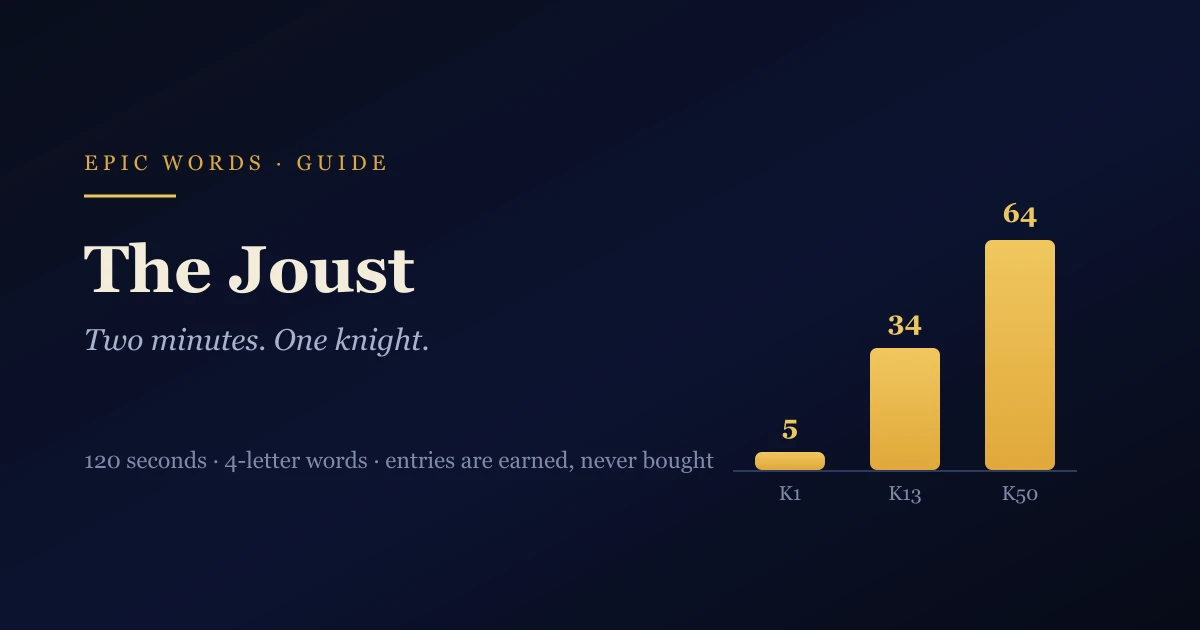
Targets scale by kingdom and are uncapped:
| Kingdom | Words to beat |
|---|---|
| 1 | 5 |
| 2 | 8 |
| 3 | 12 |
| 13 | 34 |
| 50 | 64 |
The early numbers look trivial and the late ones look impossible, but the raw target misleads, because the clock is not fixed at 120 seconds once you get going. Every tenth word you find is a secret word worth +15 seconds. So a run that reaches 34 words has banked three secret words along the way: 45 extra seconds, 165 in total, a shade under five seconds per word. A run that reaches 64 has banked six, giving 210 seconds for 64 words, or roughly three and a quarter seconds each.
That is the real shape of the ladder. The target grows faster than the time bonus does, so the pace demand tightens the deeper you go, but the mode is far less brutal at Kingdom 50 than a flat 64-words-in-120-seconds reading would suggest.
Scoring inside the round
Points during a round work like this:
- Common word: +3
- Rare word: +10
- Wrong guess: −2
- Using New Board: −15
- Multiplier: caps at 5×
Two of those numbers are worth doing arithmetic on. A wrong guess costs 2 and a common word pays 3, so a speculative guess is worth throwing only if you expect to be right more than two times in five. Below that rate, typing on instinct is a net loss. Above it, hesitation costs you more than error does.
New Board is the harsher one. At −15 it costs you the equivalent of five common words, so a swap has to produce five words you would not otherwise have found just to break even, and it does not refund any clock. It is an escape hatch for a board you cannot read, not a tool for upgrading one you merely dislike.
Entries are earned, never bought
You cannot buy a Joust entry. Entries come from map pieces: every completed row of three pieces banks one entry, and your very first map piece ever grants one as well. The bank caps at 99.
Map pieces drop as you play a kingdom, roughly one every seven rounds, and nine pieces restore a kingdom's map. There is no Gold path to a piece. A full nine-piece map (three rows, three entries) is therefore something like 63 rounds of ordinary play.
The reason for the wall is the currency split. Renown is the permanent skill record, the only thing the main leaderboard ranks, and it can never be bought or spent. Gold is ordinary spending money, and Gold is buyable. A Joust win mints Renown, so if entries were purchasable there would be a cash line running straight into the skill ranking. Making entries drop-only is what keeps that line closed.
What a win pays, and what a loss pays
The first win over a given knight pays 40 Gold + 25 Renown. A rematch win against a knight you have already beaten pays 10 Gold + 15 Renown, with a daily ceiling of 30 Gold / 45 Renown: three rematch wins and you have hit both caps for the day, so a fourth rematch is played for the ladder position, not the payout.
A loss still pays 2 Gold per word found, capped at 20 Gold. That cap arrives at ten words. It is a small number by design, but it means an entry is never fully wasted: a bad run against a hard knight still returns something, and a run that dies at 14 words pays the same 20 Gold as one that dies at 40.
Revenge, and a ladder with no ceiling
Lose, and your first revenge attempt is free. After that a revenge costs 50 Gold, with a maximum of two paid revenges per day. Note that 50 Gold is more than the 20 Gold ceiling a loss pays, so paid revenge is a losing trade in pure Gold terms: you are buying a shot at Renown, which nothing else in the game sells.
Beating a knight does not retire him. Each time you win, he returns +5 words harder, without a bound. Beat the Kingdom 3 knight three times and his target has moved from 12 to 27. This is why the rematch reward is lower than the first-win reward: you are being paid less for a fight that is getting steadily harder. Since the escalation has no bound and your own ceiling does, a knight you keep beating will eventually set a target you cannot reach.
The Tiltyard
The Tiltyard is practice. A pass costs 50 Gold and lasts 24 hours, and during that window you can face the same knights without spending an entry. It mints no Renown.
Both halves of that are deliberate. Spending no entry is why the Tiltyard is useful at all, given how slowly entries accumulate. Minting no Renown is the same rule as before: Gold buys the pass, so the pass cannot produce ranking. Buy one when you have entries banked and no confidence, not as a general-purpose way to play more.
There is also a separate Joust leaderboard, filtered to the 120-second, four-letter format, so sprint results are ranked against other sprint results rather than folded into overall standings.
Where to go next
Gold is what pays for Tiltyard passes and revenge attempts, so the economy is the natural next read: Gold and Renown covers what each currency does and where it comes from, and the Vault guide covers what 100 Gold a roll actually buys. If you want the fiction behind the knights rather than their numbers, the Codex is the encyclopedia, and the Chronicles guide covers the long-form record of a run. Or skip the reading and play a round.
Related articles
Chronicles: The Story Under the Epic Words Puzzle
How the Chronicles layer of Epic Words works — when an Encounter interrupts, why some choices permanently close a path, what the Journal records, and how the Echo Stone lets you replay a finished Chronicle.
How to Build Collections in Epic Words
Epic Words keeps six separate collections, and they fill at wildly different speeds. Here is what each one tracks, what it actually costs to complete, and which one is designed never to finish.
How to Explore the Vault in Epic Words
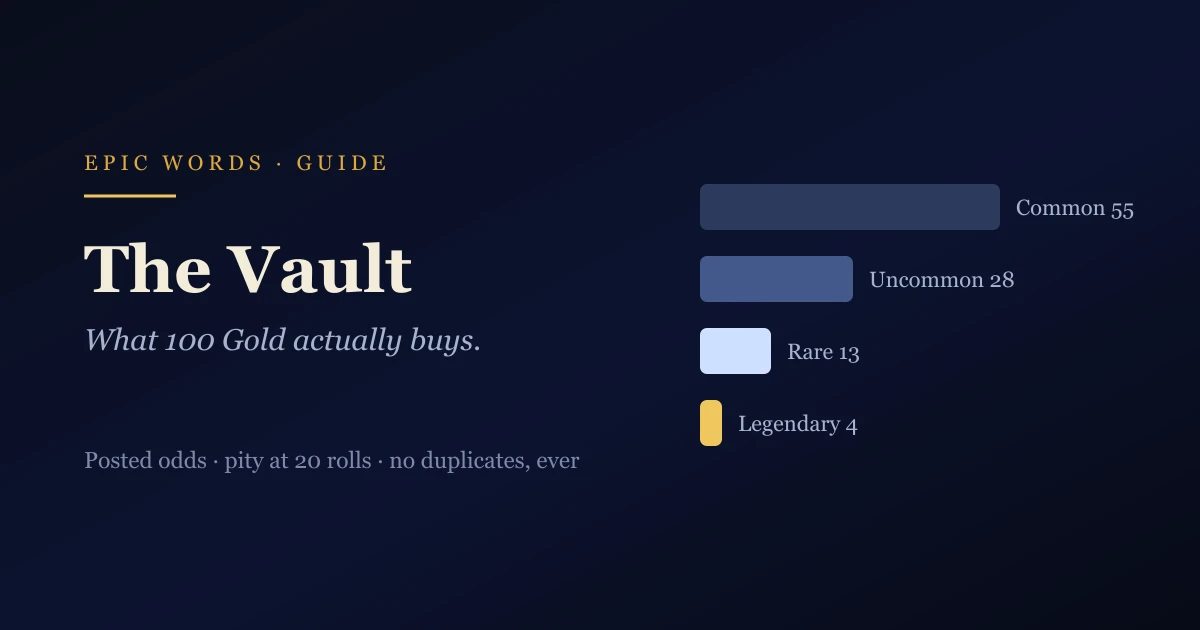
A plain walkthrough of the Vault in Epic Words — what a roll costs, the posted tier odds, how the pity timer and no-duplicate rule work, and the two rewards the paid roll will never give you.