
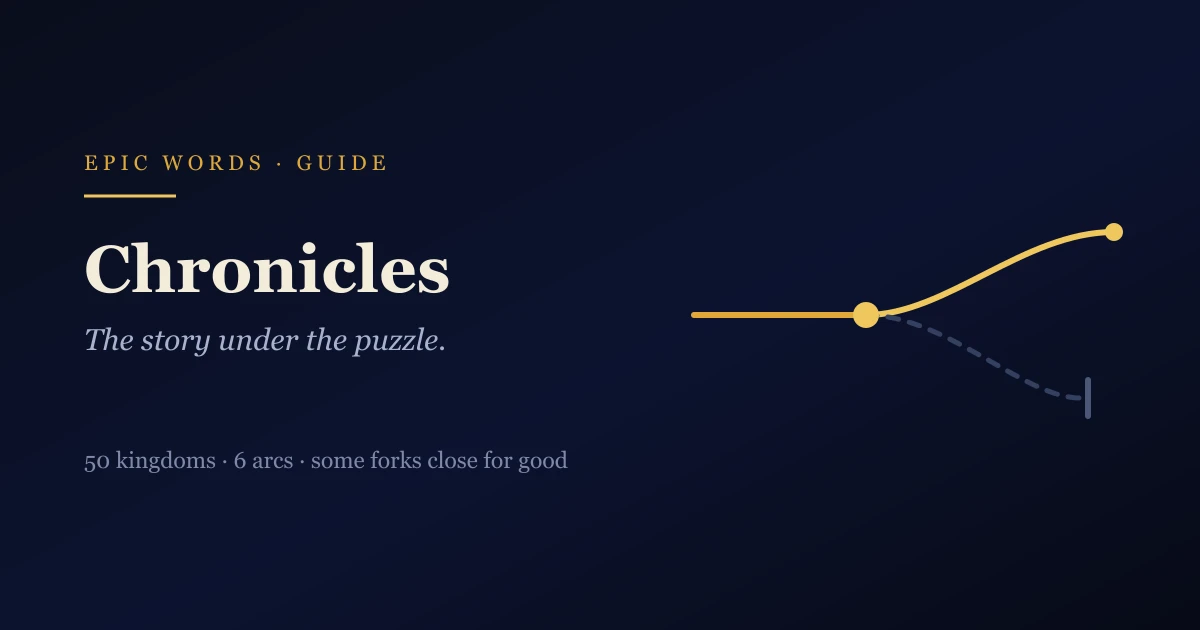
Epic Words is a word game first. You solve rounds, you earn Renown, you climb. But running underneath that is a second layer called Chronicles, and it behaves differently from most story systems bolted onto puzzle games. It does not gate your progress, it does not hand you a wall of text between levels, and it is not something you browse at leisure. It arrives on its own schedule, asks you a question, and remembers your answer. This guide explains the mechanics of that layer: when it appears, what your choices actually do, and what the game keeps a record of. If you have not played a round yet, the rules primer is the place to start; Chronicles only makes sense once the puzzle itself is familiar.
An Encounter interrupts between rounds, never inside one
The story does not reach you mid-puzzle. It waits for a round boundary and then interrupts there, which is a deliberate constraint rather than a technical one: the moment you are holding letters in your head is the worst possible moment to hand you a decision. So an Encounter (and the game calls it an Encounter, not a "story") surfaces cleanly between rounds, opens with a cryptic teaser, and gives you three options:
- Engage: take the Encounter now and make a choice.
- Add to Chronicles: set it aside and come back to it.
- Continue: carry on with the puzzle.
That third option matters more than it looks. A player who is on a roll and wants nothing to do with narrative can dismiss every Encounter and lose nothing from the word game. A player who wants the story but not right now can bank it. The framing is that Chronicles is offered rather than imposed, and the three-button layout is the whole design argument in one screen.
Stories arrive at authored points, not on a browsable list
You cannot flip through the story ahead of time. Stories reveal at authored thresholds inside a kingdom, which means each kingdom holds its narrative at fixed points in its own run of rounds and releases it as you get there.
The first kingdom is tuned as a teaching taste: its first story lands at round 5, early enough that you learn what an Encounter is before you have formed habits without one. Later kingdoms typically start further in, around round 10 to 12, on the assumption that you already know the shape of the thing and would rather play a while first. The practical effect is that story density is front-loaded for a new player and then settles into a steadier rhythm.
Some choices close a door permanently
Most choices in Chronicles are choices in the ordinary sense: you pick, you get a consequence, the story continues. Some are not. Certain choices are exclusive forks: taking one path permanently locks the other card and the branch behind it. That lock is real and it is not undone by playing better later.
This is the part worth reading slowly, because it changes how the system feels. An exclusive fork means the Chronicle you end up with is not the complete Chronicle; it is yours. An encounter might, illustratively, offer a choice between helping a stranger and walking on, and if the two are an exclusive pair, whichever you decline is not sitting in a menu waiting for a second visit. The game is willing to spend content you will never see in order to make the content you do see mean something.
The Journal keeps the receipts
The record of all this is the Journal, presented in-game as Your Saga. It stores every choice you made along with the one-line consequence that followed it, the NPCs you met, and relationship reveals as they come out.
The value of the Journal is that it makes the exclusive forks legible after the fact. A run of choices spread over dozens of rounds would otherwise blur into a general impression; here you can read back the actual sequence: what you chose, what it cost, who you met because of it. It is also the only honest way to compare two runs, since no two Journals with different forks in them contain the same story.
If you want the wider context behind the names and places that turn up in Encounters, the Epic Words codex is the encyclopedia side of the same world: entries you can actually read at your own pace, as opposed to the Chronicles layer, which only ever gives you what your choices earned.
The Echo Stone: the one way back
There is exactly one instrument for revisiting a closed branch. The Echo Stone replays a finished Chronicle so you can take the other path through it. You either win one from the Vault or buy one for 200 Gold, which gets you 3 charges.
That price sits deliberately above a single Vault roll, and the charge count is small, because the Echo Stone is meant to be a considered decision about one Chronicle you care about, not a way to sweep up every branch in the game. It is also worth noting that Gold, unlike Renown, is ordinary spending money: Renown is the permanent skill record and the only thing the leaderboard ranks, and nothing in Chronicles can be converted into it. Replaying a Chronicle buys you story, not standing.
The other Gold cost inside Chronicles is small: a Seek Guidance clue runs 25 Gold when an Encounter has you stuck.
Titles for the long road
The run is 50 kingdoms of 64 rounds each (3,200 rounds), grouped into six story arcs that run from The Birth of Language through to The Last Lexicographers. Against a span that long, a single progress bar would be useless, so prestige titles advance every 5 kingdoms and give the run visible waypoints.
You begin as Newcomer at zero, become an Ink-Stained Beginner after the first kingdom, reach Page Turner at six, and the ladder continues in five-kingdom steps until the final title, The Last Lexicographer, at 46. Prestiging also pays 100 Gold, which is a modest nod rather than a reward: the title is the point.
The other three tabs
Chronicles has five tabs in total: Stories, Journal, Places, Atlas and Guild. The first two are the narrative machinery described above. The last three are collections (the Places Deck, the Kingdom Atlas of 50 restored jigsaw maps, and the Guild Registry of 52 tradespeople) and they are covered properly in the collections guide rather than duplicated here.
Where to go next
The useful follow-ups are the systems Chronicles borrows from. The Vault guide explains where an Echo Stone comes from and what else the draw contains. The Joust guide covers the competitive side, which is the part of the game Chronicles deliberately stays out of. And the Gold and Renown breakdown is the one to read if the split between spending money and permanent record is still fuzzy. This guide covers the main fifty kingdoms specifically; the country packs are separate side trips with their own map and their own ending. When you are ready, play Epic Words and let the first Encounter find you.
Related articles
How to Build Collections in Epic Words
Epic Words keeps six separate collections, and they fill at wildly different speeds. Here is what each one tracks, what it actually costs to complete, and which one is designed never to finish.
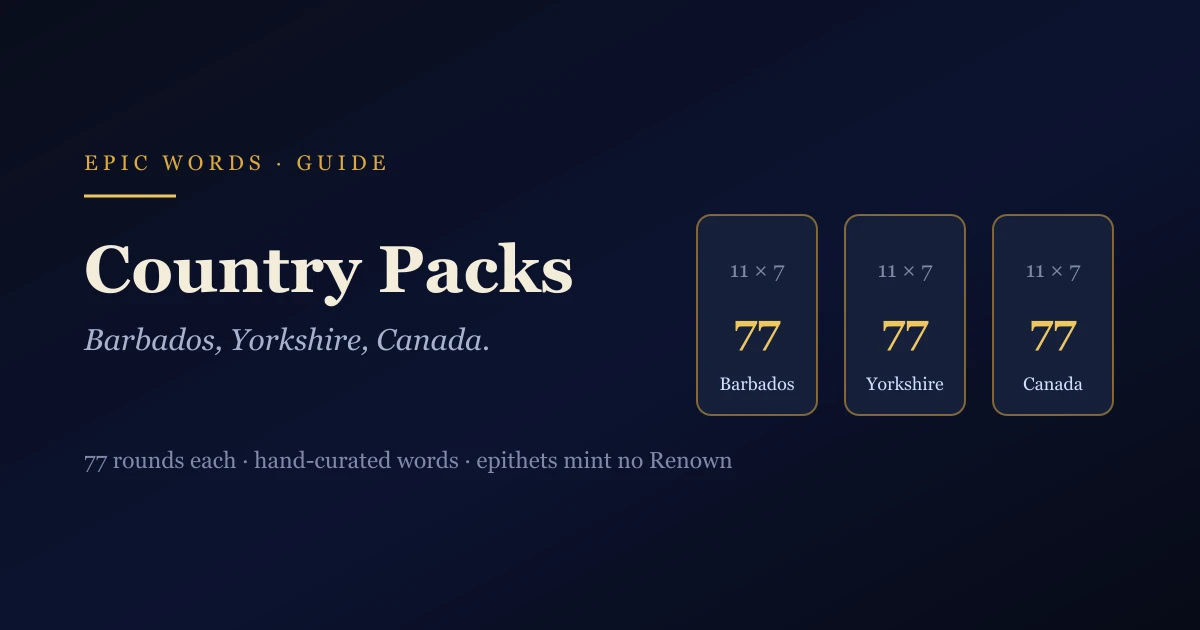
The Epic Words Country Packs: Barbados, Yorkshire and Canada
A plain look at the three Epic Words country packs — what a 77-round pack actually contains, what $1.99 buys you, and why a pack epithet can never move you up the Renown leaderboard.
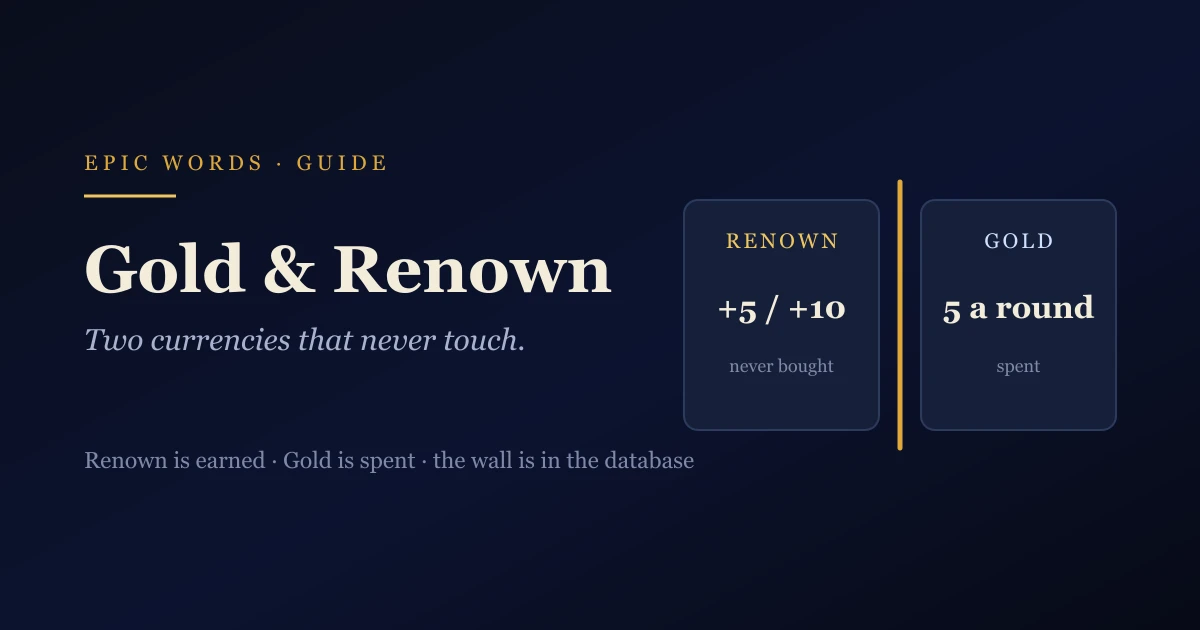
Gold, Renown and the Tools in Epic Words
Epic Words runs two currencies that never touch — Renown, minted only by six skill sources and enforced in the database, and Gold, which pays for hints, tools and Vault rolls.