
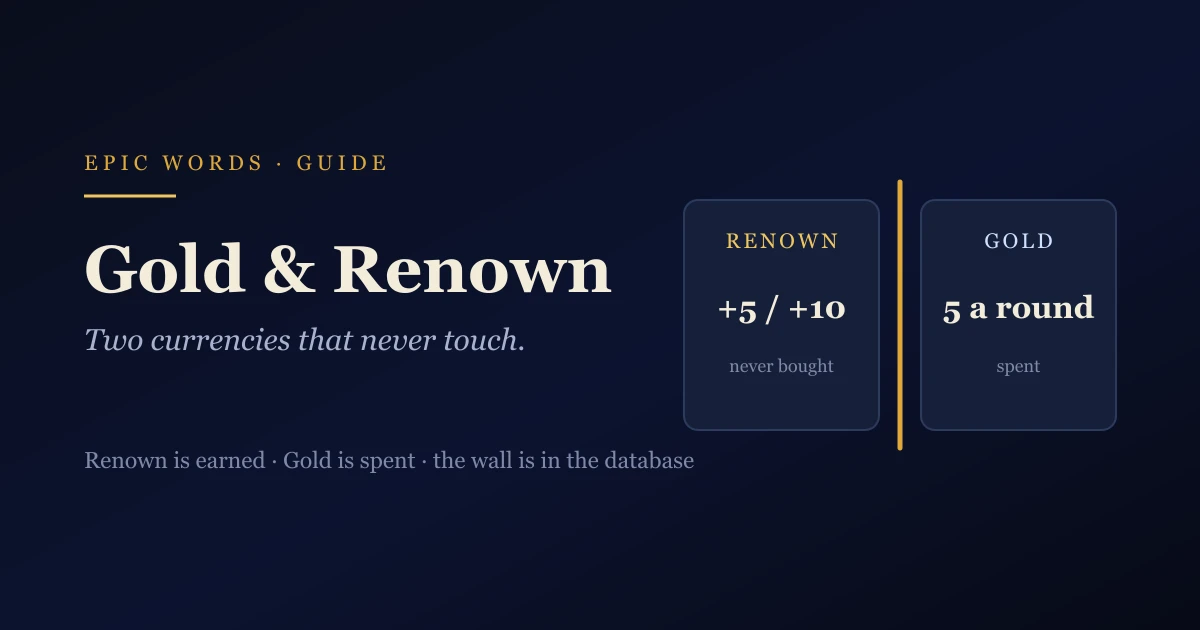
Epic Words runs on two currencies, and almost every question about whether the game is fair comes down to knowing which one you are looking at. Renown is your record. Gold is your spending money. They are earned differently, they are enforced differently, and only one of them can ever be bought. If you have not played a board yet, start with the rules: everything below assumes you know how a round works.
Renown is the record
Renown is minted by six sources and no others: completing a round, finding a bonus word, completing a collection, winning a Joust, earning a skill achievement, and prestiging. That list is the whole list. There is no advert source. There is no in-app-purchase source. You cannot watch a video for Renown and you cannot buy it in a bundle, because no code path exists that would let you.
The reason that claim is worth more than the usual reassurance is where the rule lives. It is not a check in the app that a later build might loosen. It is a constraint in the Postgres database (added in migration 010) that rejects any Renown write whose source is not on the allow-list. A client-side rule is a promise. A database constraint is a guarantee. If someone shipped a paid Renown bundle tomorrow, the write would be refused at the storage layer and the feature would simply not work.
Renown is also never spent. There is no shop that takes it, no upgrade that consumes it, no sink of any kind. It only accumulates. The Hall of Fame leaderboard ranks Renown, and Renown is the only thing it ranks, which is the point of the whole arrangement: the leaderboard is a table of how well people have played, not of how much they have spent.
The round scoring reflects the same split. A correct pair is +5 Renown. A wrong guess is −2 Renown, with no free first attempt. And a bonus word is +10 Renown and zero Gold: it makes your record better without making you richer. That one line is the cleanest illustration of how the two currencies divide the game.
Gold is the spending money
Gold does everything Renown refuses to do. It arrives from play, from habit, and from a couple of one-off events.
| Source | Gold |
|---|---|
| Completing a round | 5 |
| Collectible icon | 3 |
| Collection completed | 50 |
| Word search word | 2 |
| Word search secret word | 5 |
| Daily login | 5, rising to 25 by streak day |
| Launch bonus | 75 |
| Prestige | 100 |
The shape of that table matters more than any single number in it. Rounds pay a small, steady 5, so Gold accrues at roughly the pace you actually play rather than in windfalls. A completed collection pays 50 because it stands in for weeks of accumulated collectibles rather than a single sitting. Daily login climbs with the length of your streak, which pays for showing up regularly instead of binging once. And the Gold Pan doubles the first two rows (rounds and collectible icons), which is exactly why it is the most expensive tool in the shop.
What Gold is for
Every sink in the game takes Gold. None of them takes Renown.
| Sink | Cost |
|---|---|
| Hint | 25 |
| Chronicles "Seek Guidance" clue | 25 |
| Streak Freeze | 100 |
| Echo Stone, 3 charges | 200 |
| Vault roll | 100 |
| Joust revenge | 50 |
| Tiltyard pass | 50 |
| Streak Repair | varies |
| Tool charges | varies by tool |
| Relic recharge | varies |
Two things are missing from that list, and the absence is the design rather than an oversight. Nothing in it buys Renown, and nothing in it buys a Joust entry. A Joust win mints Renown, so a Joust entry can never be bought: paying your way to the table would be paying your way onto the leaderboard, and the database would refuse the write regardless.
Three tools ship
The toolbelt is short on purpose. Three tools are sold for use out on the board:
| Tool | Effect | Cost | Charges |
|---|---|---|---|
| Magnifying Glass | Highlights collectible words for one hour | 30 Gold | 3 |
| Metal Detector | Reveals every bonus word on the board for five minutes | 45 Gold | 1 |
| Gold Pan | Doubles the Gold you earn for your next 30 word finds | 150 Gold | 5 |
Read those three against what they do to your score. The Magnifying Glass points at collectibles, which feed collections: it helps you fill a set, not solve a board. The Metal Detector shows bonus words, which are worth +10 Renown each, so it is the one tool that touches your record directly, and it is priced and rationed accordingly: 45 Gold for a single five-minute charge. The Gold Pan is the compounding purchase. At 150 Gold for 5 charges it is the biggest outlay in the shop, and it pays back only if you keep playing after you buy it.
The Rest Area halves the price
Every tool is half price inside a Rest Area, and a Rest Area sits at round 40 of every kingdom. The run spans 50 kingdoms of 64 rounds each, so a rest stop is a regular, predictable event rather than a rare one. Restocking there instead of mid-kingdom is the single easiest way to make your Gold go further.
The Rest Area also runs a timed word search that pays real Gold (2 per word plus 5 per secret word) and sells two tools that exist only for it: Radar and Icepak, 30 Gold each. Both serve that timed search and nothing else, which is why they are not part of the main toolbelt.
Buying a hint costs you the perfect round
A hint costs 25 Gold, and buying one forfeits the perfect-round bonus for that round. That is worth reading as a feature rather than a punishment. The hint exists to get you unstuck so you can finish the board; it does not exist to buy you a better score. Paying for a hint is always available and always fine, it just stops being a scoring move the moment you use it.
A perfect round requires zero wrong guesses and no hint, and the bonus is tiered by how much the board was hiding:
- +25 if the board had no bonus words at all
- +75 if it had 1–3 bonus words and you found all of them
- +100 if it had 4 or more and you found all of them
The tiering keeps the reward proportional to the work. A bare board is a smaller ask, so it pays less. A board hiding four or more bonus words asks you to search it thoroughly without a single wrong guess, and it pays four times as much. Either way, the number is earned on the board and cannot be topped up from the shop.
Where to go next
If the currency split makes sense now, the places it shows up hardest are worth reading next. The Joust guide covers the mode whose entry can never be bought, and the Vault guide covers the one sink where Gold buys a roll of the dice rather than a certainty. The collections guide explains what all those collectible icons are actually filling. Neither currency opens the $1.99 country packs: a pack only opens with a purchase. For the characters, kingdoms and lore behind it all, the Epic Words codex is the encyclopedia. Or skip the reading and play a round.
Related articles
Chronicles: The Story Under the Epic Words Puzzle
How the Chronicles layer of Epic Words works — when an Encounter interrupts, why some choices permanently close a path, what the Journal records, and how the Echo Stone lets you replay a finished Chronicle.
How to Build Collections in Epic Words
Epic Words keeps six separate collections, and they fill at wildly different speeds. Here is what each one tracks, what it actually costs to complete, and which one is designed never to finish.
The Joust: Epic Words' Two-Minute Word Sprint
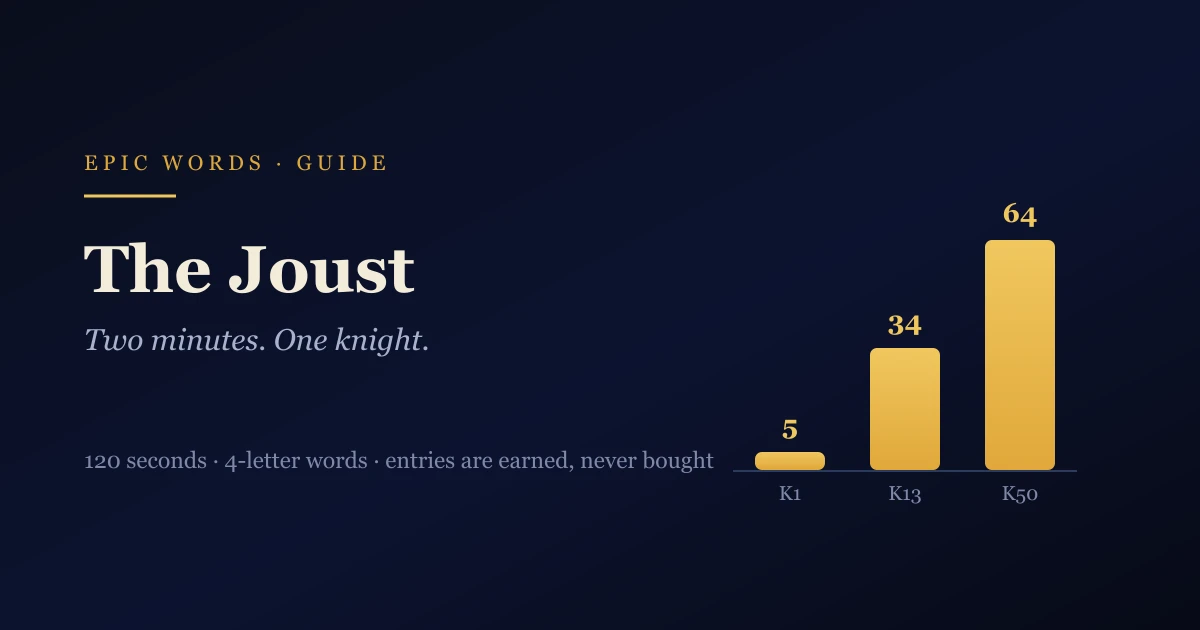
The Joust is a fixed 120-second, four-letter sprint against one reigning knight per kingdom. Here is what the targets are, what a win pays, and why entries cannot be bought.