
Epic Words is built around one long main run: fifty kingdoms, sixty-four rounds each. That is the spine of the game, and it is where most players spend most of their time. The country packs sit beside it. Each one is a self-contained side trip with its own map, its own vocabulary and its own ending: it does not extend the fifty kingdoms, it runs parallel to them.
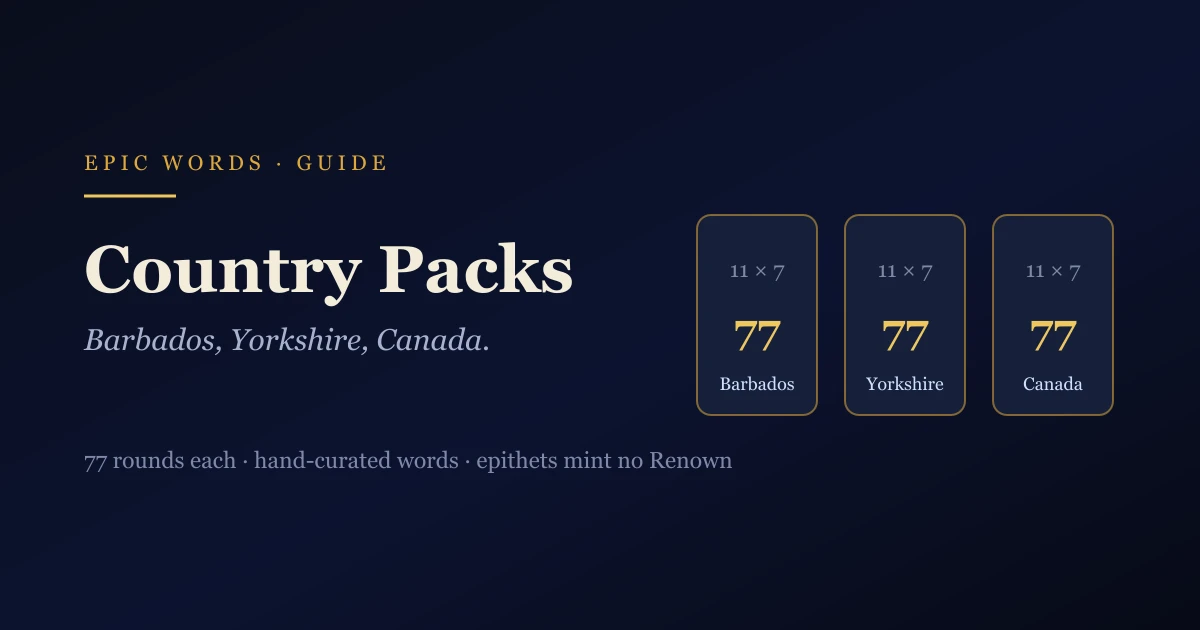
Three packs ship today: Barbados, subtitled Gem of the Caribbean; Yorkshire, subtitled God's Own County; and Canada, subtitled From Sea to Sea. This post explains what is inside one, what it costs, and (the part worth being precise about) what buying one does and does not do to your standing in the game.
What a pack actually is
If you have played Epic Words you already know the board. Twelve tiles arrive in two columns of six. Every tile carries two letters rather than one, and six words are hidden in the grid, each formed by joining a tile from the left column to a tile from the right. The halves are scattered deliberately, so the word you are looking for is almost never sitting on the same row as its other half. If you are new to that, the how to play guide covers the mechanics properly.
A country pack keeps that board and builds a trip around it. The structure is identical across all three packs, which is deliberate: you learn the shape once and it holds wherever you go:
- 11 sub-regions, 7 rounds each: 77 rounds in total. In Barbados the sub-regions are parishes; in Yorkshire and Canada they are regions.
- Roughly 462 hand-curated words, chosen for the place rather than pulled from the general dictionary.
- A 33-landmark map that fills in as you travel.
- A 9-item collectible trail running the length of the trip.
- Easter eggs tucked into the route.
- Rest areas between the harder stretches.
- A Grand Finale at the end, which awards a badge and a cosmetic epithet.
The epithets are pack-specific: Barbados gives Island Explorer, Yorkshire gives White Rose, Canada gives Voyageur. They are titles you display, and nothing more than that: more on why that matters below.
Hand-curated vocabulary is the whole point
The number that surprises people is 462. Compared to the main run it is small, and it is fixed. There is no endless mode inside a pack, no procedural top-up when you reach the end. That is the trade the packs make on purpose.
Every word in a pack is chosen for the place. The vocabulary is not drawn from the general dictionary the main game uses; it is selected, board by board, to belong to the country or county you are travelling through. That kind of curation does not scale. You cannot generate it, and you cannot pad it out without immediately diluting the thing that makes it worth playing: the moment where a word lands and it is obviously, specifically from there.
So the honest framing is this: a pack is a designed route, not a content faucet. Seventy-seven rounds is what careful curation produces, and the fixed ending is a feature of that, not a limitation someone forgot to remove. If you want to read around the vocabulary and the world it comes from, the Epic Words codex is the encyclopedia side of the game.
Bonus words still work exactly as they do everywhere else. Any extra real word the tiles can make beyond the six required ones pays +10 Renown, and packs are no exception. How many a given pack board is hiding depends on the same thing it depends on in the main game: how long the words are, since short words recombine into other words far more readily than long ones.
Price, platform and restoring
Each pack is $1.99. They are non-consumable purchases, handled through RevenueCat: you buy a pack once and it is yours on that store account permanently. There is no subscription attached, no per-region unlock, and no consumable currency involved in getting one.
There is no free-unlock override. No amount of Gold, no streak, no achievement path opens a pack without a purchase. That is worth stating plainly rather than leaving people to discover it: the packs are paid content and the game does not pretend otherwise.
Restore Purchases lives on the pack hub. If you reinstall, move to a new device, or lose local data, that is the button that brings your packs back.
Epithets do not mint Renown
This is the part that matters most, and it deserves saying without hedging.
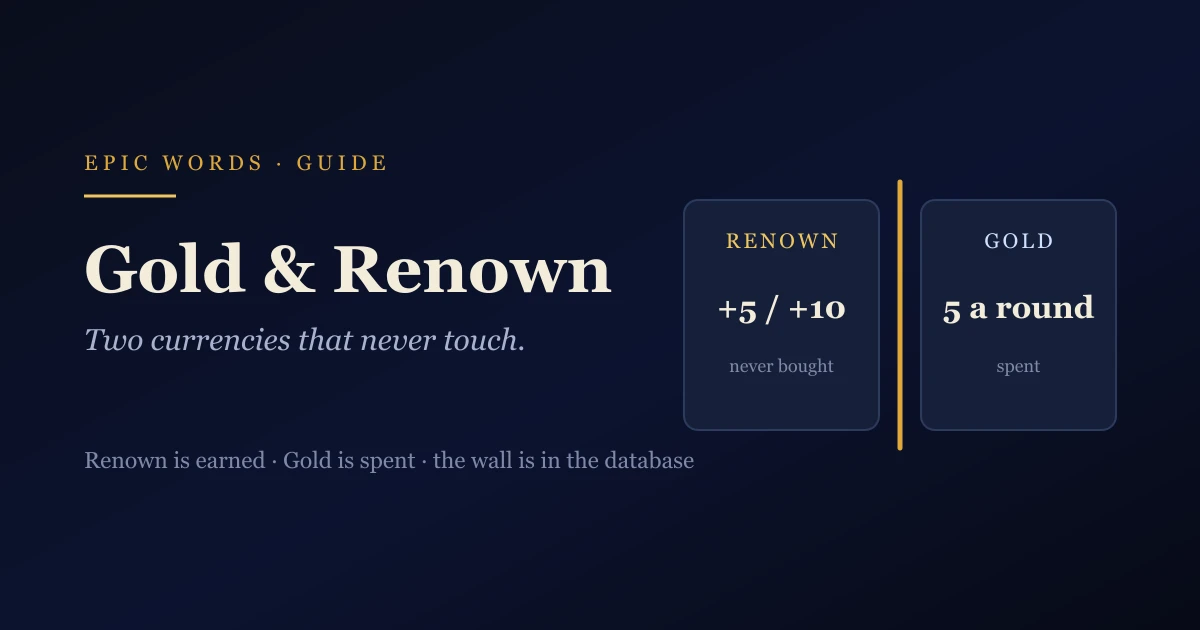
Epic Words keeps two separate things. Renown is the permanent record of your skill. It is the only thing the leaderboard ranks, it cannot be bought, and it cannot be spent. It only accumulates from play. Gold is spending money, and it does none of the ranking work.
The epithet you earn at a pack's Grand Finale (Island Explorer, White Rose, Voyageur) is purely decorative and mints no Renown whatsoever. Finishing a paid pack gives you a badge and a title to display. It does not move you a single place up the leaderboard.
That means a $1.99 purchase buys you two things: more puzzle, and a cosmetic title. The Renown you earn inside a pack's rounds is earned the ordinary way: by solving boards and finding bonus words, at the same +5 and +10 they pay anywhere else. What the purchase itself mints is nothing at all: the badge and the epithet at the end are decoration, and the money buys you rounds to play rather than a score to hold.
Which one to start with
The three are built to one specification, so the choice between them is not a difficulty question. The structure is identical down to the round count; what changes is the vocabulary and the map. Pick the country you actually want to spend seventy-seven rounds inside.
If you are still working through the main fifty kingdoms, there is no reason to rush. A pack is a self-contained side trip rather than a step in that sequence, so it keeps.
Where to go next
If you want to understand the systems around the packs before buying one, three guides cover the ground:
- The collections guide explains how collectible trails work, useful before you start a pack's 9-item trail.
- The gold and Renown guide goes deeper on the two-currency split described above, and on what Gold is actually for.
- The Joust guide covers the competitive side of the game, which is where the Renown-cannot-be-bought rule earns its keep.
If you want to see how the Chronicles story layer works in the main fifty kingdoms, that guide covers it separately from these packs. Or just play Epic Words and see how the board feels first.
Related articles
Chronicles: The Story Under the Epic Words Puzzle
How the Chronicles layer of Epic Words works — when an Encounter interrupts, why some choices permanently close a path, what the Journal records, and how the Echo Stone lets you replay a finished Chronicle.
How to Build Collections in Epic Words
Epic Words keeps six separate collections, and they fill at wildly different speeds. Here is what each one tracks, what it actually costs to complete, and which one is designed never to finish.
Gold, Renown and the Tools in Epic Words
Epic Words runs two currencies that never touch — Renown, minted only by six skill sources and enforced in the database, and Gold, which pays for hints, tools and Vault rolls.