The Chronicle of Epic Words
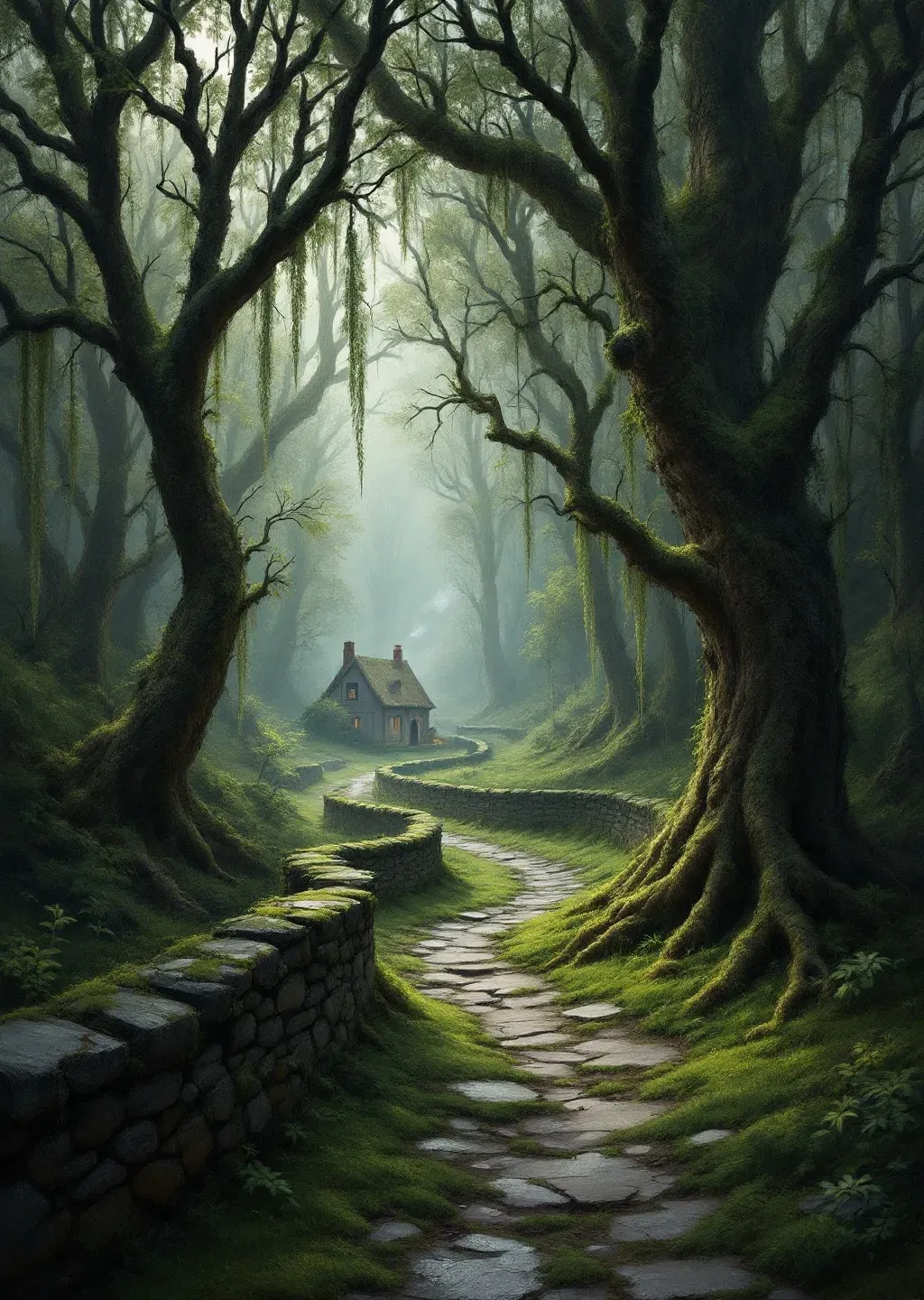
The Witch's Wood
A wood at the edge of the vale, where a missing word waits and a debt is carried on toward the river.
At a glance
- Kingdom III (The Ink Well)
Kingdom III is called the Ink Well, after its black water — though which black water, precisely, the locals will argue at you cheerfully and at length, and have no intention of ever settling. The wood above it has a simpler name and a much shorter argument. The Witch's Wood is a deep, damp stretch of hazel and grey siltstone at the far edge of the vale — the place the Duke's roads run out of and the river road hasn't quite reached — and it is named, first and last, for Yarrow the hedge witch, who has lived at its edge long enough that travelers stopped naming the trees and started naming her.
You come in the hard way, down off the Duke's roads to the east, where the lane runs between high dripping walls of grey siltstone until the trees lean across and nearly block the sky. The horses balk where the paths go over to grey needle-mold, and that is where the wood truly begins. Nothing here holds onto a word for long. The damp gets into ink, into carved stone, into the very labels on a bottle, and the whole kingdom is quietly organized around that one fact — a place that cannot keep its own writing legible and has made a kind of peace with the losing.
The heart of it is Inkhollow, the village below the treeline, whose dark spring stains teeth and linen and the careful hand of anyone who writes there. Above the water sits Blotter's Reach, a flat shelf of stone the size of a courtyard where copyists have worked shoulder to shoulder for longer than anyone remembers — and where a thieving jackdaw once carried off a strip of bark with a word on it, three days before a cure needed it. That word was HEARKEN, and Yarrow could not finish her work until someone climbed twenty feet up a hazel to bring it back. The wood is full of these small failures of language: a blurred letter in a formula, a name run out of the paper, a well that grants fluent speech and then abandons you mid-sentence.
Out past the village, along tracks threaded with water-ditches running thick and oily this season, lies Charcoal Barrow — a charred mound that is a working kiln-ground and a burial site in the same breath. Its boundary stones keep the oldest marks found in the kingdom, cut in a hand that predates every signpost and lintel you'll read on the way in. Yarrow walks out to read them; she was there last month, among the oldest marks, and on one of them she found a name she had cause to remember — the Ferryman's, cut into stone older than anything else in the wood. She won't say much more about it. "It is not my debt to settle," she'll tell you, which is a very hedge-witch way of saying she knows exactly whose it is.
The wood carries a smaller debt too, and this one you can watch being paid. Aldric arrives unable to say his own surname — a debt-haunted traveler whose name a witch once took as surety, carried into these trees on a cliffhanger from the road behind. Yarrow's cure gives it back to him at her own table (Fenbourne, he says, twice, tasting it), and he leaves without finishing his bread, bound for the crossing beyond. That crossing is where the wood's business points. There are five fragments of something older than the vale, and one of them waits at the river with the Ferryman. Before you go, Yarrow ties a river charm to your wrist and gives you the only rule that matters at the water's edge: whatever he asks of you, do not offer him your name. Some words, she means, are load-bearing — and this is the wood that teaches you which ones.
Where you'll find it
The Witch's Wood is the treed upper reach of Kingdom III (The Ink Well) — the third stretch of road on the long walk out of the vale, reached by following the lane down off the Duke's roads until the grey stone walls give way and the trees close over the sky. You come in from the east, and you leave to the west, down past Whisper Hollow to the river crossing. The wood is only the roof of the kingdom; under it lie the dark-water places the Ink Well is actually named for — the stained-teeth village of Inkhollow, the copyists' shelf at Blotter's Reach, the old charcoal ground — and, where the trees give out, a cottage at the treeline where a hedge witch opens the door before you knock.