The Chronicle of Epic Words · Founder’s Deck
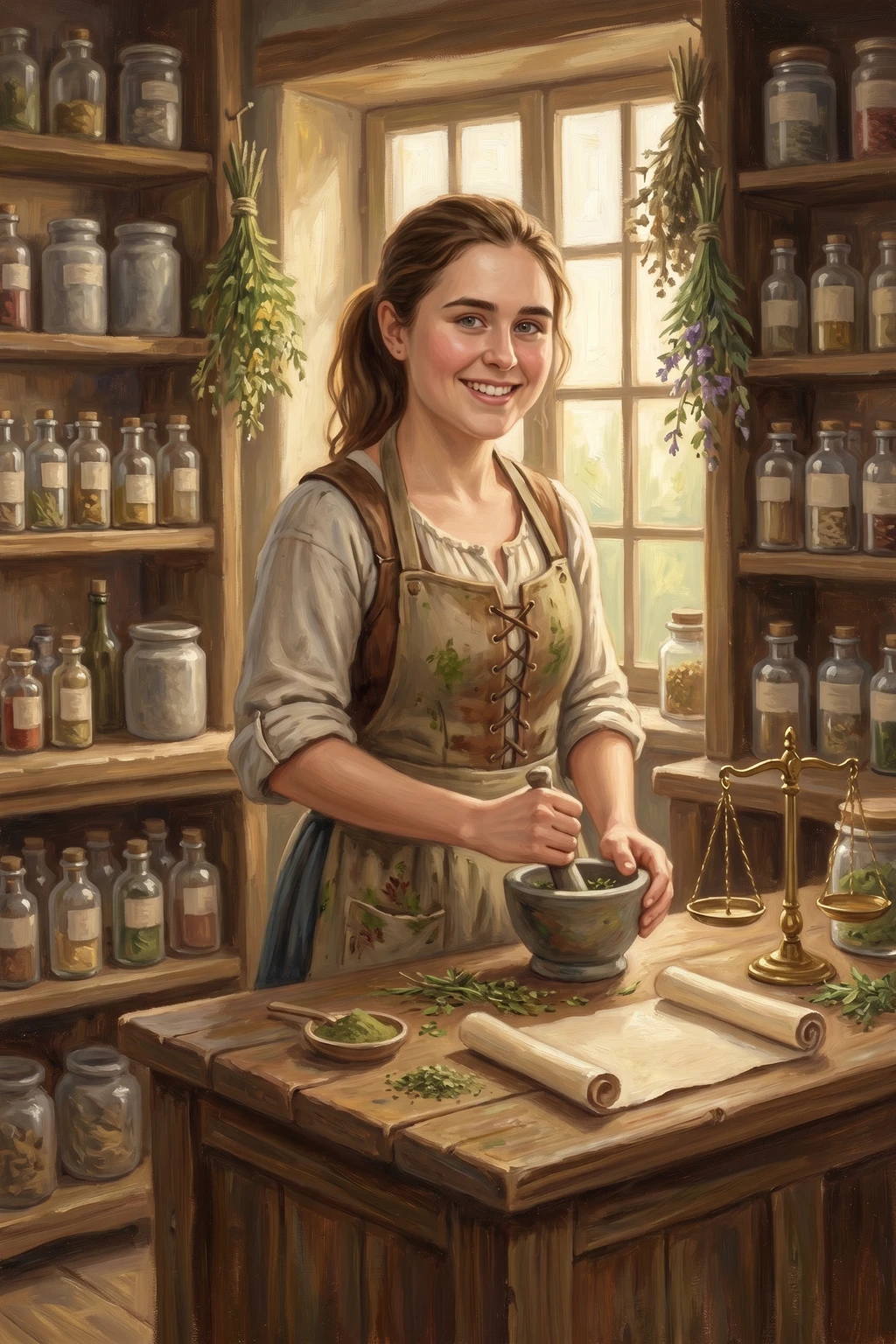
Brindle, the Apothecary's ApprenticeIn service to Yarrow, the Hedge Witch
Minds the dispensary with more confidence than she's earned and more competence than she'll admit.
At a glance
Young enough that the wax stamp on the shelf is still Yarrow's, not hers. Old enough to run the place alone all day and get it right.
- Home Inkhollow
- Kingdom III (The Ink Well)
- Faction Common folk
- Employer Yarrow, the Hedge Witch
- Founder’s card Seven of Diamonds
Brindle will tell you, before you've asked and possibly before you've fully come through the door, that she can help you. "Probably," she'll add. "Mostly." This is not a lack of confidence — it is, if anything, a small excess of it, delivered so cheerfully that you find yourself reassured by the exact words that ought to worry you. She minds Yarrow's dispensary in Inkhollow, and she minds it well, which is a thing she'll cheerfully undersell right up until the moment the work is on the counter, at which point the chatter stops and the hands take over and you understand that the whole disarming performance was, in its way, a courtesy — a way of making sure you don't feel foolish for needing her.
She is Yarrow's apprentice, and the word carries less weight than it should. In practice she runs the shop alone through most of a working day, the hedge witch being forever off past Charcoal Barrow reading the oldest marks in the kingdom, or up some hazel arguing with a jackdaw about a stolen word. What Brindle can't do yet she'll tell you plainly; what she can do she'll do faster and better than her modesty advertises. The dividing line between the two is narrower every season, and she knows it, and she is careful never to say so out loud, because saying so would feel like closing a door she'd rather leave ajar a while longer. When she seals a cure she presses her own thumbprint into the wax instead of Yarrow's stamp — not from any doubt about the cure, only about her right to the stamp. She'll get there. She is in no hurry. The dispensary is not going anywhere, and neither, blessedly, is she.
The dispensary smells of wormwood and wet linen and whatever the dark spring has got into this week, and its walls are a climbing wall of plain stoppered bottles, every label inked in a careful hand, every label — this being Inkhollow — slightly smudged. This is Brindle's quiet war. She relabels the blurred ones as an ongoing project, marking each letter and then marking it again to darken it, filing a note under every delivery in the thick sheepskin register whether the delivery needs a note or not. It is a reflex more than a task. Show her a word going soft on the stone and something in her sets to work before she's decided to — not adding ink, she'll correct you, holding down what's already there so it stops sliding off. She built her fixing-blend out of Yarrow's recipe to do exactly that, and has been improving it privately ever since, on couplets and charters and anything else the world has started to forget how to keep. She would tell you this is just tidiness. You may, if you like, believe her.
She has a collector's eye for the thing nobody else has a use for. A drop of cold-blue ink from the deep drain of the spring, refusing to dry; an odd shard, a spare charm, a problem that isn't hers. She hoards these against a future in which the right person walks in needing exactly one of them, and when that person arrives she hands the thing over with a line about how they look like the sort who collects problems — which, from Brindle, is affection. She likes a loose end. She likes better the idea that a loose end kept long enough eventually finds the hand it was meant for. It is not a philosophy she'd dignify with the word; it is simply how she keeps a shop, and a village, and possibly more than that, from going quietly illegible around her.
You'll meet her mid-crisis over a formula that has lost a letter — RELIE_E, the damp having taken the stroke that decides whether a merchant has a restful night or an unforgettable one. Help her read it and she'll grin, exhale, and pronounce you not as unhelpful as you look, which you should take, correctly, as the compliment it is. Then she'll go back to the wall of bottles and start again on the smudged ones, one at a time, cheerfully, forever. If ink can be lifted, she'll say — mostly to herself, capping the last vial — then ink can be held down. Somebody just has to be stubborn enough to work out how, in the right order. She says it like a plan. With Brindle, it usually is.
Tales & Rumors
She minds Yarrow's dispensary in Inkhollow whenever the witch is out past Charcoal Barrow reading old marks, which is often — and she runs it with a confidence that outpaces her years by a comfortable margin and a competence she'll shrug off if you name it. The fixing-ink she works with started as Yarrow's recipe; the adjustments are her own. 'It's mine now the way a road is still a road after you've paved it,' she'll tell you, with the specific pride of an apprentice whose work has quietly outgrown its teacher's. When she seals a finished cure she uses her own thumbprint — the wax stamp on the shelf is still Yarrow's, and she isn't quite there yet, and is entirely at peace about it.
Her ongoing, self-appointed campaign is against the smudge. She relabels every bottle whose ink has begun to blur, marks each letter and then marks it again to darken it, files a note under every delivery in a hand thinned by damp to spider-tracks — a thoroughness she applies automatically, to everything, whether or not anyone asked. It is, she'll inform you pleasantly, never finished. In a village that has noted the colour of its own teeth for years, nothing stays legible for long, and she has made her peace with that too, by refusing to lose to it one bottle at a time.
She collects oddments the way she collects loose ends. She once fished a single drop of ink out of the deep drain of the dark spring — cold blue, faintly glowing, refusing to dry or to mix with water — and kept it in a heavy little bottle for no reason she could name, on the grounds that it might one day matter to the right sort of person. 'You look like the sort of traveler who collects problems,' she'll say, pressing it into your hand, which is either an insult or the highest compliment in her vocabulary. With Brindle the two are frequently the same thing.
How They Measure Up
An apprentice keeps her own accounting too — in a careful hand, slightly smudged.
Grinds a siltstone mortar heavy enough to ring like a bell, all day, and doesn't mention it. Everything else in the shop, she asks you to reach.
Her hands are the whole trade — a quill-point kept fine, a stopper seated true, a fading letter darkened twice before she's decided to. Watch the hands, not the chatter.
Relabels every blurred bottle on the wall as an 'ongoing project.' In Inkhollow, where everything smudges, that is a project with no far end. She is unbothered.
Reads a damp-blurred formula the way other people read a clear one, and knows which missing letter turns a soothing tonic into a very memorable evening.
Wanted a second pair of eyes before she poisoned a merchant — which is the whole of her good sense, spent well, in one sentence.
'I can help you. Probably. Mostly.' Somehow that lands as reassurance. She is very hard to be in a bad mood around.
Legibility — she cannot leave a fading label alone. Show her a word going soft on the stone and something in her sets to work — not to add ink, but to hold down what's already there before it slides off for good. It is a reflex more than a decision, and she performs it on everything, always.
Where you'll meet her
You'll find Brindle behind the stone counter of Yarrow's dispensary in Inkhollow, Kingdom III (The Ink Well) — grinding something vigorously in a siltstone mortar, a splash of green mint-syrup on her collar she's trying to hide with a dried bay leaf, and very pleased to have company. Yarrow is out past Charcoal Barrow until dusk, which leaves Brindle in charge. The trouble is a strip of inscribed bark: the damp has lifted the ink on one word, leaving a gap where a letter used to be — RELIE_E, which is either an f or a v, and the difference is a soothing tonic or a memorable evening. The customer is due in an hour. She would like, very much, a second pair of eyes before she commits.