The Chronicle of Epic Words
Charcoal Barrow
A charred mound that keeps the oldest marks in the wood — and its first and last word is ashes.
At a glance
- Kingdom III (The Ink Well)
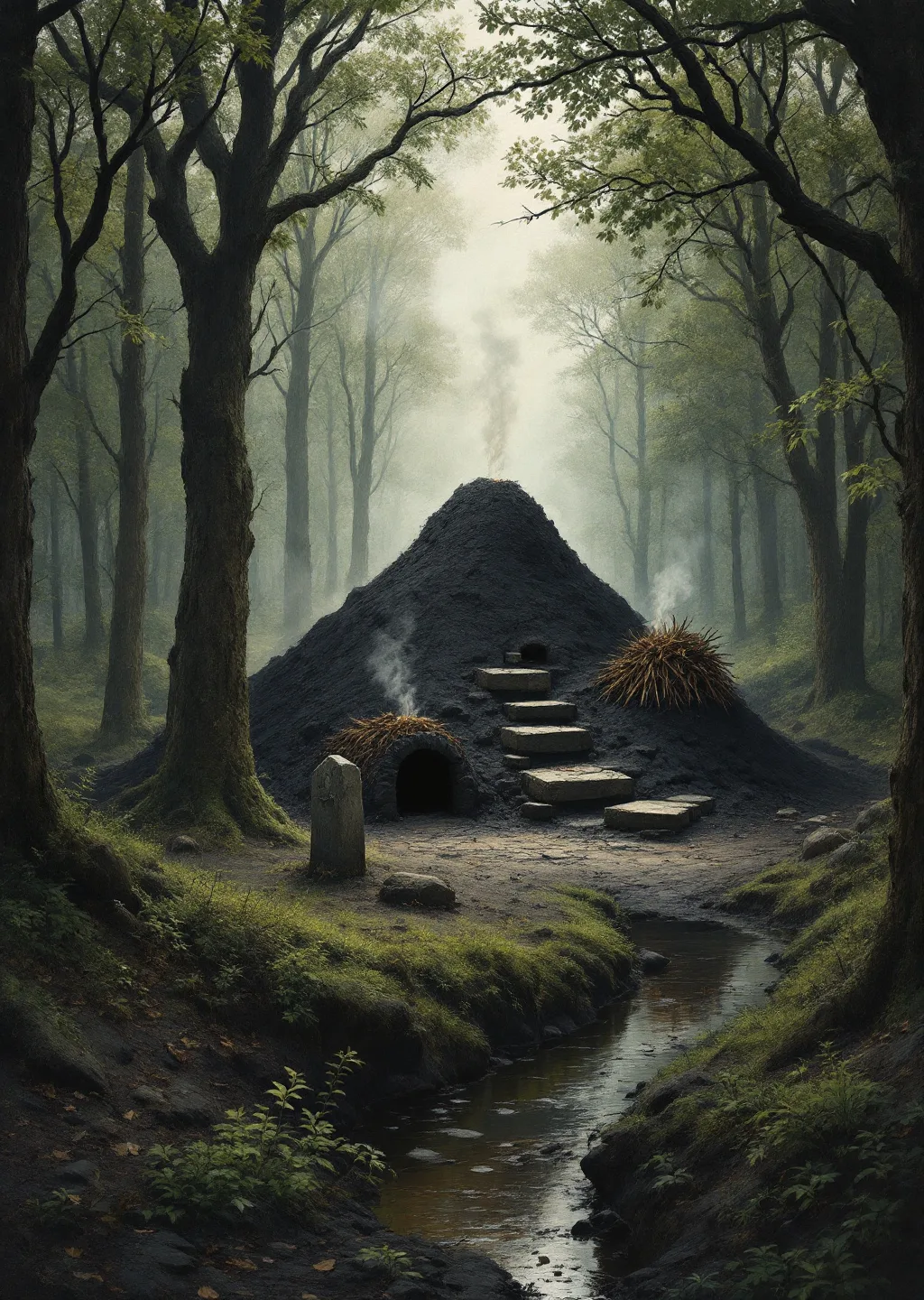
Every wood has a place it doesn't talk about, and in The Witch's Wood that place is Charcoal Barrow — a low, charred mound where two very old occupations have quietly overlapped for longer than anyone bothers to date. Under it lie the oldest marks found in this kingdom, cut into founding-era boundary stones. Over it stand the kilns. The wood has never seen a contradiction there, and after a while neither will you.
The living work comes first, because it's the part that smokes. Charcoal-burners have kept their kilns here for generations, feeding them soot-blackened hazel-billets and drawing off the slow, patient char that the whole vale runs on. Giles the charcoal-burner is the man you're most likely to meet on the path, resting his horse beside a heavy cart, wiping his forehead with a filthy sleeve and grumbling — because the water-ditches near the Barrow are "running thick and oily this season," and even the dead wood has started to "smell like old sheepskin before it hits the kiln." He isn't wrong, and he isn't only complaining about the weather. Something is off in the ground here, and the men who work it are the first to taste it.
Under the kilns, older than the trade, lie the marks that give the mound its weight. Charcoal Barrow keeps the oldest marks found in this kingdom. Its boundary stones were cut when the wood was first spoken into shape, in a hand and a method that predate every signpost, lintel, and well-stone you'll read on your way in. Yarrow the hedge witch makes the walk out to read them — she was here last month, bent over the oldest marks, and it was on these stones that she found a name she had reason to remember: the Ferryman's own, waiting at the river-edge of her memory. "But it is not my debt to settle," she'll tell you, which is the kind of thing people say at Charcoal Barrow and mean.
The marks are not merely old. They are cut with what Yarrow calls the founding protocol — the same method used to erase, not scratch, ink from a page: letters called out of the material rather than scraped off it. She's seen it once on a redacted parchment and recognized it instantly, because she'd seen it here first, on the oldest boundary stones. It is the wood's original way of writing, and, in the wrong hands, its original way of un-writing. Whoever is cleaning debts in this kingdom, Yarrow reckons, is working in the very hand these stones were cut in — and she does not think that is a coincidence. The Barrow, if she's right, is not just the oldest record in the wood; it may be where the trick was first written down.
Scholars come to transcribe the marks, and they come away speaking in riddles, because the marks answer in them. One old transcription, scrambled by a copyist who claimed the answer was simply what was done here, once, to everything, resolves to a single word: BURNED. Another, worn down until two letters had crumbled to soot, gives up ASHES — "the barrow's first and last word." That is the whole of Charcoal Barrow's philosophy, if a mound can be said to have one. Everything green becomes char; every char becomes ash; every name, given time and the right protocol, becomes a blank space where a name used to be.
It is not a frightening place, exactly. The kilns are warm, the char is honest work, and the burners will nod you past without much fuss. But you'll leave with soot on your boots and the sense that you've walked across the top of something that remembers more than it lets on. As Giles might say, and as the stones certainly would if they could: charcoal doesn't lie. It just takes a while to say it.
Where you'll find it
Charcoal Barrow sits out past Inkhollow, along the woodland tracks of Kingdom III (The Ink Well), on the far side of the dark spring from Yarrow's cottage. It's the kind of errand a local names without thinking — 'Yarrow's out past Charcoal Barrow until dusk' — a working ground and an old, old mound in the same breath. Come to it by the water-ditches that thread the wood's edge, or by the kiln-smoke, which you'll smell before you see the mound. You don't so much arrive as notice the ground has gone black underfoot.