The Chronicle of Epic Words
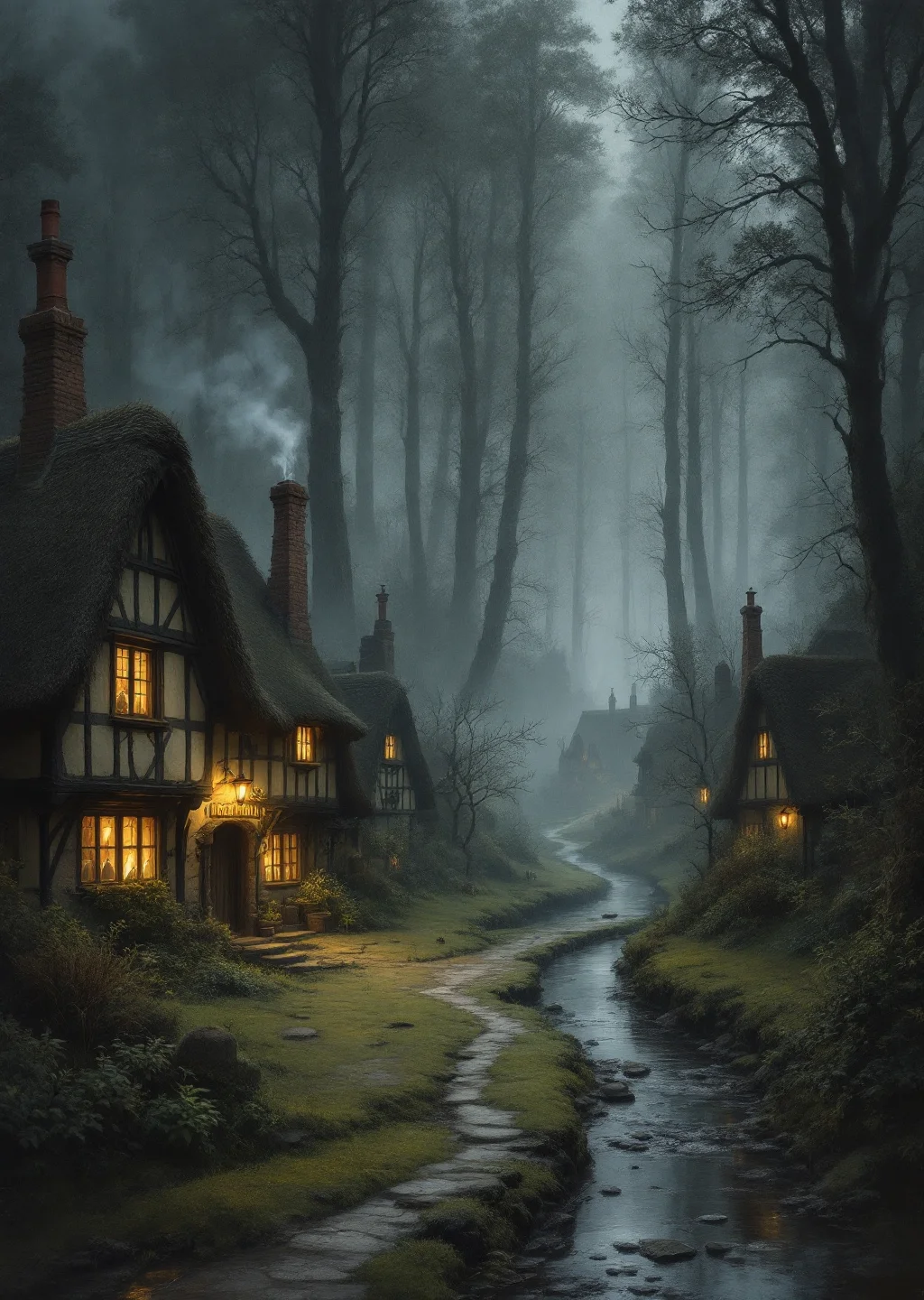
Inkhollow
The village where every label runs and no word ever quite dries.
At a glance
- Kingdom III (The Ink Well)
There are villages that are named for a founder, a river, a battle. Inkhollow is named for a habit. The dark spring that runs past the houses carries something the stone got into long ago — a mineral dark that stains teeth, stains linen, stains the careful hand of anyone who writes here — and the village simply gave up fighting it and took the stain for its name. In Inkhollow everything is slightly smudged. It is not a complaint. It is closer to a civic principle.
You reach it the hard way. The road out of Whisper Hollow runs between high, dripping walls of grey limestone until the trees lean across and nearly close the sky, and where the horses balk and the paths go over to grey needle-mold, that is where Inkhollow begins. The Stained Lintel marks the boundary — an old inn whose doorframe wears the black handprints of every traveler who ever pressed a palm to it before the wood took them in. Some do it for luck. Most do it because the person ahead of them did, and Inkhollow is a place that keeps its customs the way it keeps its ink: without ever quite meaning to.
The heart of the village is Yarrow the Hedge Witch's dispensary, minded in her frequent absences by her apprentice Brindle. It smells of wormwood, wet linen, and whatever the dark spring got into that probably has a name in a language nobody local speaks. Shelves of plain stoppered bottles climb the wall above a deep stone counter, and every single label is inked in a careful hand and blurred by the damp before the week is out. Brindle's ongoing project — she will tell you so cheerfully — is relabelling the bottles whose ink has run, which is all of them, forever. It is the truest work in the village: a place that cannot hold onto its own words, patiently rewriting them anyway.
That losing war with legibility is everywhere once you notice it. On the well-stone of the dark spring, a tool is named and two of its letters have run like wet ink. Above the Stained Lintel's door, beneath the soot, a short carved word is missing letters lost under fresher grime. Follow the water out to the flat copyists' stone at Blotter's Reach and frost has pulled the letters clean off the word carved at its edge — the very stone where scribes come to work is the one that eats their letters. Even the old charred mound at Charcoal Barrow, past the far edge of the wood where Yarrow gathers, keeps one of the oldest marks in the vale with two letters crumbled to soot. The whole hollow is a lesson, endlessly repeated, in how words outlast the hand that wrote them — and then, given a little water, don't.
For all that, it works. Cures get made. Coughs that turn people into frogs get quietly un-made. Merchants ride in for tonic and, unusually for Inkhollow, sometimes arrive exactly when they said they would. Brindle keeps the counter, Yarrow keeps the wood, and the spring keeps blotting out every label they hang — an economy running, contentedly, on smudge. Travelers who meet Mara the Healer further down the road will find she knows the place at once: the witch of Inkhollow's green ribbon is worth more than a letter of introduction, and it does not run in the rain.
Where you'll find it
Inkhollow sits below the treeline of the Witch's Wood, in Kingdom III — the village you reach by following the road along the lip of Whisper Hollow until the trees grow too thick for horses. Come in past the Stained Lintel and its soot-black handprints, or up from the dark spring that runs past the houses; either way you'll know the place by its water, which gets into everything and leaves it smudged. It's the last named settlement before the wood closes over the path to Yarrow's cottage.