The Chronicle of Epic Words
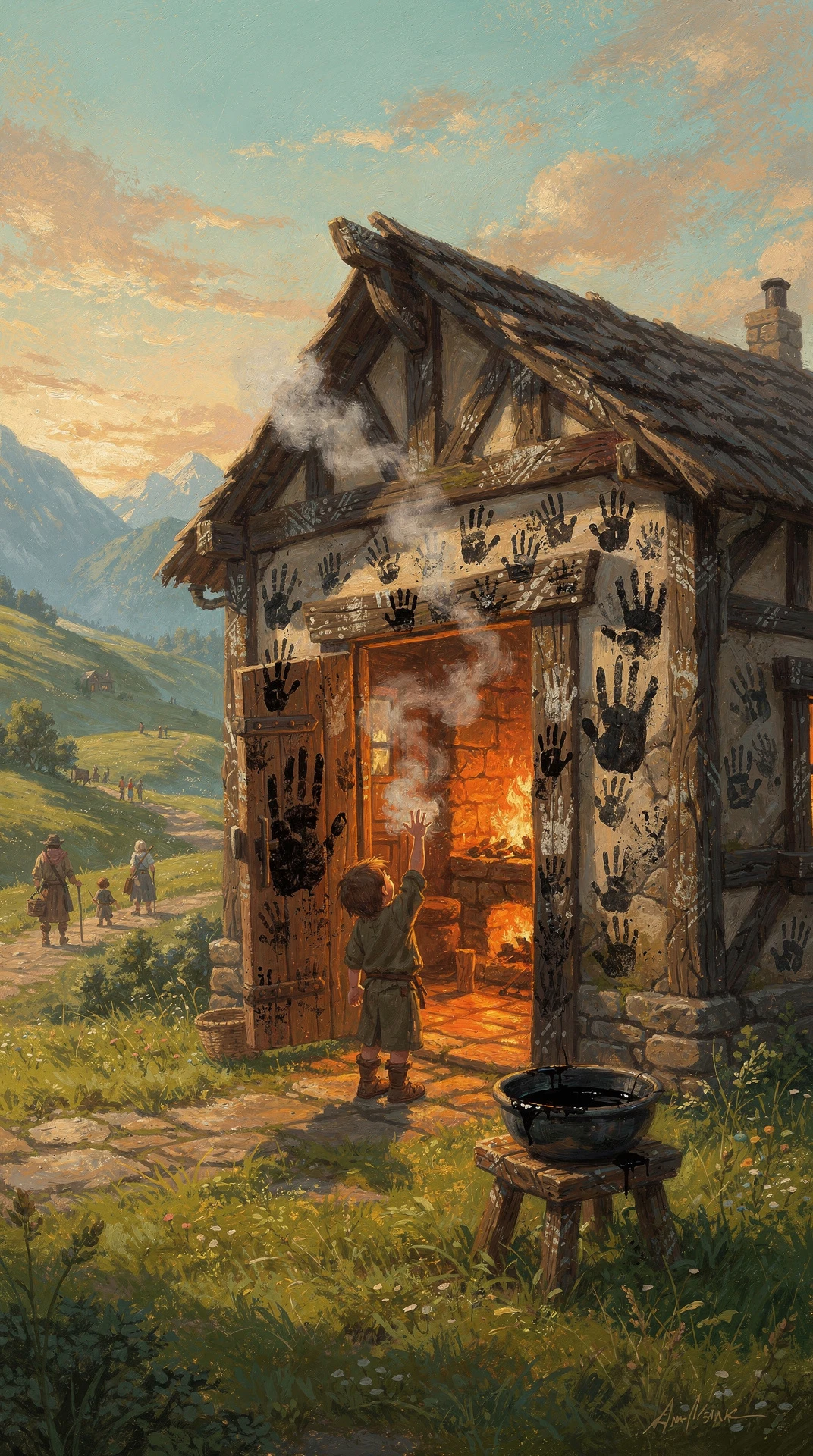
The Stained Lintel
The one signature in the Ink Well that never smudges is a palm pressed in soot.
At a glance
- Kingdom III (The Ink Well)
Most inns hang a sign. The Stained Lintel wears its custom instead: every inch of its doorframe, and a good deal of the wall besides, carries a carbon-black handprint — hundreds of them, layered years deep, from great spade-fingered farmers' hands down to prints so small their owners needed lifting to place them. A bowl of soot-black pigment sits on a stool by the door, kept filled the way other houses keep a lamp lit. Travelers press a palm before walking on up into the wood. Some do it for luck. Most do it because the person ahead of them did, and the Ink Well is a country that keeps its customs the way it keeps its ink: without ever quite meaning to.
But there is a better reason underneath the habit, and the inn itself will tell it to you if you look up. Passed around Inkhollow like a password, and pressed in soot above this very door, is a riddle: Every hand that passes leaves me here. I am not a name, yet I prove someone came. What am I? A mark. That is the whole wisdom of the place. This is a kingdom where writing loses — where the dark spring gets into everything, labels blur before the week is out, and even the carved word beneath all these sooty prints has surrendered two of its letters, reading P_L_ where it once plainly said palm. Ink runs. Carvings weather. But a hand pressed in carbon cannot be misspelled, cannot go thin, cannot drop a letter. In the Ink Well, the handprint is the only signature the damp has never beaten — proof positive that someone came this way, made by the one instrument everybody carries.
The inn earns its keep honestly beyond the doorframe. It is the last fire and the last dry bench before the trees lean across the path and the wood takes over, which makes it the natural place to gather nerve. Travelers bound for Yarrow the Hedge Witch's cottage stop here to rehearse their requests; travelers coming back down stop to stop shaking, or to celebrate, depending on how the request went. From the inn's yard you can see the smoke of the witch's chimney, and from the witch's dooryard you can see the handprints — the two establishments keeping an eye on one another across the treeline, in the manner of professionals who share a clientele.
Read the prints long enough and they start telling stories. The lintel remembers everyone who has gone up under the trees — including, one grey dawn not long ago, a print pressed fresh beside the door, dark as ink and still damp, left by someone setting out for somewhere they were not certain of. Locals still argue about whose it was. Some say a half-named man on his way toward The Dipping Well and the river crossing beyond, walking hard after something he'd only just gotten back. Nobody asked at the time. That is part of the custom too: the inn takes your mark, not your business.
Down in the village, Brindle fights her endless, cheerful war of relabelling every bottle whose ink has run — which is all of them, forever. Out at Blotter's Reach, the copyists' own stone eats the letters off the words carved into it. The Stained Lintel is the quiet answer to both: a black archive of everyone who ever passed, kept in the one medium the Ink Well cannot blot. Press your hand. It costs nothing, it proves you came, and long after your name has worn off every ledger in the kingdom, the door will still be holding your place.
Where you'll find it
The Stained Lintel stands third on the path through Kingdom III (The Ink Well), on the road between Inkhollow and the treeline where the wood closes over the way to Yarrow's cottage. You will not need directions; it is the timber-framed inn wearing several hundred black handprints, and you can see them from the witch's own dooryard. Press your palm to the frame before you go up under the trees. Everyone does. Nobody can quite tell you when that started.